

You're standing in the kitchen with a hospital bag at your feet, a stack of papers on the counter, and a new set of medications that suddenly seems to belong to the whole household. Your parent is home, but the familiar routine feels unfamiliar. Which appointment comes first? Who will remember the questions? What should happen if something feels different tomorrow?
Reducing hospital readmissions starts with understanding this transition as a period of daily adjustment, not a single moment at the front door. The research points to early follow-up, reliable communication, medication organization, movement, rest, and human connection. Together, these ordinary parts of home life can help an older adult protect independence while family members stay involved without taking over.
Table of Contents
- What Coming Home From the Hospital Really Looks Like
- The First Week at Home as Three Checkpoints
- Everyday Rhythms That Keep Recovery on Track
- When Tools and Monitoring Help and When They Miss People
- Why Connection Shows Up in the Data
- Gentle Movement as Part of Recovery
- A Simple Plan for the First Thirty Days
What Coming Home From the Hospital Really Looks Like
An older adult may arrive home tired, carrying a small bag of belongings and several pages of instructions. An adult child may be nearby, trying to sound calm while wondering whether the right pharmacy has the updated list, whether the next appointment is arranged, and whether everyone understands what happens next.
That uncertainty matters because the first days at home can be busy and fragile. An AHRQ analysis of Medicare hospital use found that nearly 1 in 5 Medicare patients was readmitted within 30 days of discharge. Roughly 90% of those readmissions were unplanned, and the annual cost to Medicare exceeded $17 billion. The 30-day measure includes any later inpatient admission within 30 days of the original hospitalization, so it reflects the quality of the transition from hospital to home as well as the person's underlying health.
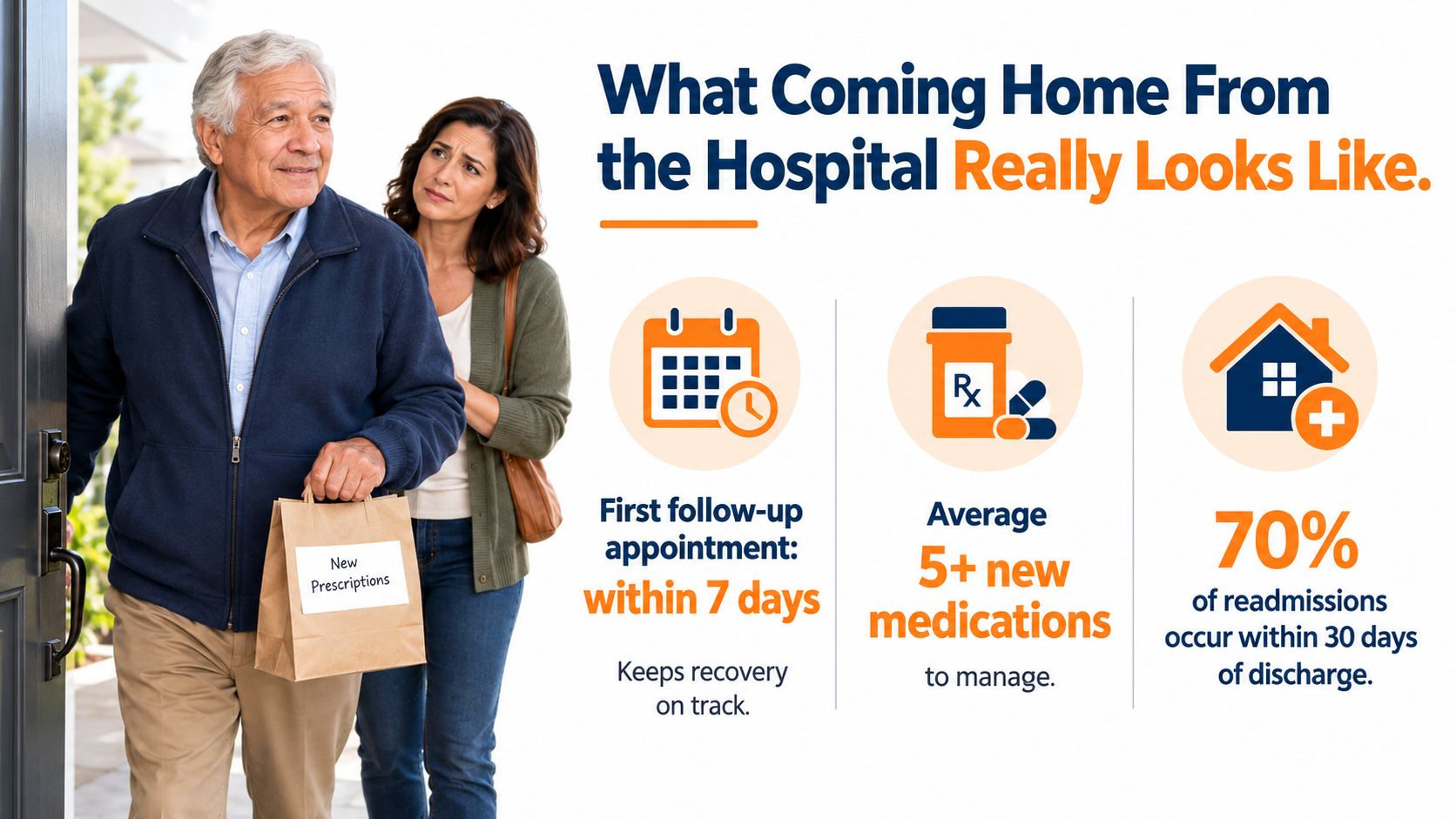
The numbers describe a population pattern, not a prediction about one person. They also explain why the home environment deserves attention. A missed message, an unclear medication change, difficulty getting to an appointment, or a disrupted sleep routine can make an already demanding week feel harder.
A transition is shared work
The older adult remains the central person in the plan. Family members, friends, primary-care clinicians, pharmacists, home-support workers, and other care professionals may each hold a different piece of information. A simple shared understanding can make those pieces easier to connect.
For families looking at elderly care management resources, the useful question isn't only, “What happened in the hospital?” It's also, “What will make the next few days at home feel manageable?”
That might mean keeping appointment details in one place, choosing a familiar time for a check-in, or making sure the older adult knows whom to contact with a question. The purpose isn't to create surveillance. It's to protect choice, confidence, and continuity while the normal rhythm of home life returns.
The First Week at Home as Three Checkpoints
AHRQ transition guidance indicates that roughly 25% of 30-day readmissions occur within four days of discharge, while about 50% occur within ten days. That timing gives families a practical way to think about the first week, using a few clear checkpoints instead of trying to remember everything at once.
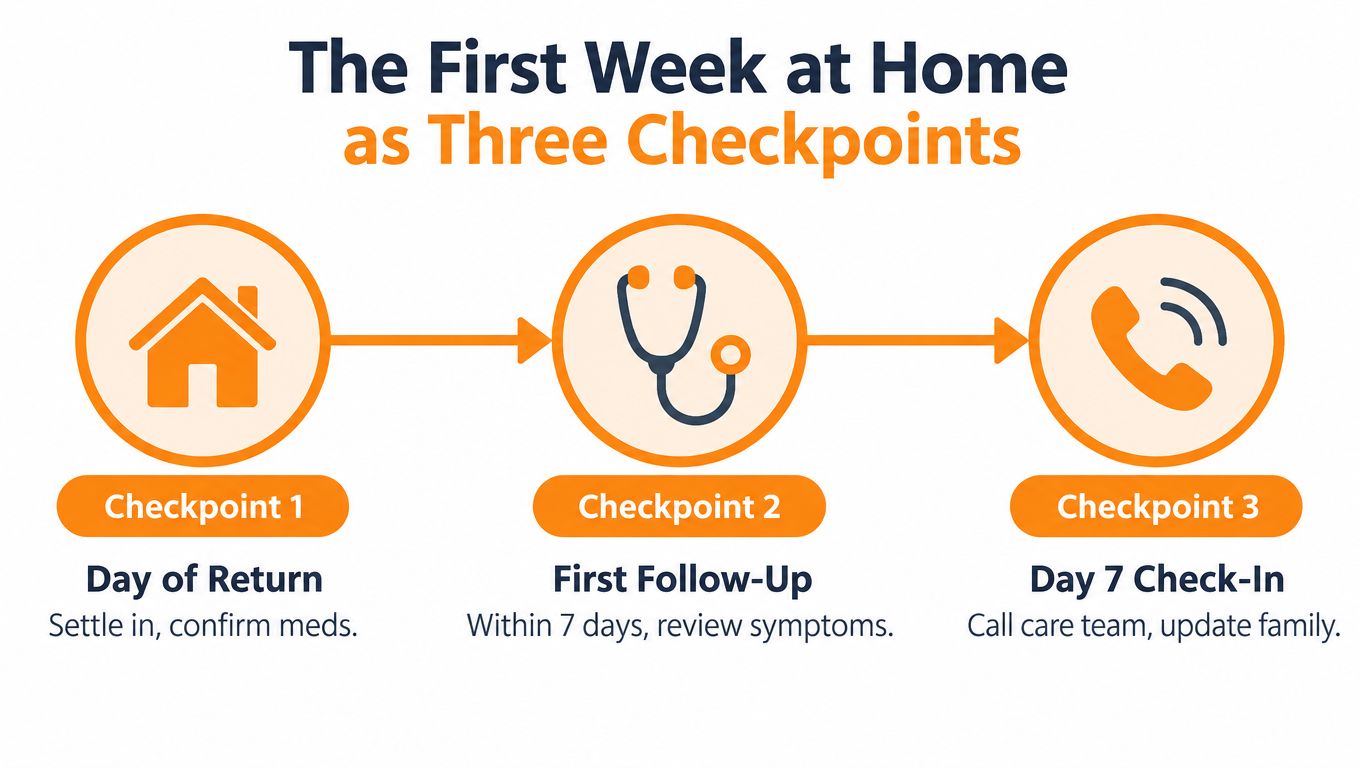
Checkpoint one, the day of return
The first day is about orientation. The older adult gets settled, the home becomes comfortable again, and the household confirms what changed during the hospital stay. Medication names and timing may need to be compared with the written list, while appointments and contact details should be easy to find.
This doesn't need to become a family meeting with a dozen questions. A calm conversation can be enough: “What feels clear?” and “What still feels confusing?” Those questions give the older adult room to lead.
Checkpoint two, the first follow-up
The first follow-up touchpoint is a chance to discuss how the transition is going with the appropriate care team. It may involve an appointment, a phone conversation, or another contact arranged at discharge. The important distinction is between a referral being mentioned and the connection taking place.
A family member can help by keeping a short list of questions and noting whether the planned appointment or service has been obtained. That record can reduce repeated explanations and help the older adult remain involved.
Checkpoint three, the end of the first week
By the end of the first week, the family can look at the routine rather than trying to judge recovery by one moment. Is the medication schedule understandable? Are meals, rest, movement, and communication fitting into the day? Has anyone noticed a change that should be discussed with the care team?
A useful rhythm: settle in first, make the planned connection, then review what is and isn't working.
This three-part view keeps reducing hospital readmissions from an abstract hospital metric to a series of ordinary home conversations. It also leaves room for independence. The older adult can decide which tasks to manage personally and where another person's support would make daily life easier.
Everyday Rhythms That Keep Recovery on Track
A systematic review of transitional-care approaches for older adults found associations between lower readmission risk and several forms of support: self-management support, RR 0.81; telephone follow-up, RR 0.84; and medication reconciliation, RR 0.88. These findings don't turn one routine into a guarantee. They show that recovery is often supported by repeated, practical contact rather than by discharge instructions alone.

At home, the three ideas overlap. A medication list is easier to use when it matches the calendar. A follow-up call is more useful when the older adult can describe what has happened since discharge and reach someone who has the authority to respond. Self-management becomes more realistic when the person isn't expected to remember every detail while tired or distracted.
Build around familiar habits
A morning routine might include opening the curtains, having breakfast, reviewing the day's appointments, and checking the medication schedule. An evening routine might include preparing questions for the next call, arranging the next day's clothing, and protecting a regular period for rest.
The details should fit the older adult's preferences. Some people like a paper calendar on the refrigerator. Others prefer a phone reminder, a shared digital calendar, or a family member's brief message. The useful system is the one the person can understand and use without unnecessary effort.
Notice changes without turning home into a clinic
Families often become anxious when they believe they must interpret every sensation. A calmer approach is to notice changes, write down questions in plain language, and share them with the relevant care team. A short note such as “sleep was different,” “the appointment was difficult to arrange,” or “the schedule is confusing” may be more useful than trying to explain what the change means.
Follow-up contact should be two-way. A call that is recorded but cannot lead to clarification or action may leave the household with the same uncertainty. Reducing hospital readmissions therefore depends not only on the number of contacts, but also on whether concerns are heard, understood, and connected to an appropriate response.
When Tools and Monitoring Help and When They Miss People
A 2025 study of a telehealth transition program reported that 443 of 1,374 referred patients, or 32.2%, completed a telehealth visit. Engaged patients had an 18.7% readmission rate, compared with 21.3% among nonparticipants. The authors noted that stronger statistical analysis was needed, so the findings shouldn't be treated as proof that telehealth alone caused the difference.
The participation gap is the central lesson. People who completed visits tended to be seen sooner, have more family or caregiver involvement, have social needs addressed, need less language interpretation, and have fewer episodes of altered mental status. A video appointment may be convenient for one person and difficult for another.

Participation is not the same as access
An older adult with cognitive changes may lose track of the appointment link. Someone with limited English proficiency may need another communication route. Hearing or vision changes, limited digital confidence, unreliable internet access, or the absence of a caregiver can all affect whether a digital program is usable.
This is where behavior pattern recognition tools can be considered carefully. A pattern or alert may help a support network notice that a routine has changed, but it doesn't replace conversation, consent, or a person who can respond.
Useful design choices include:
- Simple interfaces: Keep instructions short and reduce the number of steps required to join a call.
- Alternative communication: Offer phone, in-person, or other options when video isn't suitable.
- Consent-based caregiver support: Let a trusted person help with technology while preserving the older adult's control.
- Human follow-up: Contact the person when a visit is missed instead of treating nonattendance as the end of the process.
- Equitable measurement: Track who participates and who doesn't, rather than counting enrollment alone.
Technology can extend awareness across distance. It can't solve an unanswered question, arrange every practical service, or make an older adult feel supported by itself. The most useful tool is one that fits the person's abilities, preferences, language, and relationships.
Why Connection Shows Up in the Data
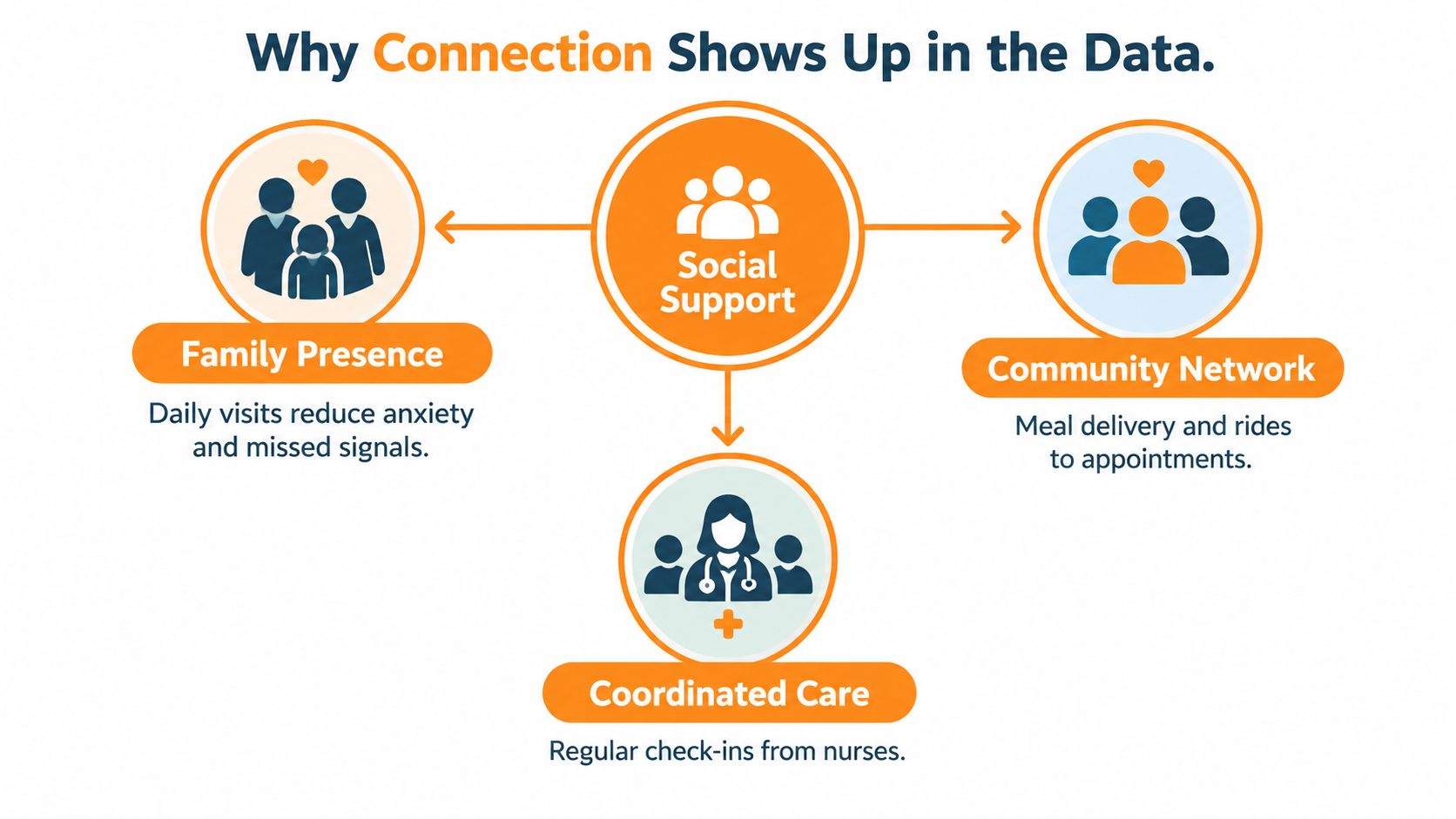
A peer-reviewed safety-net cohort study of older adults found that people reporting the highest level of perceived social support had an 8.6% combined 30-day readmission-or-death rate, compared with 16.9% among those reporting very low support. The study measured an association, not proof that social support alone caused the difference.
A broader systematic review of social relationships and healthcare use found that 75% of the high-quality studies it assessed reported an association between weaker social relationships and higher hospital-readmission rates. That doesn't mean every older adult needs the same kind of social life, or that family contact substitutes for professional care. It does show why connection belongs in a conversation about recovery at home.
Support can be quiet and ordinary
Connection doesn't have to mean a crowded calendar. It may be a short call after breakfast, a neighbor dropping off a meal, a friend helping with a ride, or a family member asking about the day without turning the conversation into an interrogation.
The older adult should remain part of the decision about who is involved and how often. Independence isn't the same as doing everything alone. It can mean choosing the kind of help that makes it easier to continue familiar routines.
| A person's preference | A respectful form of connection |
|---|---|
| Wants privacy | One agreed check-in at a predictable time |
| Enjoys conversation | A short daily call or small group activity |
| Needs practical help | A specific offer, such as a meal or ride |
| Lives far from family | Shared updates with consent |
| Feels overwhelmed | Fewer contacts, with clear responsibility |
Connection works best when it protects dignity instead of replacing it.
Family members can also watch for unspoken strain. Someone may say everything is fine because they don't want to worry anyone, while a simple question about meals, sleep, transportation, or loneliness opens a more honest conversation. The aim is not to monitor every hour. It's to make sure the older adult has a reliable human bridge when a routine becomes difficult.
Gentle Movement as Part of Recovery
The SoMoVe study of a volunteer-led mobility intervention reported 30-day readmission of 18% among participants, compared with 30% in a baseline group. The study focused on feasibility and acceptability, so those results shouldn't be treated as a promise that every mobility program will produce the same outcome.
Movement matters here because it connects hospital recovery with everyday independence. Standing safely, walking a short distance, changing position, or returning to a familiar household task can help an older adult feel more like themselves. The activity should match the person's situation and any guidance already provided by their care team.
Make movement part of the day
A routine can begin with small, recognizable moments:
- Walk to a nearby room: Use an ordinary task, such as getting a drink, as a reason to move.
- Practice balance with support: Pause at a stable surface rather than rushing through a change of position.
- Break up long sitting periods: A brief change of posture can fit naturally between meals, calls, or television programs.
- Step outside when appropriate: Fresh air and daylight can make movement feel like part of life rather than a separate assignment.
The point isn't to turn recovery into a performance. An older adult might prefer moving after breakfast, while someone else feels more comfortable later in the day. A family member can offer company, carry an item, or clear a path without hovering.
A friend's encouragement can also preserve autonomy. “Would you like company for a short walk?” leaves the choice with the older adult. That small distinction matters because independence includes deciding when and how support is accepted.
A Simple Plan for the First Thirty Days
A transitional-care study of older patients found readmission rates of 11.4% within 30 days and 17.5% within 60 days. The different windows show why recovery can't be judged by one phone call or one successful appointment. What happens at home continues to matter after the first few days.
A family can write a calm, flexible plan on a notepad:
- On the day of return: Make the home comfortable, keep the updated information together, and let the older adult identify what feels unclear.
- During the first follow-up: Confirm that the planned contact happens and bring a short list of questions.
- Through the first week: Notice whether sleep, meals, medication routines, appointments, communication, and movement are settling into a workable pattern.
- Across the first month: Keep the agreed social connections, review practical barriers, and use the medication timing guide as one way to organize questions about the daily schedule.
- When something feels off: Contact the appropriate care team rather than trying to interpret the change alone.
The research describes patterns across groups, not a scorecard for one person. A readmission isn't a moral failure, and a smooth week doesn't guarantee that every later day will be easy. The purpose of a plan is to support confidence, communication, and independence while making it easier to ask for help early.
The kindest plan is clear enough to use and flexible enough to respect the person living it.
Reducing hospital readmissions is therefore connected to more than hospital discharge paperwork. It includes a familiar morning, a reachable family member, an understandable medication routine, a completed follow-up, gentle movement, adequate rest, and a way to speak up when daily life no longer feels right.
Rx360 brings medication management, wellness signals, and connected updates into one experience for older adults, families, and care teams. If you're building a calmer home routine after a hospital stay, visit Rx360 to see how its tools can support independence while keeping trusted people connected.
Lower-Risk Medication Plan Checklist
Below is a practical checklist and step plan you can implement into your daily life:
-
List all medications
Include prescriptions, over-the-counter drugs, supplements, sleep aids, creams, patches, eye drops, and inhalers.
-
Mark fall-risk drugs
Flag medicines that cause dizziness, sleepiness, confusion, blurred vision, low blood pressure, or low blood sugar.
-
Ask for a medication review
Bring the list to a pharmacist or prescriber.
-
Review after any warning sign
Request a new medication check after a fall, near-fall, new prescription, dose change, dizziness, or confusion.