

You wake before the alarm, notice the light under the bedroom door, and walk to the kitchen. The kettle clicks on. A familiar mug comes down from the shelf. After coffee, you move toward the front door, perhaps to collect the newspaper, water a plant, or take a short walk. None of these moments seems important on its own. Together, repeated across many mornings, they form the shape of your day.
Behavior pattern recognition means finding that shape in small, repeated signals. A motion sensor may register movement between rooms. A door contact may record an exit. A wearable may capture acceleration at the wrist or ankle. Over time, these observations can describe ordinary rhythms without requiring someone to write down every activity.
The important point is simple: the system isn't looking for one dramatic event and treating it as a conclusion. It learns what a usual morning, afternoon, and evening look like, then highlights a change that lasts or appears unusual in context. A later human conversation can supply the meaning.
Table of Contents
- A Familiar Morning, Recounted
- How a Signal Becomes a Recognized Pattern
- The Sensors That Make It Work in Real Life
- Metrics That Actually Matter at Home
- Turning Routines into Positive Wellness Habits
- When Change Is Just the World, Not the Person
- Keeping Control of Your Own Data
- Practical Questions Families and Care Teams Ask
A Familiar Morning, Recounted
At 7:10, movement begins in the bedroom. A few minutes later, activity appears in the hallway and kitchen. The coffee cupboard opens, the back door remains closed, and the living room becomes active after breakfast. On another morning, the sequence may shift. You might sleep later, prepare tea, or read before moving around the house.
That variation helps define a useful baseline. Behavior pattern recognition does not impose one correct morning. It looks for relationships that recur for one person, such as waking around a familiar time, visiting certain rooms, and remaining at home before going outside. The comparison is personal, like judging a familiar walking pace rather than comparing everyone with the same standard.
A JMIR study of smart-home motion data used thermostat motion readings recorded at 5-minute intervals. It examined 30 households that stayed connected for at least 355 days, finding regular annual and weekday patterns involving sleep timing, wake-up timing, and time spent at home.
Small signals become useful together
One sensor offers only a fragment. A door event may show that someone left, but not whether they went into the garden or attended an appointment. A kitchen motion detector may register activity without showing whether the person prepared breakfast or reached for a glass.
Sequence and repetition add context. A system can compare today's activity with the person's usual rhythm, while people familiar with the circumstances decide what the change means. A late start could reflect a quiet morning, a visitor, a revised schedule, or no meaningful change at all.
A pattern becomes useful when it prompts a careful question, not when it produces an automatic conclusion. A single unusual Tuesday should not carry the same weight as a change that persists across familiar routines.
Practical rule: A flagged change is an invitation to understand the day, not a verdict about the person.
This approach supports aging in place because independence often appears in ordinary details. The National Institute on Aging frames aging in place around independence and informal support, which is the layer a routine baseline can make visible without manual reporting. Household activity, errands, companionship, and time in familiar spaces can all form part of that picture, as described in the National Institute on Aging guidance on aging in place.
How a Signal Becomes a Recognized Pattern
A behavior-recognition system usually turns raw events into a sequence of increasingly useful descriptions. The process can be understood as four connected steps.
Step one, collect observations
Sensors record simple signals: motion, acceleration, door openings, light changes, or interaction with an object. At this stage, the system doesn't know whether a person is making breakfast or looking for a book. It only has time-stamped observations.
Step two, extract features
Feature extraction summarizes what happened. It may describe how long movement lasted, how often it occurred, which room was involved, or whether a wrist signal followed an entry into the kitchen. The system turns scattered events into features that can be compared.
Step three, model the sequence
Time changes meaning. Walking into the kitchen after waking is different from entering it after returning from outside. Early behavior-pattern research relied on methods such as Hidden Markov Models and Gaussian Mixture Models, which represented activity as movement among underlying states such as rest, activity, transition, and inactivity.
The field developed gradually. Behavior pattern recognition became a formal research field during the 1950s and 1960s, and in 1959, IBM researcher Arthur Samuel coined the term “machine learning” while developing a checkers program that improved through experience, as described in this history of pattern recognition and machine learning. By the 2000s, researchers were using spatiotemporal interest points with Support Vector Machines to identify changes across space and time. Later deep-learning systems learned useful representations directly from larger datasets.

Step four, classify with caution
Classification gives a sequence a practical label, such as mobility, rest, self-care, or nutrition. That label is still an estimate. A system needs enough observations, sensitivity to temporal context, and validation against false positives.
A single unusual event is weaker evidence than a persistent change across multiple measurements. Personal baselines and confidence thresholds therefore matter more in everyday use than the name of the algorithm. A technically advanced model can still misread a sensor that shifted position, an activity performed differently, or a routine disrupted by a visitor.
The research on sequence-based behavior recognition emphasizes that behavior becomes interpretable through repeated observations of transitions, frequency, duration, and context. That is why the system should describe a pattern with appropriate uncertainty rather than present an isolated classification as certainty.
The Sensors That Make It Work in Real Life
Different sensors answer different questions. A wearable stays close to the body. An ambient sensor observes activity in a space. An object-mounted sensor adds context about what the person is handling.
| Sensing approach | What it captures well | Practical limitation |
|---|---|---|
| Wearable accelerometers | Wrist and ankle movement, locomotion, and activity intensity | The person needs to wear and maintain the device consistently |
| Ambient sensors | Room use, movement between spaces, and door activity | They don't directly capture the body's movement or the object being used |
| Object-mounted sensors | Context around cups, utensils, containers, or other household items | They require additional setup and placement |
A study of older adults using wearable accelerometers found that combining ankle and wrist signals achieved more than 80% accuracy across 16 activity classes, as reported in this research on wearable sensor placement. The reason is intuitive. An ankle can capture locomotion and gait dynamics, while a wrist can capture upper-body actions such as eating, grooming, or handling an item.
Object context can answer questions body movement alone leaves open. In an instrumented-home dataset covering 17 daily activities, a random-forest model achieved 97.19% functional-area accuracy with wearable sensors and 99.58% when wearable and object-mounted inertial sensors were combined, according to this multisensor behavior-recognition study.

Why hybrid sensing adds context
Suppose a wearable records arm movement in the kitchen. That signal could represent preparing food, cleaning, or reaching into a cupboard. If an object sensor also records interaction with a cup or utensil, the system has more context to separate these possibilities.
Ambient sensors provide another layer. A motion detector can show that someone entered a room, while a door contact can show an exit. These signals can support a routine baseline without cameras or continuous manual entries.
For platforms such as connected health solutions from Rx360, the practical question is not which sensor is universally best. It is whether the setup captures enough useful context while remaining simple, discreet, and acceptable in the home. Non-camera sensing can support awareness of daily rhythms without turning ordinary life into a performance for a device.
Metrics That Actually Matter at Home
Headline accuracy can sound impressive while hiding the questions that matter in a real home. A useful system needs to show whether it catches meaningful changes, avoids unnecessary alerts, adapts to one person, and remains reliable as routines unfold.
Sensitivity and specificity
Sensitivity asks whether the system notices a real change in routine. If a person's usual morning movement shifts across several days, a sensitive system should be able to surface that change.
Specificity asks whether the system avoids calling ordinary variation a meaningful event. A visiting family member, a pet, furniture movement, or a different route through the house can create signals that look unusual without representing a lasting change.
Both measures matter. A system that misses every change is unhelpful, but a system that flags every small variation can create noise and invite unnecessary intervention.
Calibration belongs to the individual
A population average can't describe every household. One person may read late into the evening, while another starts the day early. One person may spend much of the afternoon outside, while another prefers indoor hobbies.
That is why per-user calibration matters. The system should learn the person's established rhythm and use confidence thresholds that reflect the quality and consistency of their signals. Hierarchical labels can help too. A system may first identify broad categories such as mobility, self-care, and nutrition before attempting to distinguish fine-grained actions.
The privacy-preserving home-monitoring research describes a system that combined binary motion sensors with a bidirectional long short-term memory neural network. It used sensor features alongside temporal details such as the previous activity and the activity's starting timestamp. That design reflects a central principle: what happened immediately before an event can help explain what the event means.
Stability over time
Temporal stability asks whether a pattern remains consistent across repeated observations. A model that classifies one movement perfectly but changes its interpretation every few minutes may be less useful than a model that recognizes a broad routine shift consistently over several days.
Families and care coordinators generally need a short, understandable summary, not a flood of isolated alerts. A well-supported observation might describe a sustained change in room use, sleep timing, or movement rhythm, while showing the confidence and time period behind it.
For readers exploring related data concepts, Rx360's heart-rate variability chart by age illustrates why measurements need context rather than isolated interpretation. The same principle applies here: a number or label becomes more useful when paired with a person's baseline, timeframe, and surrounding observations.
Turning Routines into Positive Wellness Habits
Behavior pattern recognition can describe the routines people already value, including sleep timing, movement, balance practice, time outdoors, and social connection. It doesn't need to turn a day into a score. It can organize observations so that a person notices duration, frequency, intensity, and type of activity.
The World Health Organization's physical-activity guidance for older adults specifies 150 to 300 minutes of moderate-intensity aerobic activity per week, or 75 to 150 minutes of vigorous-intensity activity, or an equivalent combination. It also calls for multicomponent activity emphasizing functional balance and strength at moderate or greater intensity on 3 or more days each week.
These are population-level recommendations, not an automatic interpretation of one person's routine. A tracking system can still use the categories as an organizing language. Instead of reducing movement to a single step count, it can help describe whether activity happens regularly, how long it lasts, and whether different types of movement appear across the week.
Routines support independence
Aging in place involves more than staying inside a home. The National Institute on Aging connects it with independence, help from family and friends when needed, transportation, errands, household tasks, and companionship. A routine baseline can make those ordinary parts of life visible without requiring constant manual reporting.
That visibility may support positive conversations. A person might notice that morning walks have become less regular, that sleep timing has shifted, or that social visits are happening less often. Family members can remain gently informed, while the older adult continues deciding how to spend the day.
The technology doesn't replace personal preference, family knowledge, or professional judgment. It can provide a shared description of routines, leaving people to discuss what the pattern means and whether any change is temporary, welcome, or worth revisiting.
When Change Is Just the World, Not the Person
A change in behavior isn't automatically a change in the person. Weather, air quality, public restrictions, transport problems, neighborhood conditions, and events in the household can all reshape a familiar day.
Smart-home data identified population-level changes in older adults' sleep efficiency, time spent outside the home, and overall activity during the COVID-19 pandemic and wildfire-smoke events, as described in this research on environmental context and older adults' routines. The system could detect that routines had changed, but the signal alone couldn't safely establish why.
Add context before escalation
A sound interpretation process can combine a personal baseline with outside information. It can then describe the change using three questions:
- Confidence: How strong and consistent are the underlying observations?
- Duration: Did the shift last briefly, or did it continue across several observations?
- Reversibility: Did the routine return when the outside condition changed?
A hot day may reduce time outdoors. Smoke may lead someone to keep windows closed and skip a walk. A household illness may alter sleep and room use. None of those changes should be treated as a personal failing or automatically converted into an alert about the individual.
Over-alerting has a human cost. If every unusual Tuesday prompts intervention, people may feel watched rather than supported. That can weaken the sense of independence that aging in place is meant to preserve.
A system can identify a deviation accurately and still explain its cause incorrectly.
The next human step should therefore be proportionate and respectful. A check-in can begin with curiosity about the day, not with an assumption that the person has a problem.
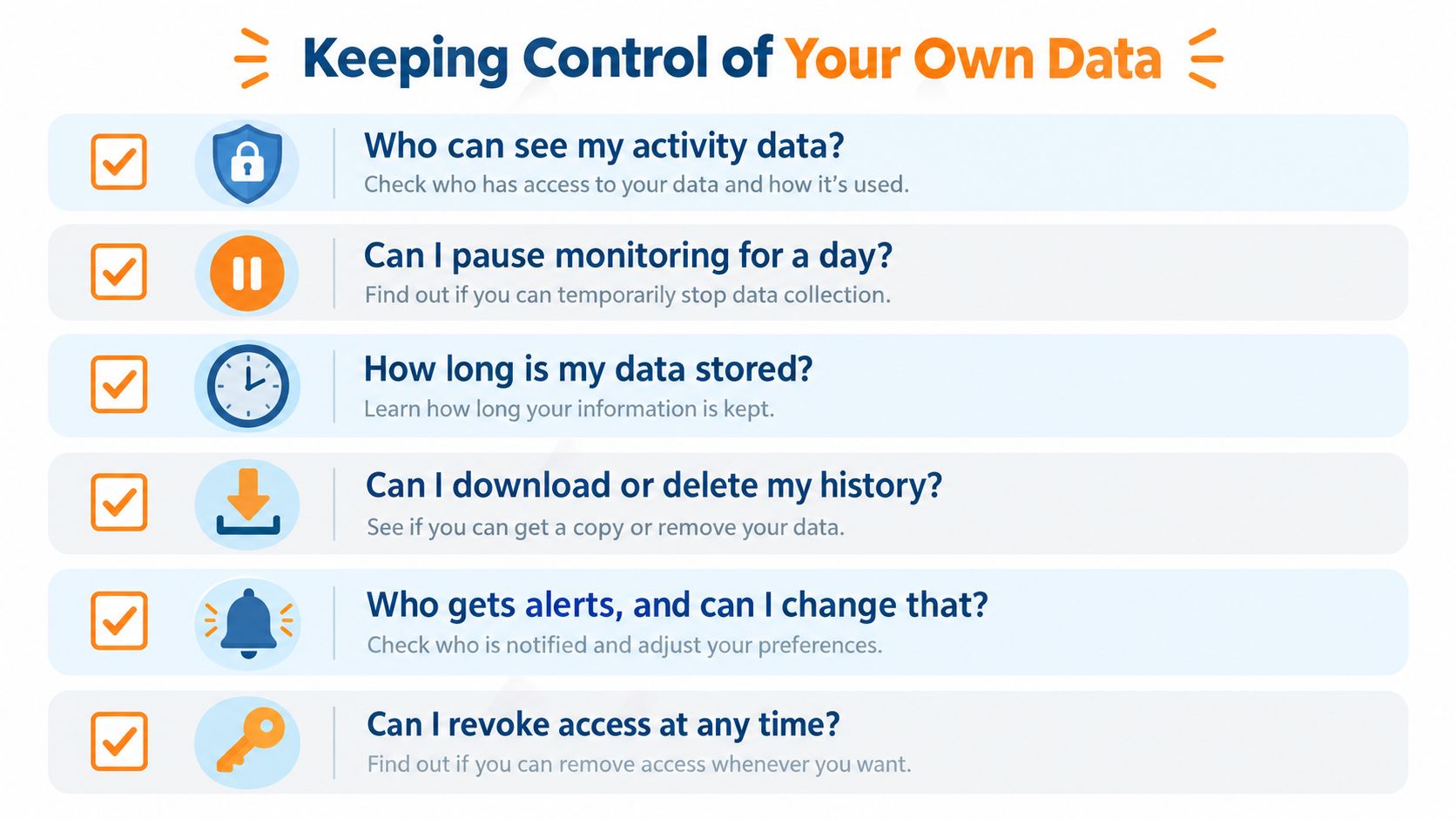
Keeping Control of Your Own Data
A quiet Tuesday morning can reveal the privacy question clearly. A motion sensor may show that someone entered the kitchen, but the person should still decide who sees that event, how long it remains available, and what happens if the system interprets it incorrectly. Privacy is an ongoing set of choices, not a one-time decision made during installation.
A scoping review of 34 studies on privacy and passive monitoring found that privacy is often omitted from technology-acceptance frameworks. The review also separated concerns about the monitoring technology, the data infrastructure, and the people who can access the information. Its findings, alongside reported concerns among older adults and caregivers, point to control, stigma, overreliance on technology, isolation, deception, privacy breaches, and the risk of replacing human care as issues that require discussion.
Turn consent into practical control
Before monitoring begins, an older adult should be able to ask:
- Who creates the baseline? The person should know whether their usual routine is set by them, a family member, or a service provider.
- Who receives an alert? Recipients should be named, and the person should be able to change them.
- What gets stored? The system should explain whether it keeps raw sensor events, summaries, or both.
- Can monitoring pause? A person should be able to pause it for privacy, guests, travel, or personal preference.
- How are disagreements handled? The person should be able to challenge an inference and have the correction recorded.
These questions turn consent into practical control. They also make it easier to distinguish support from silent observation.
Prefer negotiated support over invisible surveillance
Motion, door, and illuminance sensors can describe daily rhythms without recording a person's appearance. That may feel more acceptable than a camera, but the distinction matters only when the person understands the system and retains meaningful control.
The older adult should be able to define monitoring zones, choose recipients, see why an alert appeared, approve escalation rules, and pause monitoring. Tools such as clinical decision support tools from Rx360 fit within that support relationship. They can organize information for review, but they should not replace conversation, consent, or human care.
Practical Questions Families and Care Teams Ask
A quiet Tuesday may look unusual because a visitor stayed late, rain changed a walk, or a family member handled dinner. What kind of change should prompt a human check-in? A persistent deviation supported by several observations deserves more attention than one uncertain event. The first response should be friendly and open: ask how the person's day has been rather than assume the cause.
How long does a system need to learn a baseline? There is no universal period. It needs repeated observations from ordinary routines, including differences between weekdays, weekends, seasons, and unusual days. As the smart-home routine study in the opening section showed, patterns can emerge across weekly and annual scales.
What should the older adult control? They should understand what is collected, who receives summaries or alerts, how long information is kept, which spaces are monitored, and whether monitoring can pause. They also need a way to question or correct an interpretation.
How does environmental context fit in? Heat, smoke, travel disruption, restrictions, or illness in the household can change a routine without changing the person's health or ability. Reviewing those conditions helps families separate a noisy day from a sustained shift in the person's own pattern.
The goal is modest: support familiar routines, preserve independence, and keep loved ones and clinicians gently informed.
Rx360 brings together Health Insights, Smart Technology, and Connected Care to help independent older adults stay connected at home. Explore how Rx360 supports wellness updates, discreet activity awareness, and communication with important contacts.
Lower-Risk Medication Plan Checklist
Below is a practical checklist and step plan you can implement into your daily life:
-
List all medications
Include prescriptions, over-the-counter drugs, supplements, sleep aids, creams, patches, eye drops, and inhalers.
-
Mark fall-risk drugs
Flag medicines that cause dizziness, sleepiness, confusion, blurred vision, low blood pressure, or low blood sugar.
-
Ask for a medication review
Bring the list to a pharmacist or prescriber.
-
Review after any warning sign
Request a new medication check after a fall, near-fall, new prescription, dose change, dizziness, or confusion.