
You glance at your watch after an afternoon outside, and the skin-temperature reading looks different from yesterday's. Or you rest a hand on someone's forehead and wonder why they feel warmer than the room. It's an ordinary moment that raises a surprisingly tricky question: what does the temperature of the skin tell you?
Table of Contents
- A Warm Wrist and a Quiet Question
- What Skin Temperature Actually Is
- What Moves Skin Temperature Up or Down
- Ways to Measure Skin Temperature
- How to Read a Skin Temperature Number Wisely
- Skin Temperature and Everyday Wellness Routines
- Friendly Monitoring Habits for Older Adults and Caregivers
- A Calm Takeaway on Skin Temperature
A Warm Wrist and a Quiet Question
Research on wearable temperature estimation helps explain why a wrist reading needs context. Researchers combined wrist skin temperature with heart rate and ambient temperature to estimate internal temperature, rather than treating the wrist measurement as a complete answer.
That distinction changes how we can understand an everyday reading. A watch displays a neat value, but the person wearing it has been moving between rooms, changing clothes, resting, and going outdoors. The display doesn't necessarily show all those circumstances beside the result.
Suppose you've been gardening in a long-sleeved shirt. Your wrist feels warm when you come inside, while someone who's been sitting in another room has cooler hands. Those observations describe different moments, not a competition over whose temperature is more normal.
A reading is an observation, not a verdict
A useful starting point is to separate what the device measured from what you're wondering about. The device recorded temperature at a particular location. Questions about comfort, sleep, or daily routines require more information.
- The observation: Your wrist reading differs from its usual pattern.
- The surroundings: You've just returned from outdoors or changed rooms.
- The comparison: Yesterday's reading may have been taken during a different activity.
Curiosity is more useful than attaching a label to an isolated value. A reading can become part of a broader record without becoming a judgment about how well someone is doing.
This is especially relevant when family members share wearable updates. A number can start a friendly conversation about the afternoon rather than an anxious exchange about whether the display looks right. The useful question isn't whether the wrist is warm. It's what was happening around the person when that warmth was measured.
What Skin Temperature Actually Is
A physiological review of human temperature regulation describes skin temperature as a variable surface measurement, unlike the more tightly regulated temperature deeper inside the body. Environmental conditions, blood flow, clothing, activity, and local anatomy all influence it.
Think of the skin as the body's responsive outer layer. A porch floor can feel different in sunlight and shade without telling you the temperature inside the house. Likewise, a measurement at the body's surface isn't interchangeable with a measurement intended to represent its interior.
The analogy has limits, of course. Skin isn't passive flooring: its temperature helps the nervous system detect thermal conditions and adjust heat-loss responses. It participates in temperature regulation while also responding to the surroundings.
What “warm” means in research
Physiological reviews commonly classify mean skin temperature as cool below 30°C, warm from 30°C to 34.9°C, and hot at 35°C or higher, according to the physiological review linked above. These are descriptions of mean skin temperature, not universal targets for an individual wrist or fingertip.
| Term | What it describes |
|---|---|
| Skin temperature | Temperature at the body's surface |
| Mean skin temperature | A combined description of temperatures across measured skin sites |
| Core temperature | Temperature deeper inside the body |
A wrist reading and a whole-body average answer different questions. Mixing them together is rather like comparing the temperature beside a window with the average temperature throughout a home.
Useful distinction: A description of surface warmth isn't automatically a description of internal body temperature.
That's why a familiar clinical temperature number shouldn't become a target for a wearable skin sensor. The location and type of measurement are part of its meaning, not incidental details.
What Moves Skin Temperature Up or Down
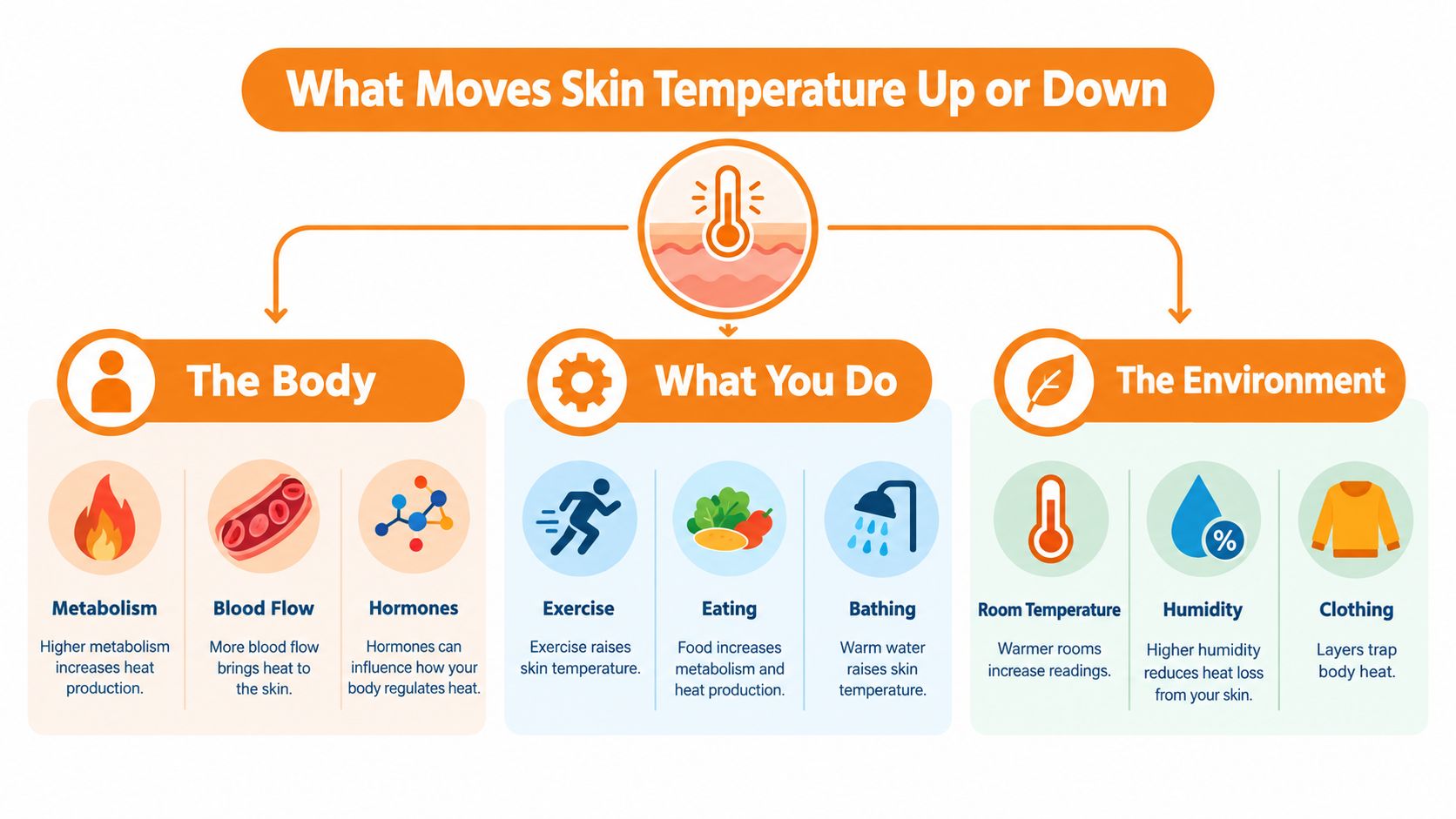
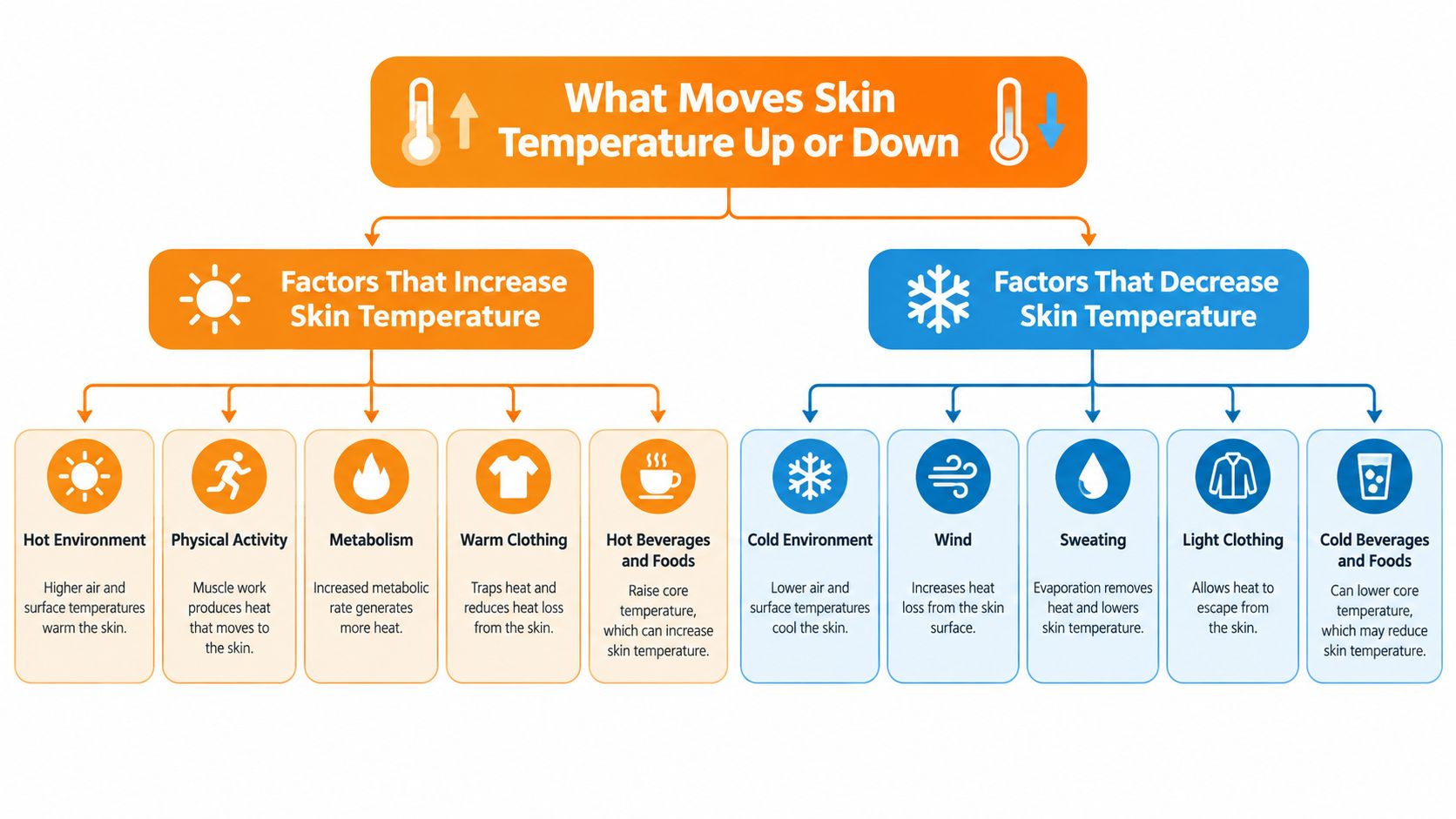
A controlled study of daily skin-temperature rhythms identifies light exposure, physical activity, body position, surrounding temperature, and sleep as influences on temperature patterns. It also shows why measurements from different body locations shouldn't be treated as interchangeable.
These influences are easier to understand when grouped into the body, behavior, and environment. They overlap throughout an ordinary day, so a changing reading rarely comes with a single obvious explanation.
The body and what you're doing
Hands, feet, and the torso don't follow identical temperature patterns. The research above describes a larger daily rhythm in distal areas, such as the hands and feet, than in core temperature. Distal means farther from the center of the body.
Movement and posture add another layer. Comparing a reading taken after a walk with one taken while reclining means comparing different circumstances, even when the device stays in the same place.
- Body location: A fingertip measurement describes a different surface from a torso measurement.
- Activity: A walk and a quiet afternoon provide different settings for observation.
- Position: Sitting, standing, and lying down belong in the background record when comparing patterns.
The point isn't to explain every change after it happens. It's to recognize when the circumstances themselves have changed.
The room belongs in the picture
An afternoon by a sunny window and an evening in a cooler hallway aren't equivalent settings. Clothing also changes the immediate surroundings of the skin, as the earlier physiological explanation describes.
For someone enjoying independent life at home, these are familiar details: a favorite chair, a gardening jacket, a bedroom window, or the time of a regular walk. Recording such details doesn't require turning home life into an experiment.
It makes comparisons clearer. A changed setting is useful information, even when there's no reason to assign a deeper meaning to the changed reading.
Ways to Measure Skin Temperature
A sensor-comparison study of thermal comfort provides a helpful reality check: ambient temperature alone predicted comfort with about 81% accuracy, compared with roughly 76% for wrist temperature and 75% for facial temperature. Those findings concern comfort prediction, not the diagnostic accuracy of household thermometers.
Readers commonly encounter contact sensors, infrared devices, and wearables. These labels don't describe entirely separate categories: a wearable can contain a contact sensor. One label describes the measurement approach, while another describes how someone wears the device.
Comparing Skin Temperature Measurement Methods
| Method | Where it sits | Strength | Best for |
|---|---|---|---|
| Contact sensor | Directly against a selected skin site | Keeps the measurement tied to a defined location | Observing the same surface over time |
| Infrared surface thermometer | Directed toward an exposed skin site | Provides a spot measurement without a continuously worn sensor | Occasional surface observations |
| Wearable sensor | At the device's designated site, such as the wrist | Supports repeated observations during everyday life | Exploring personal patterns and routines |
Comfort and repeatability depend on the particular device, its placement, and its intended use. A watch may fit naturally into someone's routine; another person may prefer an occasional measurement rather than wearing something continuously.
The contact-sensor study discussed earlier placed sensors directly on the skin, allowing heat to move conductively between the surface and the sensor. That detail matters: a device's physical relationship with the skin is part of what it measures.
Compare like with like
A forehead surface reading and a wrist record aren't automatically competing answers to the same question. They describe different locations and may cover very different periods.
Ear thermometers shouldn't be grouped with ordinary surface skin readings. The measurement site and the device's stated purpose matter more than whether the instrument happens to use infrared technology.
The best comparison starts with the same measurement question, not merely the same unit on a display.
For everyday wellness observation, useful device information includes the intended site, whether results are spot readings or trends, and whether ambient conditions are included. More measurements don't remove the need to understand what's being measured.
How to Read a Skin Temperature Number Wisely
A review of aging and heat regulation explains why a steady skin reading doesn't establish that an older adult is dissipating heat effectively. In controlled studies, the body-temperature rise required for sympathetic activation associated with heat-loss responses was approximately 1.3 ± 0.4°C in older adults versus 0.9 ± 0.3°C in younger adults, and older adults increased skin blood flow roughly 2–3 times less during heat exposure.
Those are research observations, not thresholds for interpreting a home wearable. Their practical educational value is narrower: an apparently ordinary surface reading doesn't tell the whole story about someone's thermal circumstances.
Separate the value from the pattern
An absolute value is the reading at a particular moment. A trend describes how readings change over time, while a personal baseline describes someone's usual pattern under comparable circumstances.
| Observation | Context that makes comparison clearer |
|---|---|
| A warm wrist after gardening | Outdoor conditions, clothing, and recent movement |
| A cool fingertip on waking | Measurement location, room conditions, and time |
| A gradual change across evenings | Whether activity, timing, and surroundings were similar |
These examples don't identify causes or establish conclusions. They show why comparing a person with their own familiar pattern can be more informative than comparing unrelated readings.
Keep different wellness measures distinct
Someone's description of feeling comfortable, chilly, or unusually warm adds context that a graph doesn't supply. It remains a separate observation, not something a temperature sensor can replace.
For readers exploring normal vital signs in older adults, the same distinction matters: a skin-temperature baseline isn't a universal clinical range. Keeping those categories separate prevents a familiar-looking number from acquiring a meaning it wasn't designed to carry.
Skin Temperature and Everyday Wellness Routines
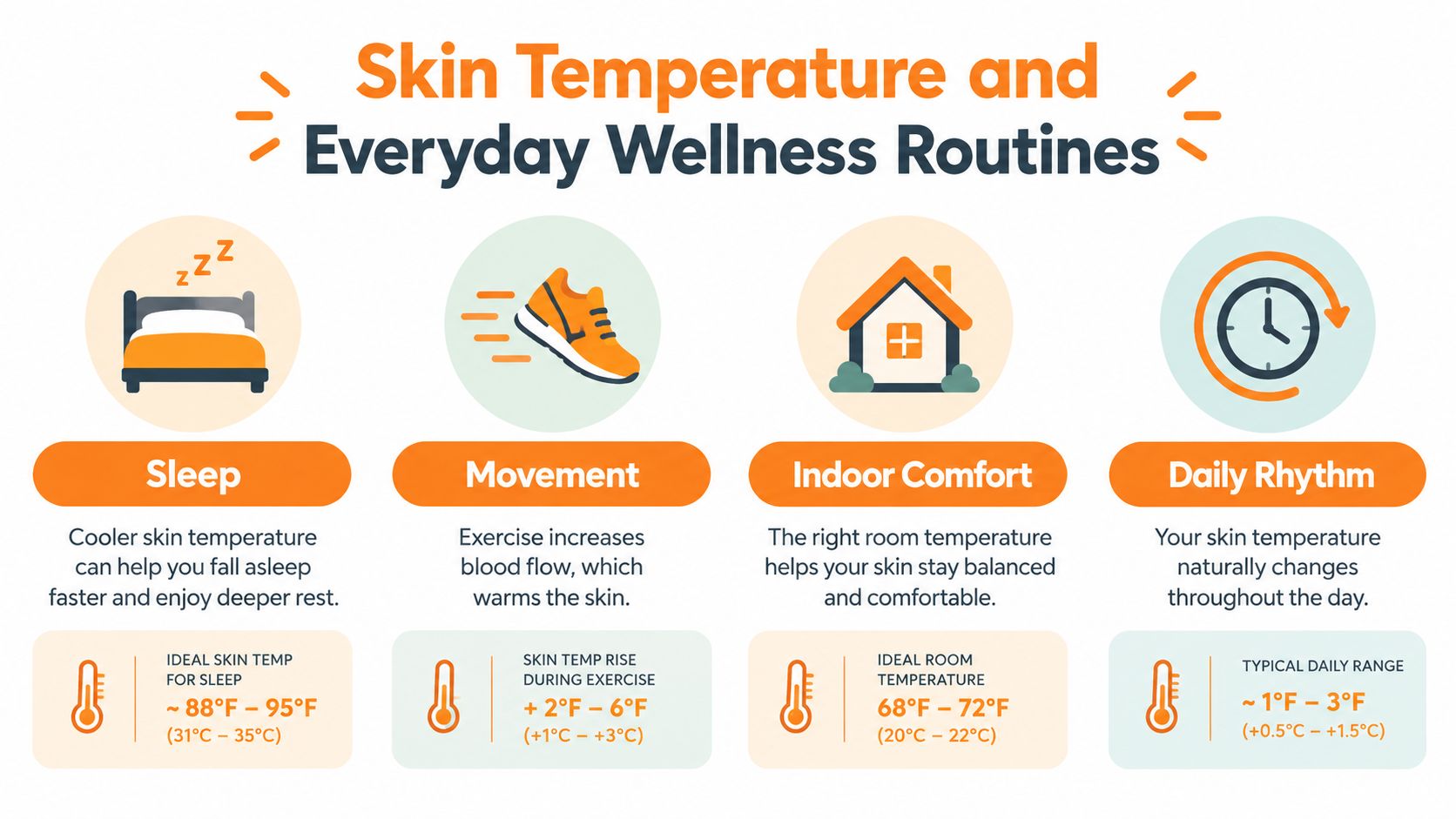
A real-world study of skin-temperature rhythms and sleep followed 2,187 community-dwelling adults and found that more stable daily patterns and stronger relative amplitude were associated with higher sleep efficiency, less wakefulness after sleep onset, and longer total sleep time, with each association having a probability value below 0.001. Because the study was observational, it doesn't establish that changing skin temperature improves sleep.
“Relative amplitude” can sound technical. In this setting, it describes how strongly the warmer and cooler portions of a daily pattern differ. Researchers examined the shape and consistency of the rhythm, not whether someone's skin was warm.
That's a useful distinction for everyday wellness. A regular walk, an evening reading routine, and a changing sleep schedule provide a daily backdrop against which temperature patterns can be observed.
Sleep isn't a simple warmer-or-cooler story
A review of thermoregulation around sleep describes hands and feet becoming warmer at night as heat loss through the extremities increases while core temperature declines. Surface warmth and internal cooling can therefore occur together.
That finding doesn't establish a personal warming method or a preferred bedroom setting. It explains why the simple idea that cooler skin always means better sleep misses an important part of the physiology.
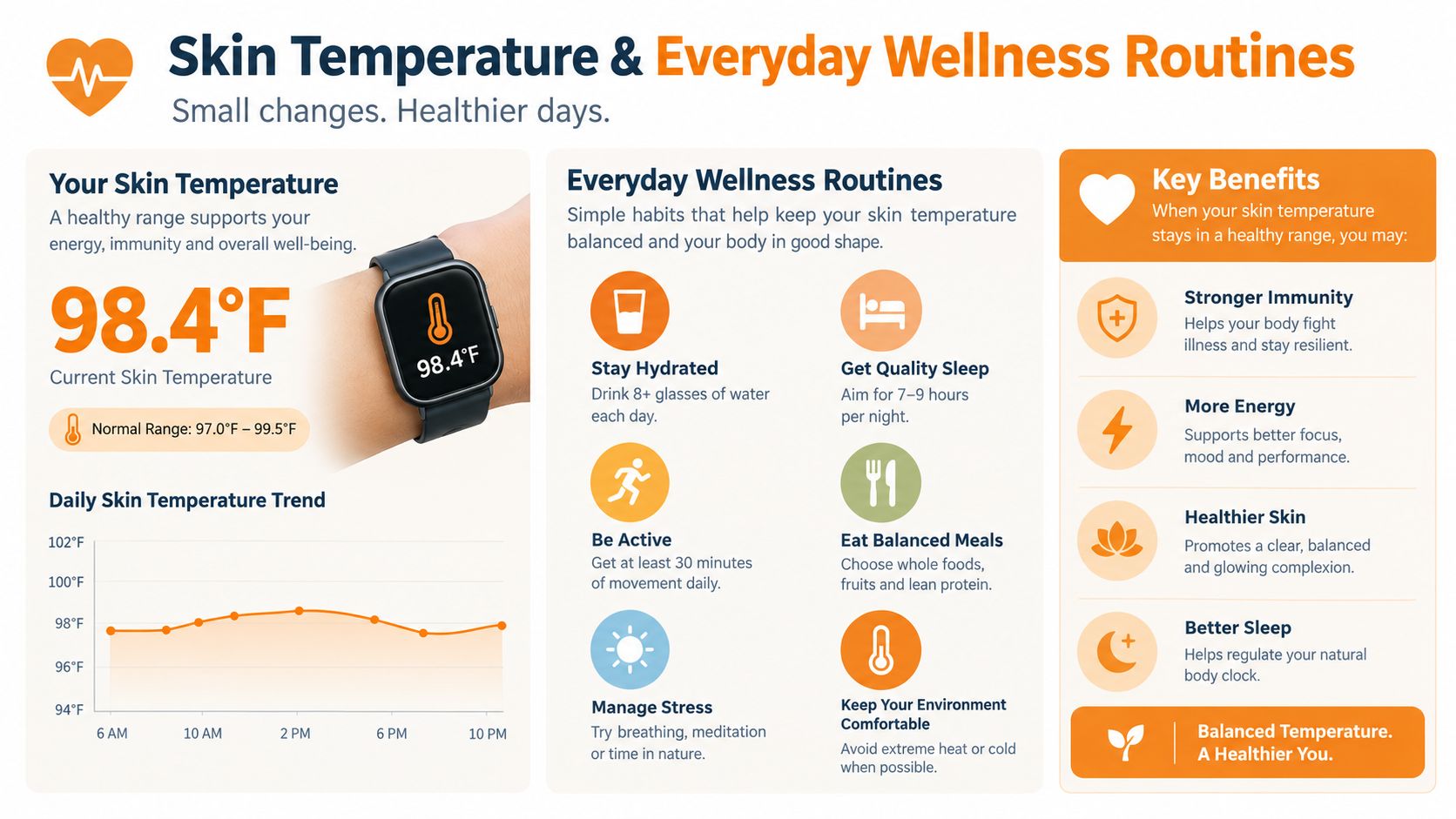
Research perspective: An association with better sleep isn't a temperature target to pursue.
Keep the routine larger than the metric
- Sleep: A temperature record can describe a rhythm without grading the night.
- Movement: Activity belongs beside the reading rather than disappearing from the comparison.
- Indoor comfort: Room conditions remain relevant even when a wearable supplies personal data.
Other wearable measures also need their own context. Reading about stress and heart-rate patterns can broaden that understanding without assuming every signal changes for the same reason.
Friendly Monitoring Habits for Older Adults and Caregivers
Research on skin temperature and circadian timing found that skin-temperature rhythms include both an internally generated component and a component responsive to abrupt changes in sleep timing. The researchers identified skin temperature as a comparatively low-burden signal for studying daily rhythms.
That makes routine changes relevant to conversations about wearable records. A later bedtime, a different morning schedule, or travel can belong in the story without turning the graph into a problem to solve.
A shared record can stay simple
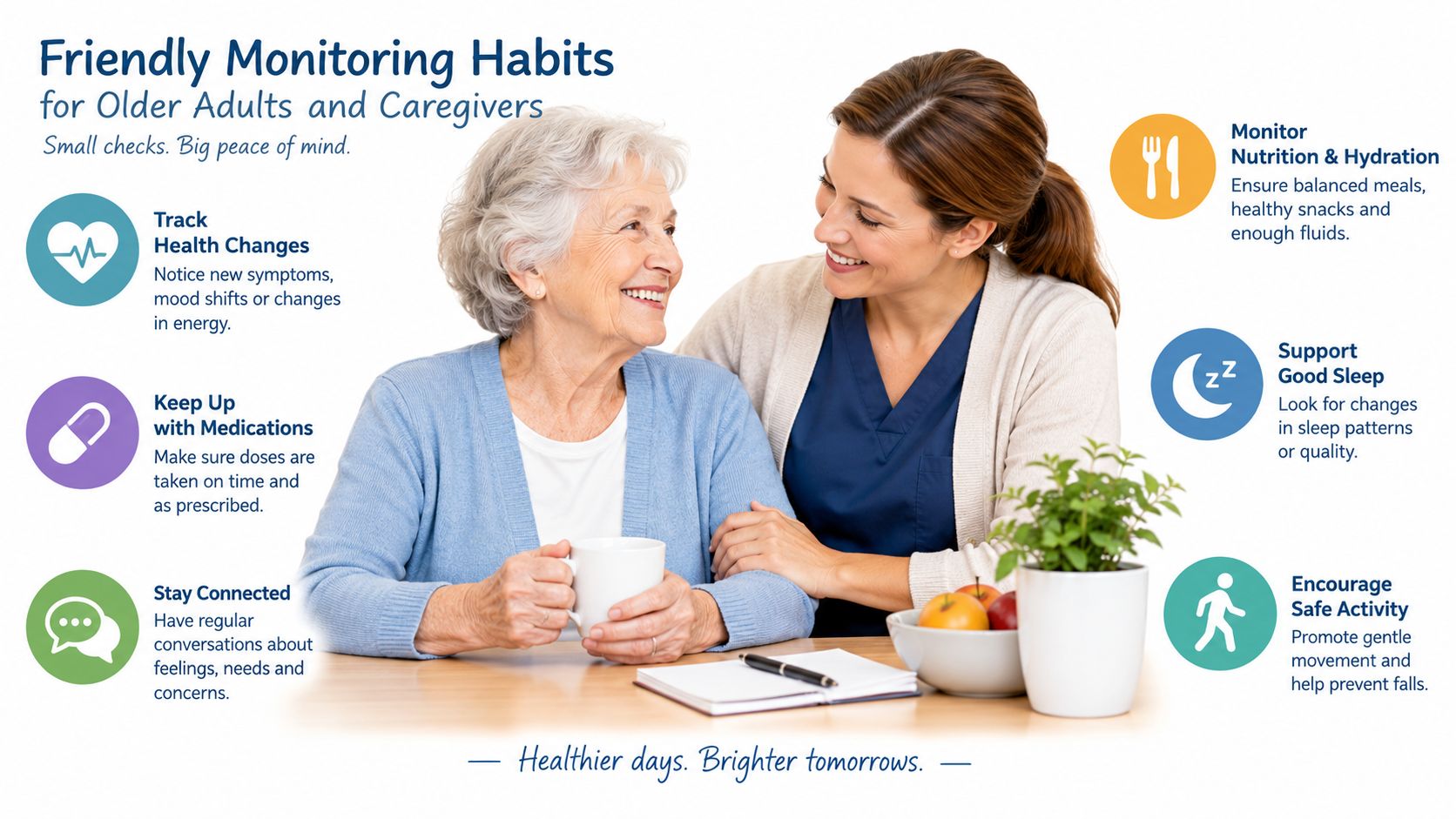
For families who already enjoy tracking wellness information, a small set of descriptive notes can keep the record understandable. These are observation options, not a prescribed monitoring schedule.
- Use a familiar setting: Note the location and circumstances rather than treating every measurement as equivalent.
- Describe the day: A walk, a quiet afternoon, or a later bedtime may be more useful than a long list of unexplained values.
- Include the person's words: “Comfortable” or “the room felt warm” preserves information the sensor didn't collect.
- Keep preferences visible: The person wearing the device remains part of deciding what gets recorded and shared.
There's no need to invent a universal number of daily checks. The research described here doesn't establish a household checking schedule.
Technology and conversation have different roles
A shared display can show recorded observations. A conversation provides personal meaning: whether someone enjoyed their afternoon, changed their routine, or found a room uncomfortable.
Readers exploring connected wellness solutions can consider that distinction when thinking about family updates. Connection doesn't require interpreting every fluctuation, and a graph doesn't replace someone's account of their own day.
A Calm Takeaway on Skin Temperature
A history of clinical temperature measurement describes the transition from judging warmth by touch to using numerical instruments. That history helps explain a familiar source of confusion: a surface impression and an internal-temperature measurement aren't the same kind of information.
Today's devices make surface measurements easier to collect, but a precise-looking display doesn't erase those distinctions. Understanding what a measurement represents remains just as important as being able to record it.
The most useful shift is away from memorizing a universal skin-temperature number. The temperature of the skin is a responsive signal, and its meaning depends on the circumstances already discussed.
A compact reference for everyday observation
- Know the measurement: Identify the site and what the device says it reports.
- Keep comparisons fair: Use the person's familiar pattern rather than unrelated readings.
- Preserve context: Include surroundings, activities, and timing.
- Keep the person central: Leave room for comfort, preferences, and conversation.
These aren't steps toward diagnosing anything. They're ways to describe observations more clearly and avoid asking a surface sensor to answer questions beyond its purpose.
A useful wellness record leaves room for ordinary life, not just numbers.
The linked research offers different perspectives: temperature regulation, measurement methods, daily rhythms, and sleep. Reading them together reveals why no isolated display can represent the whole person.
A wearable record can sit alongside the routines someone values, whether that's walking, reading before bed, or staying connected with family. It doesn't need to become the main event.
Rx360 brings together Health Insights, Smart Technology, and Connected Care to help independent older adults stay aware of wellness signals and connected with loved ones. Visit Rx360 to explore how simple updates and shared information can support everyday routines while keeping independence at the center.
Lower-Risk Medication Plan Checklist
Below is a practical checklist and step plan you can implement into your daily life:
-
List all medications
Include prescriptions, over-the-counter drugs, supplements, sleep aids, creams, patches, eye drops, and inhalers.
-
Mark fall-risk drugs
Flag medicines that cause dizziness, sleepiness, confusion, blurred vision, low blood pressure, or low blood sugar.
-
Ask for a medication review
Bring the list to a pharmacist or prescriber.
-
Review after any warning sign
Request a new medication check after a fall, near-fall, new prescription, dose change, dizziness, or confusion.