HIPAA compliance is the ongoing process of following U.S. federal rules that protect people's health information, and it applies to certain organizations and the vendors that work with them. It's not a single certificate or sticker. It's a set of everyday habits for handling private information with care.
Maybe you're a daughter checking a simple alert about your dad's morning routine. Maybe you're an older adult who loves living at home and uses a wellness app to stay connected. Either way, you want the helpful information to flow, and the private details to stay private. That's the balance HIPAA is built to support.
Table of Contents
- A Friendly Look at HIPAA Compliance
- The Three Core Rules Made Simple
- Who HIPAA Actually Applies To
- Examples of PHI and the Minimum Necessary Rule
- Common HIPAA Myths Worth Debunking
- HIPAA and Connected Care for Older Adults
- Practical Steps and Breach Response Basics
- Frequently Asked Questions
A Friendly Look at HIPAA Compliance
The U.S. Department of Health and Human Services, often called HHS, explains the background in its HHS guidance on standards for privacy of individually identifiable health information. That's a long title for a simple idea. When health information can identify a person, there are rules for how it's used and shared.
So, what is HIPAA compliance in plain language? HIPAA is the Health Insurance Portability and Accountability Act of 1996. Congress enacted it on August 21, 1996, and the law authorized HHS to set national privacy and security standards. Compliance means an organization follows those standards in its daily work.
Think of a neighborhood example. A friend helps you water plants while you're away, so you give her a house key. You don't give her every key you own, and you expect her to lock up when she leaves. HIPAA works in a similar spirit for health information. The right people get access for the right reason, and everyone takes care to protect what they've been trusted with.
Why It Feels Personal
Health information isn't like a shopping list. It can include notes about care, daily wellness signals, and messages between family members and care teams. For someone enjoying aging in place, that information supports independence, positive routines, and staying socially connected. It also deserves respect.
A helpful way to think about it: HIPAA compliance isn't about hiding information from everyone. It's about sharing thoughtfully, protecting carefully, and knowing who is responsible at each step.
That framing helps calm a common worry. HIPAA doesn't exist to make family connection harder. It exists so connection happens with clear permission, clear limits, and good safeguards. Once you see it as an operating discipline, rather than a scary legal label, the individual rules start to make much more sense.
The Three Core Rules Made Simple
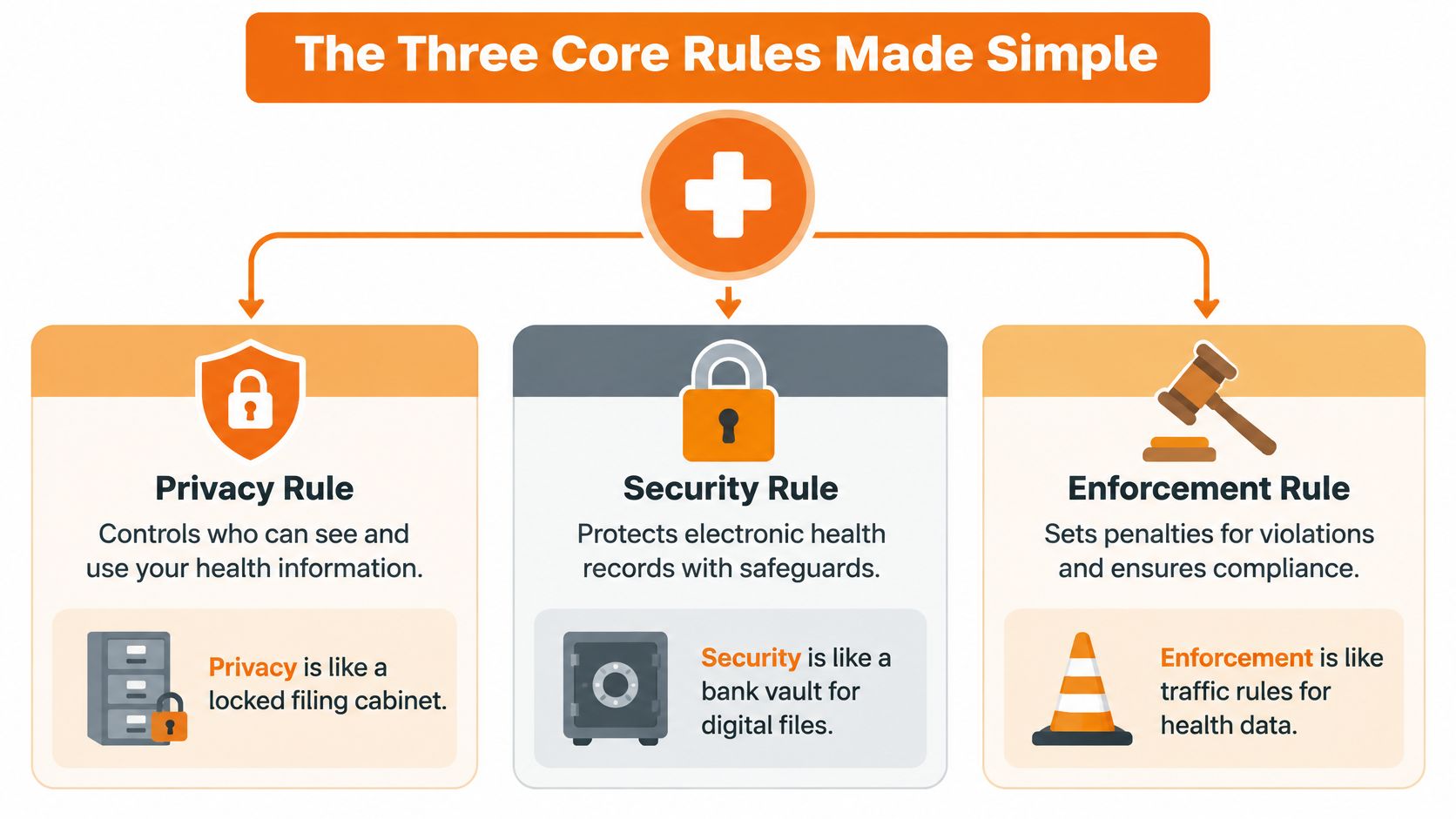
HHS lays out the safeguard basics in its HHS Security Rule educational paper on safeguards. Drawing on that guidance, you can sort HIPAA into three core rules that work as layers. Each layer answers a different question.
The Privacy Rule Is the Guest List
The Privacy Rule governs permitted uses and disclosures of protected health information, or PHI, and it covers individual rights. Like a guest list for a private gathering, it helps decide who may see information and for what purpose. A person involved in care may need certain details. A person outside that circle usually doesn't.
The Security Rule Is the Locks and Alarm
The Security Rule focuses on electronic PHI, often shortened to ePHI. It requires regulated organizations to protect that information through administrative, physical, and technical safeguards, with the goal of ensuring its confidentiality, integrity, and availability.
In everyday terms, those safeguards work like layers around a home:
- Administrative safeguards: These include assigning responsibility for security, workforce procedures, and security awareness training.
- Physical safeguards: These address facilities, workstations, devices, and electronic media, such as restricting access to systems and keeping off-site backups.
- Technical safeguards: These concern technology controls, including access control so only authorized people can reach ePHI.
The point isn't one fancy lock. It's several sensible protections working together, chosen to fit the organization's size and risks.
The Breach Notification Rule Is the Fire Drill Plan
The Breach Notification Rule covers what happens after a breach of unsecured PHI. Like a fire drill plan posted by the door, it sets out who must be told and how quickly. You'll see the specific timelines later in this article.
Together, the three rules ask simple questions. Who should see this? How do we protect it? What do we do if something goes wrong? That's a practical system, not just paperwork.
Who HIPAA Actually Applies To
HHS explains the vendor side of HIPAA in its HHS guidance on business associates. That guidance matters because HIPAA doesn't apply to every company that mentions wellness. It depends on an organization's role and activities.
Covered Entities Are the Starting Point
HIPAA applies primarily to three categories of covered entities:
- Health plans: Organizations that provide or pay for medical care coverage.
- Health care clearinghouses: Organizations that process health information into standard formats for transactions.
- Health care providers: Providers that electronically transmit health information in connection with specified administrative or financial transactions.
Notice the careful wording for providers. It's not just whether someone works near health care. The electronic transmission part matters.
Business Associates Extend the Circle
Many covered entities don't do everything themselves. They use vendors for hosting, messaging, analytics, support, or care coordination. When a vendor creates, receives, maintains, or transmits PHI on behalf of a covered entity, HHS describes that vendor as a business associate.
Covered entities must obtain satisfactory written assurances, normally through a Business Associate Agreement, or BAA, that the associate will appropriately safeguard PHI. Business associates are also directly liable for specified HIPAA obligations, including relevant Security Rule, Privacy Rule, and breach notification requirements.
Signing a BAA documents responsibilities. It doesn't, by itself, make the day-to-day work compliant.
That's why figuring out roles comes first. Is the organization a covered entity? Is it a business associate handling PHI for one? Or is it a general wellness product that isn't working on behalf of a covered entity at all? Those answers shape contracts, access controls, incident response, and almost every other decision that follows.
Examples of PHI and the Minimum Necessary Rule
HHS explains this sharing limit in its HHS frequently asked questions on the minimum necessary standard. Before we get to the limit, it helps to picture what PHI can look like in real life.
PHI is health information that can identify a person. Depending on context, examples can include a name tied to care notes, prescription information, lab results, wellness alerts linked to an individual, and caregiver communications about that person's care. A device identifier can matter too if it connects back to a specific person and their health information.
Context is key. A first name on a birthday card isn't PHI. That same name attached to a care plan in a provider's system is a different story. The information and the link to a person are what count.
Share What Is Needed for the Task
The minimum necessary standard requires covered entities to make reasonable efforts to limit uses, disclosures, and requests for PHI to the minimum amount needed for the intended purpose. It doesn't demand the smallest possible data set every time. Instead, organizations set policies for which roles need access, what categories they may see, and under what circumstances.
HHS identifies exceptions, including disclosures for treatment purposes, disclosures made directly to the individual, and disclosures authorized by the individual. So the rule is a thoughtful filter, not a brick wall.
Here's a simple example. A family caregiver helping with a daily routine may need a timely alert that a check-in was missed. She may not need an entire medical record to make that supportive phone call. A clinician coordinating care may need more. Different roles, different access.
That's also why reading a company's privacy materials is worthwhile. Rx360's Rx360 privacy policy is one example of where a platform explains how it handles information, and it's the kind of page families can review before choosing tools that support independence at home.
Common HIPAA Myths Worth Debunking
HHS describes the evolving security expectations on its HHS HIPAA security page for professionals, and that page helps clear up several stubborn myths. Let's walk through the ones that cause the most confusion at kitchen tables and in product meetings alike.

Myth one: HIPAA means share nothing. That's not accurate. As the connected care section below explains with its source, providers may share information relevant to care or payment with family and friends in defined situations. HIPAA-compliant doesn't mean silent. It means sharing only what's permitted, relevant, and appropriately authorized.
Myth two: HIPAA compliance is a single certification. HHS describes the Security Rule as requiring reasonable and appropriate administrative, physical, and technical safeguards. That's ongoing risk management, not a one-time badge. HHS's December 2024 proposed Security Rule changes would add more specific cybersecurity expectations, including written policies and procedures plus regular review, testing, and updates.
Myth three: Encryption alone equals compliance. Encryption is important, and it appears in the technical safeguards discussion. But a locked front door doesn't help much if everyone has the key, nobody checks who came in, and there's no plan when the alarm sounds. Access rules, training, logging, and response procedures matter too.
Myth four: Every health-related product is automatically covered by HIPAA. A product marketed for general wellness, like step counting for your own enjoyment, isn't covered just because it touches health topics. What matters is whether PHI is handled on behalf of a covered entity.
Plain truth: When someone says HIPAA in a conversation, ask two friendly questions. Whose information is it, and in what role is this organization handling it?
Those two questions cut through a lot of vague fear. They also lead to better, calmer conversations between families, providers, and technology teams.
HIPAA and Connected Care for Older Adults
HHS guidance on sharing with people involved in care, in its HHS guidance on sharing health information with family and friends, speaks directly to family life. It states that providers may share information relevant to a patient's care or payment with family members, friends, or other involved people when the patient agrees or does not object. When the patient is absent or incapacitated, providers may use professional judgment that sharing limited information is in the patient's best interest.
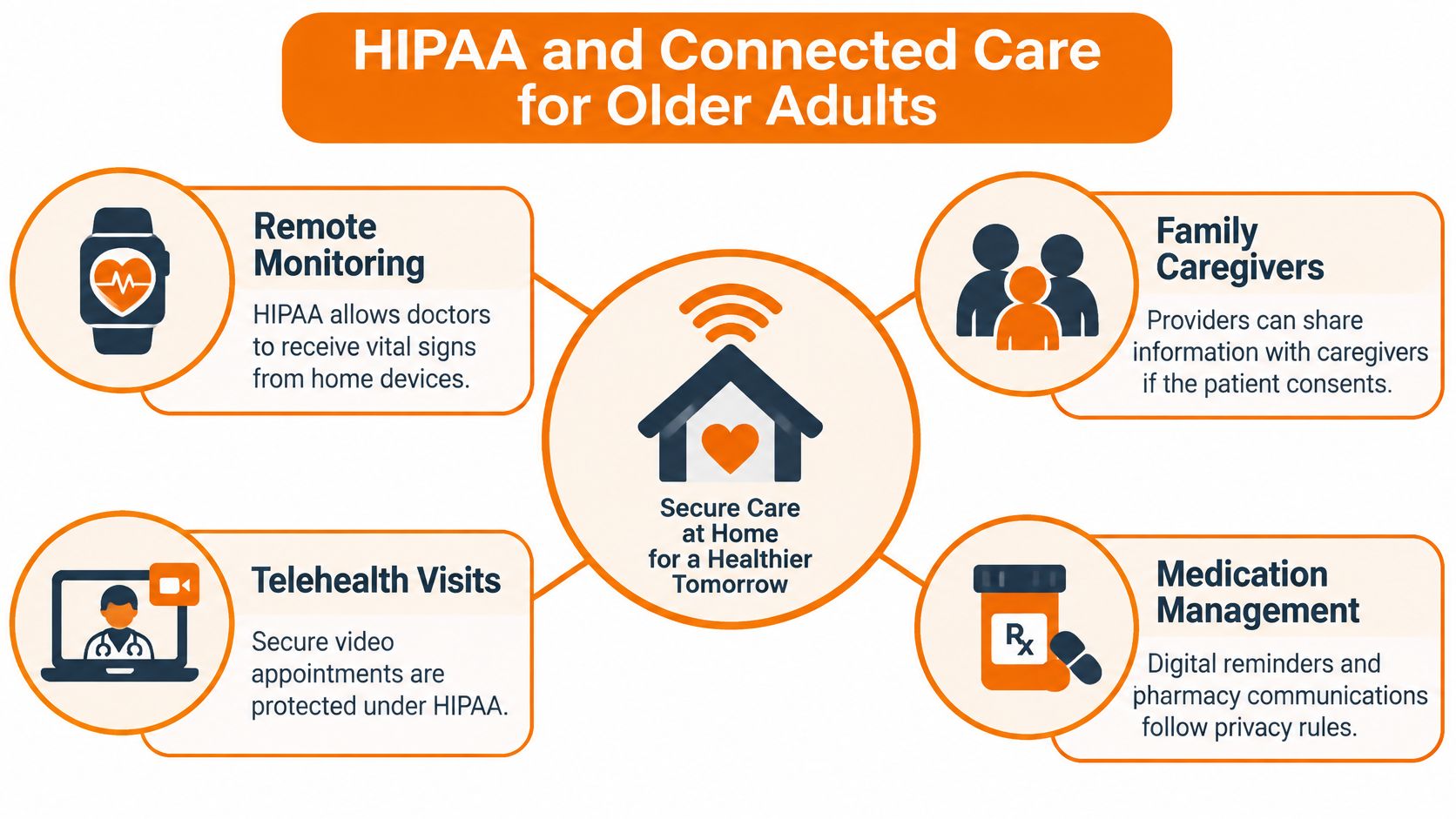
Permission Comes in Different Shapes
Families often blend a few different ideas together. It helps to separate them:
- Informal caregiver updates: A patient agrees, or doesn't object, to relevant information being shared with someone involved in care.
- Patient authorization: The patient directs access in a more formal way.
- Personal representative status: A legally recognized representative generally receives the patient's access rights for matters covered by that representation.
- State-law authority: Tools such as a healthcare power of attorney can define who may act and when.
Not every relative is automatically entitled to a complete record. At the same time, HIPAA permits many helpful updates. Knowing which category fits your family prevents frustration on all sides.
What Good Connected Care Design Looks Like
Connected care can support sleep routines, daily activity, mobility, and social connection without broadcasting everything. A narrowly scoped alert, such as a missed check-in, can prompt a warm call from a son. Role-based permissions can let a caregiver see routine updates while a clinician sees care-related details. Consent workflows can record what the older adult agreed to share.
You can explore that broader idea in this overview of connected health solutions for everyday support. The technology questions behind it are practical ones. Who can see each signal? How long is it kept? How is access revoked when roles change? How is information kept available during an outage? HIPAA gives families and providers a shared language for asking those questions early.
Practical Steps and Breach Response Basics
HHS sets out the reporting mechanics in its HHS breach reporting guidance. With that source in mind, here's a calm, practical way organizations often organize the work before anything goes wrong.
First, they map where health information is created, received, maintained, processed, or transmitted. That includes health signals, care notes, alerts, and caregiver messages. Next, they define roles and use least privilege, so patients, caregivers, clinicians, and administrators each see only what fits their role. Then they document safeguards, train their teams, review vendors, log access and exports, and test backup and recovery procedures.
Technical details support those habits. Required controls include unique user identification, emergency-access procedures, audit controls, and transmission security. Automatic logoff and encryption are addressable specifications, meaning an organization implements them when reasonable and appropriate or documents an equivalent alternative. Audit controls record and examine activity in systems that use ePHI, which helps spot inappropriate access.
When Something Goes Wrong
The Breach Notification Rule applies to breaches of unsecured PHI. For a breach affecting 500 or more individuals, the covered entity must notify the Secretary of HHS without unreasonable delay and no later than 60 calendar days after discovering the breach. Smaller breaches are generally reported annually. A business associate must notify the covered entity without unreasonable delay and no later than 60 calendar days after discovery.
Quick HIPAA Response Checklist
| Step | What to do | Timing |
|---|---|---|
| Detect | Use logs and alerts to identify possible inappropriate access | Ongoing |
| Assess | Determine discovery date, affected individuals, and whether PHI was unsecured | Promptly after detection |
| Notify | Business associate notifies the covered entity | No later than 60 calendar days after discovery |
| Report large breaches | Covered entity notifies HHS and affected individuals for breaches of 500 or more | Without unreasonable delay, within 60 calendar days |
Families benefit from understanding these steps too, which is why resources on connected care for families can be a helpful companion. Clear logs and tested escalation procedures aren't just technical niceties. They're how an organization can answer basic questions and on time.
Frequently Asked Questions
HHS provides contract details in its HHS sample business associate agreement provisions, which is a handy reference for the first question below. These answers stick to the facts in that kind of federal guidance.
Does Signing a BAA Make a Product HIPAA Compliant
No. A BAA must define permitted uses and disclosures, prohibit uses outside the contract or law, and require appropriate safeguards. It must also address reporting impermissible uses and breaches, subcontractors accepting the same restrictions, and return or destruction of PHI at contract end when feasible. The agreement documents responsibilities. The daily safeguards still have to happen.
Can Family Members Automatically Receive Health Updates
Not automatically. HIPAA permits many disclosures to people involved in care when the patient agrees or doesn't object, and a personal representative has broader rights. But HIPAA doesn't generally require providers to proactively share information unless the caregiver has qualifying legal authority or the patient directs access. A friendly conversation about preferences, while everyone is calm and healthy, goes a long way.
Does HIPAA Apply to General Wellness Apps
It depends on role and data flow. An app you use on your own to enjoy walking, sleep routines, or balance exercises isn't covered because the topic is wellness. If a vendor handles PHI on behalf of a covered entity, business associate obligations may apply. Always ask who the vendor is working for and what information it receives.
What Does the 60-Day Clock Really Mean
For large breaches of unsecured PHI, notification to HHS is due without unreasonable delay and within 60 calendar days of discovery, as covered above. In practice, that deadline is why organizations keep centralized logs and tested response plans. They need to know when discovery happened and who was affected.
If you're exploring ways to support independence at home while keeping family members thoughtfully in the loop, Rx360 brings health insights, smart technology, and connected care together in one simple circle of support for older adults and the people who care about them. Visit the site to see how timely wellness updates and clear, privacy-minded design can help your family stay connected with confidence.
Lower-Risk Medication Plan Checklist
Below is a practical checklist and step plan you can implement into your daily life:
-
List all medications
Include prescriptions, over-the-counter drugs, supplements, sleep aids, creams, patches, eye drops, and inhalers.
-
Mark fall-risk drugs
Flag medicines that cause dizziness, sleepiness, confusion, blurred vision, low blood pressure, or low blood sugar.
-
Ask for a medication review
Bring the list to a pharmacist or prescriber.
-
Review after any warning sign
Request a new medication check after a fall, near-fall, new prescription, dose change, dizziness, or confusion.