You may be in this moment right now. Your mom forgot a bill she never used to miss. Your dad had a minor fall and brushed it off. Or you visited for the weekend and noticed three things at once: the fridge was sparse, medications were scattered, and something about the routine no longer felt steady.
That uneasy feeling matters. Most families don't begin looking into elderly care management because of one dramatic event. They begin because small signs start to form a pattern. What used to feel manageable now feels fragile.
The good news is that care management isn't about taking control away from an older adult. It's about building a support system that keeps life safer, more organized, and more independent for as long as possible. When families understand the process, decisions become less reactive and a lot less frightening.
Table of Contents
- What Is Elderly Care Management Really
- The Four Pillars of Effective Care Management
- Assembling Your Circle of Care
- How to Implement and Evaluate a Care Plan
- Using Technology to Support Independence
- Navigating Common Challenges and Solutions
- Your Next Steps on the Care Journey
What Is Elderly Care Management Really
A lot of people assume elderly care management means hiring someone only after a crisis. In practice, it usually starts earlier, at the point when a family realizes that “checking in more often” isn't a full plan.
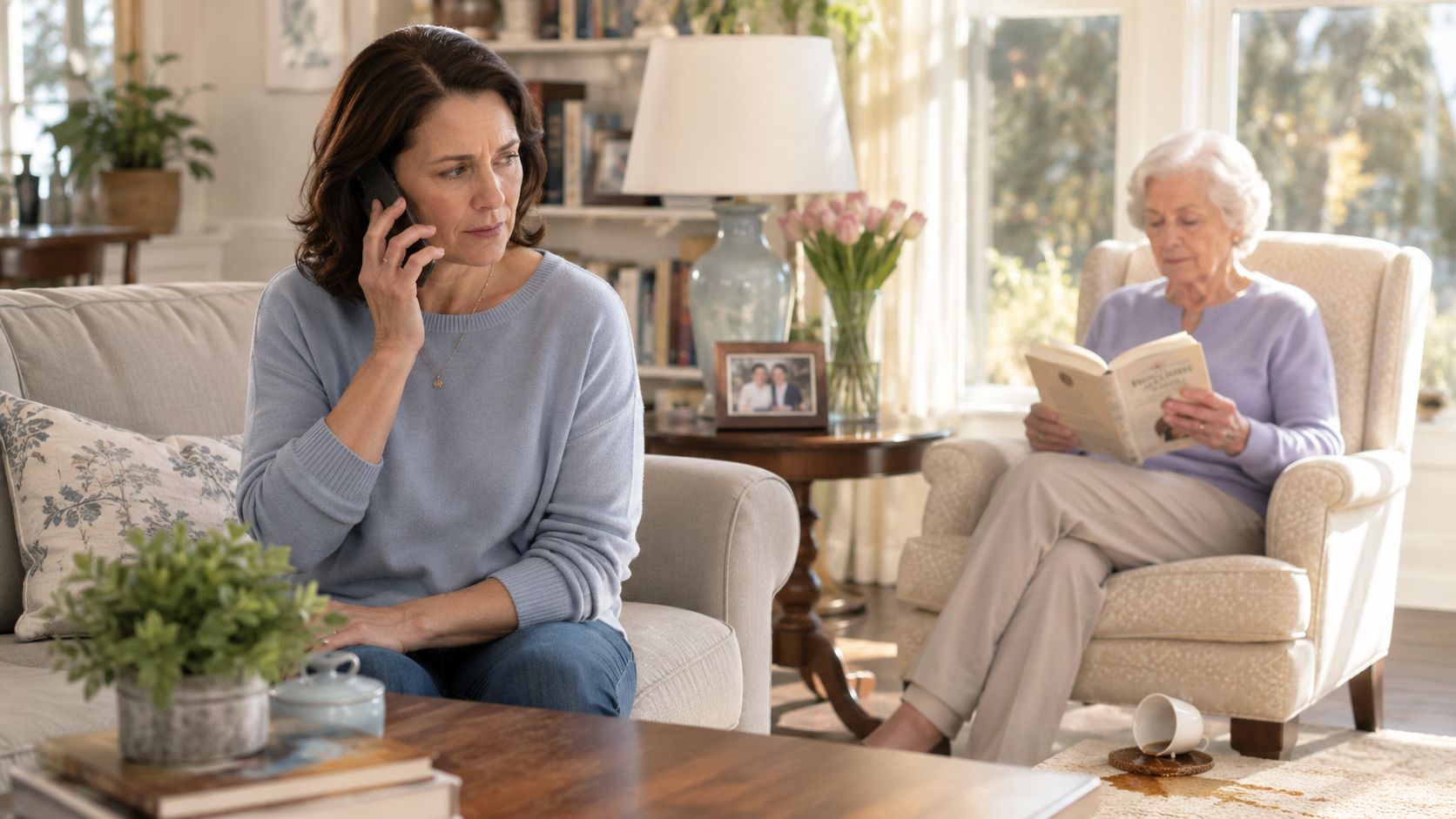
Think of it as creating a personalized safety net. Not a single service. Not a one-time appointment. A process. Someone needs to understand the older adult's health, home setup, daily habits, goals, family dynamics, and risks. Then those pieces need to be organized into something usable.
One family might need help tracking medical appointments and rides. Another may need home safety changes, medication organization, and better communication among siblings. A third may be dealing with memory changes, caregiver stress, and disagreement about what comes next. Elderly care management pulls those moving parts into one coordinated picture.
Why families are paying more attention now
This isn't a niche issue. The need is growing across healthcare systems and households. The global elderly care market was valued at $53.29 billion in 2025 and is projected to reach $114.57 billion by 2034, with a CAGR of 8.93%, according to Fortune Business Insights' elderly care market analysis. That projection reflects a broad shift: more families are trying to support aging relatives while balancing work, distance, and complex health needs.
Practical rule: If your family is relying on memory, informal texts, and last-minute decisions, you don't yet have a care system. You have good intentions.
At its best, elderly care management helps an older adult stay the main decision-maker for as long as possible. It supports independence by adding structure. The goal isn't to make life feel clinical. The goal is to make daily life feel steadier.
The Four Pillars of Effective Care Management
A good way to understand elderly care management is to compare it to building a house. If one part is missing, the whole structure becomes harder to live in.
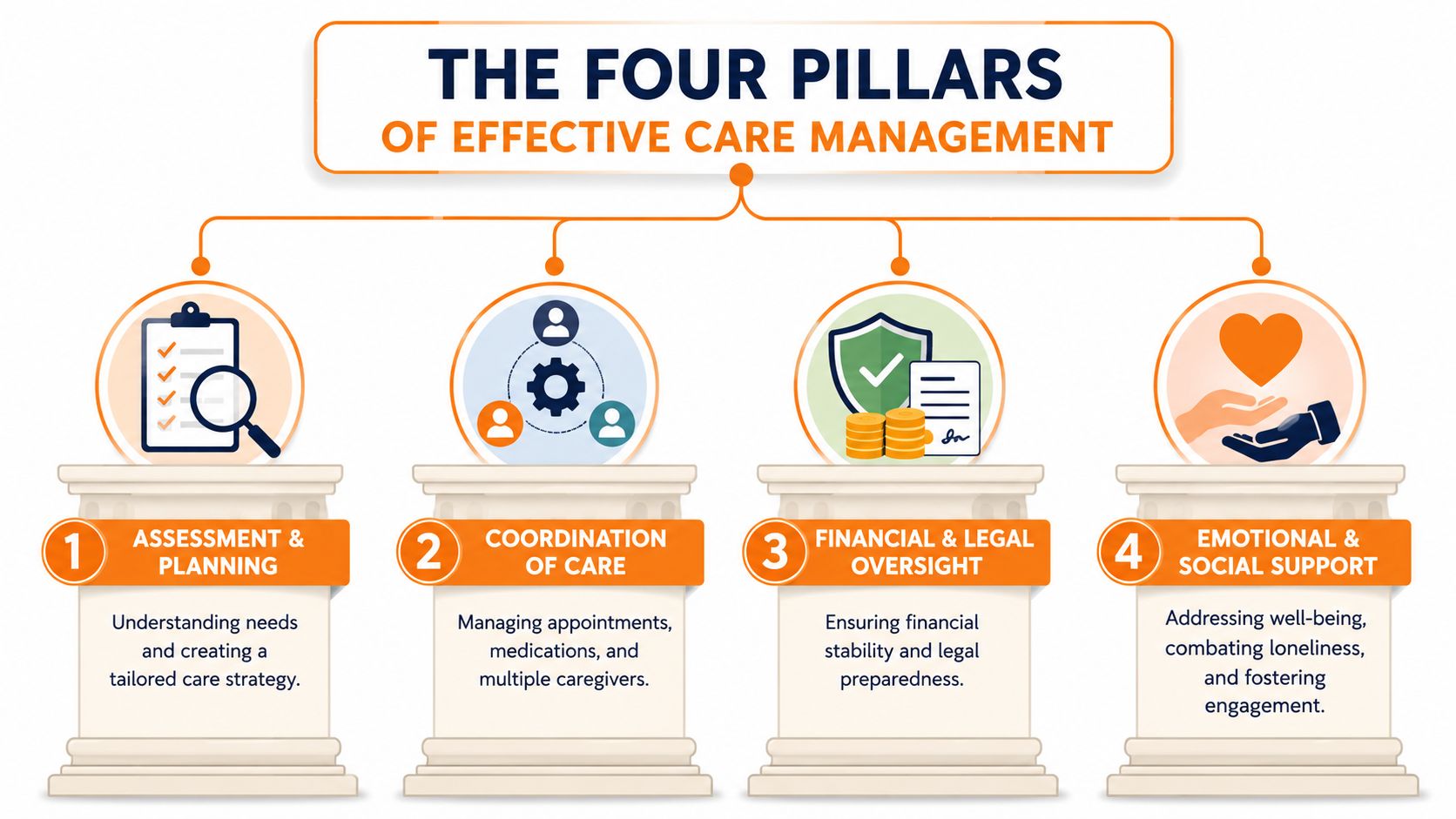
Assessment and planning
This is the blueprint. Before anyone arranges services or buys equipment, they need to know what problem they're solving.
That means looking at daily functioning, memory, mood, mobility, medications, nutrition, home safety, social connection, and personal preferences. Some older adults need help remembering appointments. Others manage fine medically but are isolated and anxious. A useful plan starts with the actual person, not with a generic checklist.
A strong plan also respects values. If an older adult says, “I want to stay in my own home and keep going to church,” that belongs in the plan just as much as a medication list does.
Coordination of care
This is the general contractor role. Even a smart plan falls apart if no one is coordinating the work.
Coordination often includes:
- Medical logistics: Scheduling primary care and specialist visits, keeping medication lists current, and making sure one clinician's recommendation doesn't conflict with another's.
- Daily support: Arranging transportation, meal help, in-home assistance, or therapy visits.
- Family communication: Making sure the right people get updates without turning every issue into a chaotic group text.
Many families get stuck here. They know what needs to happen, but no one has time to connect the pieces.
Monitoring and reassessment
These are the inspections. A care plan that worked six months ago may not fit now.
Mobility can change. Appetite can change. A new medication can affect balance or energy. A caregiver can gradually burn out. Effective elderly care management includes regular check-ins so small issues are caught before they become emergencies.
Good care plans are living documents. If nothing about the plan changes while the person's life is changing, the plan is already out of date.
Legal and financial navigation
These are the permits and financing. Families often postpone this part because it feels uncomfortable, but delaying it creates bigger problems later.
This pillar usually includes questions like:
| Area | What families need to clarify |
|---|---|
| Decision-making | Who can speak for the older adult if they can't speak for themselves? |
| Healthcare wishes | Is there a healthcare directive or similar document? |
| Payment planning | How will home support, transportation, or added services be paid for? |
| Record access | Who has access to insurance details, medication lists, and key documents? |
Some families would add a fifth pillar, emotional support. That's fair. In practice, emotional and social well-being should run through every pillar. A care plan that keeps someone physically safe but leaves them lonely, confused, or shut out of decisions isn't complete.
Assembling Your Circle of Care
Elderly care management works best when everyone knows their role. Confusion usually doesn't come from lack of love. It comes from overlap. One daughter thinks she's handling doctors. A son assumes someone else is reviewing medications. The primary care office believes the family understands the plan. Nobody notices the gaps until something slips.
Keep the older adult at the center
The older adult is not a bystander in this process. They're the center of it.
That sounds obvious, but families often drift into talking about a loved one instead of with them. Even when health concerns are real, the person should still be included in choices as fully as their condition allows. Ask what matters to them. Ask what help feels acceptable. Ask what they want to keep doing on their own.
That shift changes the tone. Instead of “We need to take over,” the conversation becomes “How do we support you safely?”
Know who handles what
Family caregivers carry a huge amount of the day-to-day load. In this review on care for older adults, United Nations data noted that 727 million people worldwide were age 65 and above in 2020, and among 25 OECD countries, approximately one in eight people aged 50 and over provides informal care. The same review states that the 2020 AARP Family Caregiving Report documented an increase in family caregivers from 23% in 2015 to 31% in 2020. Those numbers help explain why so many families feel stretched. Informal care isn't a side issue. It's central.
Professional support can lighten and organize that load. A geriatric care manager, for example, typically serves as an advocate, organizer, and guide. According to Welkin Health's overview of geriatric care management, the benchmark includes a bachelor's degree in a healthcare field, a preferred master's in Gerontology, and a minimum of 120 hours of post-graduate or post-specialty training in geriatric care management domains. That training supports tasks like in-home assessments, care plan development, service coordination, and accompanying patients to appointments.
Here is a simple view of the care circle:
| Team Member | Primary Role | Key Responsibilities |
|---|---|---|
| Older adult | Central decision-maker | Shares goals, preferences, concerns, and consent |
| Family caregiver | Daily support and observation | Notices changes, helps with logistics, communicates concerns |
| Primary care clinician | Medical oversight | Reviews conditions, medications, treatment priorities |
| Specialists | Focused medical input | Address condition-specific issues such as cardiology or neurology needs |
| Geriatric care manager | Coordination and advocacy | Assesses needs, organizes services, helps align the full plan |
| Home health aide or service provider | Hands-on support | Assists with personal care, routines, mobility, or household help |
A useful test: If you're not sure whom to call when a new problem appears, roles aren't clear enough yet.
Families often ask whether a geriatric care manager replaces the doctor. No. Medical advice belongs to clinicians. The care manager's strength is making the plan workable in real life. They connect recommendations to schedules, transportation, home routines, family capacity, and follow-through.
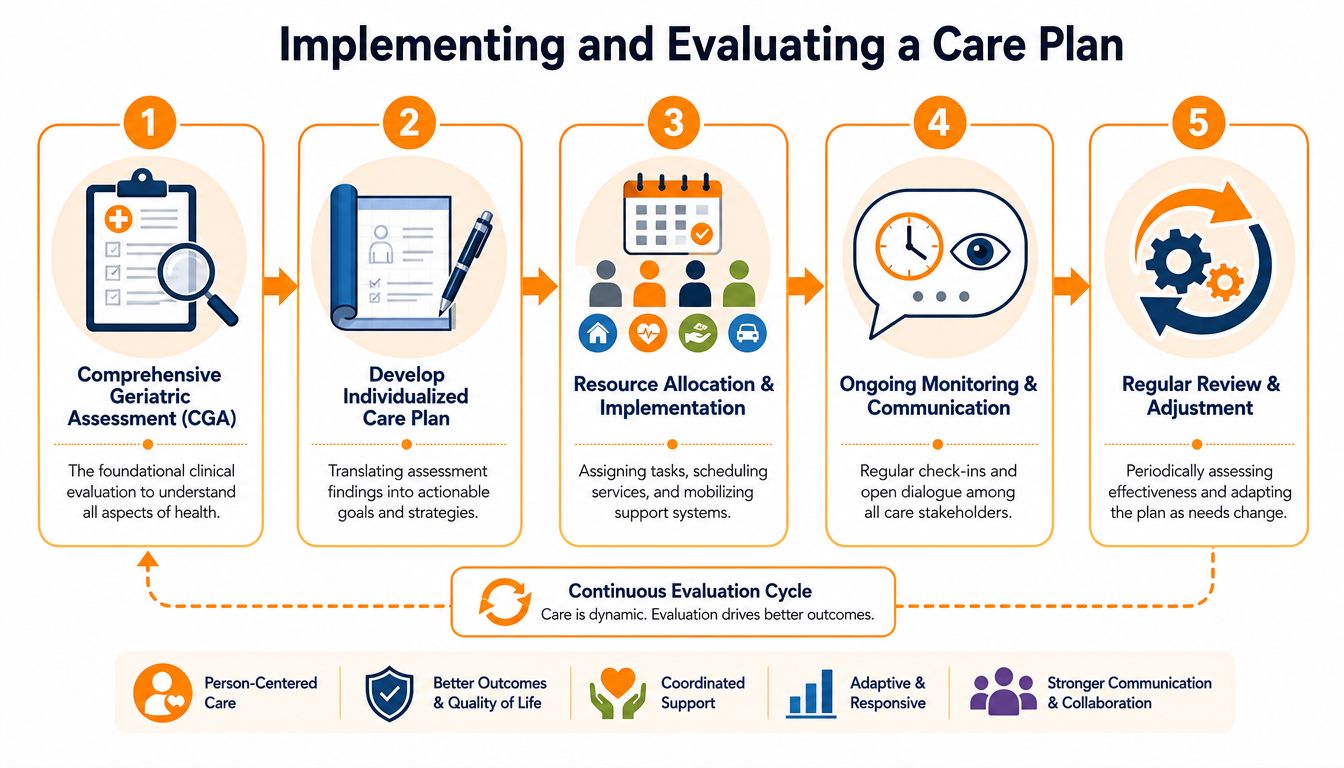
How to Implement and Evaluate a Care Plan
A care plan shouldn't live in a binder and gather dust. It needs to guide what happens this week, this month, and when something changes.
Start with a real baseline
The most solid starting point is a Thorough Geriatric Assessment, often called a CGA. This is more than a routine office visit. According to the National Care Management Authority's description of geriatric care management, the CGA includes structured screening for cognitive function using MoCA or MMSE, depression using the Geriatric Depression Scale-15, and fall risk using the Timed Up and Go test, along with full medication reconciliation. When documented in the EHR, that information can trigger referrals and timed reassessments if frailty concerns are high.
Families sometimes hear terms like MoCA or Timed Up and Go and feel intimidated. Don't let the names throw you. These are tools that help the team answer practical questions. Is memory changing? Is mood affecting daily life? Is walking becoming less steady? Are medications creating problems?
For families using digital workflows, it's helpful to understand how structured inputs support decisions. Articles on clinical decision support tools in coordinated care can make that connection easier to grasp.
Turn findings into an active plan
Once the assessment is done, convert findings into actions people can follow.
A workable care plan usually includes:
- A priority list: Focus first on the issues most likely to affect safety or daily function.
- Named responsibilities: Decide who schedules appointments, who checks the medication list, and who follows up on referrals.
- Clear goals: “Walk safely from bedroom to bathroom with support strategies in place” is stronger than “improve mobility.”
- Review dates: Put reassessment on the calendar before you think you need it.
This is what that can look like in plain language:
- Mobility goal: Attend physical therapy as recommended and remove tripping hazards at home.
- Medication goal: Reconcile all prescriptions, over-the-counter products, and supplements in one updated list.
- Communication goal: Hold one weekly family check-in so concerns don't build in silence.
A care plan works when it answers four questions: What are we doing, who is doing it, when will we review it, and how will we know it's helping?
If the plan isn't being followed, don't assume the family has failed. Usually the plan is too vague, too ambitious, or not matched to the older adult's real routine. Good elderly care management includes adjustment, not blame.
Using Technology to Support Independence
Technology often gets introduced at exactly the wrong moment. A family is worried. An older adult already feels watched or overwhelmed. Someone buys a device, plugs it in, and expects instant comfort. That rarely works.
The better approach is to treat technology as part of the care foundation. Not as surveillance. Not as a gadget collection. As a simple bridge for communication, reassurance, and everyday independence.

Use technology as a bridge, not a burden
The most helpful tools usually fall into three categories.
First, there are communication tools that help family members and care partners stay aligned. These reduce the “I thought you were handling it” problem. A shared update system can keep everyone aware of appointments, changes in routine, or concerns that need follow-up.
Second, there are support tools for routines, such as medication reminders, calendars, or easy-to-read prompts. These can protect independence because they let an older adult do more without relying on another person to call every time.
Third, there are wellness and safety tools that notice patterns. The point isn't to flood families with alerts. The point is to make subtle changes visible early enough to respond calmly.
For a broader look at this model, connected health solutions for older adults and caregivers show how communication, wellness insight, and coordination can work together.
How to introduce tools without creating anxiety
Many families require substantial assistance, particularly as this report on older adults in underserved communities highlights digital literacy and technology adoption anxiety as important barriers, and practical guidance often skips the “how-to” that would help older adults build confidence.
That insight matters. Resistance isn't always about disliking technology. Often it's about fear of doing something wrong, fear of losing privacy, or fear that technology signals a loss of competence.
Try this approach instead:
- Start with one problem: Choose the tool based on a real frustration, such as missed medications or unclear family communication.
- Introduce one feature at a time: Don't teach every screen, setting, and notification on day one.
- Use familiar language: Say “this helps us stay in touch” instead of “this monitors compliance.”
- Practice side by side: Let the older adult press the buttons. Confidence grows through use, not observation.
- Preserve choice: Ask what alerts, reminders, or updates feel comfortable.
“The best technology for aging in place is the one the person will actually use without feeling managed.”
When technology is introduced gently and tied to the older adult's own goals, it often stops feeling like an intrusion. It starts to feel like support.
Navigating Common Challenges and Solutions
Even well-planned elderly care management runs into friction. Families disagree. Older adults push back. Budgets tighten. Caregivers get tired. None of that means the process is failing. It means real people are involved.

When family members disagree
Disagreement usually hides a deeper issue. One sibling may be focused on safety. Another may be protecting dignity. Another may feel guilty for living far away.
Use one shared list of concerns and one shared list of priorities. Keep the discussion tied to observable facts and the older adult's stated wishes. If conflict keeps circling, bring in a neutral professional such as a care manager, social worker, or clinician who can help ground the conversation.
When an older adult resists help
Resistance often softens when help is framed as a way to keep control, not lose it.
Instead of saying, “You can't manage this alone,” try, “What would make it easier for you to stay in your home safely?” That language respects autonomy. It also opens the door to partial solutions. A person may reject “care” but accept grocery help, ride support, or a medication reminder.
For safety concerns related to mobility, families often benefit from reviewing practical guidance around fall risk assessment tools for older adults. It helps turn a vague worry into a clearer conversation.
When money and energy are both tight
Not every family can hire extensive private support. Start by identifying what only a professional must do and what can be simplified, shared, or reorganized.
Try these problem-solving moves:
- Reduce duplication: If three relatives are making separate calls to providers, assign one point person.
- Use community resources: Local aging services, meal programs, transportation options, and caregiver support groups can fill important gaps.
- Schedule respite deliberately: Even a short break for the main caregiver can prevent resentment and exhaustion from building.
- Simplify paperwork: Keep medications, clinician contacts, insurance details, and legal documents in one accessible place.
Caregiver burnout deserves the same seriousness as any other risk in the system. If the family caregiver collapses, the care plan collapses with them.
Your Next Steps on the Care Journey
Elderly care management is not one decision. It's a series of steady decisions that create a safer, more connected life around an older adult's preferences. The strongest plans don't try to control every future problem. They make the next problem easier to handle.
If you're feeling behind, you're probably not. Most families begin after they've already been carrying too much for too long. Starting now still counts as early action.
Use this checklist for the coming week:
- Start one calm conversation: Ask your loved one what feels harder lately and what kind of help would feel acceptable.
- Gather core documents: Pull together medication lists, clinician names, insurance information, and healthcare decision documents.
- Write down warning signs: Note recent falls, missed appointments, memory concerns, appetite changes, or trouble managing the home.
- Contact local aging resources: Reach out to your Area Agency on Aging or similar community resource hub.
- Clarify roles: Decide who will be the family point person for medical updates and scheduling.
- Explore simple technology: Look for tools that improve connection and routine support without creating complexity.
- Book an assessment if needed: If concerns are growing, ask about a formal geriatric assessment or care management consultation.
Small steps matter because they turn worry into structure. Structure creates relief.
Rx360 helps independent older adults stay connected, informed, and supported without adding unnecessary complexity. If you're looking for a simpler way to strengthen communication, spot meaningful wellness changes, and support aging in place with confidence, explore Rx360's connected care platform.
Lower-Risk Medication Plan Checklist
Below is a practical checklist and step plan you can implement into your daily life:
-
List all medications
Include prescriptions, over-the-counter drugs, supplements, sleep aids, creams, patches, eye drops, and inhalers.
-
Mark fall-risk drugs
Flag medicines that cause dizziness, sleepiness, confusion, blurred vision, low blood pressure, or low blood sugar.
-
Ask for a medication review
Bring the list to a pharmacist or prescriber.
-
Review after any warning sign
Request a new medication check after a fall, near-fall, new prescription, dose change, dizziness, or confusion.