
Your phone rings while you're clearing the dinner dishes. The caller says there's a problem with an account, but something feels off. Meanwhile, an insurance statement sits unopened beside the mail. You don't need another worry. You need a manageable way to check what matters, keep control, and ask someone you trust for help when you want it.
Table of Contents
- Why This Conversation Matters Now
- A Simple Weekly and Monthly Routine
- Locking Down the Accounts That Matter Most
- The Medicare Paperwork Most People Skip
- Choosing and Briefing a Trusted Person
- A Calm Response When Something Feels Off
- Your Steady Start This Week
Why This Conversation Matters Now
The FTC's Consumer Sentinel Network report recorded more than 6.5 million consumer reports in 2024, including over 1.1 million identity-theft reports and more than 2.6 million fraud reports. People aged 60 and older filed roughly 421,000 fraud reports, reporting nearly $2.4 billion in losses, according to that same report.
Those are substantial figures, but they aren't a prediction about what will happen to you. They describe reported experiences across many people and circumstances. The FTC also cautions that most fraud incidents go unreported, so these totals aren't a complete count.
Notice the mismatch without assuming the worst
An unfamiliar charge deserves a closer look. So does a password-reset message you didn't request or an insurance statement listing something you don't recognize. None of those details, by itself, tells you exactly what happened.
The useful response is to separate something unfamiliar from something confirmed as unauthorized. That leaves room to investigate an ordinary mistake without ignoring a genuine problem.
A practical starting point: You don't have to recognize every scam. You need a reliable way to check an unexpected request before acting on it.
Identity theft protection seniors can use comfortably shouldn't depend on constant vigilance. A workable approach combines account safeguards, paperwork checks, and a trusted person who understands how you'd like to be supported.
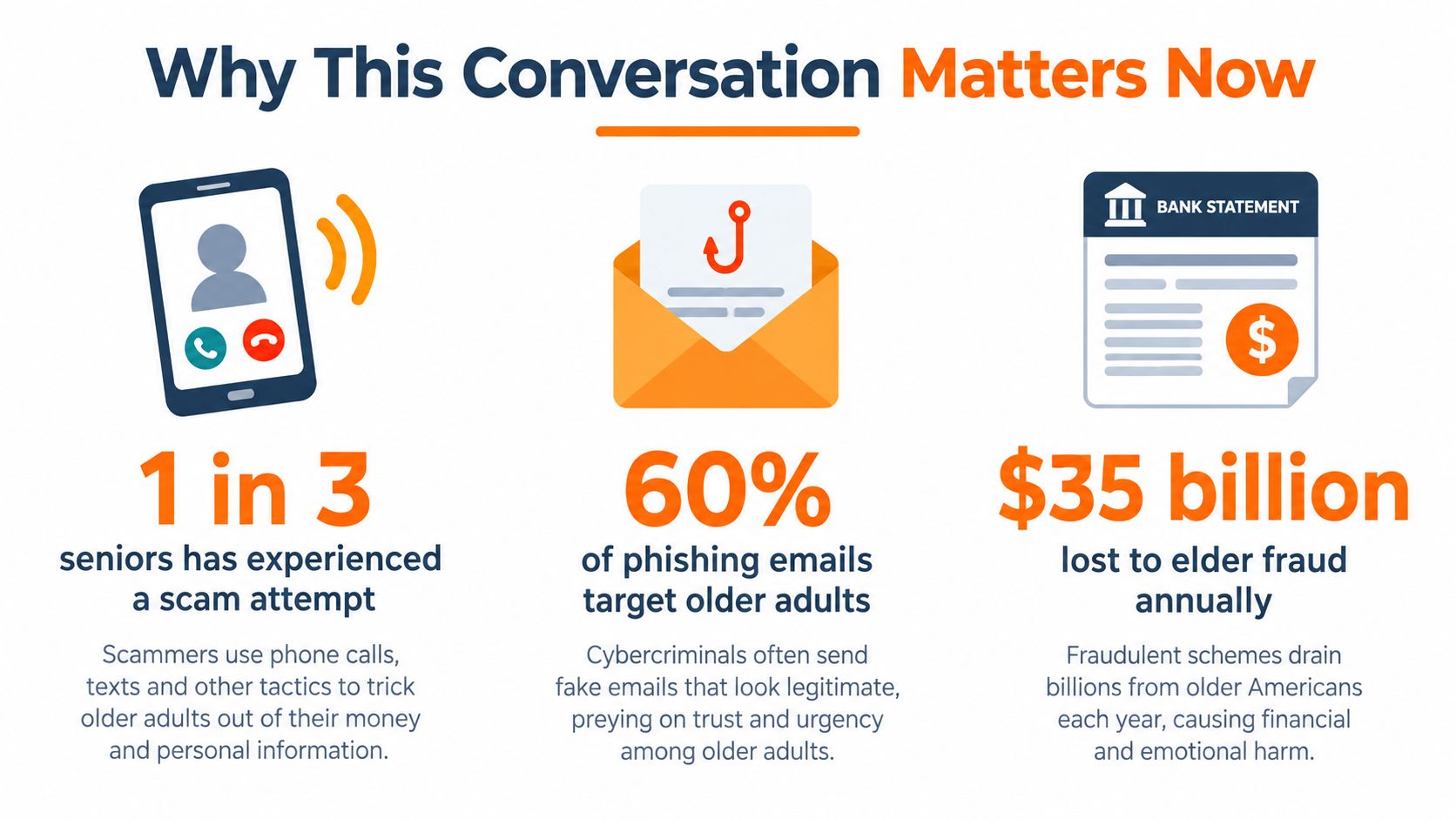
For statistical evidence, use the FTC figures cited above rather than the illustrative figures in this graphic.
Keep independence at the center
Protection doesn't have to mean handing over your finances or letting someone inspect every purchase. You can choose which records to review together, which alerts deserve attention, and when another person should get involved.
That distinction matters. The aim is a routine you can live with, not a second job checking your phone.
A Simple Weekly and Monthly Routine
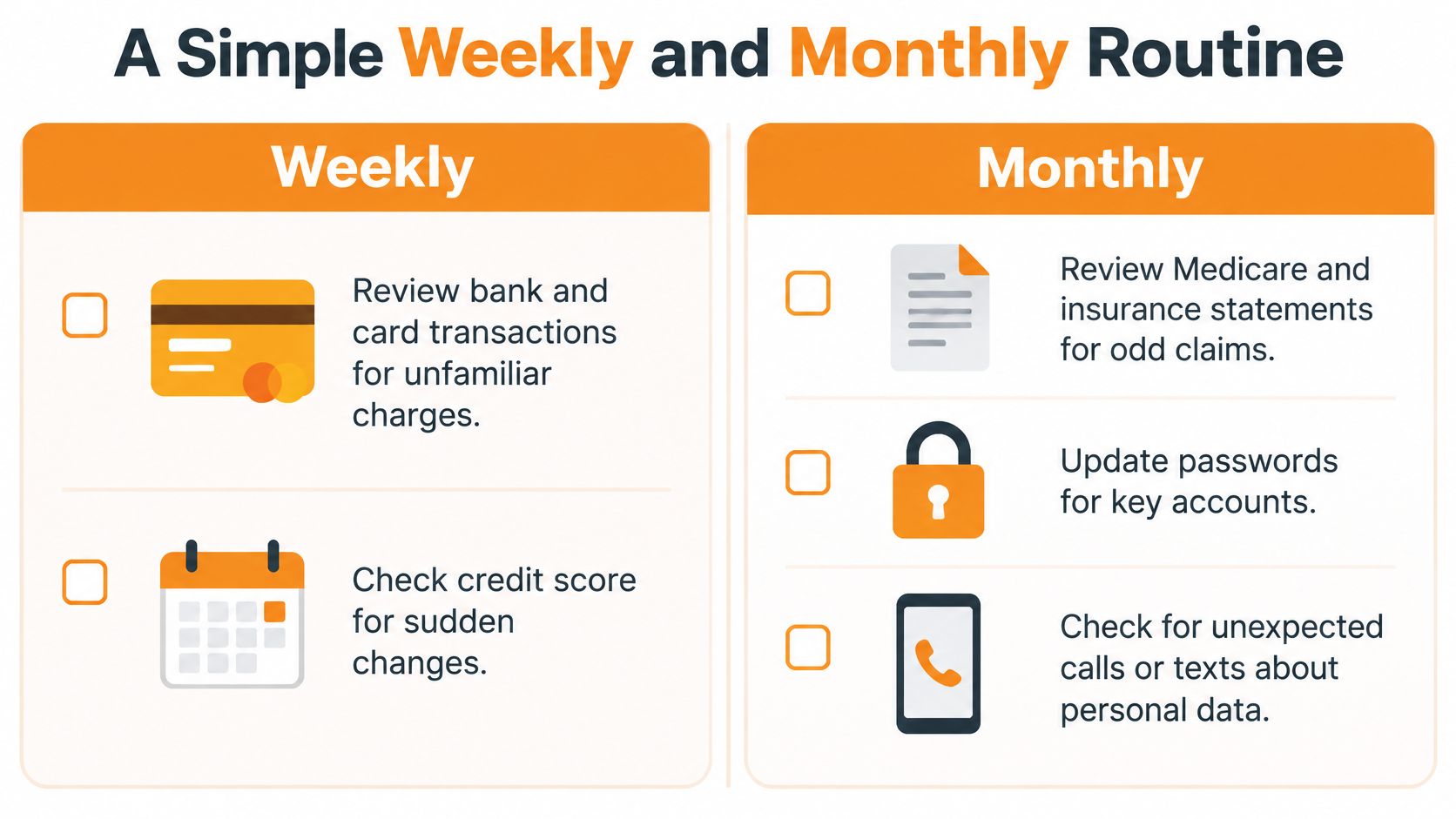
The FTC's older-consumer report describes an approach built around detecting unusual activity, verifying it independently, and responding promptly. A weekly and monthly schedule is a practical way to organize those tasks, not an official deadline.
Choose a familiar moment, perhaps coffee after breakfast or the afternoon you sort the mail. Keep your statements and a short question list together so you don't have to start from scratch.
A weekly glance at money and messages
Open your bank and card accounts through the access method you normally use. Look for activity you don't recognize and security messages about changes you didn't make.
- Check transactions: Mark unfamiliar payments for follow-up rather than deciding immediately that they're fraudulent.
- Notice account changes: Give attention to unexpected password resets, new payees, changed contact details, or altered authentication settings.
- Keep questions together: Record the account, date, and what looks wrong. Leave passwords and full account numbers out of that note.
A trusted person can sit alongside you if you want another pair of eyes. They don't need to take over the account to help you read a statement.
A monthly paperwork appointment
Set aside your available bank statements, insurance documents, and Medicare notices for a more complete review. The care-record check below gives those insurance papers their own place in the routine instead of leaving them at the bottom of the pile.
Keep a small follow-up record:
| What needs checking | What to record |
|---|---|
| An unfamiliar transaction | Date, description, and amount shown |
| An unexplained account change | What changed and when you noticed |
| A paperwork question | Document date and the item in question |
During a seasonal account review, check that your recovery details still belong to you and that you can use your chosen sign-in method. Review password security rather than treating a monthly calendar reminder as a requirement to replace every password.
The schedule is there to reduce unfinished questions. It shouldn't require you to spend every day looking for trouble.
Locking Down the Accounts That Matter Most
NIST's digital-identity guidelines distinguish proving an identity, authenticating someone signing in, and recovering access. The Consumer Financial Protection Bureau's freeze and fraud-alert guidance addresses a different task: limiting opportunities to open new credit accounts.
Those are separate protections. Monitoring can tell you something changed, but it doesn't replace stronger sign-in settings or restrictions on new credit.
Protect access before adding more alerts
Start with email, banking, credit cards, government benefits, and healthcare portals. Use unique passwords stored in a password manager, then review the authentication options each service supports.
A hardware security key offers a phishing-resistant option where supported. An authenticator app may be more manageable for someone who finds a physical key difficult to use. Text-message codes provide another factor, but number takeover and social engineering remain concerns, as described in the NIST guidance.
Usability matters here. A safeguard you can operate independently, with a tested recovery method, is more practical than a complicated setup you can't reliably access.
For broader background on technology and shared support, the overview of connected health solutions offers related reading. Account-security settings still need to be checked with each service.
Understand the credit choice
| Tool | What it does | The trade-off |
|---|---|---|
| Credit freeze | Restricts access to a credit report and can prevent most new credit-based accounts | You'll need to lift it when appropriate for a legitimate application |
| Fraud alert | Requires businesses to take reasonable steps to verify identity before extending credit | Protection depends on the creditor carrying out that verification |
A freeze is free, remains until lifted, and must be placed separately with Equifax, Experian, and TransUnion. An initial fraud alert is also free, lasts one year, and requires contacting only one nationwide bureau, which must notify the others, under the CFPB guidance linked above.
The decision comes down to convenience versus restriction. A freeze places a stronger barrier in the way of new credit applications; an alert preserves access while requiring identity checks.
A freeze addresses new credit. It isn't a substitute for protecting the accounts you already use.
Keep the recovery instructions for these safeguards somewhere you can find them. Security needs an exit route for you, not just a barrier for someone else.
The Medicare Paperwork Most People Skip
The FTC's guidance on Medicare fraud and medical identity theft tells older adults to check notices for accurate services, prescriptions, dates, and duplicate charges. It also directs people to IdentityTheft.gov for suspected medical identity theft, which can affect records and coverage as well as finances.
That makes insurance paperwork part of identity protection, not merely bill paying. An unexplained claim can deserve attention even when you haven't received a bill or lost money.

Match the document to what you remember
During your monthly care-record check, compare available Medicare Summary Notices and insurer statements with your calendar, receipts, or other paperwork. You're checking administrative accuracy, not interpreting medical information.
- Services and prescriptions: Do you recognize the listed items as yours?
- Dates: Do they match your records?
- Repeated entries: Does something appear to have been charged more than once?
- Provider names: Can you connect an unfamiliar name with a visit or service you recognize?
If a notice hasn't arrived, there's nothing to force into that month's review. Check the documents that are available and leave a reminder for anything you're waiting on.
The broader discussion of preventive care for seniors is related background reading. This paperwork routine has a narrower purpose: checking whether documents accurately reflect your activity.
A question isn't the same as confirmed theft
An unfamiliar entry is a reason to ask for an explanation. It isn't enough, on its own, to decide that someone used your identity.
A practical starting point is the provider's billing office, using contact details obtained independently. Ask what the entry represents and whether the office can explain or correct it. Write down the answer and any reference number.
If the explanation doesn't resolve the concern, contact the health plan or Medicare through established channels. Senior Medicare Patrol is another escalation resource identified in the guidance.
Keep the question specific: “I don't recognize this service on this date. Can you help me check whether this entry belongs to me?”
For suspected identity misuse, use the FTC recovery route described above. If information in a provider's records needs correction, ask that organization about its records-correction process rather than trying to interpret the entry yourself.
Choosing and Briefing a Trusted Person
The CFPB's guidance for authorized representatives explains that being a relative doesn't automatically give someone authority over another person's credit file. For everyday account help, the NIST guidance discussed earlier also supports separate access, limited permissions, and clear authorization boundaries.
A trusted person's role can be modest. They might help read confusing paperwork, sit with you during a verification call, or receive an agreed notification. None of that requires giving them every password.
Agree on the boundaries while things are quiet
Choose someone who can listen without rushing you. Then discuss the difference between helping you understand a situation and making decisions on your behalf.
A starter script could be:
I'd like you to be my second pair of eyes if an account message worries me. Please help me check it, but don't change settings or contact anyone on my behalf unless we've agreed you can.
This is a suggested conversation, not a quotation from an outside source. You can make it more specific by agreeing on the following:
- What's shared: Selected notices or questions, rather than unrestricted access.
- What stays private: Passwords, security codes, and unrelated spending details.
- What happens if you're unavailable: Who may be contacted and what authority they have.
Where a service offers delegated access, use its permission controls instead of sharing a login. The overview of elderly care management provides related reading about organizing support.
Formal authority is a separate matter
Beginning September 21, 2018, an authorized representative could request a free security freeze for a qualifying protected consumer with each of the three nationwide credit-reporting agencies, with proof such as a court order or valid power of attorney, under the CFPB guidance linked above.
The protected-consumer definition includes an incapacitated person or someone with an appointed guardian or conservator. Older age alone doesn't establish that status, and an agency may require documentation.
Support and legal authority aren't interchangeable. Keeping that distinction clear protects both the older adult's choices and the person helping.
A Calm Response When Something Feels Off
As noted in the FTC older-consumer report linked earlier, roughly 74% of older adults' fraud reports in 2024 indicated no monetary loss. That report also estimated total annual harm, accounting for underreporting, at about $10.1 billion to $81.5 billion.
Those findings need to be read together. No reported financial loss doesn't establish that information stayed private, but an odd message doesn't establish that identity theft occurred either. Respond to what happened, not just how alarming the message sounds.
Match the response to the evidence
| Situation | What you know | Proportionate next action |
|---|---|---|
| Attempted scam | You received a suspicious request but didn't disclose information or authorize anything | Stop engaging, retain relevant evidence, and block or report the contact |
| Exposed information | You shared a password, account detail, or identifying information | Secure the affected access and consider the credit safeguards described earlier |
| Confirmed misuse | You found unauthorized activity or verified use of your identity | Contact the affected institution promptly and begin the relevant reporting and recovery process |
These are categories, not inevitable stages. An attempted scam doesn't automatically lead to exposure, and exposure doesn't automatically lead to confirmed misuse.
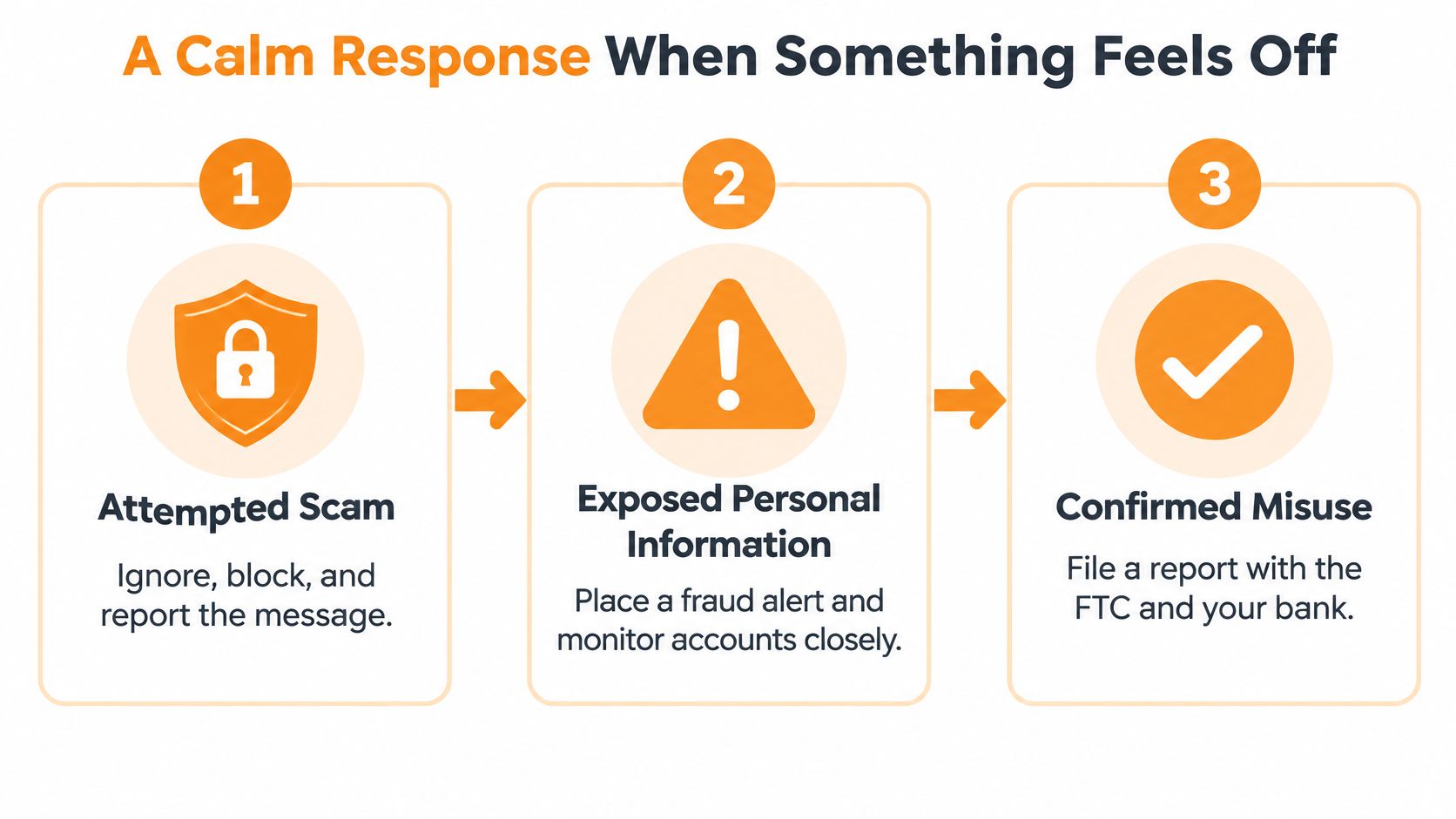
Verify calmly, then act promptly
Don't use a phone number or link supplied in the suspicious message to check whether it's genuine. Use a known number, an existing statement, or a bookmarked website instead.
Preserve relevant emails, screenshots, transaction records, and timestamps. If account access is affected, ask the institution about locking the account and replacing compromised credentials; use a device you don't suspect is compromised when making changes.
Keep a short incident record so you and your authorized supporter can track what's been done. For confirmed identity misuse, follow the FTC's IdentityTheft.gov recovery process described earlier.
A calm response isn't a delayed response. It means taking the next verified step without letting the caller or message dictate your actions.
Your Steady Start This Week
The FTC, CFPB, and NIST guidance discussed above addresses different parts of protection: noticing problems, restricting access, and responding with clear authority. Together, those sources support a layered approach rather than reliance on a single alert or service.
You don't need to complete every task today. Choose a starting point that fits what's currently unfinished.
Leave yourself with something concrete
If unread statements are your sticking point, put a care-record appointment on your calendar and gather the available paperwork in a private folder. If account access feels uncertain, begin with the security and recovery settings for an important account.
If you'd rather start with a conversation, send your trusted person a short note:
I'm organizing my account and paperwork routine. Could we talk about how you could help if I ever need another pair of eyes?
The useful outcome is specific: a scheduled review, a completed setting, or an agreed role. That's easier to maintain than a general promise to be more careful.
Choose your next action today, and give it a place in your week. You can build the rest around routines you already know and people you already trust.
Rx360 brings together Health Insights, Smart Technology, and Connected Care to help independent older adults stay connected with loved ones. Visit Rx360 to explore support for aging in place and family connection alongside your account-security and paperwork routines.
Lower-Risk Medication Plan Checklist
Below is a practical checklist and step plan you can implement into your daily life:
-
List all medications
Include prescriptions, over-the-counter drugs, supplements, sleep aids, creams, patches, eye drops, and inhalers.
-
Mark fall-risk drugs
Flag medicines that cause dizziness, sleepiness, confusion, blurred vision, low blood pressure, or low blood sugar.
-
Ask for a medication review
Bring the list to a pharmacist or prescriber.
-
Review after any warning sign
Request a new medication check after a fall, near-fall, new prescription, dose change, dizziness, or confusion.