You're trying to help someone stay safe without making them feel watched.
Maybe it's your mother, who still insists on living in the home she loves. Maybe it's your dad, who says he's “fine” but forgets to mention he felt dizzy yesterday. Maybe you live across town. Maybe you live in another state. Either way, the pattern is familiar: a quick text in the morning, a call at night, and that low, steady worry in between.
That's where connected health solutions start to make sense. Not as gadgets for gadget's sake, and not as a replacement for family care. They're a practical way to keep older adults independent while making it easier for loved ones and local care teams to stay informed, respond sooner, and coordinate support without constant friction.
This isn't a small trend. The connected health and wellness solutions market was valued at USD 54.1 billion in 2023 and is projected to reach USD 295.7 billion by 2032, with a 20.9% CAGR from 2024 to 2032, according to Global Market Insights on the connected health and wellness solutions market. That kind of scale tells us something important. Connected care has moved far beyond niche devices. Families, providers, and care organizations are treating it as part of everyday health support.
Table of Contents
- The Modern Caregiver Challenge
- What Connected Health Solutions Really Are
- The Core Technologies Powering Connection
- The Human Impact on Independence and Peace of Mind
- An Adoption Checklist for Your Family
- Real-World Value and The Rx360 Example
- The Future of Aging Is Connected and Independent
The Modern Caregiver Challenge
Caring from a distance often looks deceptively simple. A few calls. A grocery order. A ride to an appointment. But the hard part isn't always the task list. It's the uncertainty.
You wonder whether your loved one took the right medication. You wonder whether yesterday's missed call means they were napping, out in the yard, or confused. You wonder whether the doctor knows what happened between visits. Most families don't need more raw information. They need a calmer, clearer way to know when things are normal and when they're not.
That's why connected health solutions matter to caregivers. They help shift care from occasional snapshots to a steadier picture of daily life. Instead of relying only on what someone remembers to mention at an appointment, families and providers can use tools that support ongoing awareness.
Practical rule: The best care technology doesn't make a family feel busier. It makes the next right action more obvious.
Local providers feel this pressure too. A primary care office may know a patient has a chronic condition, but that doesn't mean the office sees what's happening at home between visits. A home health team may notice small changes in routine, but those signals can get lost if there isn't an easy way to share them. Connected systems try to close that gap.
A simple comparison helps:
| Situation | Traditional approach | Connected approach |
|---|---|---|
| Missed medication | Family finds out later in a phone call | Reminder or wellness signal prompts a faster check-in |
| Change in routine | Not noticed until a visit | Patterns can be reviewed earlier |
| New symptom | Waits for next appointment | Telehealth or outreach can happen sooner |
| Family coordination | Multiple texts and repeated updates | Shared visibility reduces duplicate effort |
For many families, the emotional goal is straightforward. You want your loved one to keep their dignity, routines, and sense of home. You also want fewer moments where everyone is guessing.
Connected health solutions sit in that middle ground. They support autonomy, but they also make it easier to notice when extra help is needed.
What Connected Health Solutions Really Are
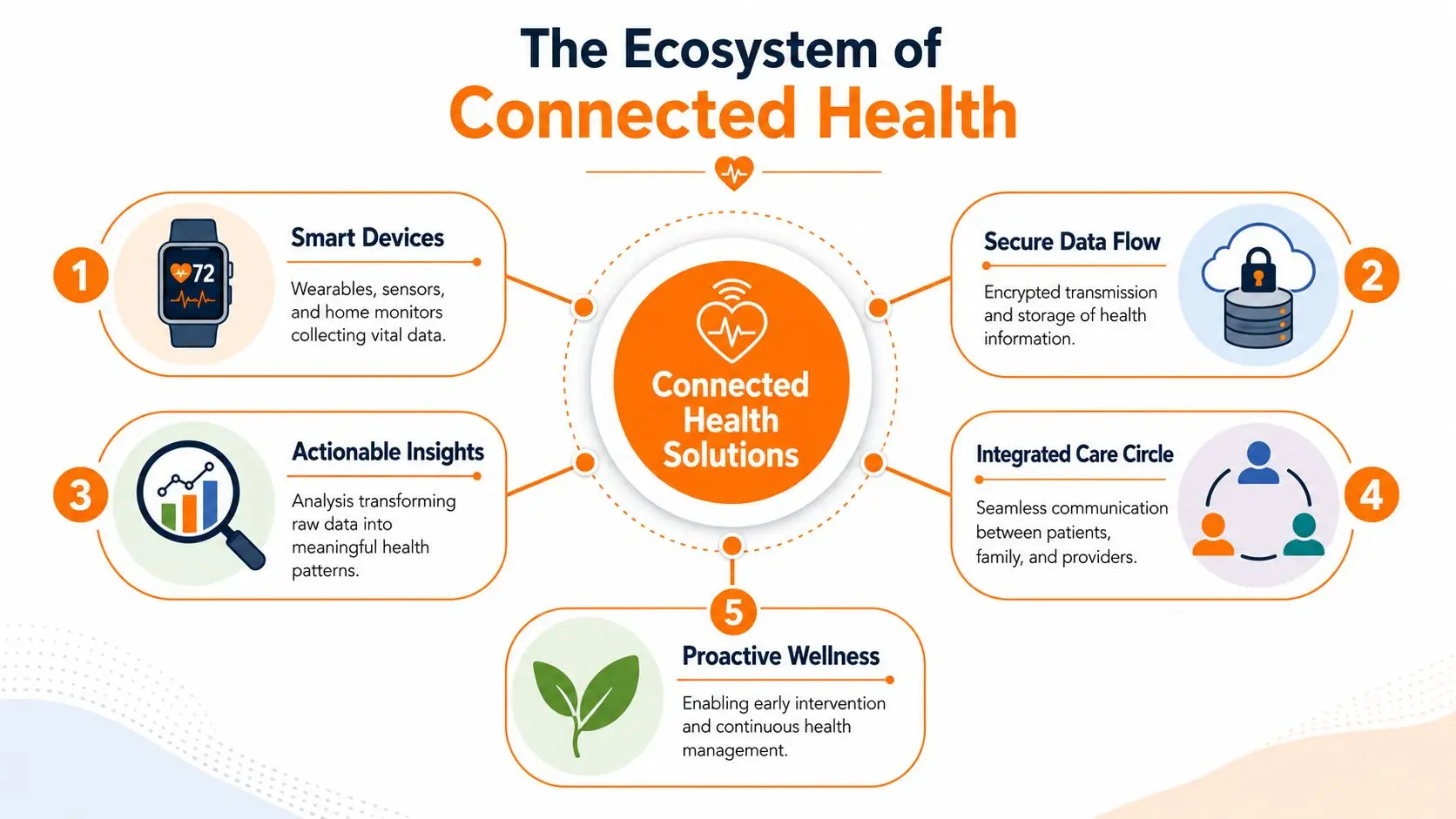
Connected health solutions aren't one device. They're an ecosystem.
A helpful way to think about them is this: they're like a smart home for wellness. In a smart home, lights, locks, and thermostats don't do much as isolated objects. Their value comes from working together. Connected health works the same way. A wearable, a home sensor, a telehealth visit, a medication reminder, and a care dashboard become more useful when they're linked to the people who need to act on the information.
More than a single-purpose alert device
Many readers picture a medical alert button when they hear about connected care. That tool can help, but it's only one piece. A traditional alert device is mostly reactive. Someone presses a button after something goes wrong.
Connected health solutions are broader and often more proactive. They can help a family notice changes in habits, support regular check-ins, and keep multiple people in the loop. That could include the older adult, an adult child, a home care worker, a clinician, or all of them together.
The national conversation reflects that broader role. In 2022, only 28% of U.S. healthcare consumers were using connected care, even as the White House launched the Community Connected Health initiative in January 2022 to reduce access barriers, according to the connected health adoption review published by OAE Publishing. That tells us two things at once. The idea has major institutional support, and many families still need help understanding how to use it in daily life.
The care circle matters as much as the device
The most important connection isn't between machine and machine. It's between people.
A connected system becomes useful when it answers questions like these:
- Who needs reassurance: Does an older adult want quiet confirmation that things are on track?
- Who needs updates: Should a daughter, son, or neighbor receive timely notifications?
- Who needs clinical context: Does a primary care doctor need a clearer view between visits?
- Who needs to respond: Which person takes action if something changes?
Connected care works best when it supports a care circle, not just a customer.
That's also why families get confused by industry jargon. Terms like platform, interoperability, and remote monitoring can sound abstract. Underneath the language, the core idea is simple: connect the right information to the right people at the right time, in a way that doesn't create more stress.
The Core Technologies Powering Connection
The technology behind connected health solutions can sound complicated until you map it to familiar roles. Think of it as four parts working together: the eyes and ears, the virtual front door, the family dashboard, and the shared language.
A major feature behind this model is closed-loop data flow, where sensors track patient data around the clock and connected systems communicate remotely to reduce delay between measurement and action, as described in this review of digital health technologies in ScienceDirect. In plain language, that means information doesn't just sit there. It moves to someone who can use it.
Remote monitoring and sensors
These are the eyes and ears of the system.
They can include wearables, home devices, or passive sensors that help track wellness signals and day-to-day patterns. For a family caregiver, the primary value isn't the hardware. It's the ability to notice small changes that might otherwise stay invisible.
For example, a person may say they're doing fine because they don't want to worry anyone. But if sleep patterns shift, movement drops, or medication reminders are repeatedly missed, those details can suggest it's time for a gentle check-in.
A useful way to judge sensors is by asking one question: do they create helpful context, or just more noise?
Telehealth
Telehealth is the virtual house call.
It gives families and providers a way to respond without turning every concern into a car ride, a waiting room visit, or a complicated schedule change. If a new issue comes up, telehealth can help decide whether someone needs home support, an in-person visit, or simple monitoring.
For older adults, telehealth can reduce disruption. For caregivers, it can reduce the scramble. For local providers, it can make follow-up easier when a concern appears between office appointments.
Mobile health apps
A mobile health app is the dashboard in your pocket.
Such solutions often display reminders, updates, patterns, or care notes. But a good app shouldn't feel like another full-time job. It should translate a stream of information into something understandable.
That might mean:
- Simple status views: A quick sense of whether routines appear normal
- Timely prompts: Reminders that support medication or follow-up
- Shared awareness: Family members can stay aligned without constant texting
- Focused alerts: Not every small change needs urgent attention
If an app makes caregivers check it obsessively, it's failed the usability test.
Interoperable records
This is the shared language.
Different people often touch the same person's care. A family caregiver notices one thing. A home aide notices another. A physician documents something else. If those details stay trapped in separate places, the burden falls on the family to repeat the same story over and over.
Interoperable records aim to make information easier to share across the care circle. That doesn't mean every system is perfectly connected. It means the goal is coordinated visibility, so that each person has enough context to do their part well.
Here's a simple summary:
| Technology | What it does | Why families care |
|---|---|---|
| Remote monitoring | Tracks ongoing signals and routines | Helps spot changes earlier |
| Telehealth | Enables virtual care conversations | Saves time and supports faster response |
| Mobile apps | Organizes updates and reminders | Makes information easier to act on |
| Shared records | Improves coordination across people | Reduces repeated explanations and confusion |
The Human Impact on Independence and Peace of Mind
Technology only matters if life feels better with it.
For connected health solutions, that usually means less uncertainty, fewer avoidable surprises, and more confidence for everyone involved. The benefits look different depending on where you stand in the care circle.
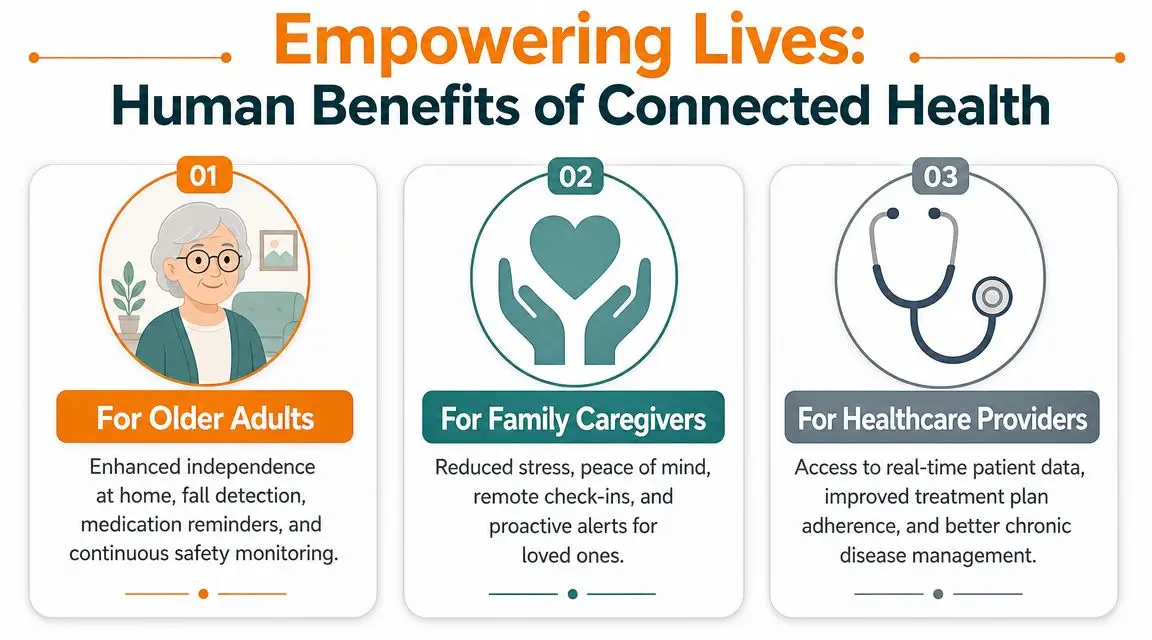
For older adults
Most older adults don't want to be managed. They want to live their lives.
That's why the strongest connected health setups support independence first. A reminder can help someone stay on track without a family member having to call. A fall detection feature can add reassurance without changing the feel of home. A telehealth option can make it easier to speak with a clinician without the strain of travel.
The emotional benefit matters as much as the practical one. When support is available subtly in the background, many people feel more confident doing ordinary things on their own.
For family caregivers
Caregiver stress often comes from not knowing whether silence means “everything is fine” or “something is wrong.”
Connected health can reduce that constant guessing. Instead of checking in just to confirm that nothing bad has happened, families can have more meaningful conversations. A daughter can call to talk about dinner plans, not just medication. A son can notice a pattern early enough to help before a problem grows.
Some of the value is invisible, but deeply real:
- Less background worry: You're not depending only on memory and chance
- Better timing: Updates arrive closer to the moment they matter
- Fewer repeated calls: Communication can become more purposeful
- Shared responsibility: Care doesn't rest on one person alone
For providers
Clinicians rarely struggle because they lack concern. They struggle because they often lack context between visits.
Connected health gives providers a richer picture of what's happening in ordinary life. That can support earlier conversations, clearer follow-up, and more preventive care. A provider doesn't have to rely only on what a patient remembers from the last few weeks. They can engage with a fuller story.
Better care often starts with better context, not more drama.
For local providers, the benefit is practical. When families and clinicians can see the same signals, conversations become more focused. That can improve coordination without turning every small issue into an emergency.
An Adoption Checklist for Your Family
Most families don't struggle because they lack options. They struggle because every option sounds helpful until it meets real life.
A strong adoption decision starts with fit. Not feature count. Not trendiness. Fit means the system matches the older adult's habits, comfort level, and actual care needs.
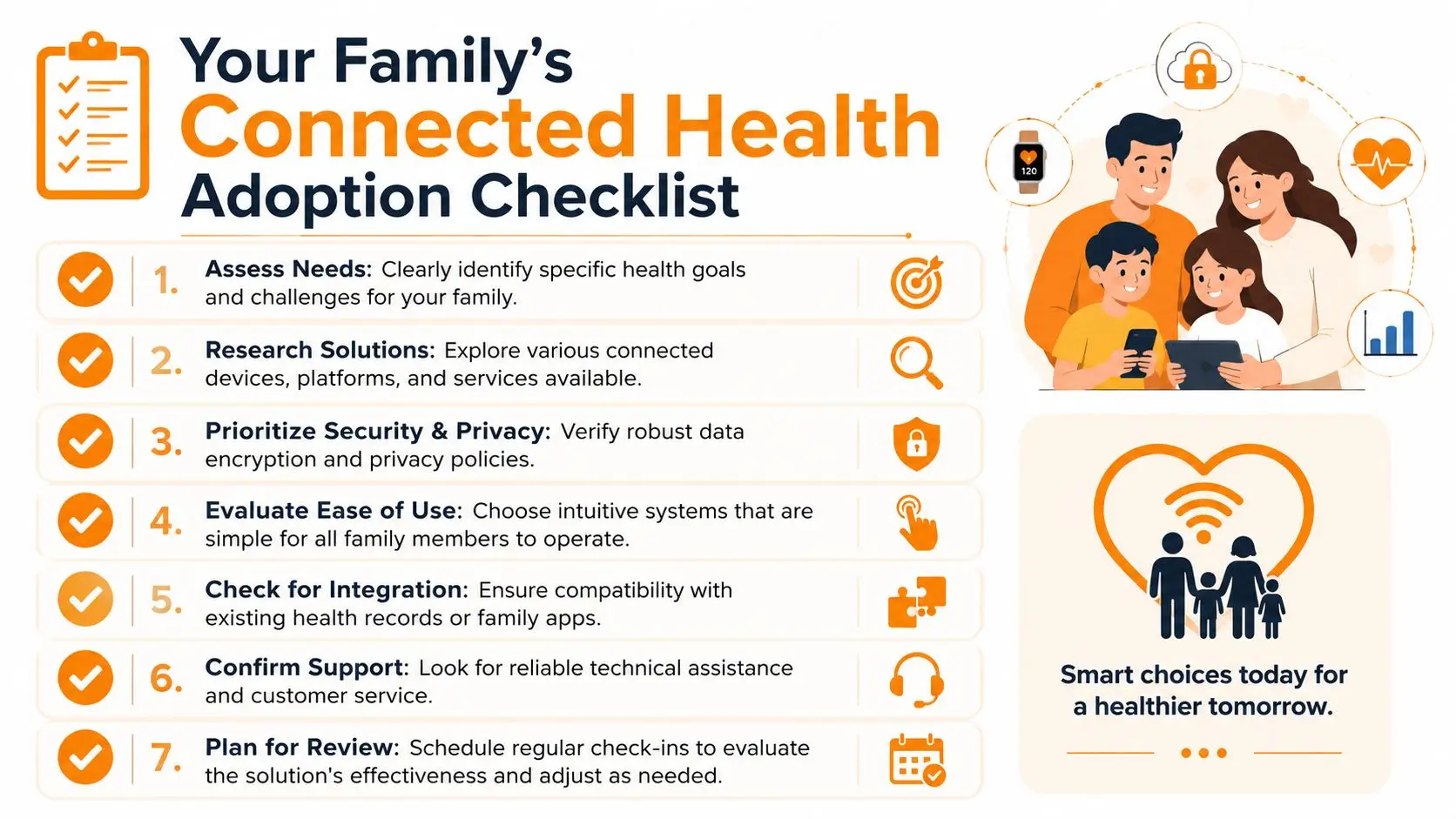
Start with the real problem
Before comparing tools, name the job you need the system to do.
Is the main goal medication support? Fall awareness? Better caregiver coordination? Easier follow-up with a local provider? Those are different problems, and they don't always require the same setup.
A simple family worksheet can help:
| Question | Why it matters |
|---|---|
| What worries us most day to day? | Helps avoid buying tools you won't use |
| What does our loved one want help with? | Preserves dignity and buy-in |
| Who needs updates? | Prevents confusion and overlap |
| What should trigger action? | Keeps alerts meaningful |
Check whether the system fits daily life
A technically capable tool can still fail if it's frustrating to use.
Look for everyday usability:
- Clear interface: Can someone understand it without a long tutorial?
- Low effort routine: Does it work with habits the person already has?
- Comfort and discretion: Will the older adult wear or use it?
- Reasonable setup: Can the family get started without calling five people?
If a product demands constant charging, tapping, syncing, or troubleshooting, adoption often slips. Families should assume that anything cumbersome will be used less over time.
Plan for digital barriers before they become care barriers
This part gets overlooked far too often. Connected health technologies can improve access, but they still require internet access, devices, and digital skills. Health Affairs notes that many older adults and underserved communities face a digital desert when those basics aren't available, as explained in Health Affairs on digital inclusion pathways for health equity.
That means families should ask practical questions early:
- Internet reliability: What happens if home connectivity is weak?
- Device access: Does the user already have the needed phone or tablet?
- Digital confidence: Can they manage simple prompts without stress?
- Fallback plan: If the system goes offline, who checks in and how?
A backup workflow is part of the care plan, not a sign of failure.
Privacy belongs on this checklist too. Before choosing any tool, read the provider's privacy policy details in plain language. Families should know who can see what, how information is handled, and how permissions can be changed.
Decide who gets what information
Not everyone needs every alert.
One family member may handle daily coordination. Another may want only urgent updates. A clinician may need summary information rather than constant notifications. The cleaner you make these roles, the less likely the system is to overwhelm people.
Try a small decision list:
- Primary responder: Who acts first when something changes?
- Secondary contact: Who steps in if the first person is unavailable?
- Clinical contact: Which concerns should be routed to a provider?
- Resident preference: What level of sharing feels respectful?
Review and adjust after the first few weeks
No family gets this perfect on day one.
Treat adoption as a trial period with honest feedback. Ask the older adult whether the system feels helpful or intrusive. Ask caregivers whether alerts are useful or excessive. Ask providers whether the information arriving is clear enough to support action.
The best connected health solution is the one your family can live with consistently.
Real-World Value and The Rx360 Example
Families often hear about “value” in abstract terms. In real life, value looks more ordinary.
It looks like fewer frantic calls to figure out what happened. It looks like less time repeating the same update to siblings, aides, and clinicians. It looks like noticing a change before it becomes a crisis. For providers, it looks like better coordination without drowning in constant alerts.
A useful framing comes from healthcare operations, not just clinical outcomes. Connected health succeeds when organizations take an ecosystem view, and the hard question is how to turn more data into fewer missed interventions without overburdening clinicians or caregivers, according to ZS on the new data points to problems we're not solving.
What value looks like in daily life
Families can evaluate a system with practical questions rather than technical ones:
- Does it reduce chasing and guessing: Are you spending less time trying to piece together updates?
- Does it improve timing: Are concerns being noticed early enough to respond calmly?
- Does it support coordination: Can family and local providers work from the same picture?
- Does it avoid overload: Are alerts specific enough to be useful?
That last point matters a lot. More data doesn't automatically mean better care. If every small event creates noise, caregivers stop trusting the system. If providers get overwhelmed, important signals can blend into the background.
One ecosystem approach in practice
One example of this ecosystem model is Rx360's connected wellness platform, which is designed to support independent older adults through a combination of health insights, smart technology, and connected care. The platform is described as including capabilities such as medication management, fall detection, and pharmacy-informed support, with an emphasis on simple user experience, discreet technology, and coordinated visibility for loved ones and care teams.
That kind of design is important because adoption often fails for human reasons, not technical ones. If a system feels intrusive, confusing, or high-maintenance, families drift away from it. If it respects independence and keeps information actionable, it has a better chance of becoming part of normal life.
For any vendor, not just one, trust should include clear privacy practices, secure data handling, and a setup that fits the actual care circle. A connected health tool is only valuable if people use it with confidence.
The Future of Aging Is Connected and Independent
The future of aging at home isn't about turning houses into clinics. It's about helping people stay themselves.
Connected health solutions can support that future when they're used with care. The goal isn't surveillance. It's reassurance. The goal isn't to replace human relationships. It's to make those relationships easier, calmer, and more informed.
For older adults, that can mean more confidence in everyday routines. For families, it can mean fewer hours spent worrying in the dark. For local providers, it can mean better chances to step in before a small issue becomes a major disruption.
The strongest systems don't ask people to give up autonomy in exchange for safety. They try to protect both. That balance matters. Independence isn't a luxury in later life. It's part of dignity.
If your family is starting this conversation, begin small. Focus on the actual concern, the specific household, and the individuals who will use the system every day. A thoughtful setup can do something powerful: help support an older adult's freedom while making sure nobody has to carry the burden alone.
If you're looking for a practical example of connected health built around independence, Rx360 offers a wellness ecosystem designed to help older adults stay connected to loved ones and care teams without adding unnecessary complexity. It's a useful starting point for families who want more peace of mind while protecting the routines and autonomy that make aging in place feel like home.
Lower-Risk Medication Plan Checklist
Below is a practical checklist and step plan you can implement into your daily life:
-
List all medications
Include prescriptions, over-the-counter drugs, supplements, sleep aids, creams, patches, eye drops, and inhalers.
-
Mark fall-risk drugs
Flag medicines that cause dizziness, sleepiness, confusion, blurred vision, low blood pressure, or low blood sugar.
-
Ask for a medication review
Bring the list to a pharmacist or prescriber.
-
Review after any warning sign
Request a new medication check after a fall, near-fall, new prescription, dose change, dizziness, or confusion.