You're sitting in an exam room with your mother. She has had back pain for weeks, has not been sleeping well, and now the doctor is considering a stronger medication. Before printing the prescription, the doctor turns to the computer, signs into a secure system, and reviews her recent medication history. For many families, that moment can feel unsettling. Is something wrong? Is your parent being flagged? Is this about law enforcement, insurance, or trust?
In many parts of the United States, that screen is a Prescription Drug Monitoring Program, usually called a PDMP. These programs are designed to give authorized clinicians and pharmacists a more complete view of recent controlled substance dispensing records. For older adults, that can matter because daily life often includes multiple appointments, pharmacy visits, changing routines, and help from family members.
If you're a clinician, this system may shape part of your prescribing workflow. If you're an older adult or caregiver, it can affect how a care team checks for duplication, overlap, or missing information. The practical question is not just whether a PDMP exists. It is how it fits into everyday care, and how patients and families can understand what is happening when it appears during a visit.
Why the PDMP helps but isn't enough by itself
What changed after statewide implementation
Measuring the PDMP's Impact on Prescribing Habits
What the system covers in Pennsylvania
What Is the PA PDMP and Why Does It Exist
Why the PDMP helps but is not enough by itself
An Introduction to Pennsylvania's Digital Safety Net
What patients can ask about privacy and access
What a real circle of care looks like
The PDMP's Role in a Complete Circle of Care
How caregivers can turn PDMP checks into safer care
Your Data Your Rights as a Patient and Caregiver
Why these prescribing changes matter
Measuring a PDMP's Impact on Prescribing Habits
When clinical judgment still matters most
What a practical workflow looks like
A Clinician's Guide to PDMP Compliance and Use
An Introduction to PDMPs as a Digital Safety Net
What changed after broader implementation
What the research says about prescribing patterns
What information these systems usually contain
What a PDMP is and why it exists
How PDMPs fit into everyday coordination
Table of Contents
- How PDMPs Fit Into Everyday Coordination
- What a PDMP Is and Why It Exists
- How Clinicians Commonly Use PDMPs
- What the Research Says About Prescribing Patterns
- Your Data and Questions as a Patient or Caregiver
- The PDMP's Place in a Bigger Picture
How PDMPs Fit Into Everyday Coordination
Sources for this section: General PDMP overviews from the Centers for Disease Control and Prevention, the Centers for Medicare & Medicaid Services, and the Office of Justice Programs.
A common scene plays out every day. An older adult sees a primary care doctor for pain, anxiety, insomnia, or recovery after surgery. The patient may also have a cardiologist, a neurologist, and a specialist in another health system. A daughter manages the pill organizer. A son picks up refills. One pharmacy changed after a move. Another medication came from an emergency visit months ago.
No one in that situation is necessarily doing anything wrong. The challenge is that information can be spread across places, people, and timelines.
When a clinician opens a PDMP, they are usually checking whether today's prescription fits into a larger record of recent controlled substance dispensing. That can help them see whether there are overlapping fills, recent changes, or details worth clarifying before anything new is added.
For older adults, this can intersect with everyday goals that have nothing to do with jargon. Staying organized. Maintaining routines. Supporting independence. Reducing confusion when more than one person is involved in medication pickup or scheduling.
Simple takeaway: If a clinician checks the PDMP before prescribing, it often means they are reviewing available records to understand the medication picture more fully.
PDMPs work best as part of coordination. They do not replace a conversation. They do not replace an updated medication list. They are one more source of factual information that can be reviewed during care.
Families interested in how technology can support safer, more connected daily life may also want to explore connected health solutions for older adults.
What a PDMP Is and Why It Exists
Sources for this section: Background information from the CDC, CMS, and the Office of Justice Programs. Interstate data sharing example from the Pennsylvania state profile published by the Office of Justice Programs.
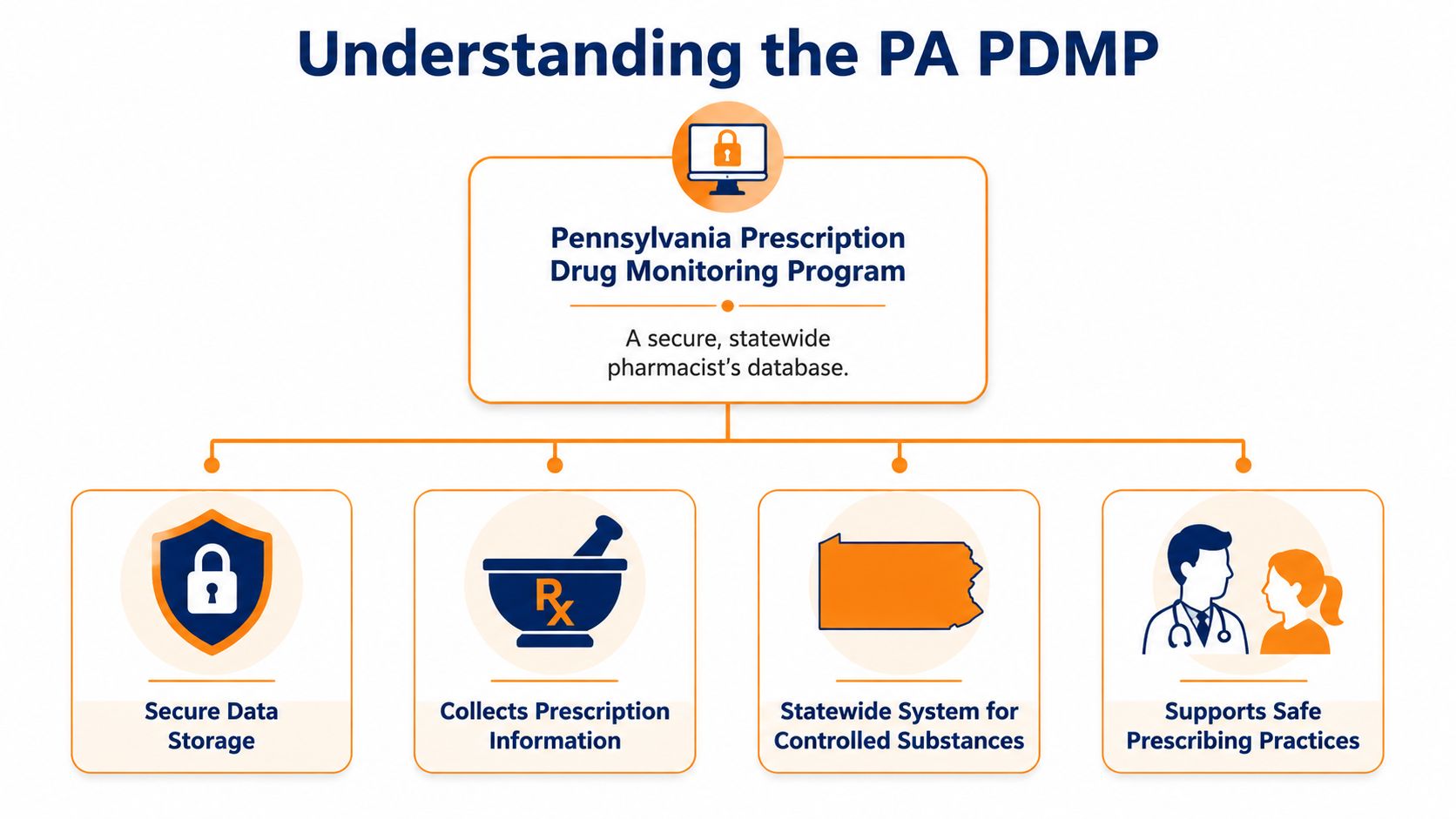
A daughter arrives at her father's next appointment with a paper list of medications folded in her purse. The list is missing the pain medicine he received after a recent procedure, and his specialist does not know that another doctor prescribed a sleep medication two weeks ago. A PDMP exists for moments like this. It gives authorized prescribers and dispensers a secure way to check recent controlled substance dispensing information before they add one more medication to the picture.
A simple way to think about it
A PDMP gathers part of a patient's controlled substance history into one secure place so a clinician does not have to rely only on memory, one pharmacy record, or an incomplete medication list. That can matter when care is spread across hospitals, primary care offices, specialists, urgent care sites, and retail pharmacies.
For older adults, the value is practical. Routines can change quickly after a fall, surgery, travel, or a move. If one clinician sees only one piece of that plan, it can be harder to understand the full timeline.
Common situations include:
- A new pain prescription after hospitalization
- An anxiety medication added by a specialist
- A refill request when the patient cannot remember the last fill date
- A caregiver trying to confirm whether a medication is still active
PDMPs are generally run at the state level, so rules, covered drug schedules, and access standards can vary. Many programs also share data with other states, which matters when people fill prescriptions across state lines or receive care away from home. Pennsylvania is one published example of interstate data sharing, according to the Pennsylvania state profile published by the Office of Justice Programs.
What information these systems usually contain
Sources for this subsection: General coverage descriptions from CMS and the CDC. One state-specific example from the Pennsylvania Department of Health PDMP overview.
A PDMP does not track every prescription in a medicine cabinet. In most cases, it focuses on controlled substances and related records defined by state law or program rules. Some states include additional information. Pennsylvania, for example, has described including medical marijuana dispensing and naloxone administration records in its program materials.
That scope is easy to misunderstand, so one point helps. A PDMP is not a diagnosis tool. It is a record system used for information review. Clinicians may look at it alongside medication reconciliation and other clinical decision support tools used in safer prescribing.
For patients and families, the reason these programs exist is straightforward. They make certain dispensing records easier to find in one place.
How Clinicians Commonly Use PDMPs
Sources for this section: Usage overviews from the CDC, CMS, and one state-level compliance example from McNees Wallace & Nurick's summary of Pennsylvania PDMP requirements.
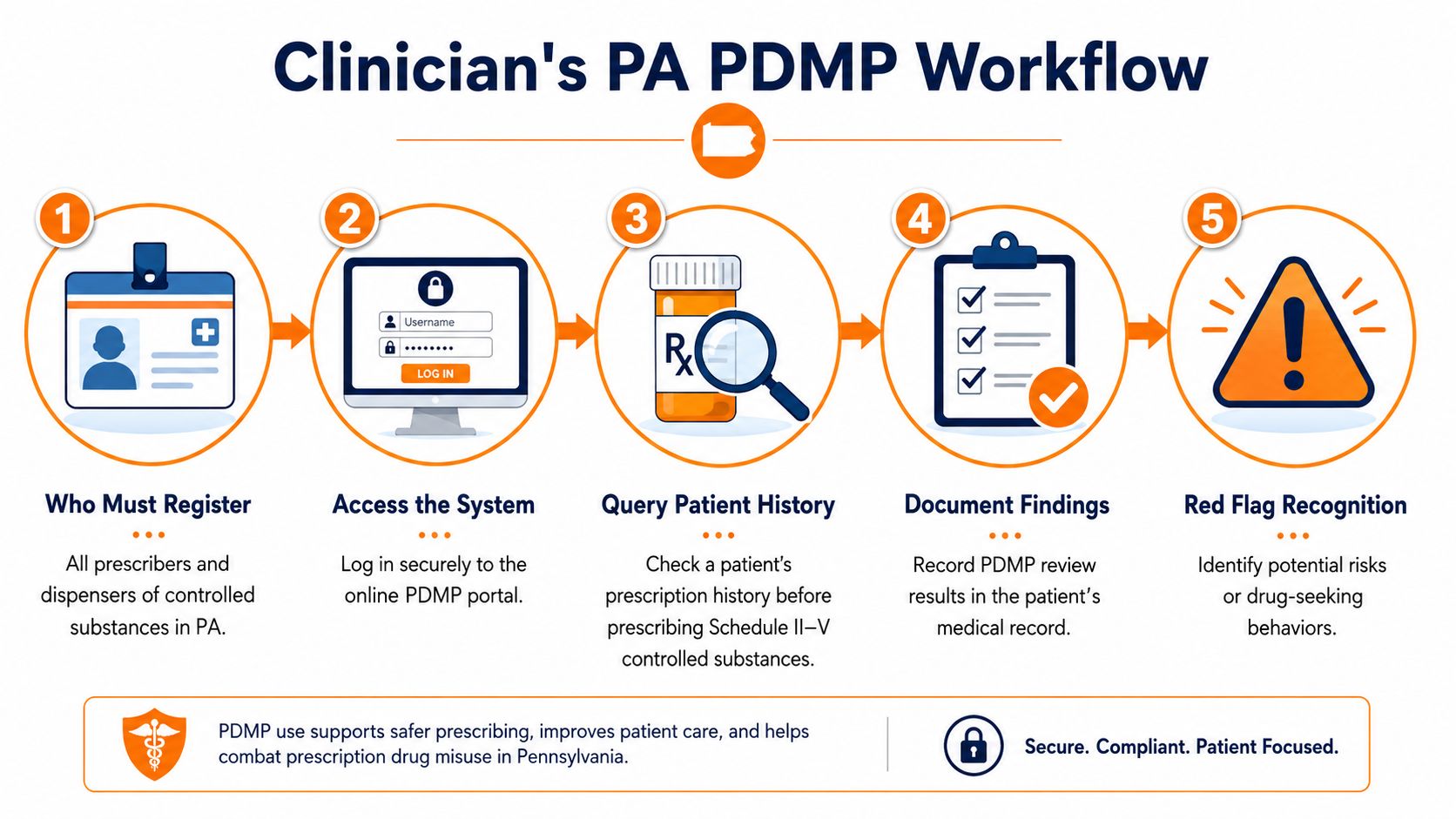
For clinicians, PDMPs are often both a legal requirement in certain situations and a practical record-checking tool. The easiest way to think about them is as part of routine workflow when controlled substances are involved.
Who may be required to use it
PDMP rules are state-specific. Registration requirements, query timing, covered drug classes, and exceptions differ by jurisdiction and practice setting.
Still, the broad pattern is similar in many states. Licensed prescribers who are authorized to prescribe controlled substances are commonly required to register for the state's PDMP and query it in certain circumstances, especially for an initial controlled substance prescription or before prescribing opioids or benzodiazepines. Pennsylvania is one published example, according to McNees Wallace & Nurick's summary of the Pennsylvania PDMP requirements.
The broad takeaway is simple. PDMP use is not limited to one specialty or one practice type. In many settings, it is part of expected record review.
What a practical workflow can look like
In a busy practice, PDMP checks are usually most manageable when they are built into the visit workflow instead of treated as a last-minute task.
A common pattern may look like this:
Confirm whether the prescription triggers a query.
Controlled substance starts, opioids, and benzodiazepines often bring the PDMP into the workflow.Review the dispensing history before finalizing the order.
This gives the clinician a chance to compare the record with the current conversation.Look for context, not just alerts.
Multiple fills may reflect care transitions, a procedure, or more than one prescriber in different systems.Document what informed the decision.
The chart may note that the PDMP was reviewed.Use the result as a prompt for clarification.
If something looks unclear, the next step is often to ask questions or confirm details.
Some practices streamline this through EHR integration or embedded prescribing workflows. Others rely on portal access and team protocols. Clinicians looking to make these checks more actionable often pair them with broader clinical decision support tools for medication-related workflows.
Why context still matters
A PDMP does not explain why a medication was chosen, whether it was taken as directed, or what daily life looks like at home. It does not show the full story behind travel, caregiving changes, memory issues, or transitions between providers.
That is why people often describe the PDMP as one source of information, not the whole picture.
A few factual reminders help:
- A query result is a record, not a personal story.
- Patients and caregivers may know details the system does not show.
- Several prescribers can be involved for ordinary reasons, including fragmented care.
- A short explanation during the visit can make the process easier to understand.
What the Research Says About Prescribing Patterns
Sources for this section: Research findings from a peer-reviewed analysis published in the National Library of Medicine, along with broader context from the Office of Justice Programs.
The most direct way researchers often study PDMPs is by asking whether prescribing behavior changed after a program was implemented or more widely used. Across states, results can vary based on program design, enforcement, workflow integration, and how consistently the data is checked.
Still, one of the clearest ways to understand possible effects is to look at published state-level examples.
What changed after broader implementation
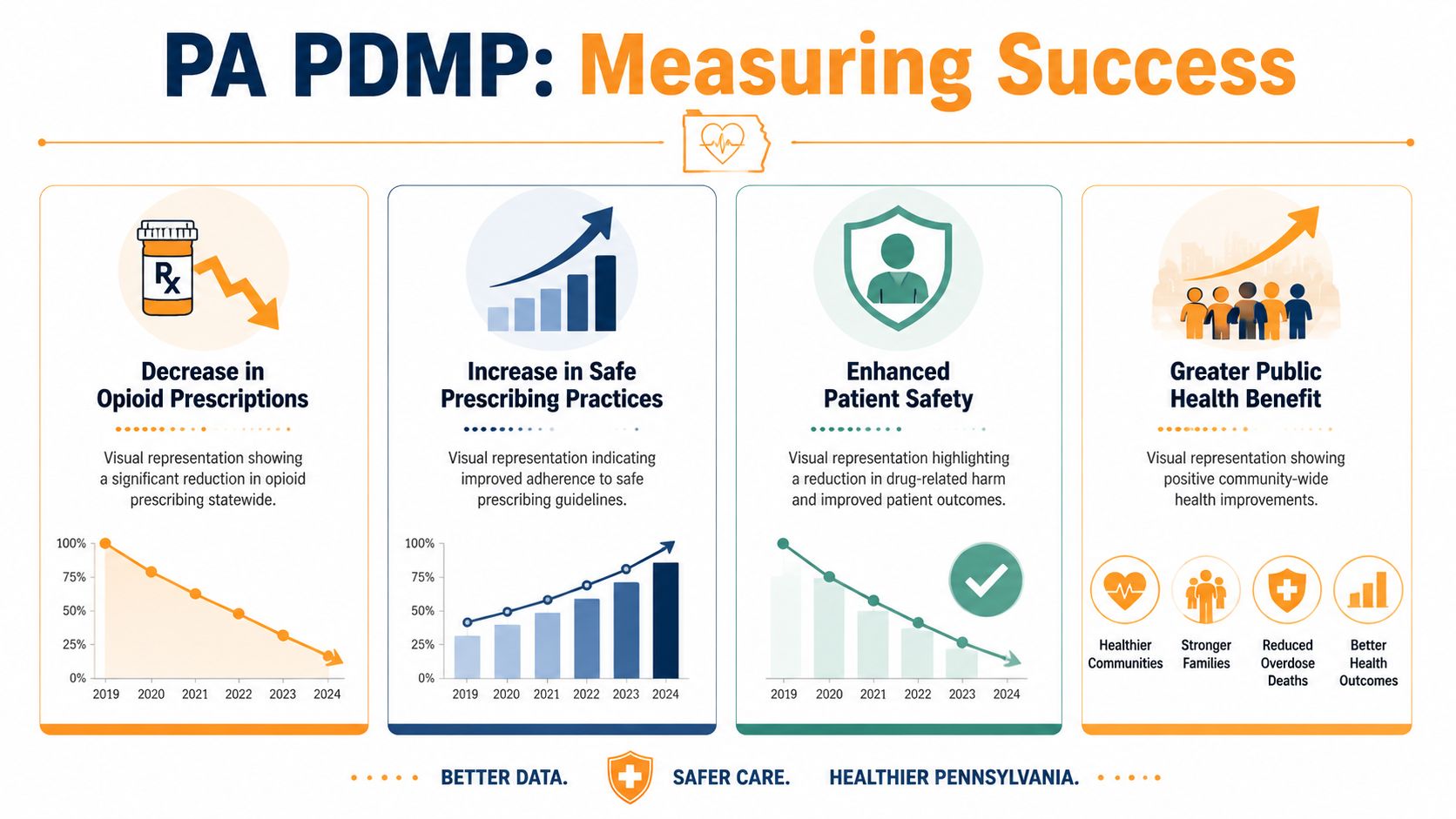
One useful example comes from Pennsylvania. Following statewide implementation in early 2017, the state recorded a 33% decrease in the overall quantity of opioid pills prescribed over the next three years, with an absolute reduction of 677,194 pills from Q1 2017 through Q1 2020, according to a peer-reviewed analysis published in the National Library of Medicine.
That decline was not evenly distributed across every prescribing pattern. The same analysis found that:
| Prescribing pattern | Reported change |
|---|---|
| Overall opioid pill quantity | 33% decrease |
| Oxycodone | 29% decrease |
| Hydrocodone | 39% decrease |
| Prescriptions exceeding 7 days | 43% decrease |
| Shorter-duration prescriptions | 27% decrease |
| Bulk prescriptions of 22 or more pills | 37% decrease |
| Smaller amounts | 21% decrease |
These findings are one example from one state, not a universal result for every PDMP in every setting. They are still useful because they show the kinds of patterns researchers measure.
Why these changes get attention
For readers outside research settings, these figures can sound abstract. In plain terms, they show that PDMPs are often discussed as tools that may change prescribing patterns, especially when they are widely used and built into routine workflows.
For families, the more practical point is that these systems are mainly about visibility. They collect and display dispensing information in a way that can make cross-checking easier.
If you're focused on day-to-day organization for older adults, broader medication management resources may also be helpful for routines such as refill tracking, medication reviews, and caregiver communication.
Your Data and Questions as a Patient or Caregiver
Sources for this section: General PDMP background from CMS, privacy-related public discussion referenced in WHYY's reporting on Pennsylvania's database launch, and broader public-interest context from the Office of Justice Programs.
A daughter sits beside her father at a follow-up visit. His doctor opens the chart, pauses to review the PDMP, and says, "I want to make sure we have the full medication picture before we change anything." For many families, that moment raises immediate questions. What information is being reviewed? Who is allowed to see it? What can a patient or caregiver ask about that process?
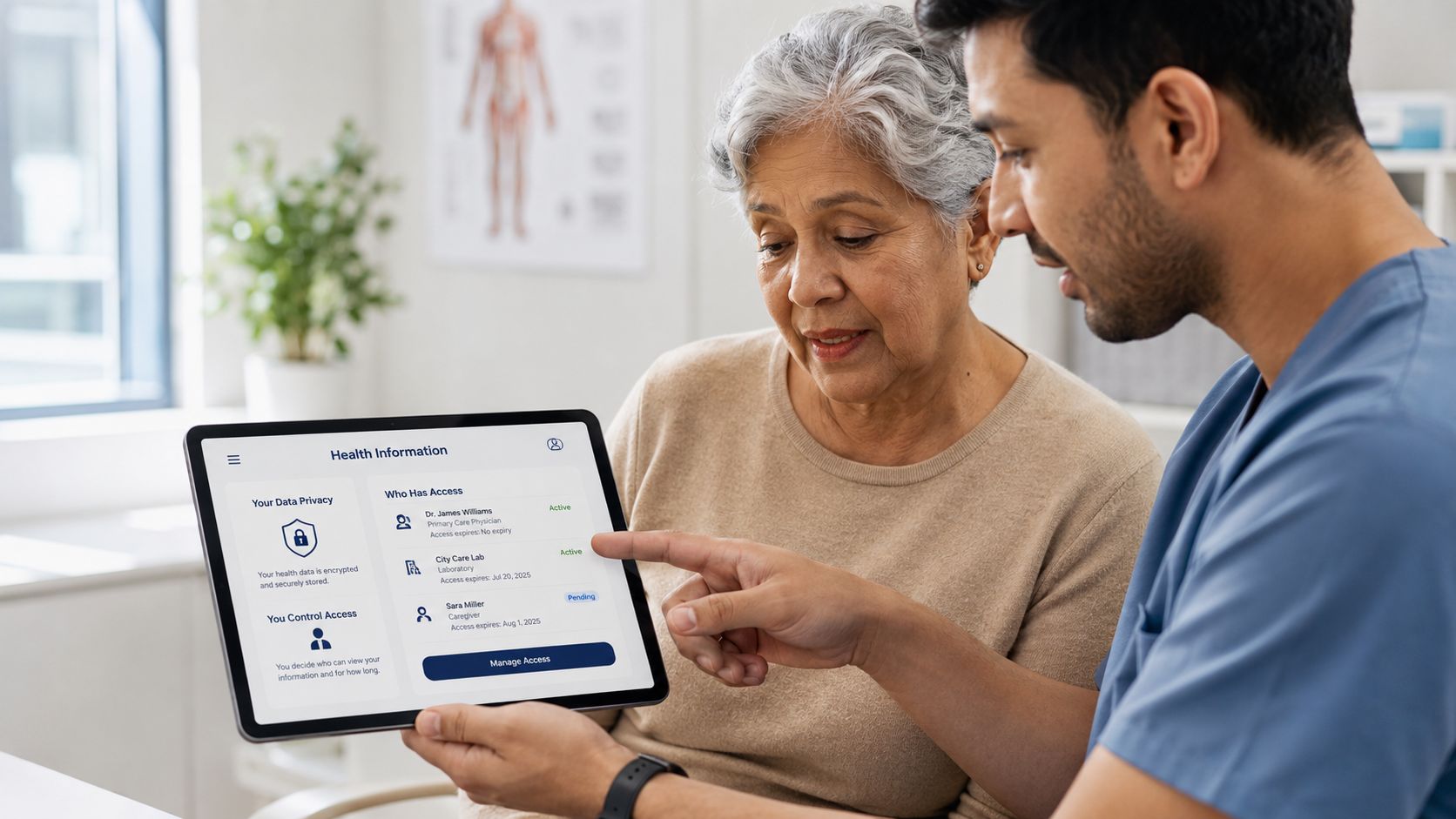
Those questions matter because a PDMP sits inside a larger picture of coordination. It is one tool clinicians use when several prescribers, pharmacies, or caregivers are involved. Patients and families do not need to stay on the sidelines while that happens. They can ask clear questions, confirm facts, and help the care team avoid mix-ups.
What information goes into the system
In most states, a PDMP is built around dispensing information for controlled substances, along with certain related records defined by state law or program rules. For patients, the key idea is simple. The system shows what was supplied, not just what was written.
That distinction can prevent confusion. A prescription written at a visit and a prescription filled are not always the same thing. The PDMP is meant to help a clinician check the part of the story that involves dispensing history.
In practice, that can help answer questions like these:
- Was a similar medication filled recently?
- Could a new prescription overlap with another controlled substance?
- Is there a recent dispensing record from another pharmacy or clinician?
- Does the broader record include naloxone or related entries in states that track them?
A PDMP does not replace a full medication review. It also does not explain the reason a medication was chosen or how someone felt after taking it at home.
What people often ask about privacy and access
Patients often want plain-language answers about privacy, and those concerns are not limited to any one state. Public discussion around PDMPs has repeatedly focused on transparency, patient notification, who can access records, and how errors are corrected. In Pennsylvania, for example, WHYY's reporting on the delayed launch of the state's monitoring database noted public concern about privacy, patient notification, and transparency.
That uncertainty makes one habit especially useful. Ask direct questions during the visit or at the pharmacy, before assumptions turn into worry.
Helpful questions include:
- Who on my care team can view this information for treatment?
- Why did you check the PDMP today?
- What part of the record is relevant to today's visit?
- If something looks wrong, how can it be corrected?
- Can you explain the process in plain language?
A short explanation from the clinician can change the whole tone of the encounter. Older adults may hear "database check" and worry they are being suspected of wrongdoing. In many cases, the check is simply part of record review.
How caregivers can support clear communication
Caregivers often notice what no database can show. They see duplicate pill bottles in the kitchen. They notice when routines change. They remember that one specialist changed a dose while another office handled a refill.
That makes the caregiver's role practical, not passive.
Here is a useful way to approach common situations:
| Situation | Helpful caregiver action |
|---|---|
| A new controlled substance is being considered | Bring an updated medication list and ask whether recent dispensing history was reviewed |
| Several specialists are involved | Ask which clinician is coordinating the overall medication list |
| The older adult uses more than one pharmacy | Mention that directly, even if the prescriptions seem unrelated |
| A medication name sounds unfamiliar | Ask where and when it was dispensed, then compare it with the bottles at home |
| The patient feels uneasy about the PDMP check | Ask for a plain-language explanation of what was reviewed |
Families can also help by keeping daily information organized. A current list, labeled pill bottles, and a shared routine for appointments and refills can make conversations simpler. For older adults who want to age in place, that kind of everyday clarity can support independence and reduce stress around logistics.
The PDMP's Place in a Bigger Picture
Sources for this section: Broader public discussion from PublicSource's reporting on the limits of the tool, along with general program background from the CDC and CMS.
A PDMP can be useful, but it is not a complete answer to every question about medication safety, trust, or coordination. A database can improve visibility. It cannot, by itself, create follow-through, simplify family communication, or guarantee that every part of a person's daily routine is easy to manage.

Why the PDMP helps but is not enough by itself
Public discussion has pointed to an important distinction. Even where monitoring programs are associated with reductions in some kinds of prescribing, that does not mean they solve every related problem on their own. Pennsylvania is one example discussed in PublicSource's reporting on the limits of the tool.
That does not make the PDMP unhelpful. It simply means the tool has a specific role.
It can show part of a record. It cannot describe relationships, routines, transportation issues, memory changes, or how well family communication is working. For older adults, those everyday factors often shape what independence looks like from one week to the next.
How this connects with independence and daily routines
When people think about aging well, they often focus on the basics that make life feel steady and positive: good sleep, mobility, social connection, reliable routines, confidence at home, and the ability to stay engaged in everyday decisions.
A PDMP is not a wellness tool in the usual sense. Still, it touches the same larger goal of staying organized and informed. When records are easier to review, conversations can be clearer. When conversations are clearer, it can be easier for families to keep routines on track.
That larger picture may include:
- A patient who wants straightforward explanations
- A family member or friend who helps keep information organized
- A pharmacist who notices timing or duplication questions
- A clinician who reviews records and explains what is relevant
- A daily routine that supports independence at home
Good coordination often comes from small habits that make information easier to follow.
In that sense, a prescription drug monitoring program is best understood as one piece of a broader information system. It is not the whole story. It is one factual record that can support clearer communication among the people involved.
Rx360 helps older adults, families, and care teams stay connected around day-to-day wellness, medication awareness, and coordinated support. If you want a simpler way to strengthen that circle of care while preserving independence, explore Rx360.
Lower-Risk Medication Plan Checklist
Below is a practical checklist and step plan you can implement into your daily life:
-
List all medications
Include prescriptions, over-the-counter drugs, supplements, sleep aids, creams, patches, eye drops, and inhalers.
-
Mark fall-risk drugs
Flag medicines that cause dizziness, sleepiness, confusion, blurred vision, low blood pressure, or low blood sugar.
-
Ask for a medication review
Bring the list to a pharmacist or prescriber.
-
Review after any warning sign
Request a new medication check after a fall, near-fall, new prescription, dose change, dizziness, or confusion.