

Between meetings, a daughter checks her phone. Her dad has taken his usual morning walk, slept within his normal routine, and shared a quick “good morning” message with the family. Nothing dramatic happened. That's the point. The information gives her a little reassurance without requiring another call, and her dad can continue his day without feeling monitored.
This is the gentle promise behind connected care for families. It brings selected wellness updates, family communication, and professional context into one shared circle, while keeping the older adult's preferences at the center. The approach fits a growing desire to remain at home and in familiar surroundings. AARP's 2024 Home and Community Preferences Survey found that 75% of older adults wanted to remain in their homes, while 73% wanted to remain in their communities.
Table of Contents
- A Quiet Start to a Bigger Idea
- What Connected Care Really Means
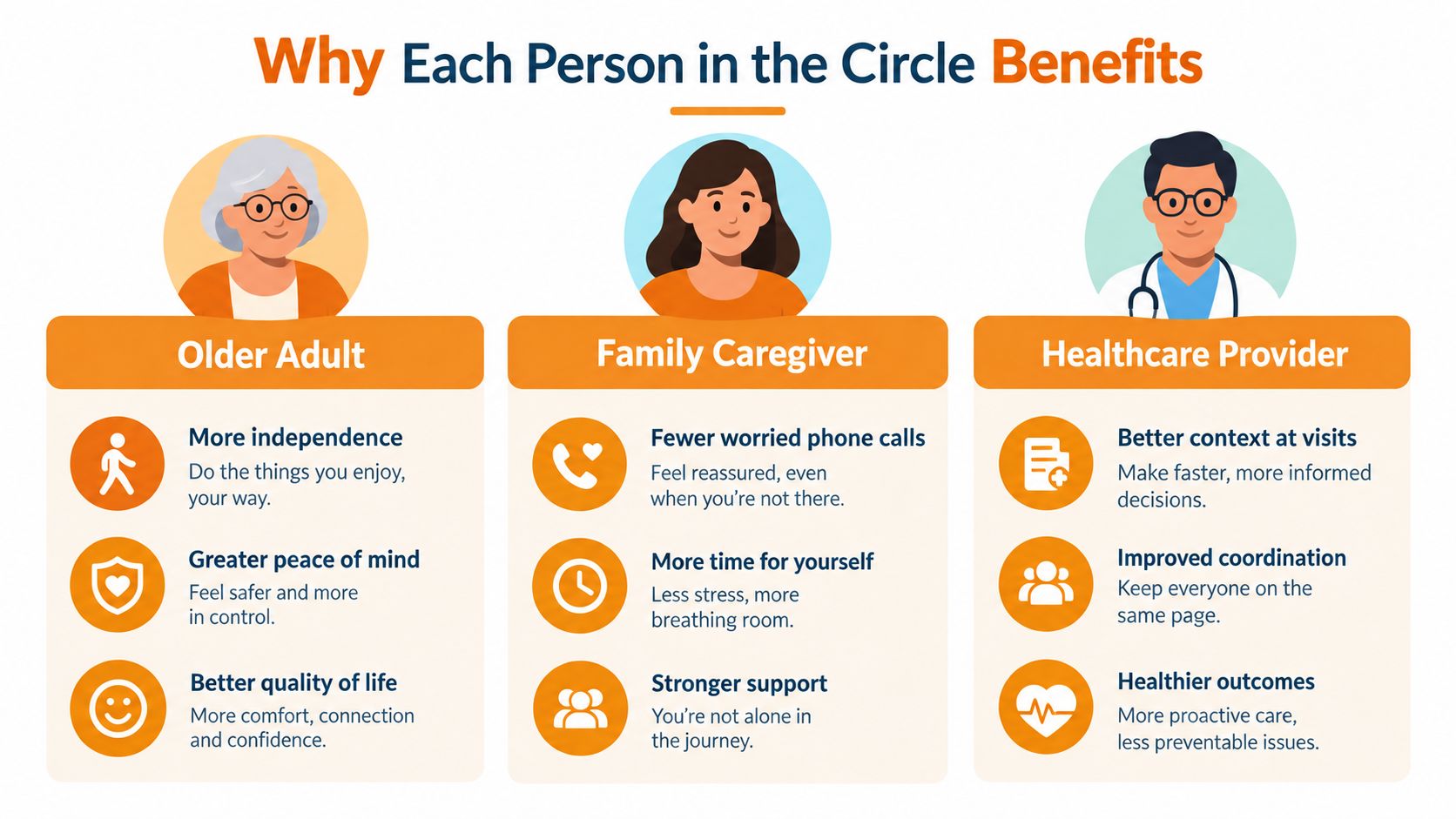
- Why Each Person in the Circle Benefits
- Daily Wellness Signals Worth Paying Attention To
- Two Families, Two Quiet Wins
- Choosing a Setup That Respects Everyone
- Your First Week and Common Questions
A Quiet Start to a Bigger Idea
A family may start considering connected care after a small change in an ordinary day. A parent misses a regular check-in, a sibling wonders whether someone has eaten, or relatives in different places find it hard to share the same view of daily life. The questions are practical: Is Dad keeping up with the routines he enjoys? Has Mom slept comfortably? Would a friendly call help?
Connected care offers answers through shared, permission-based information. That information could be a routine update, a family member's note, or context that helps a clinician understand what has happened between visits. The purpose is to make familiar patterns easier to notice, while leaving room for quiet days and personal choice.
A useful starting point: Connected care should support a person's routine, not turn that routine into a performance report.
A morning walk may show independence. A regular bedtime can help relatives recognize a familiar rhythm, while a weekly visit with a neighbor may explain why someone feels especially cheerful. These details matter because they add context to real life, not because technology has recorded them.
Family caregiving already provides much of the support older adults receive. In an analysis across 19 countries, the OECD reported that approximately 60% of older people receiving care relied exclusively on informal caregivers, usually relatives, friends, or members of their social networks. Connected care supports those relationships by making selected information easier to share. It does not take their place.
The approach keeps wellness at the center of the family conversation. Sleep, movement, balance, and social connection become gentle points of reference rather than scores to chase. With consent guiding what is shared, technology can remain a quiet aid to the older adult's routines and choices.
By the end of this guide, you'll have a practical framework for deciding who belongs in the circle, which daily signals may help, how privacy fits in, and how to begin gradually.
What Connected Care Really Means
A daughter notices that her father's sleep has shifted, while he feels fine and has been reading later. Connected care gives them a shared way to discuss that change, without turning one routine into a warning.
Connected care works like a shared family notebook that can include selected digital updates and professional information. The older adult owns the story. Relatives see only what they are invited to see, and clinicians receive relevant context when the older adult chooses to share it.
The notebook comparison matters because connected care is a communication pattern, not a device, dashboard, or alert system:
- An everyday observation is recorded or shared.
- The appropriate people receive the relevant part.
- Someone adds context, such as a message or note.
- The older adult and support circle decide whether anything needs attention.
The information may concern sleep, movement, social connection, appointments, or a change in routine. A signal does not explain itself. A missed walk could reflect rain, a busy morning, or a quiet day at home. Context prevents a simple observation from becoming unnecessary worry.
As noted earlier, most care for older adults already comes from informal networks, which is why this shared model matters. Connected care helps relatives, friends, and clinicians coordinate around the support already in place, rather than asking each person to make separate calls or depend on incomplete updates.
The three roles in the circle
| Role | Primary wellness focus | What they share |
|---|---|---|
| Older adult | Independence, routines, comfort, and choice | Preferences, daily activities, questions, and permission |
| Family caregiver | Connection, practical support, and reassurance | Encouragement, observations, messages, and agreed follow-up |
| Clinician | Helpful context around the person's experience | Visit information, relevant guidance, and professional communication |
An older adult might share a sleep summary with one daughter, while keeping it from a wider group. A relative could add a note about a social visit, and a clinician could receive a concise history before a conversation. The arrangement can remain as open or limited as the person prefers.
For a broader explanation of how connected tools can support families, see connected health solutions for families. In short, connected care means the older adult, trusted relatives, and clinicians share relevant information through an agreed circle. Wellness stays visible enough to support independence, while family life remains personal rather than surveilled.
Why Each Person in the Circle Benefits
Connected care can carry the same update to several people, but each person experiences its value differently. The older adult may see more independence. A family caregiver may feel less uncertainty. A clinician may gain a clearer view of daily life between conversations.
The older adult stays at the center
The most important benefit is choice. A well-designed arrangement lets an older adult decide who belongs in the circle, what information is shared, and how family members should respond. That can make support feel like an extension of ordinary relationships rather than an observation system.
A routine update can also help relatives notice the person's strengths. They may see that someone is keeping up with a favorite walk, meeting friends, or maintaining a familiar sleep pattern. Those details keep conversations positive and grounded in the person's own goals.
Family caregivers get useful reassurance
Relatives often care from different homes, schedules, or time zones. Shared information can reduce the need to guess what is happening between phone calls. It can also make a conversation more specific. Instead of asking a broad “How are things?”, a daughter might say, “I saw you had a busy morning. Want to tell me about it?”
A 2023 systematic review of digitally enhanced interventions for family caregivers found that more than 85% of included studies reported statistically significant improvement in at least one caregiver outcome, including psychological health, self-efficacy, and quality of life. The finding supports the value of interactive information and human support, rather than passive dashboards alone.
Clinicians receive more everyday context
A scheduled conversation captures one moment. Shared, permission-based updates can add context about routines, questions, or changes that the older adult and family want to discuss. That doesn't turn relatives into clinical decision-makers. It gives the professional a better starting point for a conversation.
The strongest circle doesn't send everything to everyone. It sends the right information to the right person, with enough context to understand it.

Daily Wellness Signals Worth Paying Attention To
Daily signals are most useful when they describe ordinary life, not when they turn every variation into a concern. Sleep, movement, balance, social connection, and hydration can help a family understand how a person's day is unfolding. They're clues for conversation, not conclusions.
Sleep creates a familiar rhythm
The National Institute on Aging explains that older adults generally need about 7 to 9 hours of sleep each night, similar to adults generally. The same source notes that regular exercise can support better sleep routines, while activity close to bedtime may interfere with sleep.
A connected-care system might make a preferred sleep window easier to notice. A family member could see that a parent has been keeping a familiar schedule and send encouragement. If the older adult wants to discuss a different pattern with a professional, a shared summary can make that conversation more concrete.
Movement and balance support everyday independence
Movement isn't limited to formal exercise. It can include walking to the shops, gardening, stretching, attending a class, or moving around the home with confidence. The World Health Organization's physical activity guidance describes endurance, muscle-strengthening, and multicomponent activity that includes functional balance and strength as distinct parts of an active routine.
That framework can help families talk about variety instead of chasing a single number. “How did your day feel?” may be more useful than asking whether someone met a target. A routine summary can support that conversation without dictating what the person should do.
Social connection belongs on the same map
A chat with a neighbor, a family video call, a community gathering, or time with friends can give a day structure and enjoyment. The Centers for Disease Control and Prevention notes that about 1 in 3 adults in the United States report feeling lonely, while about 1 in 4 report not having social and emotional support. Loneliness and social isolation aren't the same, but both show why regular connection deserves attention.

Hydration and mood can be discussed in the same gentle spirit. A note that says “tea with a friend and a good appetite” tells a fuller story than a lone alert. For questions about specific devices and measurements, families may also review what a good pulse oximeter reading means without treating a device reading as a complete picture of wellbeing.
Two Families, Two Quiet Wins
Connected care becomes easier to understand through ordinary family moments. The following composite examples focus on routines and communication, not emergencies or diagnoses.
A missed walk becomes a friendly conversation
Mara, a retired teacher, lives alone and enjoys walking to a nearby café several mornings each week. Her children live in different places, so they use a shared family app to see selected routine updates. Mara chooses what they can access and prefers a weekly summary rather than frequent notifications.
One week, her usual walk doesn't appear. Her daughter sends a message instead of assuming something is wrong: "No café walk today. Want company on the phone?" Mara replies that a friend had invited her to a garden visit. The missing walk wasn't a problem. The update opened a conversation, and the family learned something positive about her week.
That small exchange shows why context matters. A signal can invite connection without demanding intervention.

A shared routine helps a couple coordinate
Jon and Elise live together. Jon has become less confident during some movements, and the couple wants family support without giving up their independence. Their adult son helps organize shared updates and keeps communication with their clinician in one place.
The family agrees that routine changes should lead to a conversation, not an automatic reaction. When Jon has a quieter week, Elise adds context about rainy weather and fewer outings. The clinician receives that information before the next discussion, while Jon remains involved in deciding what support feels comfortable.
The World Health Organization describes longer-term assistance with daily activities such as eating, moving, or bathing as something that about 2 in 3 people who reach older age are likely to require. That broad reality makes respectful coordination valuable, but it doesn't remove the person's right to preferences, privacy, and participation.
Choosing a Setup That Respects Everyone
A connected-care setup works best when the family agrees on the rules before anyone starts sharing information. Privacy, consent, ease of use, data ownership, and support aren't technical details to leave until later. They shape whether the arrangement feels respectful in daily life.
Begin with permission
Ask the older adult:
- Who should be included? Name each relative, friend, or professional.
- What should each person see? A weekly routine summary may be appropriate for one person, while another may receive only messages.
- What can someone do? Seeing an update isn't the same as changing settings or contacting a clinician.
- How can access change? Preferences may evolve, so permissions should be easy to review.
The AARP survey of 3,605 U.S. adults found that data privacy was the biggest technology-adoption barrier for one-third of adults aged 50 and older. Ease of use, setup support, and cost were also major concerns. Those findings make a simple permission conversation part of good design, not an optional extra.
Make information understandable
Ask a provider how different tools share information. In everyday language, interoperability means that relevant information can move between systems without someone repeatedly copying it by hand. Families can ask whether updates carry a date, source, and explanation, and whether the older adult can review what has been shared.
Alerts deserve the same care. Agree on which updates are routine, which deserve a family message, and which should be discussed with a professional. Too many notifications can make people stop paying attention.

Keep the human conversation in charge
A family can ask:
- Privacy: Who can see what, and can access be removed easily?
- Consent: How does the older adult approve sharing?
- Clarity: Does each update explain what happened and when?
- Support: Who helps when a device or app becomes confusing?
- Escalation: What should a family member do when an update raises a question?
A calm setup doesn't promise that nobody will worry. It gives everyone a shared way to respond, while preserving the older adult's authority over their own information.
Your First Week and Common Questions
The first week doesn't need a large technology project. Start with one conversation and one routine that already matters to the older adult.
- Choose the circle: Agree on the older adult, participating relatives, and any professional connection.
- Set permissions: Decide what each person can see and do.
- Pick a small focus: Begin with sleep, movement, social connection, or another familiar routine.
- Choose the response style: Decide whether an unusual update leads to a text, a call, or a later conversation.
- Review together: Ask what feels helpful, intrusive, confusing, or unnecessary.
A 2025 study of 871 adults aged 65 and older found that 81% had access to a computer or smartphone and more than 93% could access the internet, yet fewer than 45% felt able to use video with a doctor easily. Access doesn't automatically mean confidence. Offer patient, practical support, and keep a low-tech way to communicate available.
Common questions
What if the older adult isn't comfortable with technology? Start with the simplest channel they already use. A trusted relative can help with setup only after permission, and the older adult can remain the person who decides what gets shared.
How can a family avoid alert fatigue? Use fewer, clearer updates. Separate routine summaries from messages that need a response, and review the settings together if notifications become stressful.
How should clinicians stay involved? Share only relevant information through an agreed channel, with the older adult's consent. Family members can provide context, but they shouldn't present themselves as making professional decisions.
What kind of sound or notification is easiest to notice? Families comparing options can review examples such as good alarm sounds and choose something recognizable without making ordinary updates feel urgent.
The most useful first action is small: ask the older adult what kind of support would make daily life feel easier while keeping independence intact.
Rx360 offers a connected wellness platform that helps independent older adults share relevant wellness signals with loved ones and care providers through a support circle. If your family wants to explore a gradual, wellness-first approach to staying connected, visit Rx360 and start the conversation together.
Lower-Risk Medication Plan Checklist
Below is a practical checklist and step plan you can implement into your daily life:
-
List all medications
Include prescriptions, over-the-counter drugs, supplements, sleep aids, creams, patches, eye drops, and inhalers.
-
Mark fall-risk drugs
Flag medicines that cause dizziness, sleepiness, confusion, blurred vision, low blood pressure, or low blood sugar.
-
Ask for a medication review
Bring the list to a pharmacist or prescriber.
-
Review after any warning sign
Request a new medication check after a fall, near-fall, new prescription, dose change, dizziness, or confusion.