
You're sitting at the kitchen table with a new pulse oximeter clipped to a finger. The screen lights up. One number says 96. Another number is bouncing slightly. You pause and think, is this good, bad, or somewhere in between?
That moment is common, especially for older adults who want to stay safe at home and for family members trying to help from nearby or far away. A pulse oximeter looks simple, but the numbers can feel loaded with meaning. If you have COPD, heart problems, or a recent illness, that uncertainty can quickly turn into worry.
The short answer is that a “good” pulse ox reading depends on who you are, what your usual baseline is, and whether you have symptoms. For many healthy adults, the usual range is straightforward. For others, especially people with chronic lung disease, the right answer is more personal.
Table of Contents
- Understanding Your Pulse Oximeter Numbers
- What Is a Normal SpO2 Level
- Your Personal Baseline and What to Know
- Common Factors That Affect Pulse Oximeter Accuracy
- Interpreting Your Results and When to Act
- Using Technology to Monitor Trends and Share Results
Understanding Your Pulse Oximeter Numbers
A pulse oximeter gives you two pieces of information in a few seconds. The first is SpO2, which means oxygen saturation. The second is your pulse rate. It's common to look at the oxygen number first, then wonder what counts as normal.
If you're asking what is a good pulse ox, you're really asking a bigger question. You want to know whether your body is getting enough oxygen to support your brain, heart, kidneys, and other organs. For someone living independently, that matters because oxygen problems can show up before a person realizes they're getting sick.
Here's where people often get confused. They hear one rule, usually “95 or higher,” and assume every reading below that means emergency. That isn't always true. Some people need prompt medical attention for a low reading. Others, especially those with chronic lung disease, may normally sit lower than the standard range.
Practical rule: Don't judge a pulse ox number by itself. Look at the reading, your usual baseline, and how the person feels at the same time.
A pulse oximeter is a helpful home tool. It's not a crystal ball, and it doesn't replace medical judgment. But when you understand what the numbers mean, it becomes much easier to use calmly and well.
What Is a Normal SpO2 Level
For a healthy adult, a good pulse oximeter reading is typically 95% to 100% SpO2, according to Yale Medicine's overview of pulse oximetry. That same source notes that values below 95% can indicate a need for clinical evaluation, readings from 90% to 94% suggest mild hypoxemia, and readings below 90% indicate severe hypoxemia. It also cites a 2019 study in Pediatrics showing the true normal range in healthy populations may be closer to 97% to 100%, which means 95% to 96% can deserve a closer look.
What SpO2 actually measures
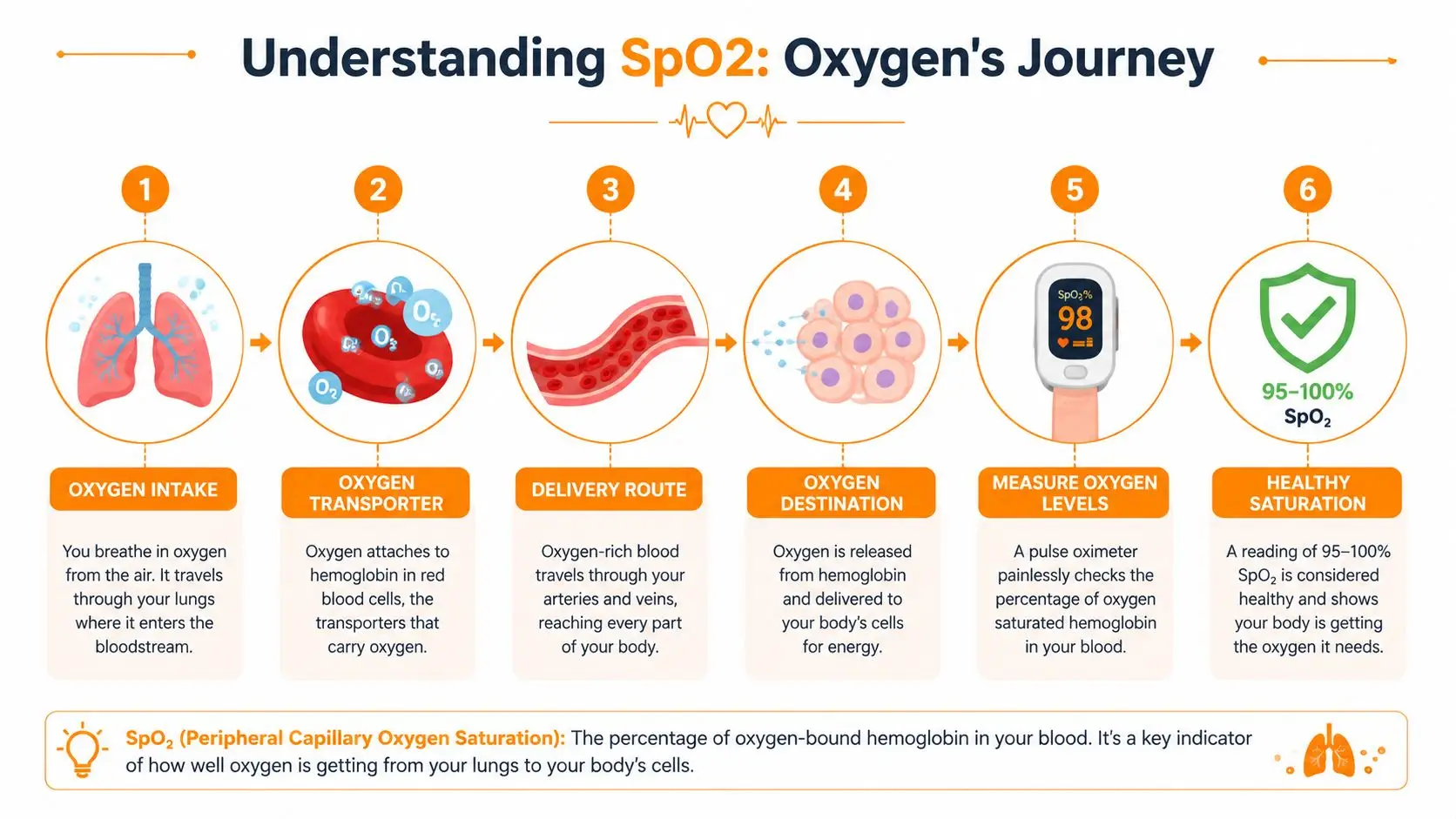
Think of your red blood cells as delivery trucks. Their job is to pick up oxygen in the lungs and carry it through the bloodstream to the rest of the body. SpO2 tells you how full those trucks are.
If the number is high, most of those trucks are carrying oxygen. If the number drops, fewer trucks are fully loaded, and your tissues may not be getting what they need.
That's why oxygen saturation matters so much. Your organs depend on a steady supply. When oxygen levels fall and stay low, the body has to work harder to keep up.
What the ranges usually mean
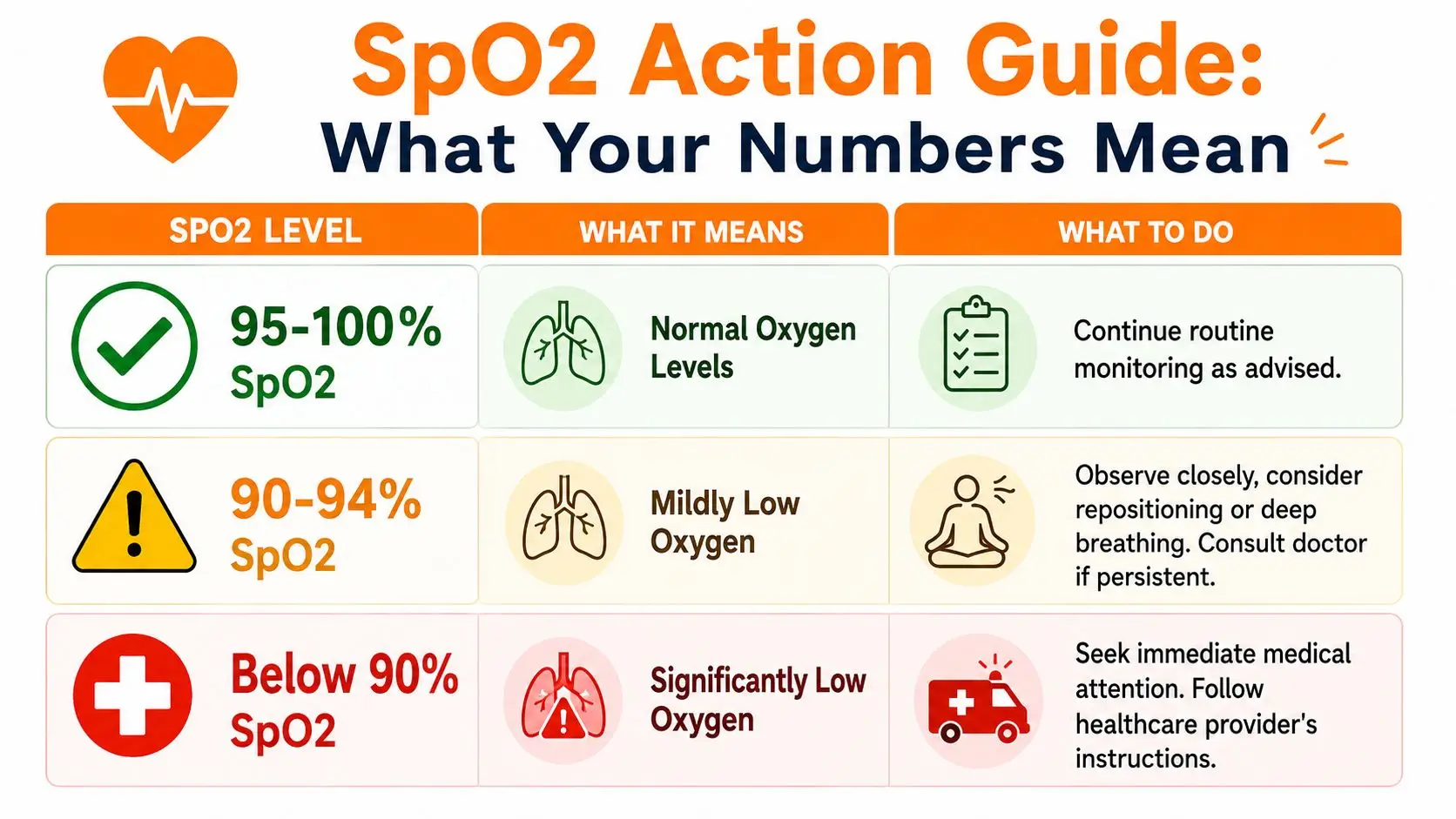
For a generally healthy adult at home, these ranges are a practical guide:
- 95% to 100%: Usually considered a normal reading for a healthy adult.
- 90% to 94%: Lower than expected. This can suggest mild hypoxemia and deserves attention, especially if it's new or persistent.
- Below 90%: This is a serious reading and can reflect severe hypoxemia.
A pulse oximeter doesn't measure how “sick” someone is. It measures one important signal. You still have to pair the number with breathing, energy level, color, and mental clarity.
The biggest takeaway is simple. If you're healthy, 95% or higher is the usual target, but the fuller story is that normal readings in healthy people often cluster even higher.
Your Personal Baseline and What to Know
The standard rule helps, but it doesn't fit everyone. It is at this point that many families get tripped up. They see a reading that looks low on paper, panic, and assume the same threshold applies to every person.
Why 95 percent isn't the whole story
For some adults with chronic lung disease, especially COPD, a “good” pulse ox may be lower than the textbook rule. The Minnesota Department of Health notes that for some people with COPD, 90% can be normal, and verified guidance also notes that a safe baseline may be 90% to 92% for some older adults with chronic lung disease, a distinction that can prevent unnecessary panic at home, as summarized in Minnesota's pulse oximeter guidance.
That doesn't mean low readings never matter. It means your baseline matters.
A person with healthy lungs who usually runs 98% and suddenly reads 92% needs attention. A person with COPD whose clinician has said 90% to 92% is expected may not need emergency care for the exact same number if they feel the same as usual.
The safest question isn't only “What is the number?” It's “Is this normal for this person today?”
Other factors can also shift what you see, including your health conditions and environment. The key is to know your own usual reading when you feel well, and to confirm your target range with your clinician.
SpO2 Levels and Recommended Actions
| SpO2 Level | For a Healthy Adult | For an Adult with Chronic Lung Disease (e.g., COPD) |
|---|---|---|
| 95% to 100% | Usually a reassuring range | May be normal, but some people with chronic lung disease may usually run lower |
| 90% to 94% | Lower than expected. Recheck and consider clinical advice if it persists | May be near baseline for some people. Compare with the person's usual number and symptoms |
| Below 90% | Concerning. Seek prompt medical advice or emergency care depending on symptoms | May still be below the person's safe range. Follow the care plan given by the clinician |
A good home rule is to write down your usual resting reading when you feel well. Keep that with your medication list and emergency contacts. It gives caregivers and clinicians context right away.
Common Factors That Affect Pulse Oximeter Accuracy
A pulse oximeter can be helpful, but the screen doesn't always tell the whole truth. Even FDA-cleared devices have an error range. The FDA says pulse oximeters have a clinical accuracy of about ±2% to ±4%, which means a reading of 92% could reflect an actual oxygen saturation as low as 88%, as explained in the FDA safety communication on pulse oximeter accuracy and limitations.
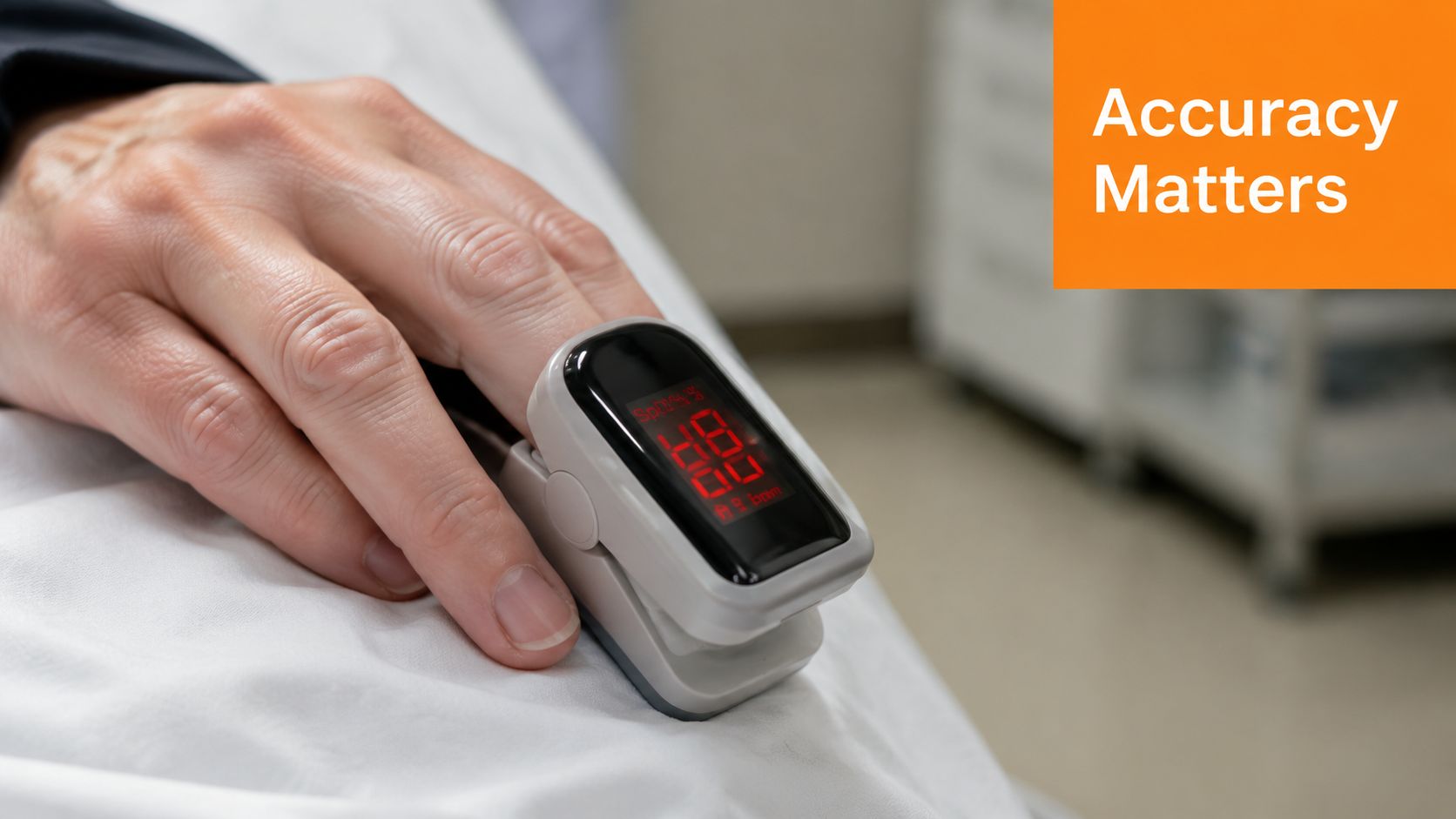
That's why technique matters. If the reading seems off, the first step isn't always panic. The first step is making sure the reading is trustworthy.
Why home readings can be off
Small things can interfere with a pulse ox reading:
- Cold hands: Poor circulation can make it harder for the device to detect a strong signal.
- Movement: Shaky hands or talking with the hand in motion can confuse the sensor.
- Nail polish or artificial nails: These can block or distort the light the device uses.
- Weak signal: Some fingers read better than others.
- Home device limits: Consumer devices can help with monitoring, but they aren't diagnostic tools.
A pulse oximeter works by shining light through the finger and estimating how much oxygen is attached to hemoglobin. If the signal is weak or interrupted, the number can drift.
A simple troubleshooting checklist
Before trusting a surprising reading, try this:
- Warm the hand: Rub the hands together or rest them under a blanket for a few minutes.
- Sit still: Rest your hand on your lap or on a table.
- Reposition the clip: Make sure the finger is fully inserted and relaxed.
- Remove barriers: Take off dark nail polish if possible, or try another finger.
- Wait for a stable display: Don't record the first flashing number.
- Repeat the check: If the reading seems out of character, test again after resting.
Here's a short visual walkthrough of good measuring technique:
If the number remains low after a careful repeat, then treat it more seriously. A single rushed reading from a cold finger shouldn't drive the whole decision.
Interpreting Your Results and When to Act
The number's real-world relevance becomes clear. A pulse ox reading matters most when you combine it with symptoms and with the person's usual baseline. Consumer oximeters also have limits. The American Lung Association notes that consumer-grade devices aren't diagnostic tools and may be accurate only within ±2% to ±4%, meaning a reading of 94% could in fact be 92%, as discussed in the American Lung Association's pulse oximetry guide.
Match the number to the person
Use the reading as a signal, not a verdict.
- If the number is in your usual range and you feel well: Keep monitoring as your clinician advised.
- If the reading is lower than your normal but you feel okay: Sit down, rest, warm your hand, and recheck.
- If the reading stays below your normal baseline: Call your clinician, especially if this is a new change.
- If the number is low and symptoms are present: Act based on both the number and the symptoms.
Symptoms matter because oxygen problems often show up in the whole person, not just on the screen.
When a call is urgent
Seek urgent help if a low reading comes with warning signs such as new shortness of breath, chest discomfort, confusion, blue lips, or trouble waking the person. A reading below the standard safe range deserves more concern when it's paired with visible distress.
Key takeaway: Treat the pulse oximeter like a smoke detector. It alerts you to a possible problem, but you still need to look for the fire.
For people with COPD or another chronic condition, follow the action plan your clinician has already given you. That plan should always overrule a generic internet rule. The goal is to avoid both extremes: ignoring a dangerous change or panicking over a number that's normal for that person.
Using Technology to Monitor Trends and Share Results
One pulse ox reading is a snapshot. A week of readings is a pattern. Patterns are often more useful.
That matters because a good pulse oximeter should track both SpO2 and pulse rate reliably. Verified clinical guidance notes that pulse and oxygen together can reveal early decompensation, since a drop in oxygen may come with a compensatory change in heart rate, as described in this NCBI review on pulse oximetry reliability.
Why trends matter more than one spot check
A single number can be affected by cold hands, poor placement, or simple timing. A trend can show something more meaningful, such as readings drifting lower over several days or oxygen dropping at the same time the pulse rate changes.
That's useful for:
- Independent older adults: Trends can show change before daily routines start to slip.
- Family caregivers: Shared updates reduce guesswork and unnecessary alarm.
- Clinicians: Logged readings provide context that memory alone often misses.
What makes shared monitoring useful
The most helpful systems don't just collect numbers. They make those numbers easy to review, compare, and share with the people involved in care.

When families can see changes over time, conversations become clearer. Instead of saying, “She seemed a little off this week,” they can say, “Her oxygen and pulse looked different from her usual pattern.” That makes it easier to decide whether to watch, call, or come in.
For older adults aging in place, that kind of steady monitoring supports independence. It doesn't take control away. It helps people stay informed while keeping family and clinicians connected.
Rx360 helps older adults stay independent while keeping loved ones and care teams in the loop. If you want a simpler way to monitor wellness signals, spot trends, and support aging in place with less guesswork, explore Rx360's connected wellness platform.
Lower-Risk Medication Plan Checklist
Below is a practical checklist and step plan you can implement into your daily life:
-
List all medications
Include prescriptions, over-the-counter drugs, supplements, sleep aids, creams, patches, eye drops, and inhalers.
-
Mark fall-risk drugs
Flag medicines that cause dizziness, sleepiness, confusion, blurred vision, low blood pressure, or low blood sugar.
-
Ask for a medication review
Bring the list to a pharmacist or prescriber.
-
Review after any warning sign
Request a new medication check after a fall, near-fall, new prescription, dose change, dizziness, or confusion.