You check the pulse oximeter before bed, expecting the usual reassuring number. Instead, it's a little lower than you thought it would be. You feel fine, mostly. Maybe a bit tired. Maybe a bit winded from the stairs. Still, that small dip on the screen can shake your confidence fast.
That moment is common in older adults who are doing their best to stay active and independent at home. It's also where panic tends to make things worse. A low reading doesn't always mean danger, but it does mean you should slow down, verify the number, and respond in a calm, practical way.
The good news is that many of the safest ways to improve oxygen levels at home are simple. Body position matters. Breathing technique matters. Sleep habits matter. So does knowing when home strategies are enough and when medical help is not optional.
Table of Contents
- Your Guide to Better Breathing and Wellness
- Understanding and Measuring Your Oxygen Saturation
- Immediate Actions to Boost Your Oxygen Levels Right Now
- Short-Term Strategies for Stable Oxygenation
- Long-Term Lifestyle Habits for Better Respiratory Health
- Partnering with Your Care Circle and Clinicians
- Frequently Asked Questions About Oxygen Saturation
Your Guide to Better Breathing and Wellness
A lot of people searching for how to increase oxygen saturation aren't in a crisis. They're trying to stay ahead of one. That's a smart approach.
I often think of the older adult who's still living independently, still cooking, walking the dog, keeping appointments, and managing the house. Then one evening, after feeling more tired than usual, they check their oxygen and start wondering if something is slipping. Their concern isn't dramatic. It's practical. They want to keep doing ordinary life safely.
That's the right mindset. Oxygen saturation isn't just a number for people with advanced lung disease. It can also be a useful wellness signal for someone who wants to notice changes early, especially if breathing feels different during sleep, after exertion, or during recovery from an illness.
Practical rule: Treat oxygen readings the way you'd treat blood pressure or temperature. One number matters less than the pattern, the symptoms, and what happens next.
What works best at home is usually not flashy. Sit upright. Reduce the work of breathing. Recheck the reading correctly. Avoid smoke and irritants. Stay hydrated. Move your body consistently. Pay attention to what happens overnight, because nighttime dips often get ignored until fatigue and poor function show up during the day.
What doesn't work is chasing every low reading with guesswork. Supplements marketed for “oxygen support” are often less useful than posture, breathing retraining, medication adherence, or a conversation with your clinician. If there's a true drop, the body needs better ventilation, better airflow, better lung expansion, or medical evaluation. Marketing language won't do that.
For independent older adults and caregivers, the key skill is knowing which actions are reasonable at home and which signs mean you need professional help now.
Understanding and Measuring Your Oxygen Saturation
SpO2 is the percentage of hemoglobin in your blood that's carrying oxygen. For healthy adults, normal oxygen saturation typically falls between 95% and 100%, while below 95% is considered abnormal and warrants clinical evaluation, and below 90% requires immediate emergency medical attention, according to Verywell Health's overview of oxygen saturation.
What the number means
Before trying to improve a reading, make sure you understand what it's telling you.
| SpO2 Level (%) | What It Means | Recommended Action |
|---|---|---|
| 95% to 100% | Typical range for healthy adults | Monitor as usual and note your personal baseline |
| Below 95% | Abnormal and worth clinical evaluation | Recheck carefully, note symptoms, contact your clinician if it persists |
| Below 90% | Emergency range | Seek immediate medical attention |
That framework helps keep people from underreacting or overreacting. If you feel well and get a single unexpected reading, confirm it before assuming the worst. If the number is clearly low or you also have shortness of breath, confusion, chest discomfort, blue lips, or unusual sleepiness, don't wait around for another “better” reading.
For a deeper explanation of normal ranges and what counts as a healthy reading, this guide on what is a good pulse ox is useful.
How to get a reading you can trust
Pulse oximeters are simple, but they're easy to misuse. Most false lows come from technique problems, not sudden respiratory failure.
Use this checklist:
- Warm the hand first. Cold fingers reduce blood flow and can give a poor signal.
- Remove barriers. Dark nail polish, artificial nails, and anything blocking the sensor can interfere.
- Sit still. Movement makes the reading less reliable.
- Place the oximeter fully. The finger should be inserted correctly and kept still.
- Wait for the number to settle. Don't react to a flashing or rapidly changing value.
- Match the number to symptoms. A reading is more meaningful when you consider how you feel.
A pulse oximeter is a screening tool, not a diagnosis. Trust patterns and symptoms more than a single isolated number.
Common mistakes that create false alarm
A few habits cause unnecessary worry:
- Checking right after exertion: Pause and let your breathing settle.
- Testing while talking: Talking changes breathing and movement.
- Using one quick glance: Watch for a stable reading rather than the first number that appears.
- Ignoring your baseline: Some people always run a little lower or higher than others. What matters is change over time.
If you use a pulse oximeter regularly, write down the time, activity, reading, and symptoms. That log is far more useful to a clinician than a vague report that “it was low once.”
Immediate Actions to Boost Your Oxygen Levels Right Now
When the number is lower than expected, the first goal is to reduce the work of breathing and help your lungs expand better. Start with body position, then breathing technique.

Change your position first
Positioning is one of the fastest home interventions because it changes mechanics right away. Sitting upright or raising the head of the bed can improve chest expansion and diaphragmatic descent. In plain terms, your lungs have more room to work.
Try one of these:
- High Fowler's position: Sit upright in bed or in a chair with your back supported and your head raised.
- Tripod position: Sit leaning slightly forward with your forearms resting on your thighs or a table.
- Semi-upright rest: If you were lying flat, stop. Flat positioning can make breathing feel harder for some people.
If nighttime readings tend to run lower, some people also notice improvement with a more supported sleep posture rather than fully flat sleep.
If you're short of breath, don't lie flat and “rest it off.” Upright positioning is usually the safer first move.
Use breathing techniques that actually help
Breathing exercises are one of the most effective immediate tools because they slow breathing, reduce air trapping, and improve oxygen exchange. The Cleveland Clinic blood oxygen guide notes that pursed-lip breathing and diaphragmatic breathing can open airways and significantly increase the amount of oxygen in the blood, and it describes a protocol of inhaling for two seconds followed by exhaling for two seconds through pursed lips.
Pursed-lip breathing
Use this when you feel winded, anxious, or like you can't quite catch your breath.
- Sit upright and relax your shoulders.
- Inhale gently through your nose for two seconds.
- Purse your lips as if you're blowing out a candle softly.
- Exhale through pursed lips for two seconds.
- Repeat for several rounds without forcing it.
This works because it helps keep airways open a bit longer during exhalation. It also gives you a sense of control quickly, which matters when anxiety is making breathing feel worse.
Diaphragmatic breathing
This is often called belly breathing. It's especially helpful when someone is breathing high in the chest and using the neck and shoulders too much.
- Put one hand on the chest and one on the abdomen.
- Inhale slowly through the nose, letting the belly rise.
- Keep the upper chest as relaxed as possible.
- Exhale through pursed lips while gently drawing the abdomen inward.
Do it slowly. If the technique makes you dizzy, pause and breathe normally before trying again more gently.
What helps and what doesn't
Here's the honest trade-off. Immediate techniques can improve comfort and support oxygenation, but they don't fix every cause of a low reading.
Helpful right now:
- Upright positioning
- Pursed-lip breathing
- Belly breathing
- Stopping exertion and resting
- Rechecking the oximeter correctly
Usually not helpful:
- Panic breathing
- Lying flat
- Pushing through breathlessness
- Trying random supplements instead of addressing airflow, posture, or symptoms
If the reading remains low, especially if it's dropping or paired with distress, stop home troubleshooting and get medical help.
Short-Term Strategies for Stable Oxygenation
Immediate techniques can settle the moment. The next challenge is keeping oxygenation steady through the day and night.
Support the next few hours wisely
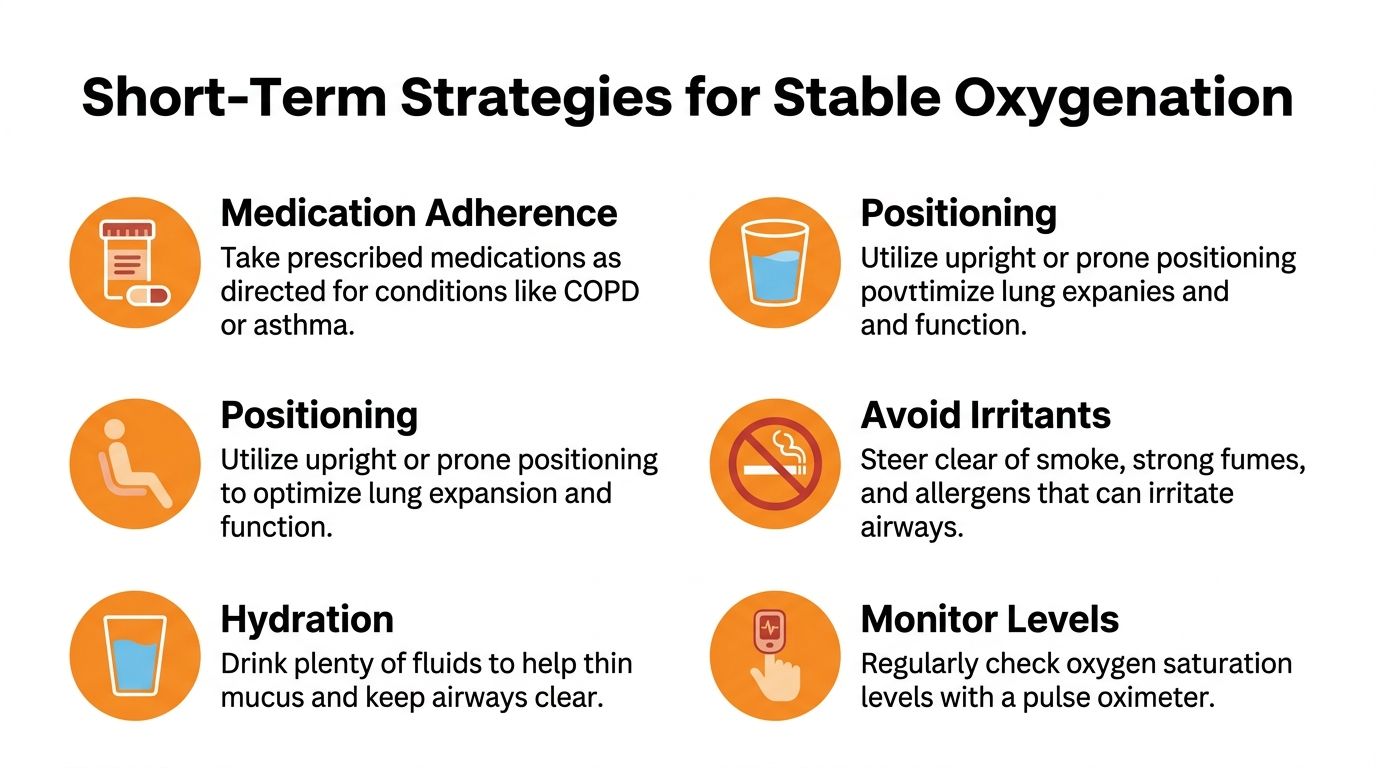
If you have a diagnosed respiratory condition such as asthma or COPD, prescribed treatment matters more than improvised fixes. Use inhalers and other medications exactly as directed. People often underrate how much a missed routine inhaler can affect breathing later in the day.
Hydration also belongs in the short-term plan. Guidance referenced by Cleveland Clinic notes approximately 8 to 10 glasses of water daily, or 2.7 liters for women and 3.7 liters for men, as a useful intake target for supporting blood volume and oxygen transport. Hydration won't rescue a dangerous desaturation, but it can support overall respiratory function and make secretions easier to manage.
Keep your environment on your side:
- Avoid smoke exposure: Even brief exposure can irritate airways.
- Skip heavy exertion for the moment: Choose gentle activity until readings and symptoms are back to baseline.
- Reduce strong fumes: Cleaning products, perfumes, and aerosol sprays can trigger trouble in sensitive airways.
- Monitor trends: Check again after rest, repositioning, and breathing practice.
One of the most meaningful short-term decisions is quitting smoking if you still smoke. Within two weeks of quitting, circulation improves significantly and lung function can increase by up to 30%, directly improving the body's ability to absorb oxygen. That's a rapid return on effort, and it matters at any age.
Know what home care cannot fix
Home strategies have limits. If your oxygen is repeatedly low, if breathlessness is new, or if you need to sit upright just to feel comfortable, talk with your clinician about whether your current treatment plan is enough.
That discussion may include:
- Medication review: Are your inhalers still right for your symptoms?
- Illness check: Infection, heart strain, or fluid problems can all affect oxygenation.
- Supplemental oxygen: This is a support tool, not a sign of failure.
- Sleep assessment: Overnight dips may need proper evaluation rather than guesswork.
When oxygen problems keep returning, the right response isn't to become more tolerant of them. It's to get more precise about the cause.
Long-Term Lifestyle Habits for Better Respiratory Health
The best answer to how to increase oxygen saturation over time is consistency. Daily habits shape how efficiently your body uses oxygen, how well your lungs expand, and how resilient you feel during activity and sleep.
Build better oxygen use into daily life
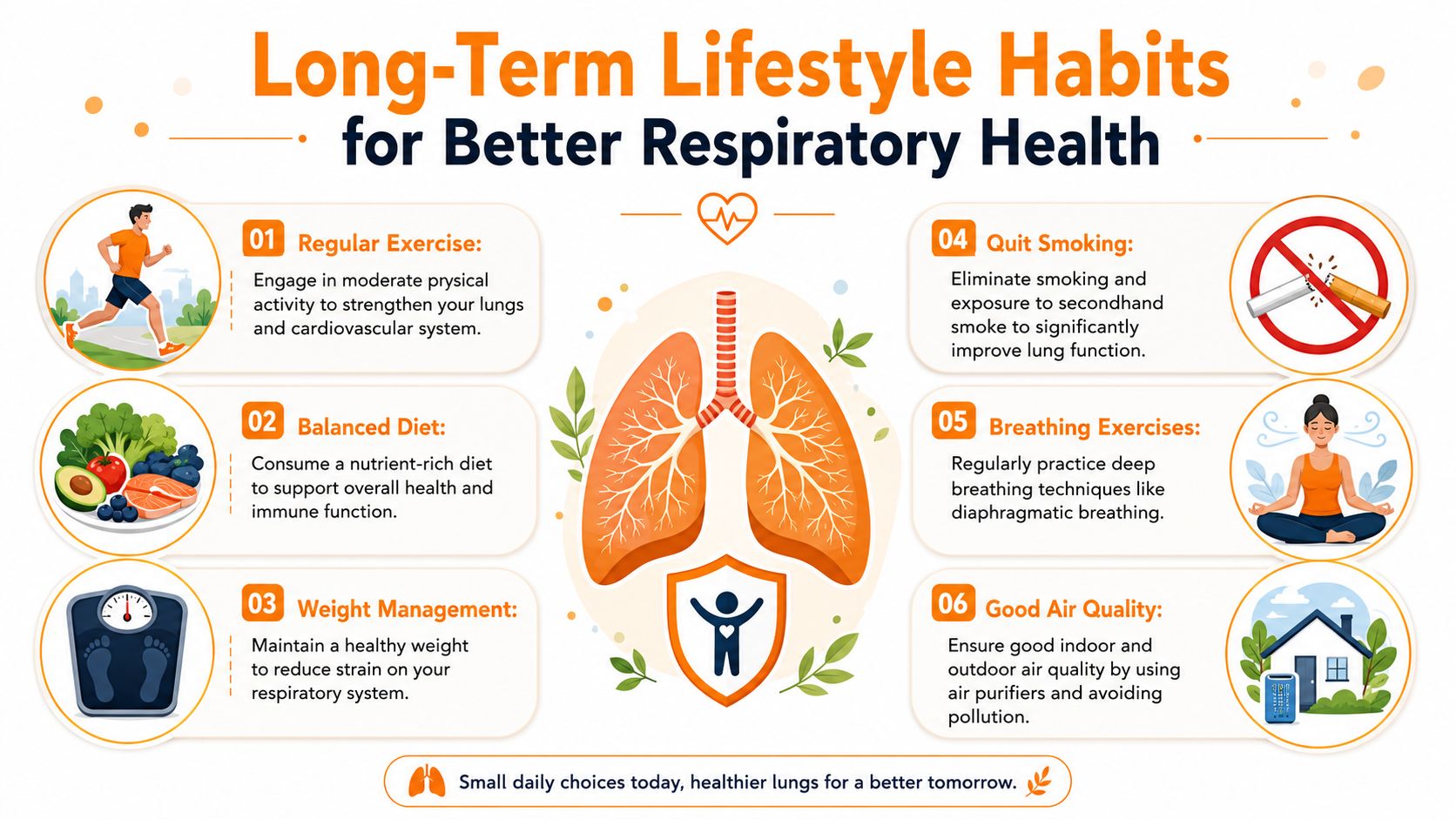
Gentle, regular movement helps more than occasional hard effort. Walking, stretching, and other manageable activity support circulation and help your body use oxygen more efficiently. For older adults, the best exercise plan is often the one you'll repeat.
A few habits matter more than they seem:
- Keep moving most days. Long periods of inactivity can leave you more breathless during basic tasks.
- Maintain a healthy weight. Extra weight can physically limit lung expansion.
- Improve indoor air quality. Air purifiers and cleaner air can reduce irritation from dust and other triggers.
- Stay smoke-free. Even after years of smoking, stopping still helps.
Some households also benefit from small environmental changes, such as better ventilation and reducing clutter that traps dust. None of that is glamorous, but it supports easier breathing.
Improve overnight breathing without overcomplicating it
Nighttime is where many independent older adults first notice a problem. They wake tired, dry-mouthed, or foggy. Their daytime readings may look acceptable, but sleep posture and mouth breathing can still work against them.
One underused strategy is sleep positioning. Some people breathe more easily in a semi-upright posture or on their side rather than flat on their back. In home-care patients with lower oxygen readings, prone positioning has also shown improvement in saturation, though it isn't practical or comfortable for everyone, especially older adults with shoulder, neck, or mobility limitations. The takeaway is simple. Sleep position affects lung mechanics, so it's worth adjusting thoughtfully instead of assuming position doesn't matter.
For sleep quality and recovery, it also helps to think beyond oxygen alone. Good sleep architecture, comfort, and routine all matter. This article on restorative sleep is a useful companion if nighttime fatigue is part of the picture.
Another emerging area is nose-breathing training. Recent data from 2024 to 2025 indicates that nose breathing increases oxygen uptake by 20% compared to mouth breathing, and using mouth tape during sleep can sustain this effect throughout the night, reducing desaturation events by 35% in adults over 60, according to this discussion of nose breathing and mouth tape.
That doesn't mean everyone should start mouth taping tonight.
Use caution if you:
- Have nasal blockage
- Snore heavily or may have sleep apnea
- Feel claustrophobic
- Use sedating medication
- Have trouble removing the tape quickly
A safer starting point is daytime nose-breathing practice. Keep your lips gently closed during quiet activity, focus on breathing in through the nose, and notice whether your mouth tends to fall open during rest. If nighttime mouth breathing is persistent, dry mouth and poor sleep may be clues worth discussing with a clinician.
What works long term is rarely one big intervention. It's the stack of small things done consistently: movement, smoke avoidance, healthy weight, cleaner air, better sleep position, and smarter breathing habits.
Partnering with Your Care Circle and Clinicians
Independence works best when it's backed by communication. Older adults often want support without feeling watched. Families want reassurance without becoming intrusive. Clinicians want useful information, not fragments.

What to share with your clinician
If oxygen levels have become a concern, bring specifics. A clinician can do much more with a pattern than with a memory.
Share:
- When the readings drop: During walking, after meals, at bedtime, or overnight
- What symptoms show up: Breathlessness, fatigue, confusion, cough, chest discomfort
- What helps: Upright sitting, breathing exercises, rest
- What's changed recently: Illness, medication changes, travel, poor sleep, smoke exposure
A simple notebook works. So does a connected system that helps keep family and clinicians aligned. For readers interested in that model, connected health solutions gives a practical view of how shared wellness information can support aging in place.
Good home monitoring doesn't replace clinical care. It makes clinical care more informed.
How caregivers can help without taking over
Caregivers are most useful when they support routine, not when they create alarm around every number.
Helpful caregiver behavior looks like this:
- Prompt, don't pressure: “Let's recheck after you sit upright.”
- Notice patterns: “You seem more tired in the mornings lately.”
- Protect autonomy: Let the older adult do what they can do safely.
- Escalate clearly when needed: If severe symptoms or emergency-level readings appear, act fast.
What usually backfires is arguing over the device, checking too often, or minimizing symptoms because the person “looks okay.” Many people with oxygen problems don't look dramatically ill at first.
Frequently Asked Questions About Oxygen Saturation
Can a pulse oximeter be wrong
Yes. Cold hands, movement, nail polish, poor finger placement, and checking too quickly can all lead to a false low. That's why the best first response to an unexpected reading is to sit still, warm the hand, reposition the device, and recheck.
Does food affect oxygen levels
Food doesn't directly raise SpO2 the way better ventilation or positioning can. Still, nutrition matters because your body needs healthy blood and good overall function to transport oxygen well. If someone has concerns about low iron, poor appetite, or unexplained fatigue, that's worth discussing with a clinician rather than self-diagnosing from an oximeter alone.
Is mouth tape safe for everyone
No. It may be worth cautious discussion for some adults who mouth-breathe at night, but it isn't appropriate for everyone. Avoid experimenting with it if you have nasal blockage, suspected sleep apnea, significant anxiety with anything on the face, or any condition that could make nighttime breathing less predictable. Start with nose-breathing practice during the day and get medical guidance if overnight symptoms are frequent.
When should I stop trying home methods
Stop and seek urgent help if the reading is in the emergency range, if you're struggling to breathe, or if symptoms such as confusion, chest pain, blue lips, or marked weakness appear. Home techniques are for support, not for delaying necessary care.
Rx360 helps independent older adults stay connected to the people who matter while maintaining autonomy at home. If you want a simpler way to keep loved ones informed, support proactive wellness monitoring, and strengthen communication around daily health changes, explore Rx360.
Lower-Risk Medication Plan Checklist
Below is a practical checklist and step plan you can implement into your daily life:
-
List all medications
Include prescriptions, over-the-counter drugs, supplements, sleep aids, creams, patches, eye drops, and inhalers.
-
Mark fall-risk drugs
Flag medicines that cause dizziness, sleepiness, confusion, blurred vision, low blood pressure, or low blood sugar.
-
Ask for a medication review
Bring the list to a pharmacist or prescriber.
-
Review after any warning sign
Request a new medication check after a fall, near-fall, new prescription, dose change, dizziness, or confusion.