

You may know this feeling well. You go to bed at a reasonable time, stay in bed all night, and still wake up feeling as if sleep never quite did its job. Your body feels heavy, your thinking is slow, and the day starts with effort instead of energy.
For many older adults, that experience can be discouraging. It raises practical worries, not just comfort questions. Will I have the energy to do my errands, keep up with my home, remember appointments, or feel steady on my feet? That's why understanding what is restorative sleep matters. It's not just about sleeping longer. It's about getting the kind of sleep that helps your body and brain recover well enough to support daily life and independence.
Table of Contents
- Why Hours Slept Is Not the Whole Story
- The Architecture of Restorative Sleep
- Key Benefits of Restorative Sleep for Older Adults
- Signs You Are Not Getting Enough Restorative Sleep
- Practical Strategies for Enhancing Restorative Sleep
- Embrace Quality Sleep for a Fuller Life
Why Hours Slept Is Not the Whole Story
A common sleep myth sounds simple: if you stayed in bed long enough, you should feel rested. But many people learn that isn't how sleep works.
Take a familiar example. Someone goes to bed on time, sleeps through the night, and still wakes up groggy, stiff, and mentally dull. Another person sleeps for a shorter stretch but wakes up clearer and more alert. The difference often isn't just how long they slept. It's how well their sleep moved through the stages that restore the body and brain.
That's the heart of restorative sleep. When people ask what is restorative sleep, the most helpful answer is this: it's sleep that gives your body and mind enough of the right kinds of recovery. You don't just lose consciousness for a while. Your system goes through organized stages that handle repair, memory, emotional balance, and physical renewal.
Practical rule: Don't judge your sleep by the clock alone. Judge it by how you feel, function, and recover the next day.
This helps explain why counting hours can be misleading. You might spend plenty of time in bed, but if your sleep is light, interrupted, or fragmented, your body may miss important restorative work. Frequent awakenings, discomfort, stress, breathing problems, or an irregular sleep schedule can all interfere.
Older adults often find this especially confusing because sleep can change with age. You may fall asleep earlier, wake more often, or feel that your sleep is lighter than it used to be. That doesn't mean good sleep is out of reach. It does mean the goal shifts from chasing a perfect number of hours to creating conditions for more effective sleep.
A better question is this: did your sleep give your body a chance to repair and your brain a chance to reset? That's what restorative sleep is really about.
The Architecture of Restorative Sleep
Sleep isn't one flat state. It moves through a repeating pattern, almost like a night crew rotating through different jobs. Some parts of sleep help you drift away from wakefulness. Other parts do the heavier repair work.
Sleep works in cycles
Think of the night as a series of rounds. In each round, your body moves through non-rapid eye movement sleep, often shortened to NREM, and rapid eye movement sleep, called REM. These stages don't all do the same thing.
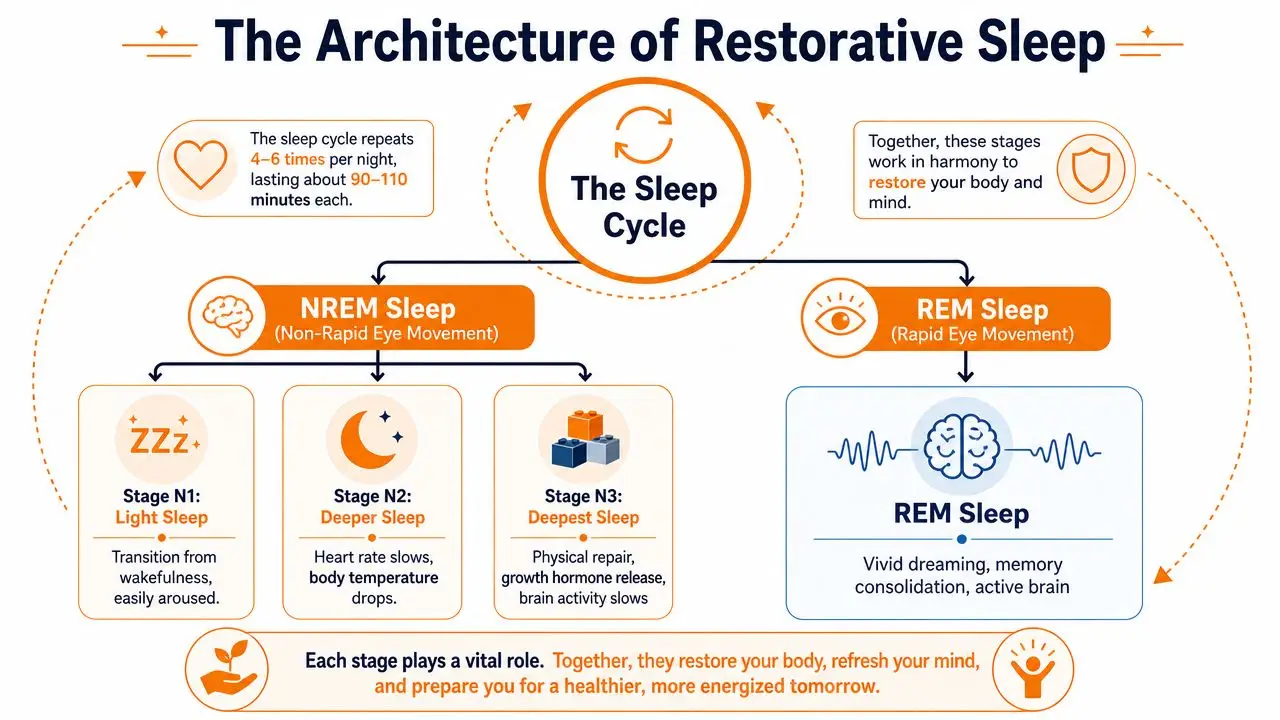
The lighter stages help you transition into sleep. Your breathing slows, your muscles relax, and your body begins to settle. Then, if sleep continues without too much disruption, you reach deeper stages where more substantial restoration can happen.
Many readers get stuck on the word “deep” and assume only one stage matters. That's understandable, but incomplete. Restorative sleep depends on the whole pattern, with special importance placed on deep sleep and REM sleep.
Deep sleep is the body's repair shift
Deep sleep is often the stage people mean when they talk about “solid” sleep. This is the stretch where the body is hardest to wake, and where physical restoration is especially active.
A useful way to picture it is a repair shop working overnight while the front office is closed. During deep sleep, the body focuses on tasks like:
- Physical repair: Tissues recover from everyday wear and strain.
- Muscle recovery: The body gets a chance to restore itself after activity.
- Immune support: Your system uses this time to strengthen its defenses.
- Energy renewal: Deep sleep helps you wake with more physical steadiness.
If someone wakes often because of pain, noise, stress, or breathing disturbances, this repair shift may get cut short. That can leave them feeling as if they slept, but didn't recover.
Deep sleep is less about being unconscious and more about giving the body uninterrupted time to do maintenance.
REM sleep is the mind's processing time
REM sleep plays a different role. This stage is closely tied to dreaming, but dreams are only part of the story. REM is also a period when the brain is active in ways that support mental and emotional function.
You can think of REM as the mind's filing system. Experiences from the day are sorted, organized, and integrated. That helps with:
- Memory: Holding onto useful information
- Learning: Making sense of new experiences
- Emotional processing: Softening the sharp edges of stress
- Mental clarity: Supporting clearer thinking the next day
That's why poor sleep doesn't just make people tired. It can make them feel forgetful, irritable, or emotionally stretched thin.
The key point is that restorative sleep isn't a single magic moment. It's a sequence. Your body needs enough stable sleep to move through these stages repeatedly during the night. When that happens, you're more likely to wake up refreshed in a real, functional sense. Not just “I was in bed,” but “I'm ready to live my day.”
Key Benefits of Restorative Sleep for Older Adults
For older adults, good sleep reaches far beyond feeling less tired. It affects how clearly you think, how safely you move, and how confidently you manage daily life.

Better sleep supports clearer thinking
Many families first notice sleep problems through changes in thinking. A person says, “I'm just in a fog today,” or forgets something they usually remember without effort. That kind of mental dullness can follow a night that lacked enough restorative sleep.
REM sleep is especially important here. When the brain doesn't get enough organized overnight processing, the next day may feel slower. You may misplace items, lose your train of thought, or struggle to focus on conversations. That can be unsettling, especially if memory changes are already a concern.
Clear thinking supports independence in quiet but important ways. It helps with medication routines, driving decisions, conversations with doctors, paying bills, and remembering appointments. Sleep won't solve every cognitive challenge, but poor sleep can make any challenge feel worse.
Physical recovery matters more with age
Deep sleep supports physical restoration, and that becomes more meaningful as the body gets older. Daily life places demands on muscles, joints, balance, and energy reserves. A restful night helps the body recover from those ordinary demands.
That can show up in practical ways:
- Morning energy: You're more likely to start the day with usable strength.
- Movement quality: Walking, climbing stairs, and standing up may feel steadier.
- Resilience: The body handles activity better when it has recovered well.
- Comfort: A rested body may feel less strained after routine tasks.
Older adults don't need to be running races for this to matter. Gardening, cooking, laundry, shopping, and housework all ask something of the body. Restorative sleep helps you keep doing those things with less strain.
A good night's sleep doesn't just improve comfort. It can make ordinary tasks feel possible again.
Sleep helps protect day-to-day independence
Independence is built on many small abilities working together. You need enough focus to make sound choices, enough energy to follow through, and enough steadiness to move safely through your home and community.
Poor sleep can chip away at all three. It can shorten patience, reduce motivation, and increase the sense that everything takes more effort than it should. Over time, that can lead people to pull back from activities they enjoy or depend on.
Restorative sleep supports independence because it improves the quality of the day that follows. It can help you stay engaged with routines that matter, such as:
- Managing the home
- Keeping up with personal care
- Staying socially connected
- Participating in favorite hobbies
- Maintaining confidence in daily decisions
For family members, this is worth noticing too. If a loved one seems more capable after a good night and much less steady after a rough one, that pattern matters. Sleep is not a luxury. It's part of the foundation that supports healthy aging in place.
Signs You Are Not Getting Enough Restorative Sleep
Some people assume poor sleep always looks dramatic, such as lying awake for hours. Often, it doesn't. Many older adults fall asleep without much trouble but still miss the deeper, more renewing parts of sleep.
How poor sleep shows up during the day
The most useful clues often appear after you get out of bed. You may wake feeling unrefreshed, even after what seemed like a full night. Or you may get through the morning but fade early, relying on naps, caffeine, or sheer determination to keep going.
Mood changes can also be a sign. People who aren't getting enough restorative sleep may feel more easily irritated, more anxious, or less patient than usual. Families sometimes mistake that for personality change, when part of the picture may be poor sleep quality.
Here's a simple self-check.
Common Signs of Poor Restorative Sleep
| Symptom | What It May Indicate |
|---|---|
| Waking up tired | Sleep may have been too light, interrupted, or poorly timed |
| Brain fog | The brain may not be getting enough overnight recovery |
| Daytime sleepiness | Sleep may not be giving enough usable restoration |
| Irritability or low patience | Poor sleep can affect emotional regulation |
| Trouble focusing | Mental processing may feel slower after fragmented sleep |
| Forgetfulness | Memory support during sleep may be reduced |
| Frequent naps that don't help much | Nighttime sleep quality may be low |
| Feeling unsteady or weak | Physical recovery may be incomplete |
| Needing caffeine late in the day | You may be compensating for poor overnight rest |
| Getting sick more often or taking longer to bounce back | Sleep may not be supporting your immune system well |
A pattern matters more than a single rough day. Everyone has an occasional bad night. The concern is when these signs keep showing up and start interfering with normal routines.
If you keep saying, “I slept, but I don't feel restored,” it's worth paying attention. Your body may be asking for better quality, not just more time in bed.
Practical Strategies for Enhancing Restorative Sleep
Improving sleep usually works best when you focus on simple, repeatable habits. A perfect routine isn't necessary; a steady one is.
Build habits that make sleep easier
Start with timing. Your body likes rhythm. Going to bed and getting up at roughly the same times helps train your internal clock. That doesn't mean life must become rigid, but wide swings from one day to the next can make sleep less predictable.
A short wind-down routine also helps. Many people try to fall asleep while their mind is still in “day mode.” A better approach is to create a gentle transition.
Consider habits like these:
- Keep wake time steady: A regular morning schedule often helps more than obsessing over bedtime.
- Create a closing ritual: Read, stretch lightly, listen to calm music, or practice slow breathing.
- Watch late stimulants: Caffeine later in the day can linger longer than people expect.
- Be careful with alcohol: It may make you sleepy at first but can lead to lighter, more broken sleep.
- Get daylight early: Morning light helps anchor the body's sleep-wake rhythm.
- Move during the day: Walking or other regular activity can support healthier sleep at night.
Many older adults also wonder about naps. Naps aren't automatically bad, but long or late naps can take pressure off nighttime sleep. If you nap and then struggle to sleep at night, that's a clue to adjust.
Shape a bedroom that supports rest
Your environment matters more than people think. A bedroom doesn't need to look fancy. It needs to help your nervous system settle.

Look at the room with fresh eyes:
- Light: Keep it dim in the evening and dark during sleep if possible.
- Noise: Reduce sudden sounds. Some people do well with a fan or gentle background sound.
- Comfort: Pillows, mattress support, and bedding temperature all matter.
- Clutter: A calm room can help create a calmer pre-sleep mindset.
If pain, reflux, nighttime urination, or room temperature regularly wake you, those are not minor details. They can repeatedly interrupt the deeper stages that make sleep restorative.
Know when to ask for medical help
Sometimes sleep hygiene alone won't solve the problem. If you snore heavily, gasp during sleep, kick often, wake with headaches, or feel persistently exhausted despite good habits, talk with a clinician.
Medical guidance is especially important if poor sleep is affecting safety, memory, mood, or blood pressure management. The same is true if a loved one notices dramatic restlessness, confusion after waking, or signs of breathing problems overnight.
Bring specific observations to the appointment. Instead of saying “I sleep badly,” try describing what happens. For example:
- How often you wake up
- How you feel in the morning
- Whether you nap during the day
- Any snoring, choking, or leg discomfort
- What medicines or supplements you take
That kind of detail can make the conversation much more useful.
How supportive wellness technology can help
For older adults living independently, sleep concerns often affect the whole family. The individual may feel frustrated. Adult children may worry from a distance. Clinicians may only hear a brief summary during a visit.
Non-intrusive wellness technology can be helpful. Some modern systems track patterns such as time in bed, overnight movement, and changes in routine. They don't replace medical care, but they can help people notice trends that might otherwise be missed.
That matters because sleep problems are often pattern problems. One restless night may mean very little. Repeated restlessness, more time spent in bed without feeling rested, or a noticeable shift in overnight habits can give families and care teams a clearer starting point for conversation.
Supportive technology works best when it stays in the background, respects independence, and helps people respond earlier to changes that matter.
For older adults, that kind of support can reduce guesswork. For families, it can provide reassurance without constant checking in. For clinicians, it can add context that helps guide better questions.
Embrace Quality Sleep for a Fuller Life
Restorative sleep is one of the quiet engines of daily well-being. It helps the body repair, helps the brain organize and recover, and helps the next day feel more manageable. That's why the answer to what is restorative sleep goes far beyond “sleeping enough.” It means getting sleep that renews you.
For older adults, that renewal connects directly to independence. Better sleep can support steadier movement, clearer thinking, better emotional balance, and more confidence in everyday routines. Those benefits show up in ordinary life, which is exactly where they matter most.
If your sleep hasn't felt refreshing lately, take that seriously, but not hopelessly. Small changes can make a meaningful difference. A steadier routine, a calmer bedroom, attention to symptoms, and the right medical support can all move sleep in a better direction.
The goal isn't perfect nights. It's better recovery, more good days, and a stronger foundation for living life on your own terms.
If you want a simple, supportive way to stay aware of wellness patterns while protecting independence, explore Rx360. It's designed to help older adults, families, and care teams stay connected through clear health insights and discreet technology that fits real daily life.
Lower-Risk Medication Plan Checklist
Below is a practical checklist and step plan you can implement into your daily life:
-
List all medications
Include prescriptions, over-the-counter drugs, supplements, sleep aids, creams, patches, eye drops, and inhalers.
-
Mark fall-risk drugs
Flag medicines that cause dizziness, sleepiness, confusion, blurred vision, low blood pressure, or low blood sugar.
-
Ask for a medication review
Bring the list to a pharmacist or prescriber.
-
Review after any warning sign
Request a new medication check after a fall, near-fall, new prescription, dose change, dizziness, or confusion.