If your watch hands you one heart rate variability number and you treat it like a grade, you're asking that number to do a job it was never built for. What is heart rate variability, if it isn't a simple score for how your heart is doing today? It's the small change in timing from one normal beat to the next. Two mornings can look different because you slept poorly, stood up, or measured at a new hour, even when the rest of your week feels the same. Older adults, and the family members who sit with them, can read those numbers more calmly once they know what a single reading can and can't show. A clearer picture comes from repeated readings taken the same way, with a short note about the day beside each one.
Table of Contents
- Heart Rate Variability in Plain Terms
- How Your Nervous System Shapes Beat-to-Beat Timing
- How HRV Is Measured and the Numbers Behind It
- What Moves HRV and How to Read a Single Reading
- Typical HRV Ranges for Older Adults and Why One Number Misleads
- Supporting Tracking as a Family Caregiver
- Tracking HRV Consistently and Knowing When to Ask for Help
Heart Rate Variability in Plain Terms
The plain definition below follows the 1996 Task Force standards, which PubMed indexes as the statement on how beat-to-beat intervals are measured and read.
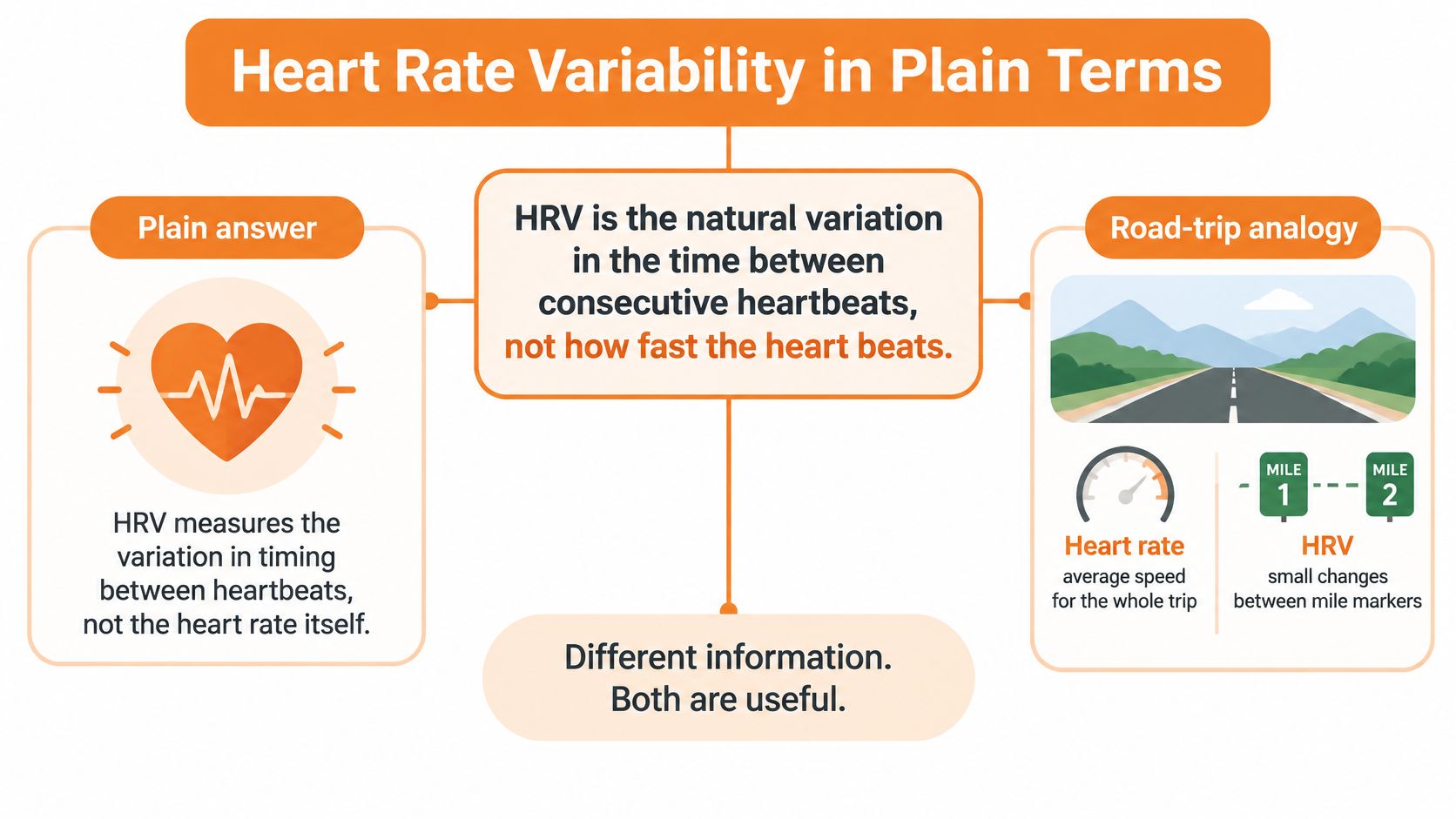
Heart rate variability (HRV) is the variation in the time interval between successive normal heartbeats. It isn't how fast the heart beats. Think of a road trip. Heart rate is the average speed for the whole trip. HRV is how much that speed rises and falls between mile markers. The heart can average the same pace while the gaps between beats still shift.
Those gaps are normal-to-normal (NN) intervals, the time between normal beats, and they're reported in milliseconds. The same standards note that two people can share an average heart rate and still have very different interval patterns. A short rest and a full-day recording also describe different windows, so the conditions of the reading belong next to the number.
| Measure | What it describes | Usual unit | How it is reported |
|---|---|---|---|
| Heart rate | Number of beats in a minute | beats per minute (bpm) | Average over a period of time |
| Heart rate variability (HRV) | Variation in the time gaps between consecutive normal beats | milliseconds (ms) | Summary values such as SDNN or RMSSD |
Three quick takeaways:
- HRV is context-dependent. Sleep, posture, and the hour of the reading sit inside the number.
- Recording conditions matter. A two-minute rest and a day-long recording aren't the same kind of summary.
- HRV isn't a diagnosis on its own. It's a physiological signal that needs the story around it.
Family test: "Heart rate is the trip's average speed, and heart rate variability is how much that speed changes along the way."
How Your Nervous System Shapes Beat-to-Beat Timing
Your autonomic nervous system is the body's automatic control panel. You don't flip a switch for it. Two partners share the work. The sympathetic branch tends to speed the heart for alertness, the way you feel when you hurry to answer the door. The parasympathetic branch tends to slow it for calm, the way you feel once you're settled in a chair.
A drummer keeps a steady beat and still shifts timing by tiny amounts, because the musician breathes, listens, and answers the room. The heart works in a similar way. The beat stays organized, and the gaps still move.
Breathing and the vagus nerve
In many healthy people, the heart speeds up a little on the inhale and slows a little on the exhale. That pattern is called respiratory sinus arrhythmia. You can picture it as the drummer leaning forward on a breath in, then settling back on the breath out. It isn't a performance you have to force. It's one reason timing changes from beat to beat while you sit still.
The vagus nerve is a fast pathway in that calmer branch. It can change beat timing quickly. That's why RMSSD, a short-term HRV summary, is often linked to this vagal activity. The link is general physiology, not a reading of any one person's health.

Everyday life nudges the balance. Sleep, posture, room temperature, a walk, and a tense conversation can all shift the timing. Say you're sitting still and you notice your pulse for a minute. Slow breathing and quick breathing won't feel identical, because the gaps respond to the breath. That little home observation is a way to notice the pattern. It isn't an assessment of you.
Emotional strain is one of the nudges people feel most clearly, and a closer look at how stress shows up in heart rate keeps the focus on daily life rather than on a single millisecond. None of this assigns a meaning to one morning's number. It only shows why the same person can look different from one quiet hour to the next.
How HRV Is Measured and the Numbers Behind It
The measurement rules in this section come from the 1996 joint Task Force of the European Society of Cardiology and the North American Society of Pacing and Electrophysiology, published in Circulation and carried on the American Heart Association journals site.
The chain is short. A sensor notices each heartbeat. That sensor might be an electrocardiogram (ECG), a chest strap, or a wrist-based optical sensor. Software records the time between beats, then sets aside abnormal or noisy beats so the remaining gaps are NN intervals. HRV is the variation in those intervals, reported in milliseconds, not a change in beats per minute.
Time-domain summaries
Two time-domain measures anchor most reports. SDNN is the standard deviation of NN intervals, a summary of overall variability across the recording. RMSSD is the root mean square of successive differences between adjacent NN intervals. RMSSD is especially sensitive to short-term, beat-to-beat changes tied to parasympathetic, or vagal, activity. SDNN takes in slower and faster influences across the whole window.
Frequency bands from the 1996 standards
The same standards split frequency-domain HRV into total power from 0.04 to 0.40 Hz, low frequency from 0.04 to 0.15 Hz, and high frequency from 0.15 to 0.40 Hz. Duration and method change the result, so these labels stay attached to the number.
| Metric | What it reflects | Typical context | Unit |
|---|---|---|---|
| SDNN | Overall variability across the recording | Standard deviation of NN intervals, with 24-hour recordings in the 1996 standards | milliseconds (ms) |
| RMSSD | Short-term beat-to-beat changes, often linked to vagal activity | Commonly used with short resting recordings | milliseconds (ms) |
| Total power | Overall frequency-domain variability | Frequency band 0.04 to 0.40 Hz | ms² |
| Low frequency (LF) power | Mid-range rhythmic variation | Frequency band 0.04 to 0.15 Hz | ms² |
| High frequency (HF) power | Faster rhythmic variation linked to breathing | Frequency band 0.15 to 0.40 Hz | ms² |
A five-minute rest and a 24-hour SDNN aren't directly comparable. They cover different stretches of life. Consumer devices also don't all print the same label. One app may show a sleep RMSSD, another a daytime spot check. Read the label before you compare two numbers, even when both are called HRV and both come from the same wrist.
What Moves HRV and How to Read a Single Reading
A 2023 systematic review of HRV as a stress measure, indexed on PubMed, screened 413 articles and included 17 studies. 11 of the 17 reported statistically significant, predictable HRV responses to stress. A broader look at devices and interpretation, in a review on PMC, describes HRV as highly context-dependent and not, by itself, a diagnosis.
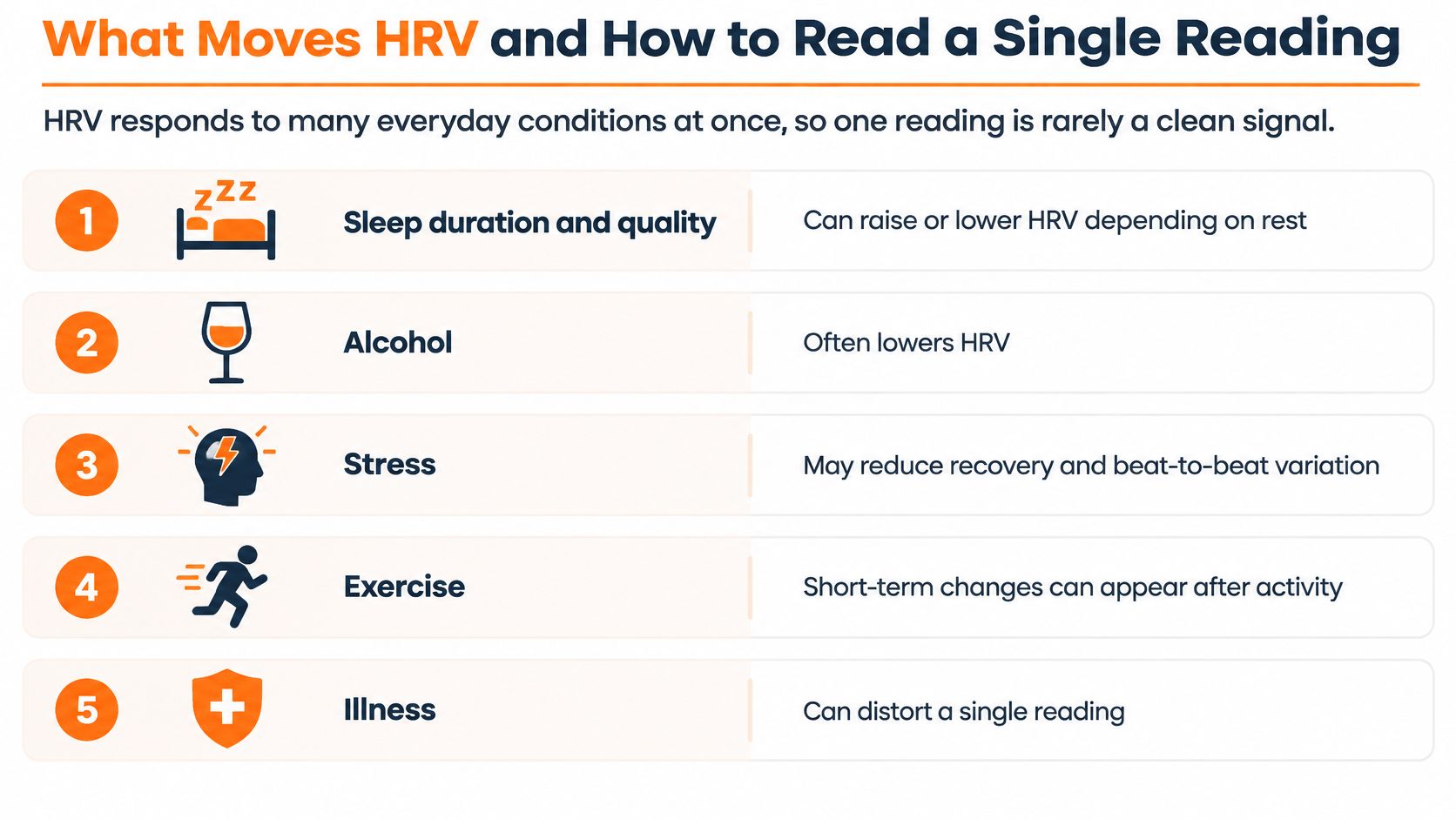
HRV responds to many everyday conditions at once, so one reading is rarely a clean signal. The same review lists medication use, sleep disruption, alcohol, illness, activity, posture, breathing pattern, age, and measurement conditions among the things that can move a result.
- Sleep duration and quality. A short night and a solid night are different starting points. Sleep debt is one plain way families talk about that gap.
- Alcohol. An evening drink can change the next reading without any other change in the week.
- Illness or fever. Feeling unwell can shift timing while you're still deciding how you feel.
- Physical activity and recovery. A long walk and a quiet day don't leave the same trace.
- Breathing pattern. Slow breaths and quick breaths pull the gaps in different directions.
- Posture. Lying down, sitting, and standing are different setups.
- Time of day. Morning and late evening aren't interchangeable samples.
- Certain medications. A pharmacist or clinician is the person who can explain a specific medicine. The list here only notes that medicines can matter.
- Emotional stress. A hard conversation can show up in the timing even when the afternoon looked ordinary on paper.
One restless night
Say you measure after a broken night, then again after a rested night. The two readings can look far apart while nothing else in your health story has changed. That's a weak signal. It's a note about the night, not a verdict.
More data isn't more certainty
Consumer devices commonly use spot readings or sleep-only measurements, and few provide continuous 24-hour HRV. Strong evidence for using those wearables for clinical HRV analysis remains limited. Device methods, outputs, validation, and interpretation also differ, which makes a neat comparison harder than the app screen suggests.
Abnormal HRV can provoke anxiety when normal variation is misunderstood. Continuous alerts without context can raise worry rather than add clarity.
One dip after a poor night is a weak signal. Several weeks of drift, written down next to sleep, activity, and how you feel, is a fuller note to bring into a conversation that already includes symptoms, vital signs, medication review, and a clinician's judgment. The number complements those pieces. It doesn't replace them.
Typical HRV Ranges for Older Adults and Why One Number Misleads
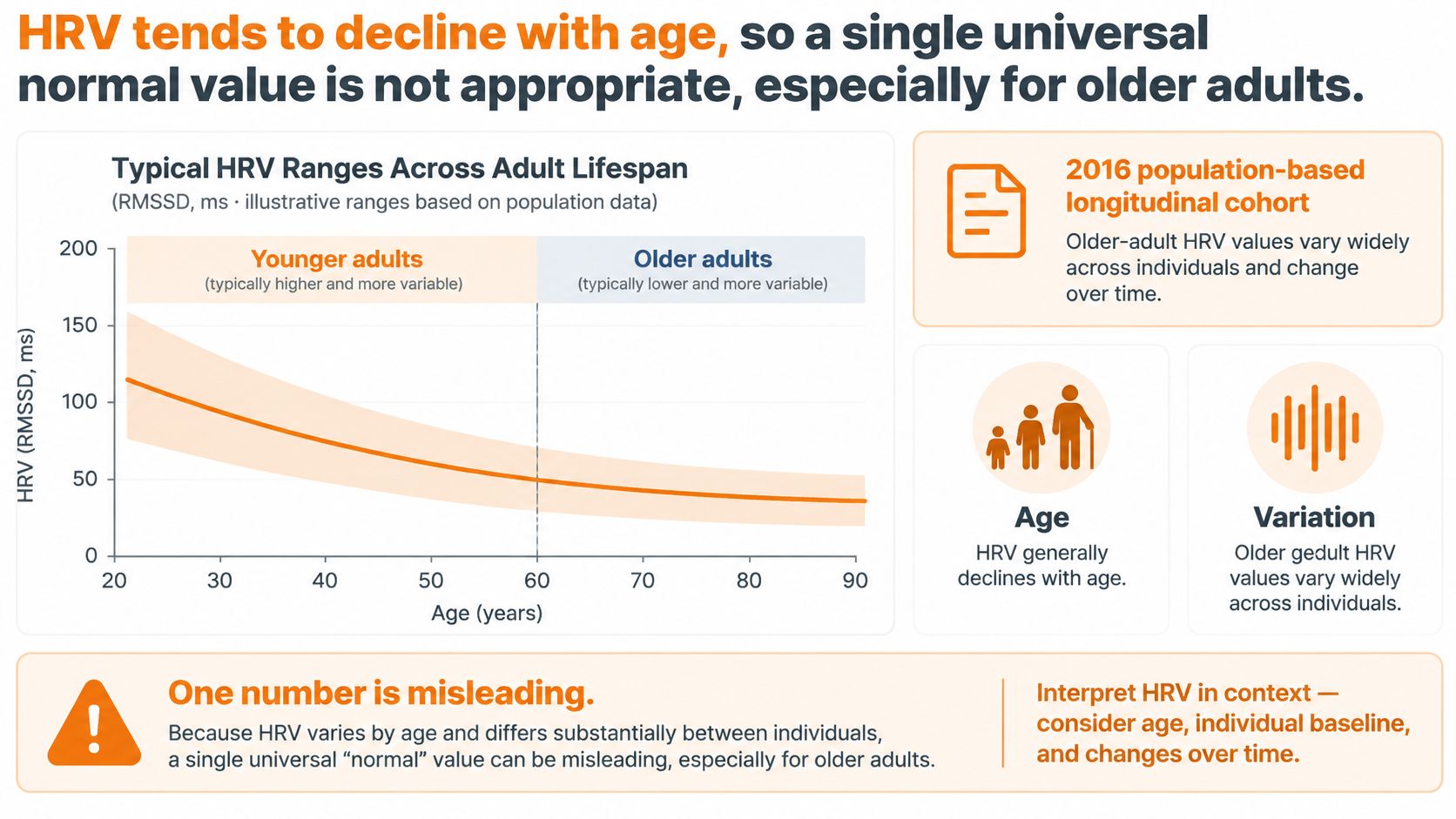
What does one HRV reading really tell you? Usually, less than it seems. HRV changes with age, so there is no single universal “normal” range that fits every older adult. The European Society of Cardiology statement gives broad reference thresholds, but they are population-level guideposts, not personal targets.
Population thresholds, not a personal rule
The 1996 standards classify 24-hour SDNN below 50 milliseconds as highly depressed HRV, and SDNN below 100 milliseconds as moderately depressed HRV. These thresholds describe groups measured over a full day. They do not, by themselves, diagnose a health problem or explain why someone's reading is low.
| Reference point | Figure | Context |
|---|---|---|
| SDNN below 50 ms | Classed as highly depressed HRV | 24-hour population threshold from 1996 Task Force standards, not an individual diagnosis |
| SDNN below 100 ms | Classed as moderately depressed HRV | Population-level threshold from 1996 Task Force standards, not an individual diagnosis |
A single number is like one frame from a film: it captures a moment, not the whole pattern. Medications, illness, sleep, breathing, physical activity, and recording quality can all affect a result. That is why comparing your reading with a neighbor's, or with a chart that does not reflect your circumstances, can be misleading.
For an older adult and the family member helping track readings, the useful comparison is usually with that person's own readings over time. Take repeated measurements under similar conditions and note relevant context. A steady pattern gives a clearer picture than an isolated high or low result, while still leaving room for normal day-to-day variation.
A personal baseline, built from repeated readings under similar conditions, carries more meaning than a generic number.
Supporting Tracking as a Family Caregiver
Caregivers often hold the notes that make a reading easier to place. The older adult still owns the routine. You're keeping the context, not grading the day.
A shared habit can stay small:
- Agree on one time of day. The same hour makes week-to-week comparisons fairer.
- Write the day beside the number. Sleep, alcohol, illness, activity, and posture take one line each.
- Check placement together. A loose band or a shifted wrist changes what the sensor sees.
- Look at weekly averages. A single day is a snapshot. A week is a pattern.
- Ask what they want shared, and with whom. Consent keeps the log inside the relationship they choose.
Those notes matter because ordinary things, from a late meal to a different chair, can move the timing. The log is a memory aid, not a scorecard.
Routines that support independence
Many older adults already keep habits that make days feel steadier. A regular sleep schedule, gentle movement they enjoy, and time with people they like are part of aging in place. They're general context for a good week, not instructions to change any treatment. Ask which routines they want to keep. A walk with a neighbor, a standing stretch by the counter, or a phone call after lunch can matter more to independence than any screen.
Connected care for families is one way relatives stay in the loop without taking over the day. If a change worries you, the useful step is to contact the older adult's clinician with the log, not to decide what the number means on your own. HRV sits beside that judgment. It doesn't stand in for it.
Tracking HRV Consistently and Knowing When to Ask for Help
HRV can change over the course of a day, so a reading is most useful when you know when and how it was taken. A PubMed-indexed summary discusses timing and device fit in work involving older adults. Wearable readings can also vary with the person, the sensor, and the conditions of measurement. A missed reading or a surprising value may reflect those factors, so it helps to consider the surrounding context before interpreting a pattern.
A steady routine
- Measure at the same time of day.
- Keep the same posture and position.
- Use the same device placement.
- Note sleep, alcohol, illness, and activity.
- Compare weekly averages, not single days.
- Keep the log for several weeks to build a personal baseline.
- Share the summary with a trusted family member or clinician when you would like another perspective.
Don't treat every low value as a health event. Check an unexpected trend against your notes before deciding what it might mean.
Consistency makes comparisons fairer, much like checking the same place on a calendar rather than comparing different days at random. Even then, HRV is one piece of information, not a diagnosis. If a device misses readings, focus on the pattern you can see rather than trying to fill gaps with guesses.
Sudden chest pain, fainting, or severe shortness of breath are reasons to contact emergency services now. A persistent change you cannot explain is worth discussing with a clinician, with your log available as context. The number can support that conversation, but it does not make the decision.
Rx360 brings health insights, simple technology, and family connection together for older adults who want to age in place. HRV can fit into that support when readings are viewed as a personal trend, alongside notes about the day and communication with people the older adult chooses. Visit Rx360 to learn how its circle of support works.
Lower-Risk Medication Plan Checklist
Below is a practical checklist and step plan you can implement into your daily life:
-
List all medications
Include prescriptions, over-the-counter drugs, supplements, sleep aids, creams, patches, eye drops, and inhalers.
-
Mark fall-risk drugs
Flag medicines that cause dizziness, sleepiness, confusion, blurred vision, low blood pressure, or low blood sugar.
-
Ask for a medication review
Bring the list to a pharmacist or prescriber.
-
Review after any warning sign
Request a new medication check after a fall, near-fall, new prescription, dose change, dizziness, or confusion.