You're sitting at the kitchen table when the phone rings. It's an unexpected call from your doctor's office, your bank, or your adult child. Before you even process the words, you feel it. Your chest seems louder. Your pulse picks up. A smartwatch might show a jump in heart rate, but you didn't need a device to tell you that your body noticed stress right away.
That reaction is common. It's part of the body's built-in alarm system. The confusing part is knowing when a racing heart is just a normal response to a tense moment, and when stress on heart rate starts to matter more for long-term health.
For many older adults, that question gets even more important. Heart rate doesn't always tell the full story. Sometimes the body shows signs of strain earlier through heart rate variability, often shortened to HRV. That matters if you're aging in place, checking in on a parent from a distance, or trying to make sense of readings from a smartwatch or home monitor.
Table of Contents
- Your Heart's Response to a Stressful World
- The Body's Alarm System and Your Heart
- Acute Spikes Versus Chronic Strain on Your Heart
- How to Monitor Stress on Your Heart Rate and HRV
- When Your Heart Rate Signals a Problem
- Practical Ways to Calm Your Heart and Mind
Your Heart's Response to a Stressful World
A near miss in traffic. A confusing insurance letter. A news alert late at night. The feeling of stress is often recognized in the body before it's identified by name. The heart beats faster, the chest tightens, and the body shifts into high alert.
That quick change doesn't automatically mean something is wrong. In many cases, your body is doing exactly what it was designed to do. It's trying to protect you by preparing you to act.
What matters is the pattern. A brief surge after a startling moment is very different from living with tension day after day. Ongoing caregiving stress, financial strain, loneliness, poor sleep, and constant worry can keep the body in a more activated state than it was meant to stay in.
For older adults, there's another layer. A person may look calm, have a fairly ordinary pulse, and still be carrying significant physiologic stress. That's where people often get confused. They assume heart rate alone tells them whether stress is affecting the heart. Sometimes it does. Sometimes it doesn't.
Stress on heart rate isn't only about a pounding pulse during a bad moment. It's also about how well the body returns to balance afterward.
That's why it helps to think of stress and heart health as a conversation between the brain, the nervous system, and the heart. Once you understand that conversation, your symptoms, your wearable data, and your daily habits start to make more sense.
The Body's Alarm System and Your Heart
Your heart doesn't speed up on its own. The nervous system gives it instructions. A simple way to picture this is to think of two controls working together: a gas pedal and a brake.
Two systems, one heartbeat
The sympathetic nervous system acts like the gas pedal. It prepares the body for action. The parasympathetic nervous system acts like the brake. It supports rest, recovery, and energy conservation.
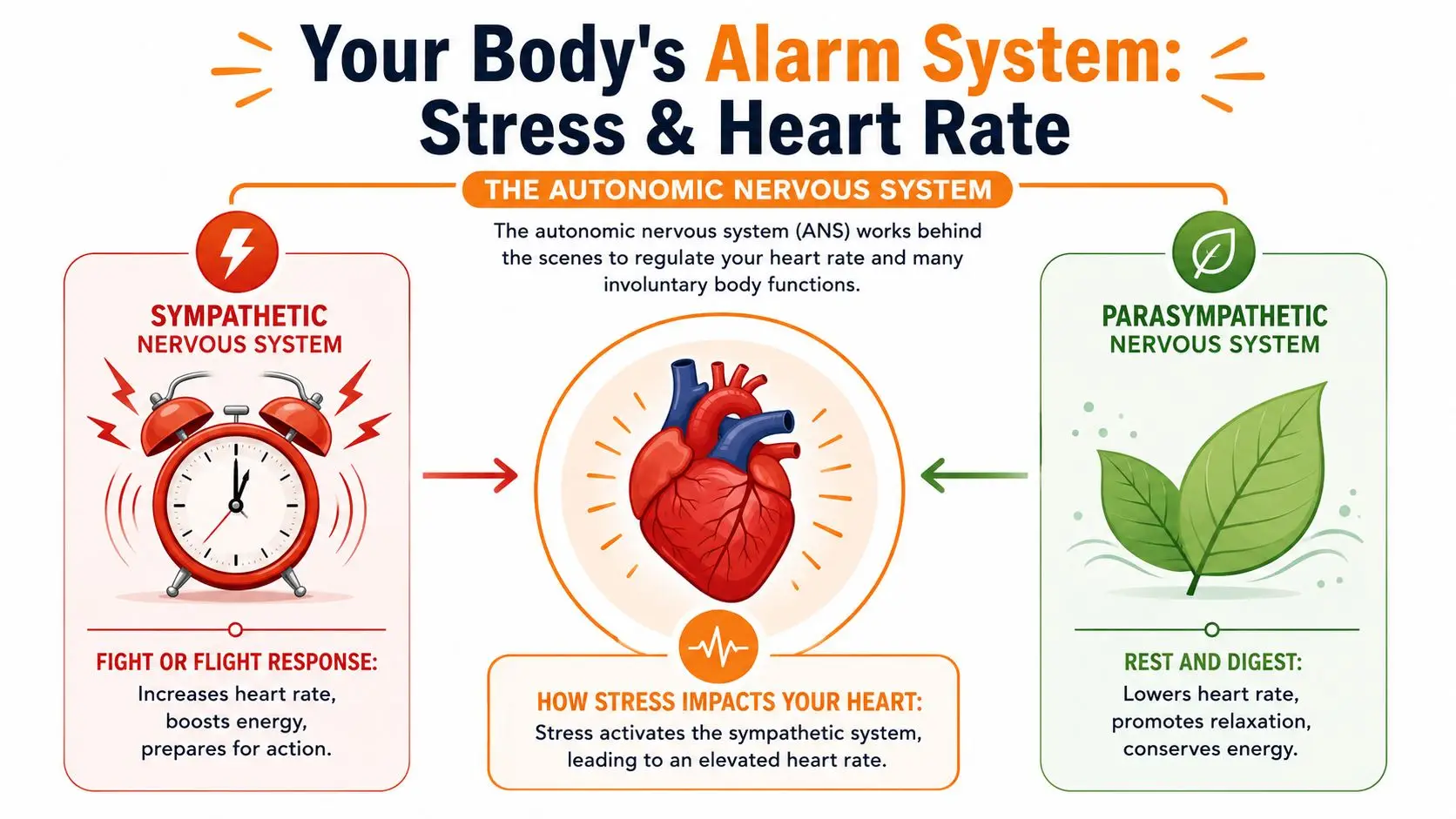
When your brain senses a threat, even a non-physical one like an upsetting message or tense conversation, it leans harder on the gas pedal. Stress hormones, including adrenaline, help the body react quickly. Blood pressure rises, the heart beats faster, and muscles get more blood flow so you can respond.
This reaction is useful in short bursts. It helps you focus, move, and protect yourself. That's why your pulse may jump before public speaking, during an argument, or while waiting for test results.
What adrenaline changes in real time
During acute stress, sympathetic activation releases adrenaline, which can push heart rate above 100 beats per minute and raise blood pressure, according to University of Missouri Health Care's explanation of chronic stress and the heart. The same source explains that if this response lasts, the extra workload on the heart and blood vessels can contribute to vascular damage and higher cardiovascular event risk over time.
That helps explain an important point. The body's alarm system is not the enemy. The issue is when the alarm keeps sounding.
Practical rule: A stress response is meant to help you handle a challenge, then settle down. If your body doesn't get that recovery time, the heart carries more of the burden.
A lot of people also wonder, “If stress is emotional, why does it feel so physical?” The answer is that the brain doesn't separate emotional threat from physical threat as neatly as we do in conversation. Your body reacts to both through the same control systems.
Some common signs that your stress system is switched on include:
- Faster pulse: Your heart may feel like it's pounding or racing.
- Higher blood pressure: You may not feel this directly, but it often rises during stress.
- Shallow breathing: Many people start breathing from the upper chest instead of more slowly and fully.
- Tense muscles: Tight shoulders, jaw clenching, and headaches are common companions.
For older adults, this explanation matters because symptoms can be subtle. A person may not describe themselves as “stressed,” yet their sleep, breathing, irritability, and heart-related readings may all reflect the same activated system.
Acute Spikes Versus Chronic Strain on Your Heart
Not all stress affects the heart in the same way. The body can usually handle a short-term demand. It struggles more when stress becomes a daily condition.
A short burst is not the same as ongoing pressure
An acute stress response happens around a specific event. You rush to answer the door. You almost slip on the stairs. You speak in front of a group. Your pulse rises, then ideally settles once the event passes.
Chronic stress feels different. It hangs around. It can come from caregiving, grief, limited mobility, family conflict, financial pressure, or feeling alone. Instead of one sharp spike, the nervous system gets repeated reminders to stay on guard.
The American Heart Association notes that a stressful situation can trigger adrenaline, briefly speeding up heart rate and raising blood pressure, while chronic stress can contribute to high blood pressure, heart attack, and stroke risk in the longer term. The same overview explains that exercise stress testing often uses a target heart rate of about 85% of the age-predicted maximum, showing how heart-rate response is used clinically as a meaningful signal in heart assessment. You can read that in the American Heart Association's guide to stress and heart health.
That distinction helps clear up a common misunderstanding. People often panic over occasional stress-related heart flutters, but overlook the slower, quieter wear and tear of unrelenting pressure.
Acute stress vs chronic stress impact on the heart
| Factor | Acute Stress | Chronic Stress |
|---|---|---|
| Typical trigger | A sudden event, surprise, deadline, or conflict | Ongoing caregiving, worry, poor sleep, repeated strain |
| Duration | Short-lived | Persistent or frequently recurring |
| Heart response | Temporary increase in heart rate and blood pressure | Repeated activation with less time to recover |
| How it feels | A clear “rush” or jolt | Fatigue, tension, irritability, poor sleep, feeling keyed up |
| Main concern | The body is usually built to tolerate short bursts | Long-term load on the heart and blood vessels |
A single stressful moment can feel dramatic. Chronic stress is often quieter, but it matters more for long-term heart health.
This is especially relevant in aging. Older adults may normalize stress because it has become part of daily life. They may say they are “fine” while also sleeping lightly, skipping meals, feeling isolated, or carrying constant low-level worry. The heart still responds to that environment, even when the stress doesn't look dramatic from the outside.
Family caregivers often miss this too. They look for emergencies. What they may need to notice instead is a pattern of reduced recovery. A loved one seems more drained after small challenges. Their pulse settles more slowly. Their sleep remains broken. They feel tense long after a stressful call or appointment.
That pattern points to strain, not just stress.
How to Monitor Stress on Your Heart Rate and HRV
Many people start with heart rate because it's familiar. You can feel your pulse, see it on a blood pressure cuff, or check it on an Apple Watch, Fitbit, Garmin, or similar device. That's useful, but it's only part of the picture.
Heart rate tells you speed, HRV tells you flexibility
Heart rate tells you how many times your heart beats in a minute. Heart rate variability, or HRV, looks at the variation in time between beats. A healthy heart doesn't tick like a metronome. It adjusts constantly in response to breathing, activity, recovery, and nervous system balance.
A simple way to think about it is this. Heart rate is the speed of the car. HRV is how well the steering and suspension are responding to the road.
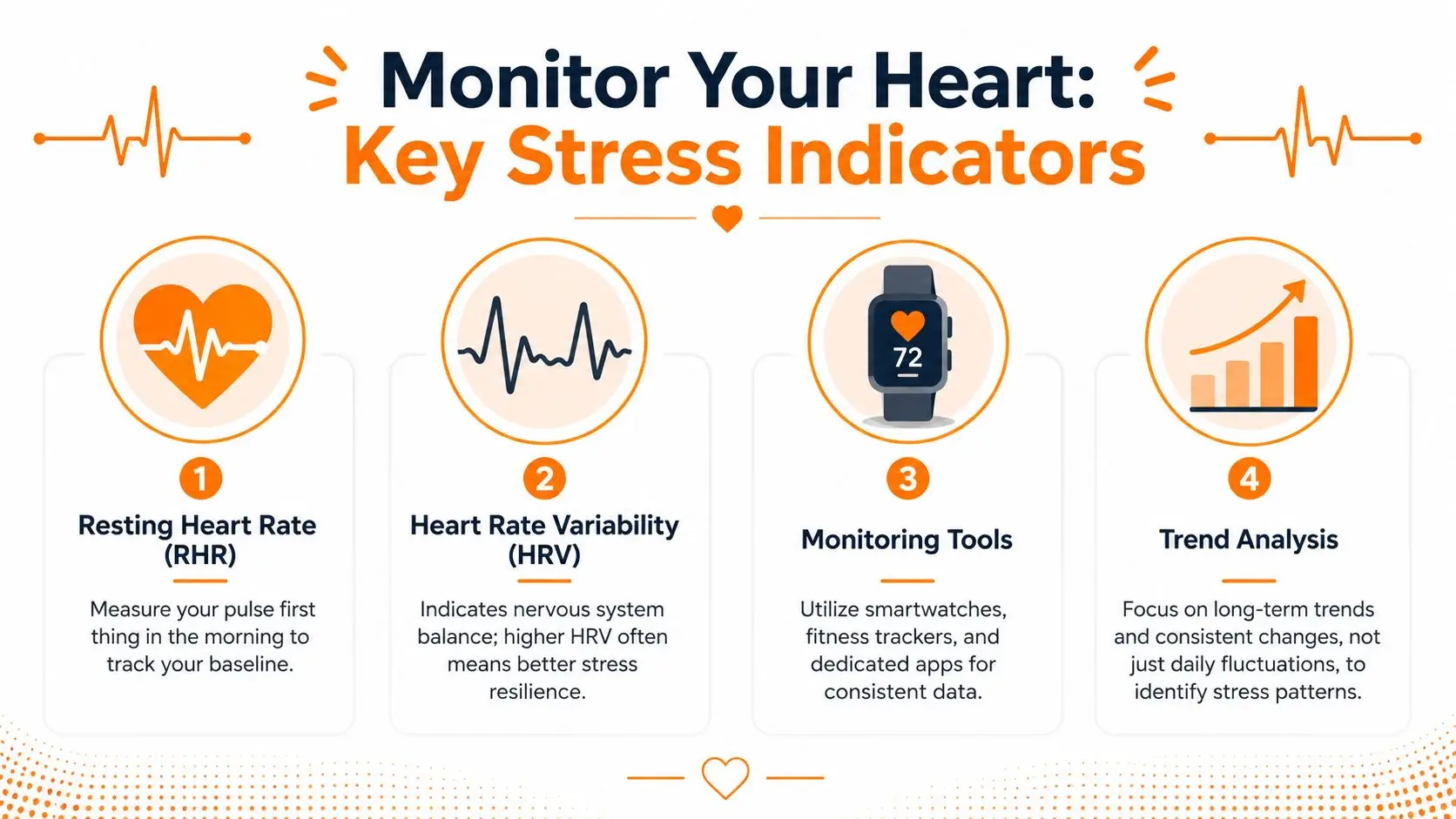
Stress tends to reduce the calming parasympathetic input to the heart. That's why HRV is considered a more sensitive stress marker than raw heart rate. A study in JMIR Human Factors on wearable stress assessment and HRV explains that stress is associated with HRV changes, and that ECG remains the most accurate measurement method. The same study also notes that consumer wearables can still offer useful trend data, even though they are not diagnostic tools by themselves.
Why older adults can have a silent stress window
The topic holds particular importance for healthy aging. Some older adults may show strain in HRV before they show a big increase in resting heart rate. In daily life, that can create a silent risk window. A watch or caregiver may see a pulse that looks ordinary, while the nervous system is already under pressure.
You don't need to treat that as a reason to panic. You do need to treat it as a reason to look at trends instead of single readings.
If you only watch heart rate, you might miss the earlier signs that the body is losing flexibility. HRV can sometimes reveal that the “brake” system is not doing its job well, even when the pulse still looks steady.
A normal-looking heart rate doesn't always mean the body is fully at ease. In older adults, reduced variability may appear first.
Simple ways to track patterns at home
You don't need to become a data analyst. You need a simple routine and a little consistency.
- Check your resting heart rate: Take it at the same time each day, ideally when you first wake up or before breakfast.
- Use the same device consistently: If you track on a smartwatch, stay with one platform so the trends are easier to compare.
- Watch for patterns, not isolated blips: A poor night's sleep, dehydration, or a stressful phone call can shift one day's reading.
- Write down context: Note major stressors, illness, poor sleep, extra caffeine, or emotional events. Those notes often explain changes better than numbers alone.
If you're supporting an older parent, ask simple questions that connect symptoms to readings. “Have you been sleeping?” “Did anything stressful happen today?” “Are you feeling more drained than usual?” Those details often matter more than one unusually high or low number.
When Your Heart Rate Signals a Problem
Monitoring is useful when it leads to action. The goal isn't to diagnose yourself from a watch screen. It's to know when a pattern deserves a conversation with a clinician.
Patterns worth discussing with a clinician
A stress response can raise heart rate for a while. But some changes should not be brushed off as “just stress.” If your resting heart rate is consistently above 100 beats per minute, that deserves medical attention. Frequent unexplained spikes, new palpitations, or a clear change from your usual baseline also deserve a closer look.
An important reason to take this seriously comes from a major study on mental stress and cardiac risk. In that study, the average heart rate increase during mild mental stress was 8.9 ± 10.8 beats per minute, and people in the highest tertile of stress-related heart-rate response had a 2.09-fold higher adjusted relative risk of sudden cardiac death compared with those in the lowest tertile, with a 95% CI of 1.13–3.86, according to the European Heart Journal study on heart-rate reactivity and sudden cardiac death. The same study found that this association was specific to sudden cardiac death rather than non-sudden coronary death.
That doesn't mean every stress-related heartbeat is dangerous. It does mean that the magnitude of the heart's response to stress can carry real clinical meaning.
Symptoms that should not be ignored
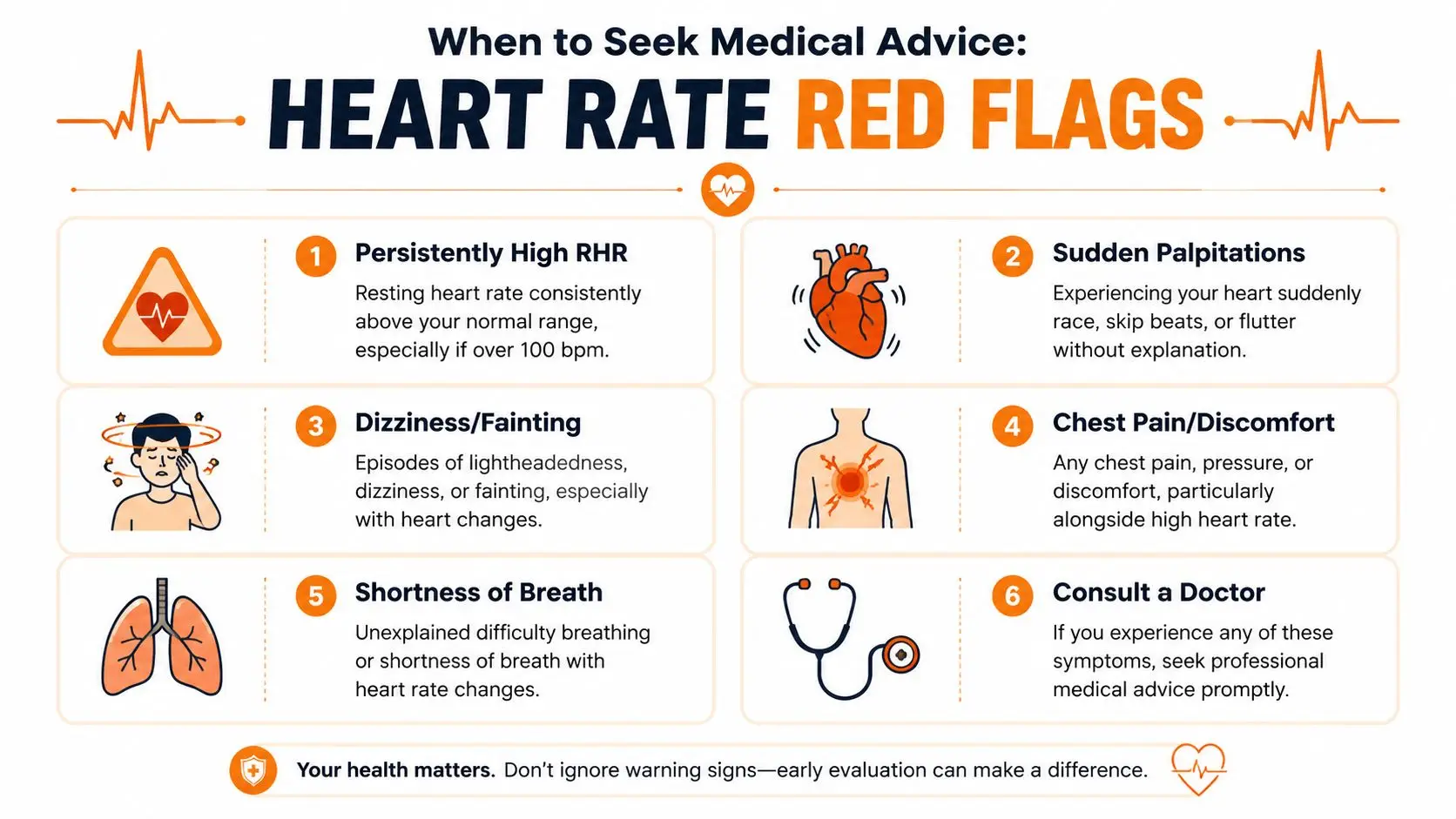
Contact a clinician promptly if heart rate changes come with any of these symptoms:
- Chest discomfort: Pressure, pain, tightness, or a sense that something isn't right.
- Shortness of breath: Especially if it's new, worsening, or out of proportion to activity.
- Dizziness or fainting: These symptoms need prompt attention when paired with heart symptoms.
- Palpitations: A feeling that the heart is racing, fluttering, skipping, or pounding without a clear cause.
- A clear drop in function: If walking across a room, climbing stairs, or doing familiar tasks suddenly feels harder.
Bring data to the appointment, not conclusions. A short record of your resting heart rate, symptoms, sleep, and stressors can help your clinician interpret the pattern much better.
For caregivers, this is an important shift in mindset. Don't wait for dramatic distress. If a loved one has repeated unexplained episodes, growing fatigue, new fluttering sensations, or a heart rate pattern that has changed from their usual, it's reasonable to ask for medical guidance.
If severe chest pain, fainting, or serious breathing difficulty occurs, seek urgent care right away.
Practical Ways to Calm Your Heart and Mind
The most helpful stress strategies are usually the simplest ones. They work best when you use them early and often, not only after a rough day.
Start with your breath
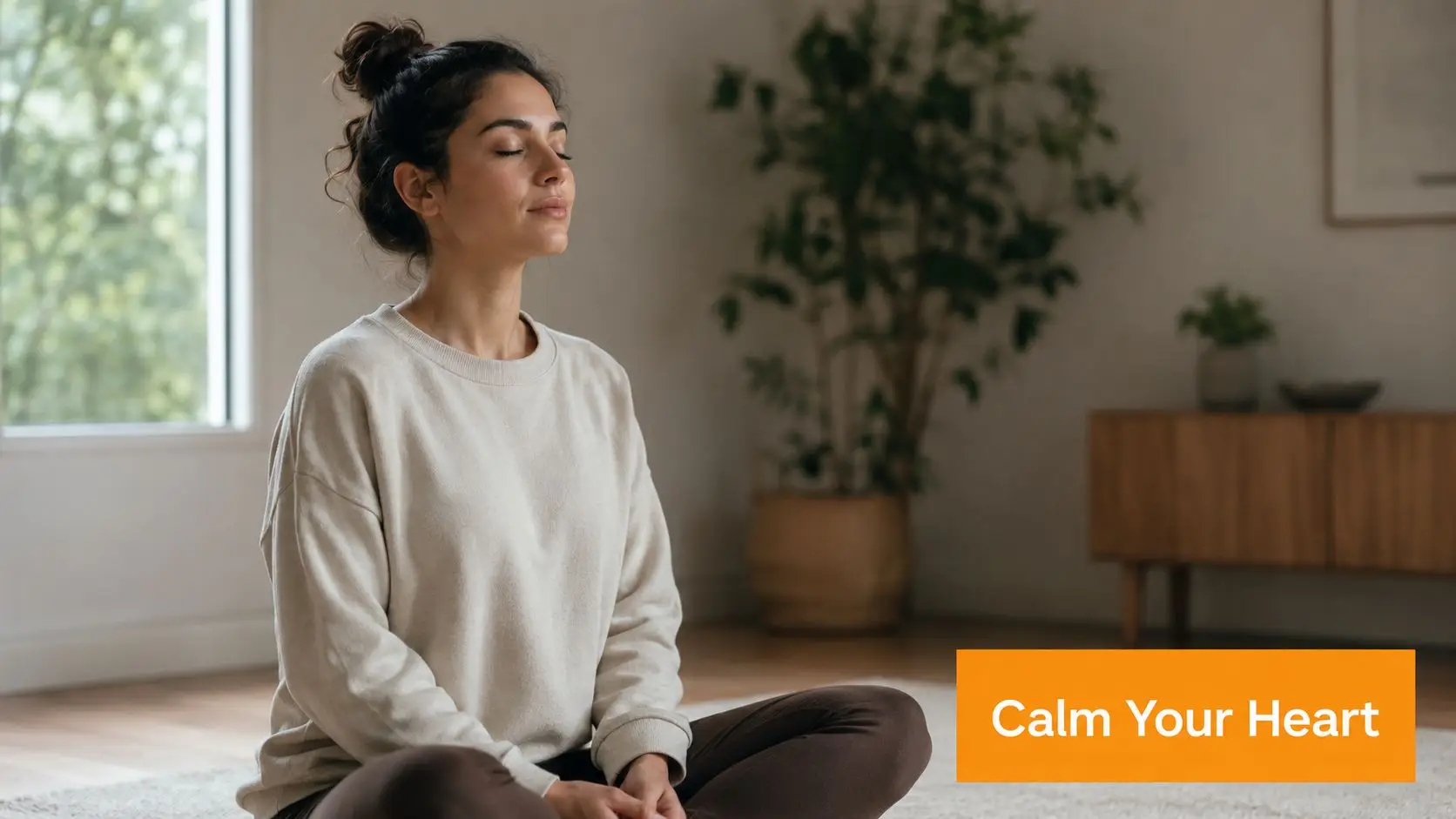
Slow breathing is one of the fastest ways to send a safety signal back to the nervous system. When you lengthen the exhale, you help the body engage its calming pathways. That can ease the sense of internal pressure that often comes with stress on heart rate.
Try this for a few minutes:
- Sit with support: Rest your feet on the floor and relax your shoulders.
- Inhale gently through the nose: Keep it easy, not exaggerated.
- Exhale a little longer than you inhale: The goal is comfort, not perfection.
- Repeat for several rounds: Many people notice the biggest benefit when they stop trying to “perform” and settle into the rhythm.
This can be especially useful after upsetting news, before bed, or after a tense conversation.
Use movement and connection to reset your system
A short walk can help discharge some of the body's stress activation. You don't need an intense workout. Gentle movement gives the body a way to use the energy that stress creates.
Social connection also matters. A calm conversation with a trusted friend, family member, neighbor, or caregiver can help your nervous system settle. People often think stress management has to be private and silent. It doesn't. Feeling safe with another person is one of the most powerful calming signals the body can receive.
If your body feels revved up, don't argue with it. Give it a job. Breathe, walk, stretch, or talk to someone steady.
A brief guided exercise can help if you're not sure where to start:
Build a routine your body can trust
Stress doesn't always respond to one big fix. It often improves with repeated signals of safety and predictability.
Here are a few routines that help many people:
- Keep a regular sleep schedule: Even a calming bedtime ritual can help the nervous system stop expecting stimulation late at night.
- Reduce overload in small ways: Turn off breaking news for a while, mute nonessential phone alerts, and avoid stacking stressful tasks back to back.
- Create transition moments: After an appointment, a difficult call, or a family conflict, take a few quiet minutes before moving on to the next task.
- Notice your personal triggers: Some people react most to conflict. Others react to uncertainty, rushing, or too much noise. Once you know your triggers, you can prepare for them.
For older adults aging in place, the best plan is often a practical one. Make the calming choice easy. Keep a comfortable chair by the window. Leave walking shoes near the door. Save a breathing exercise on your phone or tablet. Put a reminder in your calendar to pause after stressful errands or medical visits.
You don't need to remove all stress from life. That isn't realistic. What helps is building enough recovery into the day that your heart and nervous system don't stay on alert longer than they need to.
Rx360 helps older adults stay independent while keeping families and care teams connected around meaningful wellness signals. If you want a simpler way to support aging in place with health insights, smart technology, and coordinated care, explore Rx360's wellness platform for connected independent living.
Lower-Risk Medication Plan Checklist
Below is a practical checklist and step plan you can implement into your daily life:
-
List all medications
Include prescriptions, over-the-counter drugs, supplements, sleep aids, creams, patches, eye drops, and inhalers.
-
Mark fall-risk drugs
Flag medicines that cause dizziness, sleepiness, confusion, blurred vision, low blood pressure, or low blood sugar.
-
Ask for a medication review
Bring the list to a pharmacist or prescriber.
-
Review after any warning sign
Request a new medication check after a fall, near-fall, new prescription, dose change, dizziness, or confusion.