You're checking your phone after breakfast, wondering whether to call your mother again. She enjoys living independently and doesn't want every conversation to become a wellness check. You'd both like a way to notice changes in her routine without turning her day into a stream of updates.
That's the everyday question behind proactive health monitoring: how can useful information support independence without creating more work, worry, or unwanted supervision?
Table of Contents
- What Proactive Health Monitoring Is and Who It Helps
- Why Early Signals Matter for Older Adults and Families
- How Sensors, Analytics and Alerts Fit Together
- Signals Worth Tracking and How Much to Trust Them
- Who Acts and When
- Privacy, Consent and Control
- Practical Use Cases and Messaging
- How to Set Up Monitoring Step by Step
- Pick Your First Signal and Review It Monthly
What Proactive Health Monitoring Is and Who It Helps
Proactive health monitoring means regularly observing everyday signals, such as activity, sleep, mobility, and routines, so changes can be noticed and shared with the right people. The World Health Organization's healthy ageing framework provides a useful starting point: functional ability concerns what people can do and be that gives their lives value.
Consider a retired teacher who enjoys a morning walk. In this hypothetical example, her smartwatch records a gradually slower walking pace before she notices any difference herself. The record doesn't explain why she's slower, but it gives her something concrete to review.
A car dashboard offers a familiar comparison. The dashboard doesn't drive the car, and a warning light doesn't identify every possible problem. It brings a change to the driver's attention.
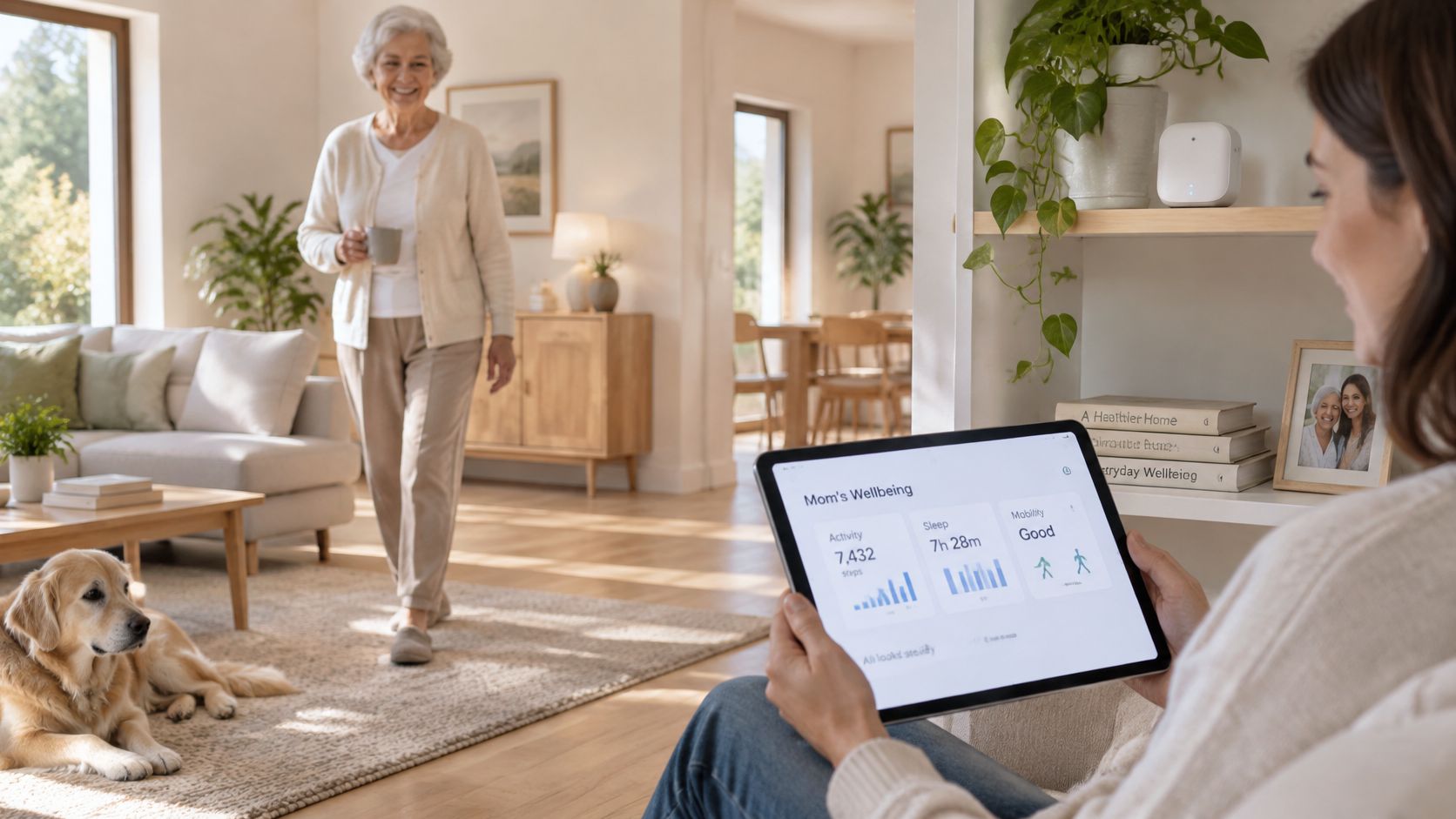
Everyday context, not constant supervision
Reactive care responds after a concern becomes apparent. Proactive monitoring adds observations between those moments, without assuming that every change is a problem.
Different people may use that context differently:
- Independent older adults can review routines they care about.
- Family members can receive agreed updates rather than repeatedly asking for reassurance.
- Care teams can consider recorded patterns alongside the person's own account.
For a broader introduction to everyday tracking approaches, Lola's seven ways to monitor health offers another starting point.
Our Pilot Services are not medical devices and are intended for informational purposes only as a wellness tool.
Proactive monitoring watches ordinary routines so people can notice changes early. It doesn't replace medical care or a clinician's judgment.
Why Early Signals Matter for Older Adults and Families
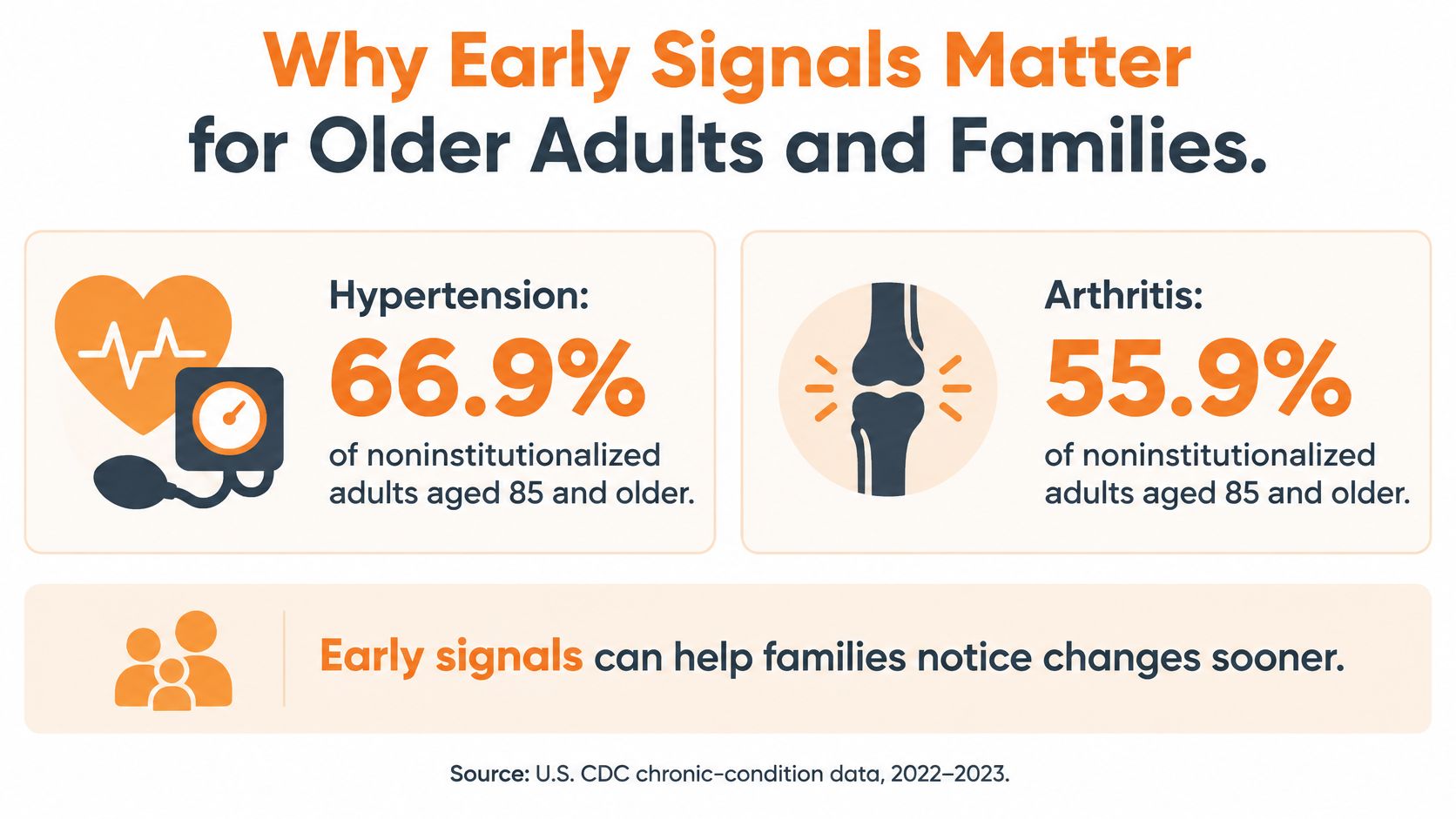
The CDC's chronic-condition report for 2022–2023 documents how differently later life can look, even within the same age group. Its findings for noninstitutionalized adults aged 85 and older provide context, not a prediction about any individual.
Chronic conditions among adults aged 85 and older (U.S., 2022-2023)
The figures below describe noninstitutionalized adults in that age group.
| Measure | Share of adults 85 and older | What it tells you |
|---|---|---|
| Hypertension | 66.9% | The most common condition in this age group |
| Arthritis | 55.9% | Common enough to shape daily routines |
| High cholesterol | 46.5% | Common and often tracked over time |
| Four or more of 11 selected conditions | 37.3% | Conditions often cluster together |
| None of the 11 selected conditions | 7.4% | Experiences differ widely |
Those differences matter when deciding what information is useful. A person who already records readings may want those records organized. Someone else may be more interested in whether they're keeping up with gardening, walking, or regular outings.
A fuller account of everyday life
Monitoring isn't limited to emergencies or a single condition. It can bring together observations that otherwise remain scattered across memory, a notebook, and separate apps.
Examples include blood-pressure readings someone has chosen to log, medication routines, activity changes, mobility records, and symptoms they choose to describe. These are conversation materials, not conclusions.
- For the older adult, a record can help describe what changed and when.
- For family members, an agreed summary supplies context without requiring a detailed daily report.
- For clinicians, the person's account and recorded observations can be considered together.
Say a parent mentions that afternoon outings have become less frequent. A family member living across town might otherwise know only that isolated detail. An activity record, together with the parent's explanation that a favorite class has stopped meeting, presents a different picture.
The useful distinction is between noticing a change and interpreting its meaning. Monitoring can help with the former. It doesn't diagnose anything, and clinicians interpret health information within the wider context of the individual.
How Sensors, Analytics and Alerts Fit Together
A Nature Digital Medicine systems paper described a zero-interaction digital exhaust containing 1,268 digital measures spanning activity, behavior, and physiology. That describes a broad technical approach, not a promise that any particular device collects every measure.
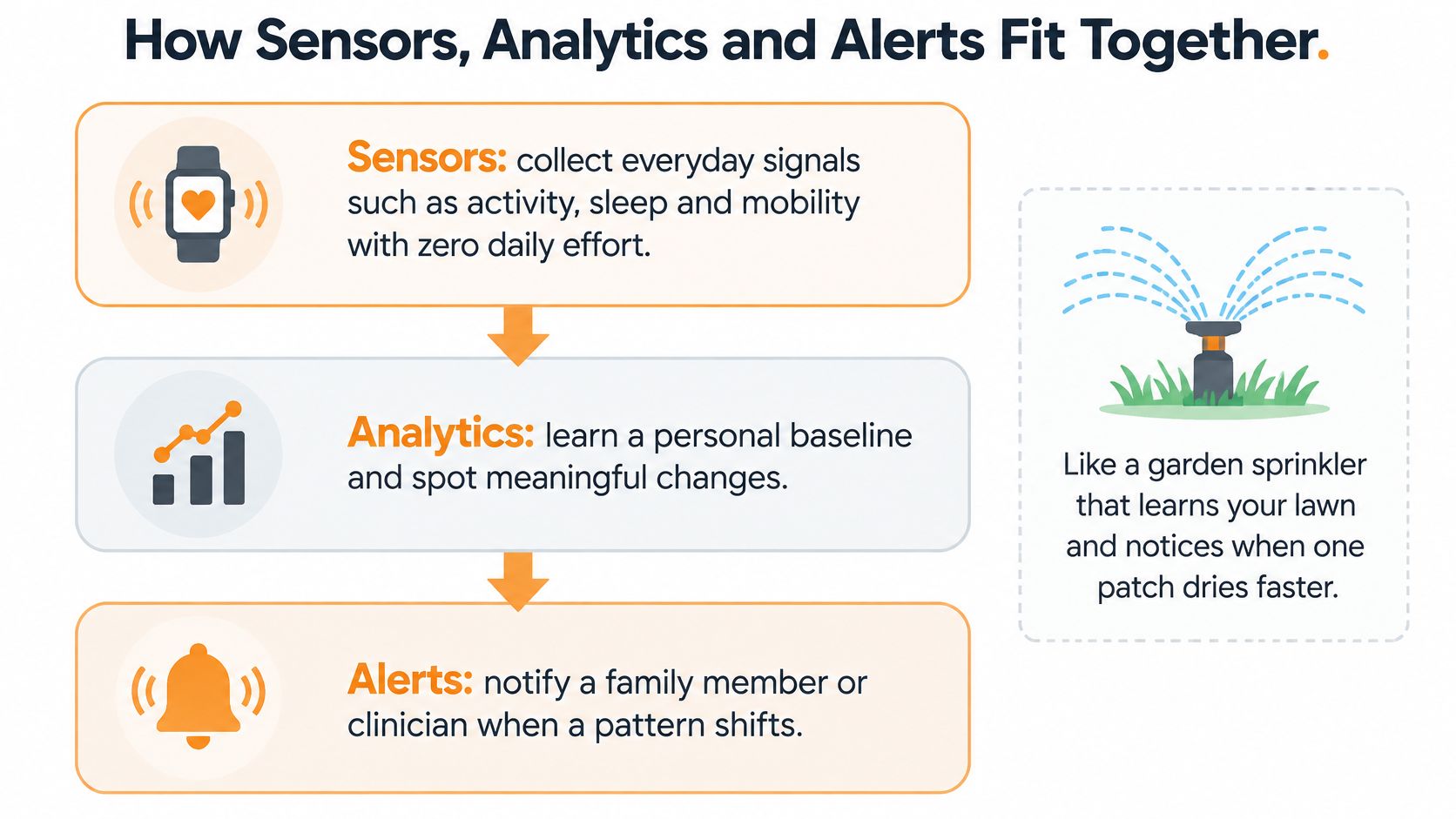
Think of a garden sprinkler that adjusts to different parts of a lawn. Instead of waiting until the whole yard looks dry, its sensors register that a patch is changing relative to its usual pattern. Personal monitoring uses a similar comparison, although interpreting human routines requires much more context.
From an observation to a useful message
Sensing collects the observations. Wearables, smartphones, and embedded home sensors can record different aspects of movement, behavior, or physiology. Passive collection may require little interaction during use, but charging, wearing, and maintenance can still take effort.
A baseline describes the person's usual pattern. Rather than treating a population average as someone's normal day, a system can build a picture of their own routine. A quiet morning may be entirely ordinary for someone who prefers evening walks.
Trend analysis compares observations over time. Rolling time windows allow comparisons across a continuing sequence of records. A change in mobility or sleep timing becomes a pattern to examine rather than an isolated notification.
Routing determines who receives a message. A monitoring design can reserve notifications for changes that meet agreed criteria. Sending every deviation to every contact creates a different experience from sharing a selected trend with its designated recipient.
Human review adds context. A person can check whether a change reflects travel, a removed device, a different schedule, or something the older adult wants to discuss. Sensor output alone isn't a diagnosis.
What makes the chain dependable
This architecture still needs validation in real homes, explicit consent, and data minimization, meaning collection limited to what the stated purpose needs. A technically detailed record isn't automatically a useful one.
The memorable chain: Sense, baseline, compare, route, review.
Each stage answers a different question. A device can record movement accurately while the notification process remains confusing. Evaluating the whole chain reveals more than looking at the sensor alone.
Signals Worth Tracking and How Much to Trust Them
The WHO's physical-activity guidance and the National Institute on Aging's sleep materials provide the general reference points below. These describe published guidance, not a personalized activity or sleep plan.
Routine reference points for healthy aging
| Routine signal | Reference point | Source |
|---|---|---|
| Moderate aerobic activity | 150–300 minutes per week | WHO physical activity guidance |
| Vigorous aerobic activity | 75–150 minutes per week, or an equivalent mix | WHO physical activity guidance |
| Muscle-strengthening activity | All major muscle groups on at least 2 days per week | WHO physical activity guidance |
| Balance and functional strength | Varied multicomponent activity on 3 or more days per week | WHO physical activity guidance |
| Sleep duration | About 7–9 hours per night | NIA, Sleep and Older Adults |
| Exercise timing before bed | Avoid exercise within 3 hours of bedtime | NIA, Sleep and Older Adults |
A routine record can distinguish different activities rather than treating all movement as interchangeable. It can also record approximate sleep duration or exercise timing without claiming to explain sleep quality.
Accuracy includes the missing information
A systematic review of wearable trackers in older adults found adequate accuracy for step counts, moderate-to-vigorous activity, electrocardiography, and heart rate, while respiratory-rate measurement was less reliable. The studies also used inconsistent definitions of valid days and non-wear time.
That makes data quality part of the signal itself. Useful context includes:
- Wear duration, showing whether the device was in use.
- Missing records, distinguishing an unrecorded afternoon from an inactive afternoon.
- Sensor confidence and calibration status, where the device makes these available.
A removed watch or poor skin contact can produce an odd reading. Repeated observations offer more context, but they still require interpretation. The discussion of patient-generated health data helps explain how personal records fit into a wider information picture.
Social connection needs a different kind of record
A cross-cohort analysis in The Lancet Healthy Longevity00110-8/fulltext) associated stronger baseline social connection with higher baseline intrinsic capacity, especially in cognitive and psychological domains, but found no clear evidence of different rates of decline during follow-up.
That's an association, not proof that logging social contact improves cognition. A voluntary note about valued activities captures something different from a sensor reading.
Lab results are another separate category. Vital iQ Health's explanation of when to see a doctor about CRP addresses a question that shouldn't be inferred from activity or sleep records.
Track fewer signals well means keeping the measurement, its limitations, and its purpose visible together.
Who Acts and When
More alerts don't necessarily mean less work. In a 2025 survey of 104 older adults and care partners, 17% of care partners said technology created more work, while 10% reported confusion about who should respond to an alert.
The uncomfortable question is straightforward: what happens after the alert? A message that reaches several relatives but belongs to nobody can prompt duplicate calls, assumptions that someone else responded, or unnecessary worry.
Different messages need different owners
The examples below illustrate an ownership arrangement, not a medical response protocol or a description of automatic product routing.
Alert types, owners and next steps
| Alert type | Example | Who sees it first | Next safe step |
|---|---|---|---|
| Informational update | Daily activity a little lower than usual | The older adult, at their own pace | Note it and check in at the next routine review |
| Trend to review | Walking pace lower for several weeks | A family member or care coordinator | Confirm with the older adult and decide whether to share with a clinician |
| Clinician question | A heart-rate change that persists across several days | The primary care clinician | Review the trend and the data-quality notes before acting |
| Urgent or emergency | A possible fall or a missed emergency call | Emergency services and the in-person caregiver | Follow emergency procedures; SMS alerts do not replace them |
The clinician row assumes an established communication arrangement. Sending information doesn't mean a practice monitors incoming records continuously.
Similarly, an emergency row describes an existing emergency procedure, not an instruction to wait for a dashboard message. Our SMS notifications are not a life-safety or emergency notification system and do not replace emergency services or caregiver supervision.
Closing the loop without multiplying tasks
Closed-loop monitoring means that someone receives a message, acknowledges responsibility, records what happened, and closes the item when appropriate. A virtual care manager discussion offers context for the coordination role, but each actual arrangement still needs named responsibilities.
A workable written agreement distinguishes:
- The minimum meaningful signal, so routine variation doesn't automatically become an urgent concern.
- The recipient and backup, including times when neither is available.
- The next action, such as confirming the observation with the older adult.
- The completion note, so other supporters know someone responded.
False positives and repeated low-value messages can add work and anxiety. The relevant question isn't how many alerts a system can generate, but whether each notification has an understood purpose.
Write the escalation path in ordinary language: who sees it first, who decides what follows, and who calls for help.
Privacy, Consent and Control
A 2025 systematic review in JMIR Aging highlights gaps in how remote-monitoring research evaluates patient and caregiver needs, privacy, usability, and empathy. Recording information is only part of the experience; people also need to understand and control that recording.
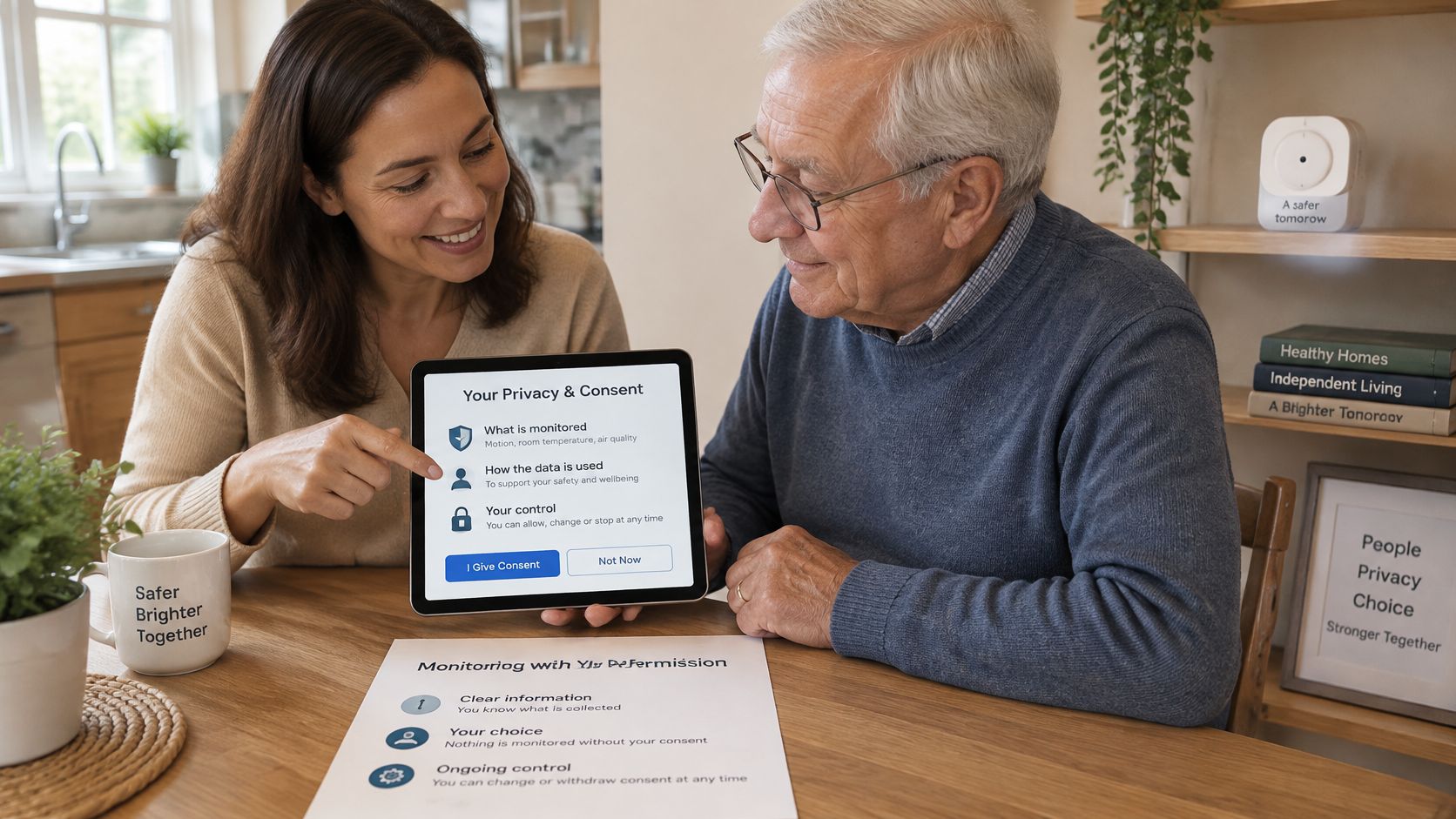
Discreet isn't the same as nonintrusive. A passive sensor may require little effort yet still feel invasive if someone doesn't know what it records or who can see the results.
Small text, difficult controls, and complicated interfaces also matter. Permission settings aren't meaningfully accessible if the person whose information is being shared can't read or operate them.
Permission includes everyday choices
Family involvement doesn't remove the older adult's role in deciding what to share. A shared agreement can distinguish information the person keeps private from information designated supporters receive.
Non-camera options provide a different privacy choice from cameras. Wearable comfort, charging, cleaning, and the placement of home sensors are also part of whether monitoring fits daily life.
For our medication taker users, Support Circle Sharing is opt-in. When a user chooses it, their Customer Data is shared with their designated caregivers and/or loved ones.
Our Privacy Notice indicates updates with an updated “Revised” date at the top. We may notify users of material changes through a posted notice or direct notification. Understanding data-retention policies also helps distinguish stopping collection from deleting information already held.
Questions that make control concrete
A plain-language privacy conversation can use this checklist:
- What is collected? Name the records, including whether audio, images, location, or activity information is involved.
- Who can see it? Identify people and roles rather than saying only that family has access.
- How can I pause it? Distinguish pausing a device, stopping collection, and stopping sharing.
- How do I change permissions? Make the process understandable, including how to withdraw access.
These questions put control into observable terms. They let the older adult discuss actual choices rather than agree to a vague promise of reassurance.
Practical Use Cases and Messaging
The product boundaries matter when turning monitoring into everyday examples. Our Pilot Services are informational wellness tools, not medical devices, and their results don't diagnose conditions; the scenarios below illustrate communication arrangements rather than additional product capabilities.
A walking routine without a daily interrogation
Say the retired teacher chooses to share a walking summary with her daughter through a service that supports that record. They agree that the daughter will read the summary at a convenient time rather than call whenever activity changes.
Our Support Circle Sharing makes designated sharing a choice, but it shouldn't be taken as a claim that our Pilot Services measure walking pace or produce weekly walking summaries.
Informational wording: Your walking pattern looks different from your usual routine. Is there any context you'd like to add?
A sleep record that replaces guesswork
A man who sleeps later on weekends records his approximate bedtime, waking time, and exercise timing. When he chooses to discuss his routine with his clinician, he brings the record rather than relying entirely on memory.
The log describes timing. It doesn't explain why he sleeps differently or prescribe a change.
Informational wording: These are the times you recorded. You can decide whether there's anything you'd like to discuss.
A coordinator who knows which messages belong to them
A care coordinator agrees to handle particular check-ins through an established arrangement. They don't assume SMS messages provide continuous supervision or emergency coverage.
Informational wording: This item is assigned to you for a check-in. Record whether you reached the person and whether follow-up remains open.
Across these examples, a potential user can ask: Who sees my information? Who acts on a message? How do I pause participation? Clear answers describe the arrangement more usefully than promises of peace of mind.
How to Set Up Monitoring Step by Step
The activity and sleep references offer categories for observation, not a universal setup schedule. A practical monitoring arrangement also needs decisions about goals, permissions, equipment, and communication.
The process below is an organizational example rather than a medically validated timetable. It can be adapted to the service's actual capabilities and participation terms.
Build the arrangement around a familiar routine
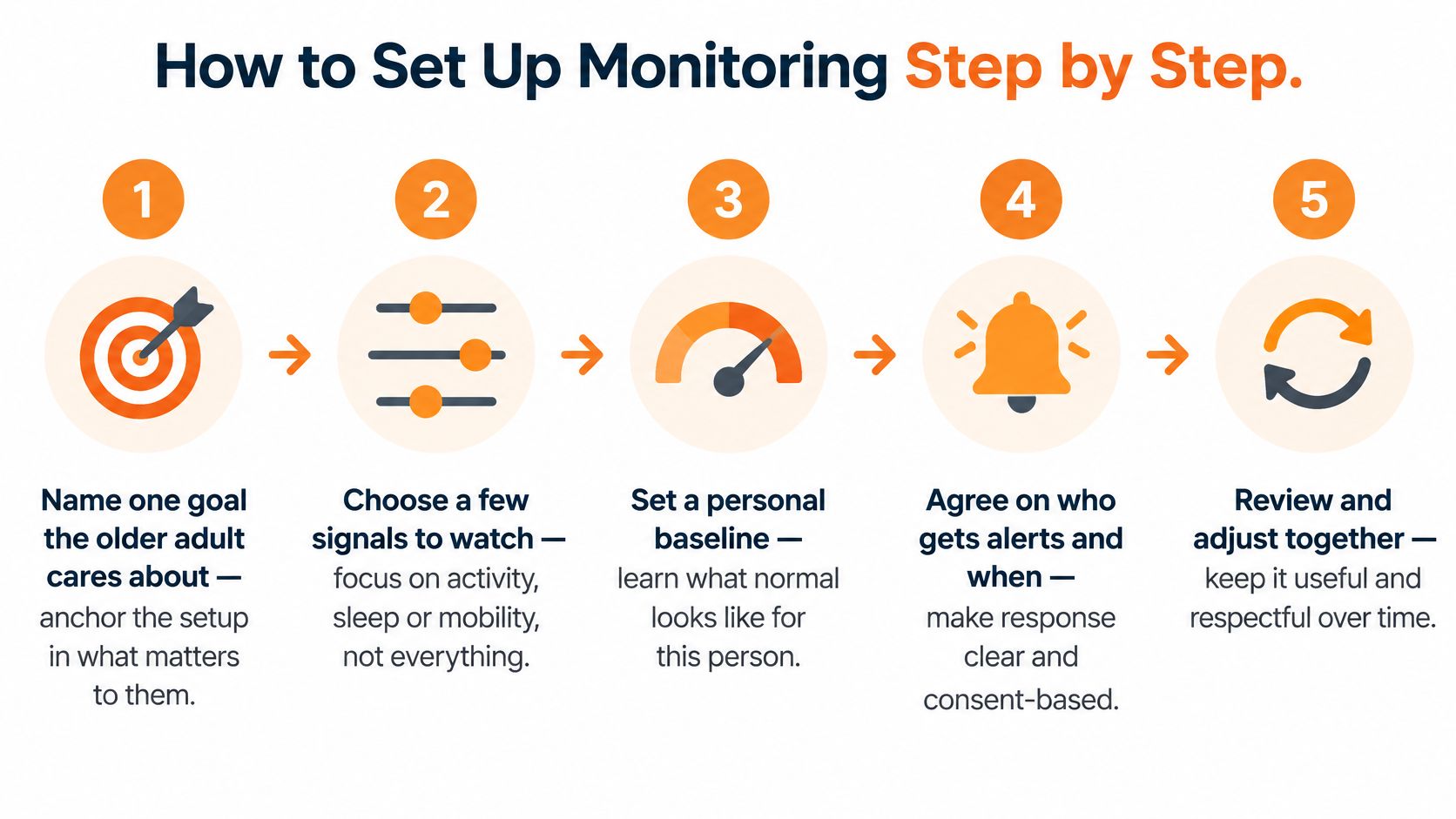
Name a goal the older adult cares about. Keeping a regular walk, attending a class, or understanding sleep timing gives the setup a concrete purpose. The person's goal determines which observations belong in the record.
Choose a small set of signals. Activity or sleep timing can be easier to discuss than a dashboard filled with unfamiliar scores. Stride's guide to which health metrics to log daily offers additional categories to consider, without making every available metric necessary.
Set permissions before information flows. Write down who can see which records and how the person can pause participation. This separates agreement about using a device from agreement about sharing its records.
Establish an ordinary-routine baseline. Follow the system's documented baseline process and inspect missing-data and wear information alongside the readings. Holidays, visitors, or a device left charging can make an initial record unrepresentative.
Test the communication, not just the device
Assign each message to a recipient. Include a backup arrangement and a description of what counts as completed follow-up. One shared record of responses can prevent supporters from handling the same item separately.
Try the arrangement for a defined period. For example, a hypothetical household could test its communication process for two weeks, recording confusing messages and false alerts. That's an illustrative household exercise, not the length of an Rx360 pilot or an evidence-based monitoring interval.
Change settings gradually. Altering a single setting at a time makes it easier to identify what changed the notification experience. Adding another signal before the first is understandable makes that comparison harder.
A useful setup note: Record the goal, permissions, recipient, backup, and completion rule together.
Keep access to settings understandable for the older adult, and include permission checks in routine conversations. Common setup problems include treating an incomplete baseline as settled and collecting more information than anyone has agreed to review.
Pick Your First Signal and Review It Monthly
A 2024 systematic review of remote patient monitoring reported positive effects on adherence and mobility, while findings for quality of life and several broader outcomes remained inconclusive. That distinction leaves room for an important question: does the arrangement feel useful to the person living with it?
A review can consider both records and experience. A declining alert count alone doesn't establish success, just as a growing collection of measurements doesn't establish value.
Review the arrangement, not only the readings
Useful discussion points include:
- Alert usefulness, including how many messages required a response.
- Ownership, checking whether any item lacked a named recipient.
- Workload, asking supporters whether the arrangement added tasks or removed them.
- Response timing, considering whether actionable messages reached someone available.
- Everyday fit, asking whether valued routines continued without unnecessary interruption.
- Personal control, checking whether the older adult still feels comfortable with participation.
As a practical planning example, choose a signal and a goal, then schedule a monthly review, such as a check-in after 30 days. That's an organizational choice, not a proven clinical interval or a statement about pilot access.
If the arrangement is understandable and welcome, consider whether another signal serves a clear purpose. If messages remain confusing, clarify ownership before expanding collection.
Choose the signal. Name the owner. Confirm consent. Set the review date. Compare any option, including ours, on those concrete terms.
Rx360 brings health insights, supportive technology, and trusted connections into a unified wellness platform designed for active, independent living. Visit Rx360 to explore its approach, then use your questions about privacy, consent, and alert ownership to decide whether it fits the support you want.
Lower-Risk Medication Plan Checklist
Below is a practical checklist and step plan you can implement into your daily life:
-
List all medications
Include prescriptions, over-the-counter drugs, supplements, sleep aids, creams, patches, eye drops, and inhalers.
-
Mark fall-risk drugs
Flag medicines that cause dizziness, sleepiness, confusion, blurred vision, low blood pressure, or low blood sugar.
-
Ask for a medication review
Bring the list to a pharmacist or prescriber.
-
Review after any warning sign
Request a new medication check after a fall, near-fall, new prescription, dose change, dizziness, or confusion.