You're on the phone with an older parent when their voice suddenly sounds different. Maybe they're struggling to find a familiar word, walking unsteadily toward the kitchen, or telling you that one eye has gone blurry. Their face may look normal, and they may insist they're fine. You're left wondering whether it's fatigue, a minor dizzy spell, or something that needs immediate attention.
That pause is understandable. It's also why recognizing stroke warning signs matters. A stroke can interrupt blood flow or cause bleeding in the brain, producing a sudden change in movement, speech, vision, balance, or awareness. The safest practical rule is simple: a sudden, unexplained change from a person's normal baseline deserves emergency attention, even if the change seems mild or disappears.
The World Health Organization's stroke information estimated that 12 million people experienced a new stroke in 2021. It also reported that lifetime stroke risk rose by about 50% over the previous two decades, with roughly one in four adults expected to experience a stroke during their lifetime. Those figures make recognition important, but you don't need to memorize population data during a tense moment. You need to notice when someone suddenly isn't moving, speaking, seeing, or thinking as they usually do.
Table of Contents
- The Moment Something Feels Off
- The Expanded B.E. F.A.S.T. Framework
- Warning Signs That Fall Outside the Classic Pattern
- How Signs Can Look Different Across People
- What to Tell Emergency Services Right Away
- When the Symptoms Disappear Before Help Arrives
- Why Waiting for Certainty Is the Real Risk
- Supporting Wellness and Connected Awareness
The Moment Something Feels Off
A familiar person's baseline is often easier to recognize than a medical checklist. You know how your partner normally smiles, how your father usually walks from room to room, or how your neighbor sounds when answering a simple question. A sudden departure from that pattern can be the first useful clue.
Notice the change, not just the label
Suppose an older adult who normally walks steadily begins veering toward one side. Perhaps they can still speak clearly, but they can't coordinate their steps. Or they answer a question with words that don't fit, then become frustrated because they can't explain what they mean. A new facial asymmetry, one-sided weakness, altered vision, or unusual confusion may be more noticeable than the word “stroke.”
Remote caregivers face a special challenge. You may see only a face on a screen, hear a short phone conversation, or receive a message from a home-care worker. That limited view can make people search for certainty. They may ask the person to rest, drink water, or wait for another symptom.
Practical rule: Don't wait for a complete pattern. One sudden, unexplained neurological change is enough to contact emergency services.
The World Health Organization identifies sudden balance problems, dizziness or loss of coordination, sudden vision loss, facial drooping, weakness in one or both arms, and slurred or unusual speech as important signs. The CDC's stroke information also includes sudden confusion, difficulty understanding speech, and a sudden severe headache with no known cause.
Keep the response calm and direct
You don't need to decide what caused the change. Describe what you observed: “Your smile looks uneven,” “Your right arm is drifting down,” or “You suddenly can't see clearly.” Then contact the local emergency number and record when the change began, or the last time the person was known to be normal.
A person may feel embarrassed, tired, or resistant to help. That doesn't make the change less important. Symptoms can also improve, but improvement doesn't make a sudden neurological event safe to watch at home. The rest of this guide uses everyday observations to make the first response clearer, without asking families to diagnose anything themselves.
The Expanded B.E. F.A.S.T. Framework
A person who usually walks steadily may suddenly reach for the wall. Someone who normally reads a message clearly may report double vision. These changes from a person's usual baseline are the signal to act, even when the familiar face, arm, and speech pattern is incomplete.
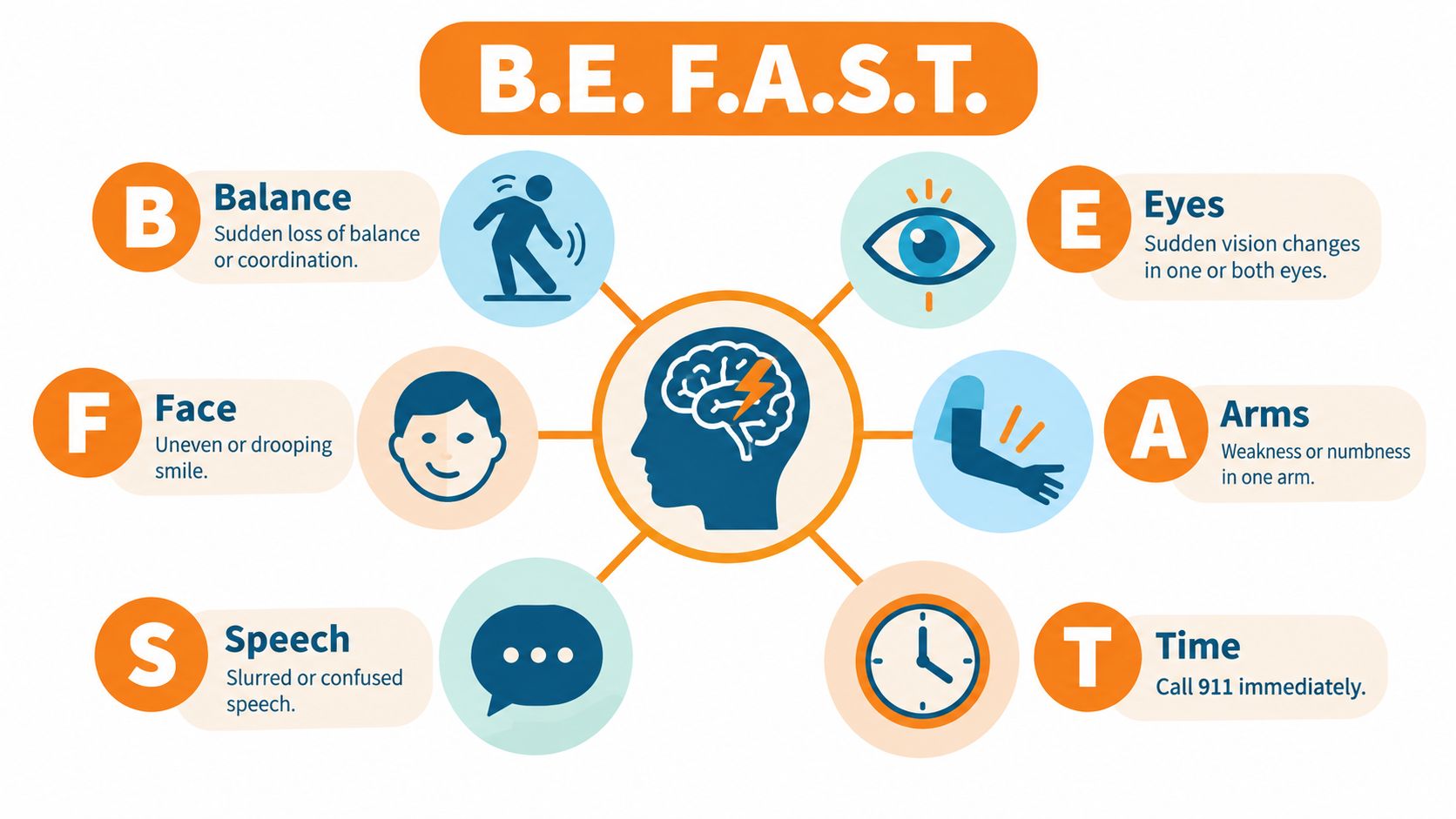
The American Stroke Association's B.E. F.A.S.T. guidance adds Balance and Eyes to the familiar Face, Arms, Speech, and Time sequence. It is a memory aid, not a home diagnostic test. Its practical value is widening what you observe.
Start with the first two letters
B is for Balance. Look for a sudden change in coordination or walking. A person may stumble, lean unexpectedly, or need furniture for support despite having no such habit before. If you are watching remotely, ask what changed and stay on the call while arranging emergency help.
E is for Eyes. Sudden blurred vision, double vision, or loss of sight may affect one or both eyes. Ask the person to describe what they can see, but do not let a normal smile or steady arm movements reassure you.
Use three simple observations
F is for Face. Ask for a smile. Compare both sides with the person's normal appearance and note new drooping or uneven movement.
A is for Arms. Ask them to raise both arms and keep them raised. One may feel weak or numb, drift down, or fail to lift as expected. Do not force movement if the person is in pain or unsafe.
S is for Speech. Ask for a simple phrase. Listen for slurring, unusual words, confusion, or difficulty understanding you.
T is for Time. A sudden change in any one area requires immediate contact with emergency services. Record when it began, or the last time the person was known to be normal.
The letters are separate observation points, not a test that requires several matching answers. The American Stroke Association's B.E. F.A.S.T. guidance supports noticing the change and communicating it clearly.
Try saying: “Her right arm drifts down when she lifts it, and this started about twenty minutes ago.” That gives emergency services an observable change and its timing.
Warning Signs That Fall Outside the Classic Pattern
A woman calls her daughter and says the room has started doubling in front of her. Her smile looks even and her words are clear, so nobody immediately thinks of a stroke. That sudden change from her normal vision still calls for emergency help.
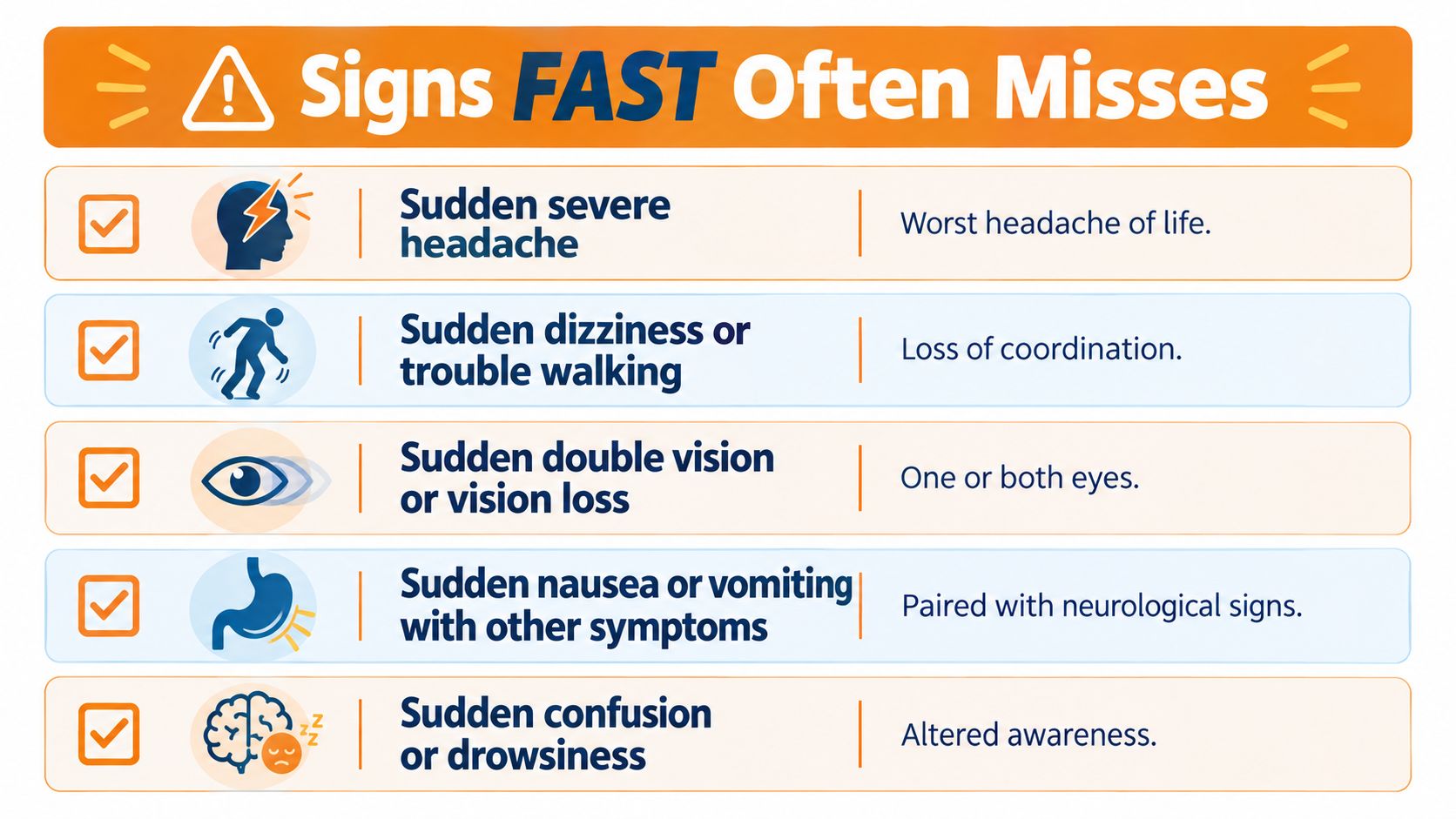
FAST observations remain useful, but they do not cover every way a stroke can appear. Sudden trouble seeing, walking, or maintaining balance may occur while the face and speech seem unchanged. Other possible changes include confusion, a severe unexplained headache, nausea, vomiting, double vision, drowsiness, or memory loss.
Why the wider lens matters
The brain controls many functions at once. A sudden problem affecting balance or vision may leave the person's smile and speech looking normal. A new inability to walk steadily can matter as much as an uneven smile, especially when there is no clear explanation.
A peer-reviewed analysis cited in the CDC's stroke signs and symptoms information examined a broader five-symptom set that included sudden trouble seeing, walking, or experiencing a severe headache. It captured 99.9% of hospitalized stroke cases. FAST alone missed approximately 8% to 9% of ischemic strokes and transient ischemic attacks and 30.6% of hemorrhagic strokes in that analysis.
Those figures do not make a symptom list a home diagnostic tool. They show why a narrow checklist can create false reassurance.
Everyday examples are often clearer
Compare each change with the person's usual abilities:
- Sudden imbalance: Someone who normally manages the stairs begins swaying or cannot walk in a straight line.
- Sudden vision trouble: A person says part of their vision has disappeared or the room suddenly appears doubled.
- Sudden confusion: They hear a question but cannot understand it, or give an answer that does not fit.
- Sudden severe headache: A new, intense headache appears without a known cause.
- Sudden altered awareness: They become unusually drowsy, forgetful, or difficult to engage.
A normal-looking smile does not cancel out a sudden problem with vision, walking, awareness, or coordination.
Use the person's baseline as your reference point. If an unexplained change begins suddenly, contact emergency services rather than waiting for another sign. Record what changed and when. A clear description helps responders, even when you cannot identify the underlying condition.
How Signs Can Look Different Across People
A person may look almost normal on a video call, yet suddenly need the wall for support or struggle to answer a familiar question. The National Institute of Neurological Disorders and Stroke's symptom guidance includes sudden vision changes, balance or walking problems, confusion, severe unexplained headache, nausea, vomiting, double vision, drowsiness, and memory loss alongside face, arm, and speech changes. The useful comparison is the person's normal baseline, not a perfect checklist.
An older adult who already walks cautiously may not produce a dramatic stumble. Watch for a new lean, reaching for furniture, or difficulty completing a route they know well. A remote caregiver can ask the person to describe what they see, answer a simple question, or walk only if it is safe. Slower replies, wandering attention, or a subtle facial change can justify urgent action when they began suddenly.
Women may have familiar stroke signs, but a sudden feeling of being unusually unwell can also draw attention away from the neurological change. Nausea, vomiting, fatigue, weakness, or confusion may be blamed on poor sleep, stress, or an upset stomach. Compare the person with her usual self, and record what changed and when.
Posterior-circulation events can affect balance, vision, coordination, and alertness without an obvious facial droop. Sudden double vision, unsafe walking, or trouble coordinating a movement deserves the same urgent response as a more recognizable sign. The question is whether the change is new and sudden, not whether it matches a textbook picture.
Common patterns across different presentations
| Group | Possible atypical sign | What it can look like in daily life | When to escalate |
|---|---|---|---|
| Older adults with a familiar baseline | New imbalance, confusion, or memory difficulty | A normally steady person suddenly reaches for furniture, gets lost in a familiar room, or cannot follow a simple exchange | Contact emergency services for any sudden, unexplained departure from usual ability |
| Women | A sudden change in routine behavior or speech | She cancels her usual morning walk because she feels “off,” and her words come out slowly | Escalate when the change is sudden, especially if neurological signs are present |
| Posterior-circulation presentations | Vision changes, double vision, dizziness, or coordination problems | The room appears doubled, walking becomes unsafe, or the person cannot coordinate movements | Do not wait for facial drooping or arm weakness |
| Anyone | Severe unexplained headache or altered awareness | A new intense headache, unusual drowsiness, or sudden difficulty staying engaged | Contact emergency services immediately |
Stress can also change heart rate and make ordinary discomfort harder to interpret. Understanding changes in heart rate may help families discuss everyday wellness patterns separately from sudden neurological changes. It should never explain away an abrupt change in speech, movement, vision, or awareness.
What to Tell Emergency Services Right Away
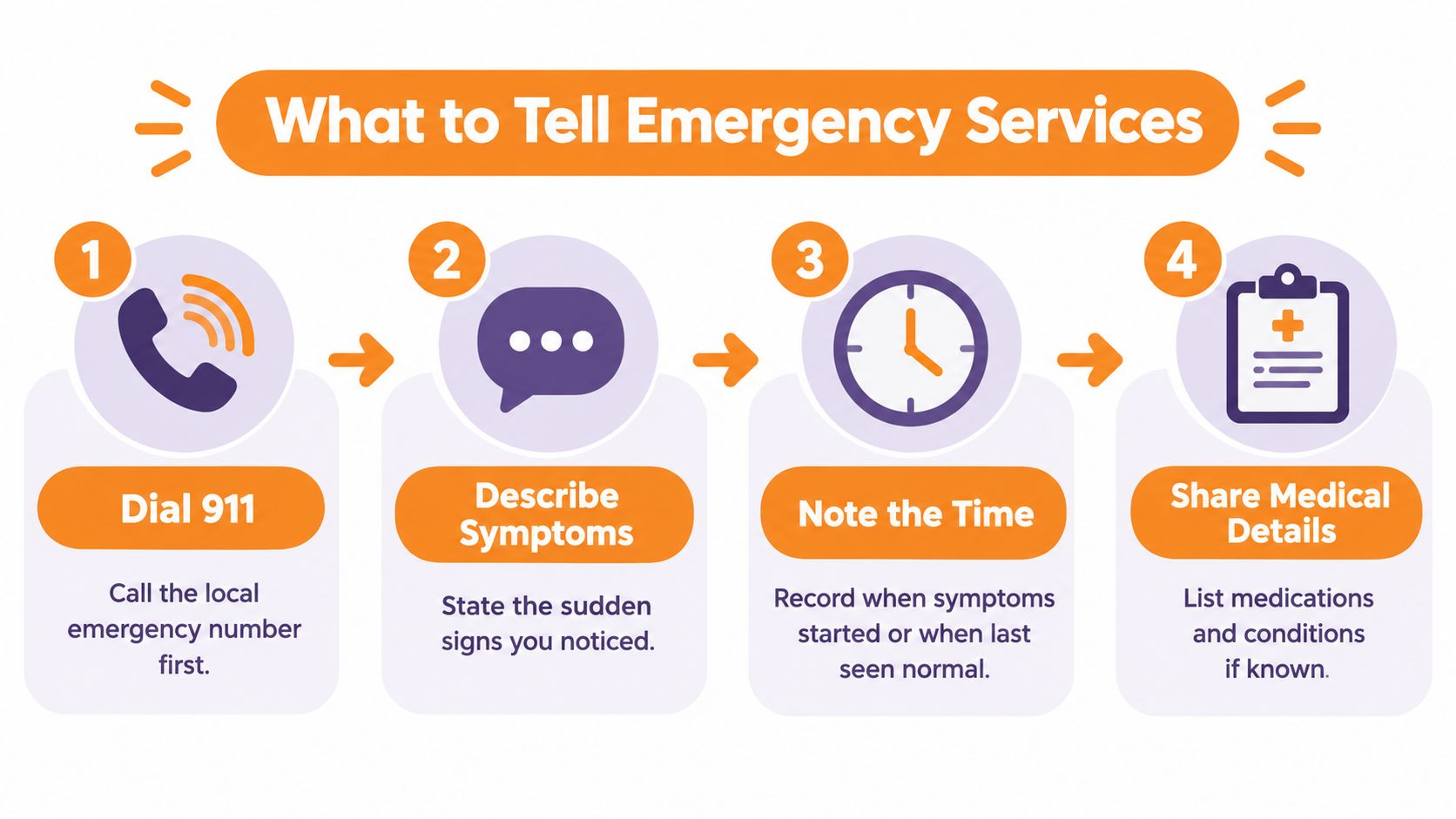
A person living independently may call you and say, “Something feels wrong,” while their speech sounds different or they cannot describe what changed. Treat that departure from their usual baseline as useful information. Emergency dispatchers need clear observations, timing, location, and relevant medical details, not a polished explanation. Guidance on contacting emergency services and recording last-known-well time supports giving this information promptly.
Use a short sequence
Call the local emergency number first. Say that the person has a sudden possible stroke symptom and provide the exact location. Do not spend time finding a clinic or arranging a private ride.
Describe the change from normal. Use plain language, such as, “Her left face is drooping,” “He suddenly cannot see out of one eye,” or “She is confused and cannot walk steadily.” Observable details help dispatchers understand the situation.
Give the time. State when the change began. If nobody saw it start, report the last time the person was known to be normal. Mention whether the symptom improved, returned, or fluctuated.
Share medical details. Include anticoagulant use, other medications, major medical history, and any recent illness or injury, if known.
Keep the waiting period safe
Wait for professional instructions before giving food, drink, aspirin, or other medication. Changes in speech or alertness can make swallowing unsafe, and the cause has not been established.
Emergency medical transport lets prehospital personnel assess the person and notify the receiving stroke center. If you are coordinating from a distance, connected health solutions can help family members and care teams share updates, but they do not replace the emergency call.
If the symptom disappears, tell the dispatcher and keep the call active. A return to the person's usual baseline does not explain what caused the sudden change.
When the Symptoms Disappear Before Help Arrives
A person may stumble, speak unusually, or develop sudden weakness, then appear normal again before help arrives. That shift can tempt family members to dismiss the event, especially if the person feels embarrassed or wants to continue breakfast. A return to the person's usual baseline is information about the episode, not proof that the danger has passed.
Symptoms that resolve within minutes may indicate a transient ischemic attack, or TIA. A TIA causes temporary neurological dysfunction and still needs urgent medical assessment because it can come before a completed stroke. Treat the sudden change from normal as the important clue, even when the visible sign is gone.
Document the brief event
For someone aging in place, a short episode can be easy to explain away. Slurred words during a morning call may sound like a dry throat. Brief dizziness may seem connected to standing too quickly. A temporary vision change may go unreported if sight returns.
Record:
- What changed: Write the exact words, movements, or visual complaint you observed.
- When it began: Note the start time when possible.
- How long it lasted: Record when the person seemed normal again.
- What happened alongside it: Include confusion, imbalance, weakness, headache, nausea, or vision changes.
- What medications are used: Note anticoagulants if known.
Give these details to emergency responders. Do not ask the person to recreate the event by walking or repeating tasks if that could cause a fall or another injury.
Regular check-ins and connected wellness tools can help distant relatives notice an unusual change in daily patterns. They support observation, but they cannot identify whether a brief episode was a TIA or another condition. If the symptom disappears, report that change and keep the emergency conversation active.
Why Waiting for Certainty Is the Real Risk
Many people hesitate because they're afraid of overreacting. That concern is understandable, especially when symptoms are subtle or the person says they feel fine. But recognizing stroke warning signs isn't a test of whether you can diagnose a stroke. It's a decision about whether a sudden neurological change needs emergency assessment.
The National Institute of Neurological Disorders and Stroke's stroke research information explains that eligible ischemic-stroke patients may receive intravenous alteplase generally within 4.5 hours of symptom onset, with greater benefit when treatment begins earlier. For selected patients with a large-vessel blockage, imaging can identify salvageable brain tissue when onset is uncertain or delayed. The DEFUSE 3 trial demonstrated improved outcomes with thrombectomy up to 16 hours in appropriately selected patients, while guideline-supported treatment can extend to 24 hours for certain imaging-selected cases.
Those windows don't tell a family member which treatment applies. They explain why the timeline matters. Delayed recognition can delay transport, imaging, and vascular assessment, which may affect what options remain available.

A false alarm is not a failure
Stroke mimics are common. A 2025 retrospective cohort of suspected-stroke patients found that stroke mimics accounted for 46.7% of final discharge diagnoses, as reported in the published cohort analysis. That means many people who trigger an emergency stroke evaluation ultimately receive another diagnosis.
This shouldn't make people less willing to call. It shows why diagnosis belongs with emergency clinicians, not with the person standing in the kitchen or answering a late-night video call.
Uncertainty is a reason to contact emergency services, not a reason to wait for certainty.
Supporting Wellness and Connected Awareness
Healthy routines can make changes easier to notice. Consistent sleep, regular movement, balanced meals, social connection, and familiar daily activities give an older adult and their loved ones a clearer sense of what “normal” looks like. A morning conversation, a walk, or a shared meal can create useful points of connection without turning everyday life into constant monitoring.
Families can agree on a simple information habit:
- Share the baseline: Note how the person normally walks, speaks, manages daily tasks, and communicates.
- Keep key details accessible: Maintain an updated list of medications, major conditions, and emergency contacts.
- Use regular check-ins: A predictable call or visit can make sudden changes easier to recognize.
- Respect independence: Awareness should support choice and confidence, not make an older adult feel watched.
- Separate wellness from emergencies: Daily activity data may show a change in routine, but it can't assess sudden neurological symptoms.
Resources about preventive care for seniors can help families think about ongoing support, routines, and coordinated care. Discreet connected tools may also help loved ones stay aware of important wellness signals when they can't be physically present. They should complement, not replace, direct communication with clinicians or emergency services.
The most useful habit is still simple: know the person's usual pattern, notice sudden changes, record the time, and act without waiting for a perfect explanation.
Rx360 helps independent older adults stay connected through Health Insights, Smart Technology, and Connected Care, giving loved ones timely updates while supporting autonomy. Visit Rx360 to explore a calmer way to share wellness signals and keep support within reach when it matters.
Lower-Risk Medication Plan Checklist
Below is a practical checklist and step plan you can implement into your daily life:
-
List all medications
Include prescriptions, over-the-counter drugs, supplements, sleep aids, creams, patches, eye drops, and inhalers.
-
Mark fall-risk drugs
Flag medicines that cause dizziness, sleepiness, confusion, blurred vision, low blood pressure, or low blood sugar.
-
Ask for a medication review
Bring the list to a pharmacist or prescriber.
-
Review after any warning sign
Request a new medication check after a fall, near-fall, new prescription, dose change, dizziness, or confusion.