By about 2 p.m., a lot of older adults know the feeling. You finish lunch, sit down to read, watch the news, or sort the mail, and your eyes get heavy. Your mind feels slower. You may even wonder, “Am I getting lazy?” or “Is this normal at my age?”
For many people, that afternoon dip isn't a character flaw or a sign that independence is slipping. It's often a very ordinary part of how the body and brain manage energy across the day. A short, well-timed nap can help. The key is knowing what kind of nap helps, what kind backfires, and why advice written for babies or younger adults doesn't always fit older adults very well.
If you've ever felt confused by mixed sleep advice, you're not alone. Some articles treat a 30-minute nap like a problem. Others praise it. Part of the confusion comes from blending very different groups together. Older adults need guidance that respects changing sleep patterns, daily routines, and the goal many people share: staying sharp, steady, and active at home. If you'd like a broader foundation first, this guide on restorative sleep and what it really means is a helpful companion.
Table of Contents
- An Introduction to the 30-Minute Power Nap
- The Science Behind the Perfect Nap Duration
- Key Benefits and Risks of Napping for Older Adults
- How to Take an Effective 30-Minute Nap
- When Napping Might Not Be Right for You
- How Caregivers Can Support Healthy Napping Habits
- Frequently Asked Questions About Napping
An Introduction to the 30-Minute Power Nap
A 30-minute nap can be a practical tool, not a retreat from daily life. Think of a retired teacher who still volunteers twice a week, picks up a grandchild after school, and wants enough mental energy left to enjoy dinner with family. By mid-afternoon, she may feel mentally foggy, even if she slept reasonably well the night before. A short nap can help her reset instead of pushing through in a tired haze.
That matters for older adults because energy isn't just about comfort. It affects balance, patience, attention, driving decisions, medication routines, and whether social plans still feel possible later in the day. When people understand 30 min naps as a strategy rather than a sign of decline, the whole conversation changes.
A lot of the confusion comes from seeing “short naps” discussed in baby sleep articles, where waking after a short nap may be treated as a problem to solve. Adult physiology is different. For many older adults, a nap capped around 30 minutes can support alertness and help them stay engaged without turning the rest of the day upside down.
A helpful nap should leave you more capable, not more checked out.
Some people don't even sleep soundly during these naps. They drift, rest, and wake feeling steadier. Others fall asleep quickly and still benefit from keeping the rest brief. Either way, the point isn't to replace nighttime sleep. It's to use a short rest period to improve the hours that follow.
The Science Behind the Perfect Nap Duration
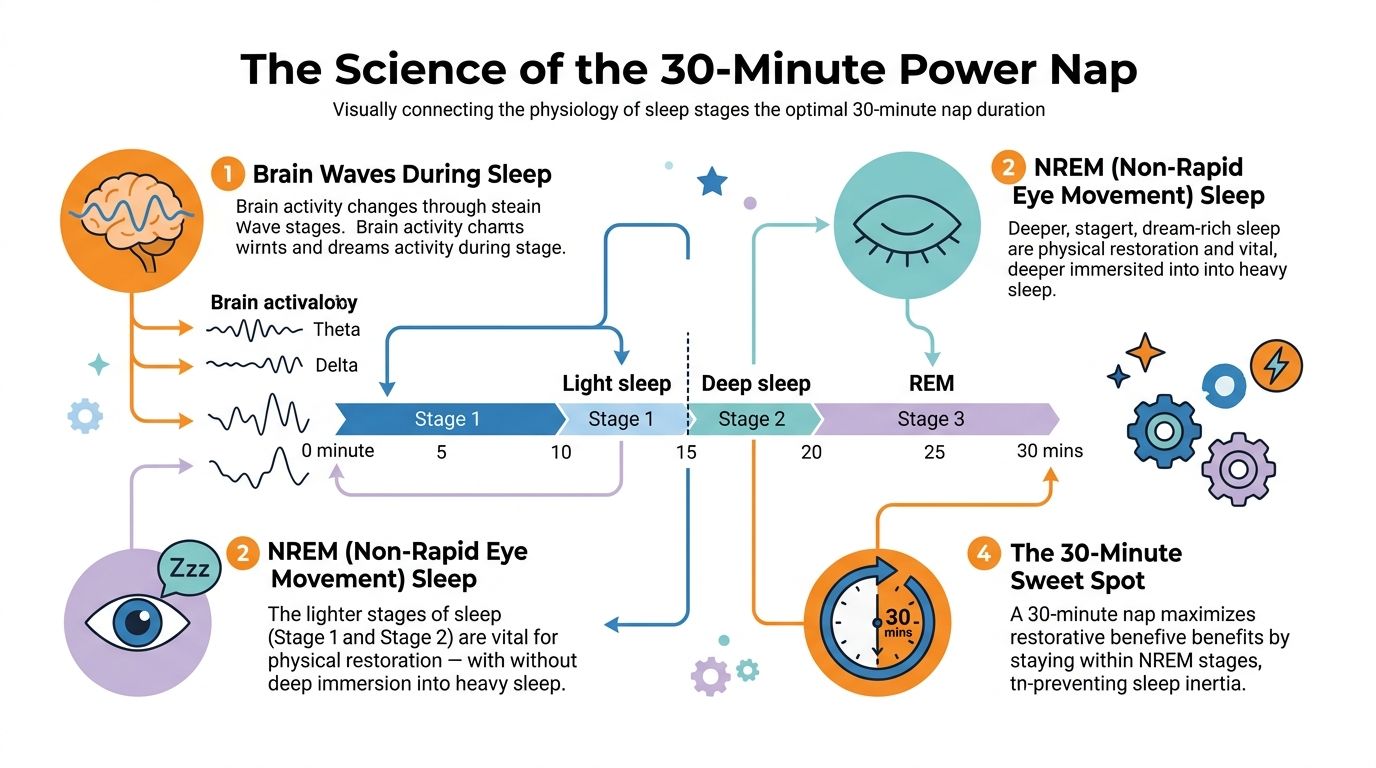
The reason 30 min naps get so much attention is simple. Duration changes what the brain does during the nap, and that changes how you feel afterward.
Research summarized by Harvard Health reports that NASA found pilots who napped for 20 to 30 minutes were over 50% more alert and over 30% more proficient at their jobs than those who didn't nap, which makes this short range especially notable for performance and alertness in demanding settings (Harvard Health on the science behind power naps).
A useful way to think about this is as a reboot, not a shutdown. You want enough time for the brain to step away from constant input and recover a bit, but not so much time that waking up feels like dragging yourself out of a much deeper state. If you've heard the term sleep debt and how it builds over time, this can help explain why some people feel pulled toward daytime sleep in the first place.
Why light sleep helps
In a short nap, the goal is usually to spend time in lighter sleep. That's where the brain can ease off, restore attention, and improve how ready you feel to handle information again.
Harvard Health's summary of work from Michael Chee's team at the National University of Singapore notes that short naps improved memory, information-processing speed, and vigilance, and Chee said that even a 10-minute nap refreshes, while a 30-minute nap gives benefits that last longer. That helps explain why many people wake from a well-timed short nap feeling more mentally “online.”
Here's a simple comparison:
| Nap pattern | Likely experience |
|---|---|
| Very short rest | Quick refresh, but the effect may fade sooner |
| Around 30 minutes | More sustained mental boost for many people |
| Longer drift into deeper sleep | Greater chance of waking up groggy |
Why deeper sleep causes grogginess
The trouble starts when a nap goes long enough that you wake during deeper sleep. That's when sleep inertia can show up. Sleep inertia is that heavy, disoriented, head-full-of-cotton feeling after waking.
Imagine the difference between stepping ankle-deep into a pool and diving into the deep end. A short nap is often like getting your feet in the water. A longer one can mean your body settles in more fully, and waking suddenly becomes harder.
Practical rule: The best nap length is the one that helps you rejoin your day quickly.
This is why the 30-minute mark gets so much discussion. It's often presented as a sweet spot because it can offer meaningful restoration, but it also sits close to the line where some people start to feel groggy. That means personal response matters. One older adult may wake clear-headed after 30 minutes. Another may do better with a slightly shorter rest. The science gives a guide. Your body gives the final answer.
Key Benefits and Risks of Napping for Older Adults
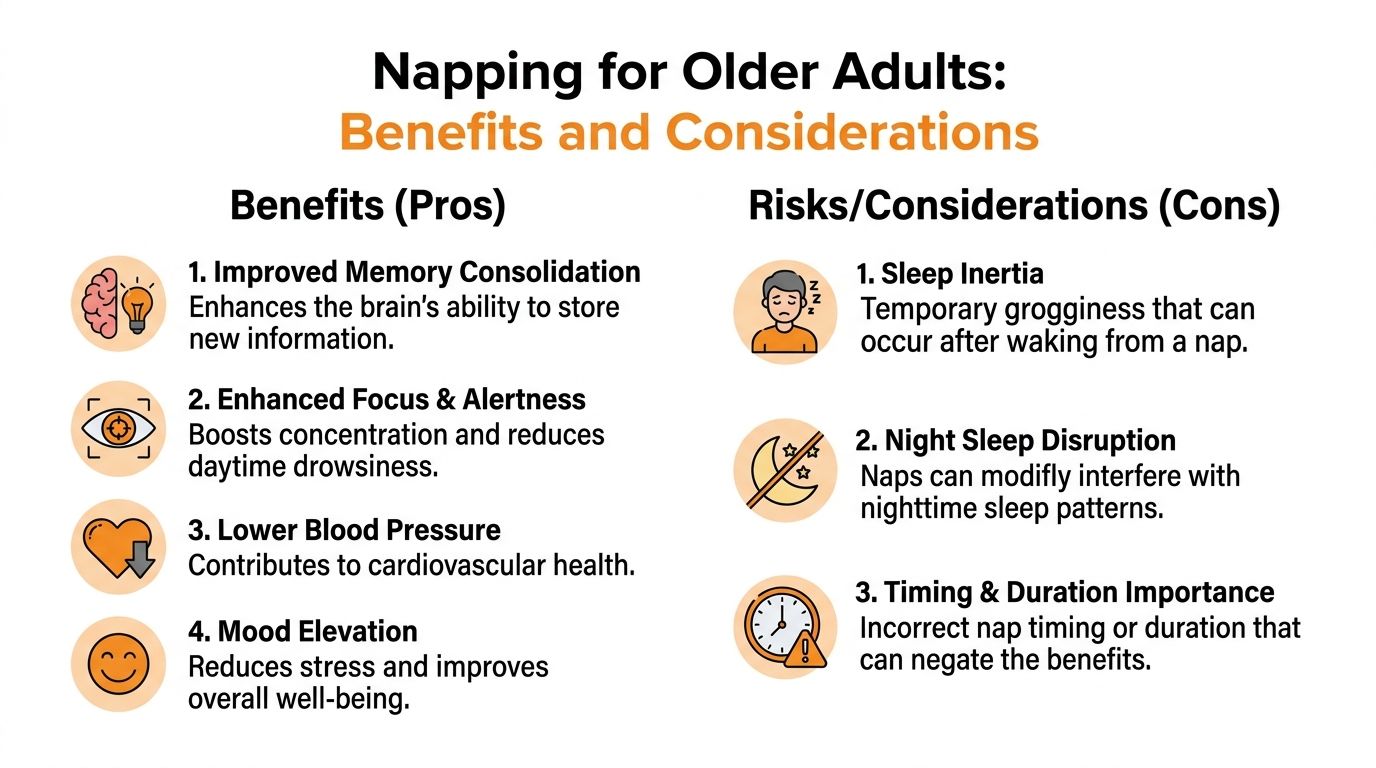
A 30-minute nap can act like a pressure-release valve in an older body. By early afternoon, many adults notice their attention slipping, their patience thinning, or their energy dropping even when they slept reasonably well the night before. A short, planned nap can sometimes restore enough alertness to make the rest of the day feel manageable again.
What a short nap may support
For older adults, the value of a nap is often less about “catching up” on sleep and more about giving the brain and nervous system a brief reset. Habitual napping has also been linked with larger brain volume in research discussed in this PMC summary discussing napping findings. That does not prove that naps directly prevent brain aging, but it helps explain why researchers remain interested in short daytime sleep as part of healthy aging.
The benefits often show up in ordinary tasks:
- Clearer attention: Following a conversation, reading instructions, or keeping track of a medication schedule may feel easier.
- Better mood regulation: Fatigue often appears as irritability, frustration, or low motivation before it feels like sleepiness.
- Safer daily function: A rested brain is generally better at judgment, reaction, and remembering the next step.
Aging changes sleep in small but meaningful ways. Nighttime sleep can become lighter and more fragmented. A brief daytime nap may help smooth out that dip without turning the afternoon into another full sleep period.
Families often notice this first. A parent who seemed worn out at 3 p.m. may be more engaged after a short nap, better able to enjoy a visit, finish a meal, or pay attention during an appointment. For caregivers using tools such as Rx360, that pattern can be useful to track. If a short nap regularly improves alertness, it may help caregivers plan calls, therapy exercises, or outings during the hours when the person feels most steady.
Where the risks begin
The main risk is not napping itself. The main risk is drifting from a short, intentional nap into a long, unplanned one.
Longer daytime naps have been associated with poorer metabolic health in some research, including this PubMed record linked in the verified data set. An association is not proof of cause. Older adults who nap longer may already have sleep disorders, depression, medication effects, chronic illness, or interrupted nighttime sleep. Still, the pattern supports a practical rule. If the goal is refreshment, shorter naps are usually the safer choice.
There is also a personal response issue. Some older adults wake after 30 minutes feeling alert. Others wake with sleep inertia, that heavy, slowed-down feeling that can linger for a while. The body is telling you something useful. If a 30-minute nap leaves you thick-headed, a slightly shorter nap may fit better.
Nighttime sleep deserves protection too. A nap that is too long or too late can reduce sleep pressure, which is the body's built-in drive to sleep at night. Sleep pressure works a bit like hunger. If you eat a full meal late in the afternoon, you may have less appetite at dinner. If you sleep too much late in the day, you may be less ready for bed.
A balanced way to use naps
For older adults, a good nap is a tool, not a test of doing sleep “correctly.” Online sleep advice often gets mixed up with baby sleep guidance, where a 30-minute nap may be treated as a problem. In later life, the goal is different. The goal is to support alertness, preserve function, and avoid interfering with nighttime rest.
That is why context matters. A short nap after a poor night, a demanding appointment, or a physically tiring morning may help. Falling asleep in a chair for long stretches every afternoon may point to something else that deserves attention, such as medication side effects, sleep apnea, depression, pain, or fragmented sleep overnight.
Used well, a 30-minute nap can support independence. Used carelessly, it can blur into a pattern that hides bigger sleep or health problems.
How to Take an Effective 30-Minute Nap
At 2:00 in the afternoon, an older adult may feel that familiar dip. Eyes get heavy, concentration fades, and even a simple task can feel harder than it should. A well-timed 30-minute nap can help, but only if it is set up with a bit of intention.
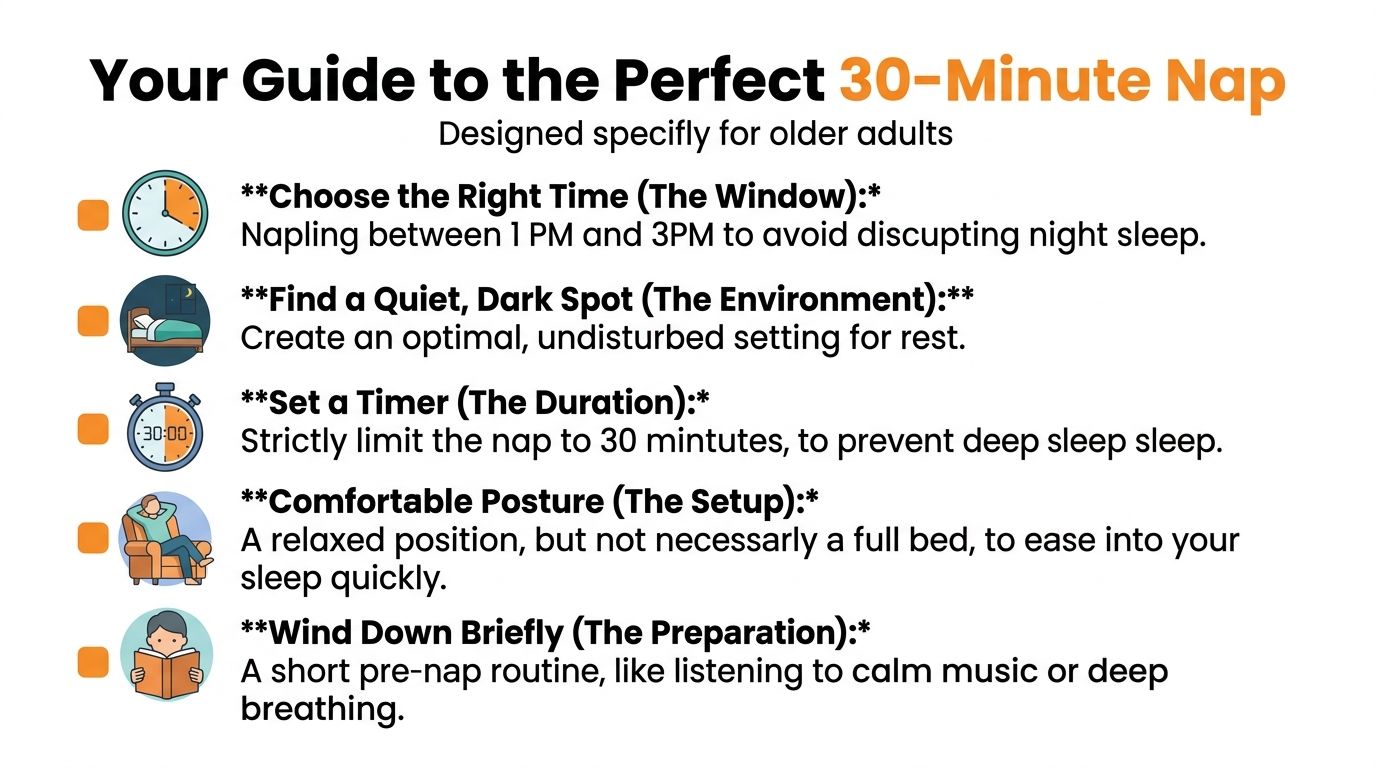
A short nap works best when you treat it like a planned reset, not a collapse into sleep whenever fatigue takes over. For older adults, that difference matters. A scheduled nap is more likely to refresh the brain and body without stealing from nighttime rest.
Pick the right window
Your body has a natural dip in alertness in the early afternoon. That is often the easiest time to nap because you are working with your internal clock instead of pushing against it.
For many older adults, the sweet spot is shortly after lunch and well before evening. If you wait until late afternoon, the nap can blur into the part of the day when your body should be building toward bedtime sleep.
A simple pattern can help:
- Notice when sleepiness shows up most days: Look for a repeatable afternoon slump.
- Choose one usual nap time: A regular rhythm helps the body settle more easily.
- Keep the nap early enough: Earlier afternoon usually causes less trouble at night than a late-day doze.
If the timing feels confusing, use this rule of thumb. Nap when you feel your energy dip, but leave a comfortable stretch of waking time before bed.
Set up the nap so it works
The goal is to make it easy for the brain to power down briefly without drifting into a long sleep cycle. A 30-minute nap is a bit like simmering soup instead of bringing it to a rolling boil. You want enough rest to restore alertness, not so much that waking feels hard.
Try this checklist:
- Use a timer: Set it before you close your eyes so the nap stays on target.
- Lower the stimulation: Dim the room, silence alerts, and reduce noise if you can.
- Choose a supportive place to rest: A recliner or bed with your upper body slightly raised can be comfortable and practical for many older adults.
- Keep the room comfortable: If you are too warm, too cold, or in pain, falling asleep may be harder.
- Plan your wake-up: Sit up slowly, get some light, and give yourself a minute to reorient.
You do not need to achieve the most restful sleep to benefit. Quiet rest still gives the brain a break, and for some older adults that lighter nap is exactly what feels best.
A brief pre-nap routine can help too. Use the bathroom, loosen shoes, straighten your legs, and take a few slow breaths. Repeating the same small steps teaches the body that this is a short rest period, much like a familiar bedtime routine helps cue sleep at night.
If waking feels foggy, open the curtains or turn on a light, sip some water, and wait a few minutes before standing or doing anything that requires balance.
Caregivers can make this easier without turning it into a big production. For example, if a father regularly nods off in front of the television around 4:30 p.m. and then struggles at bedtime, a caregiver might guide him toward a planned nap earlier in the day, set a timer, and help create a quieter space. Tools such as Rx360 can also help families keep track of patterns like late-day drowsiness, medication timing, and changes in routine that may affect how refreshing a nap feels.
The best nap routine is usually the one that is simple enough to repeat. If it feels calm, predictable, and easy to stop after 30 minutes, you are on the right track.
When Napping Might Not Be Right for You
A short nap can be useful, but it isn't always the right answer. Sometimes daytime sleepiness is less about needing a nap and more about a health issue that deserves attention.
Patterns worth paying attention to
Be careful if naps start getting longer, later, or less refreshing. A nap is supposed to support the day. If you wake feeling worse, or if you need more and more daytime sleep just to function, that's a signal worth noticing.
The same goes for nighttime sleep. If you already struggle with insomnia, even a short nap may interfere if it's taken too late or too often. For some people, the better fix is improving sleep habits overnight rather than adding daytime sleep.
Watch for patterns like these:
- You need a nap every day but still feel exhausted
- You fall asleep unintentionally in a chair or during conversation
- Your nap stretches far past your intended limit
- You wake from naps confused or poorly refreshed
- Bedtime gets pushed later because you aren't sleepy
When to call your doctor
Sudden changes matter. If an older adult who rarely napped now feels compelled to nap often, it's smart to ask why. Medication side effects, depression, chronic pain, sleep apnea, and other sleep disorders can all change daytime energy.
A doctor should also know if daytime sleepiness affects driving, balance, or medication safety. Those are not small quality-of-life issues. They can alter independence quickly.
A nap can be a tool. It shouldn't be used to ignore a new symptom.
Family members sometimes hesitate to bring this up because they don't want to seem critical. But saying, “I've noticed you're much sleepier than usual lately” is caring, not controlling. The goal isn't to stop all naps. It's to make sure a new sleep pattern isn't the first visible sign of something else.
How Caregivers Can Support Healthy Napping Habits
Caregivers often notice sleep patterns before the older adult does. They see when calls start going unanswered at the same time each afternoon, when errands become harder after lunch, or when a formerly active parent seems wiped out by mid-day.
Routine tells you a lot
A regular nap can be a healthy part of the day. What matters is whether it fits into a stable routine and leaves the person functioning well afterward.
Caregivers can help by observing without hovering. Instead of asking, “Are you sleeping too much?” it often works better to ask, “How do you feel after your afternoon rest?” That question focuses on results, not judgment.
A useful caregiver approach includes:
- Track patterns, not isolated days: One sleepy afternoon doesn't mean much. A consistent shift does.
- Support structure: Encourage a familiar nap time, a quiet room, and a reliable wake-up cue.
- Notice function afterward: The best sign of a healthy nap is better engagement later.
How technology can reduce guesswork
When family members live apart, uncertainty becomes the hard part. A daughter may know her mother usually rests after lunch, but she may not know whether that rest ended normally or turned into an unusually long, unplanned sleep.

Technology can help caregivers stay informed without turning the home into a surveillance space. Tools that reflect everyday routines can make it easier to notice changes early and check in with more confidence. Families looking for broader guidance can explore caregiver tips for supporting older adults at home.
That kind of support works best when it respects independence. The point isn't to police a nap. It's to understand whether the day's usual rhythm is intact.
For clinicians and family caregivers alike, routines often tell a practical story. When a person naps briefly, gets up, resumes activity, and remains engaged, that pattern usually looks very different from someone who becomes increasingly withdrawn, sleepy, or hard to rouse.
Frequently Asked Questions About Napping
Is a daily 30-minute nap normal for an older adult
Often, yes.
For many older adults, a short daytime nap can fit a healthy sleep pattern. The main question is not whether a person naps at all. It is whether the nap looks like a planned reset that supports the rest of the day, or a new pattern of sleepiness that signals something has changed.
A 30-minute nap is often used because it is long enough for light sleep and mental recovery, but short enough to lower the chance of waking up groggy or pushing bedtime later. In older adults, that balance matters because sleep pressure and nighttime sleep often shift with age.
What if I can't fall asleep quickly
That is common, especially for people who feel tired but not fully sleepy.
Treat the nap window like a reclining chair for the brain, not a test you have to pass. Resting in a dark, quiet room with your eyes closed can still reduce stimulation and give your nervous system a break. Slow breathing, a light blanket, and a timer can help your body settle without turning the nap into a long afternoon sleep.
Will napping ruin nighttime sleep
It can, but the nap itself is not always the problem.
Timing and duration matter most. A short nap earlier in the afternoon is less likely to interfere with nighttime sleep than a long nap taken late in the day. The body works a bit like a hunger system. If you snack too close to dinner, you may spoil your appetite. If you sleep too long at 5 p.m., you may reduce the natural sleep drive that helps you fall asleep at night.
If nighttime sleep worsens after naps become routine, try changing one thing at a time. Move the nap earlier, shorten it, or look for another cause such as pain, caffeine, medication timing, or untreated sleep apnea.
Should family worry if a parent suddenly starts napping more
They should notice it.
A sudden increase in daytime sleep can reflect poor nighttime sleep, medication side effects, infection, depression, dehydration, or changes in heart, lung, or brain health. The pattern matters as much as the nap itself. A familiar 20 to 30 minute rest after lunch is different from dozing off repeatedly, sleeping for hours, or being hard to wake.
Caregivers can use simple observations to guide the next step. Ask when the sleepiness started, whether the person seems refreshed after resting, and whether appetite, mood, balance, or memory changed too. If the shift is new, persistent, or affects safety, bring it to a clinician. Tools such as Rx360 can also help families notice changes in daily rhythm without constant check-ins.
Is a 30-minute nap better than a longer nap
For many older adults, yes.
A longer nap can drift into deeper sleep. That deeper stage is harder to wake from, which is why some people feel disoriented after sleeping for an hour on the couch. A 30-minute nap usually stays closer to lighter sleep, where the brain and body can recharge without as much sleep inertia.
Longer naps are not always harmful, but they deserve more attention in older adults, especially if they happen often or were not planned.
What if the nap turns into an hour or more
That can happen, and it usually means the setup needs adjusting.
Use a timer, nap in a chair or on top of the bed instead of under the covers, and keep the room comfortable but not too dark or too cozy. If long naps keep happening, consider whether the person is carrying a larger sleep debt or developing a medical issue that deserves evaluation.
Lower-Risk Medication Plan Checklist
Below is a practical checklist and step plan you can implement into your daily life:
-
List all medications
Include prescriptions, over-the-counter drugs, supplements, sleep aids, creams, patches, eye drops, and inhalers.
-
Mark fall-risk drugs
Flag medicines that cause dizziness, sleepiness, confusion, blurred vision, low blood pressure, or low blood sugar.
-
Ask for a medication review
Bring the list to a pharmacist or prescriber.
-
Review after any warning sign
Request a new medication check after a fall, near-fall, new prescription, dose change, dizziness, or confusion.