In a prospective analysis of 1,759 aging adults in the U.S. Multi-Ethnic Study of Atherosclerosis, the regular-optimal sleep group had a 39% lower all-cause mortality hazard than the irregular-insufficient group after adjustment. That's an observational association, not proof that changing sleep produces a specific outcome. It still reframes sleep and recovery in a helpful way, because the contrast wasn't only about longer nights. It was also about consistency.
That idea runs through the findings below. Recovery is described less as chasing a higher score and more as noticing continuity, a personal baseline, and whether daytime movement still leaves the next day feeling workable. Each section names where its information came from at the start, so you can see what's reported, how it was framed, and where the limits are before drawing any personal meaning from it.
Table of Contents
- Nightly Rest Numbers From Large Studies
- How Sleep Stages Tie Into Recovery
- Hours Continuity and a Steady Rhythm
- Morning Walks and Evening Movement
- Positive Routines Around the Same Clock
- Reading Your Pattern and Sharing Updates
Nightly Rest Numbers From Large Studies
This section starts with the National Institutes of Health healthy-sleep page, then looks at observational studies on aging and sleep regularity. The NIH page lists 7 to 8 hours of sleep per night for adults aged 65 and older. It also notes that older adults may go to bed and wake earlier, and their sleep may become shorter and lighter. The page does not establish that older adults need less sleep than younger adults.
That distinction matters. An earlier bedtime describes timing. Lighter sleep describes quality. Neither, on its own, answers the total duration question, which is why the large studies below separate hours, regularity, and how researchers framed each pattern.
| Pattern | Figure reported | How the source frames it |
|---|---|---|
| Adults 65 and older | 7–8 hours listed | NIH healthy-sleep page; timing and lightness can change |
| About seven hours in a large older-adult study | Strongest observed healthy-aging association | Inverted-U; odds lower at 5 or fewer, 6, and 9 or more hours |
| Five hours or less versus seven | Adjusted odds ratio 0.51 | Observational, not proof of cause |
| Six hours versus seven | Adjusted odds ratio 0.79 | Same healthy-aging analysis |
| Nine hours or more versus seven | Adjusted odds ratio 0.65 | Same healthy-aging analysis |
| Regular-optimal versus irregular-insufficient | 7.0 ± 1.0 hours versus 5.8 ± 1.4 hours | 39 percent lower mortality hazard after adjustment; association only |
| Most irregular sleep in UK Biobank | Highest mortality in that cohort | Rates fell toward the median regularity, then the decline plateaued |
What the healthy-aging analysis reported
In a large observational study of 35,056 older adults with an average age of about 73 years, the healthy-aging sleep duration analysis reported that 5,782 participants, 16.5%, met the study's definition of healthy aging. Using seven hours as the comparison point, adjusted odds ratios were 0.51 at five hours or less, 0.79 at six hours, and 0.65 at nine hours or more. The authors described an inverted-U pattern, with the strongest observed relationship near seven hours.
In plain language, an inverted-U means the middle point sat highest in that analysis, while values on both sides sat lower. It doesn't show that a particular duration caused the outcome. People sleeping much longer or shorter may differ in many other ways, and observational work can't untangle all of that by itself.
What regularity added
The MESA analysis compared a regular-optimal pattern averaging 7.0 ± 1.0 hours with an irregular-insufficient pattern averaging 5.8 ± 1.4 hours and roughly twice the irregularity. Read beside the table, the useful point is that duration and consistency moved together in those groups. A reader learning how to define sleep debt can keep that separation in mind, hours on one side and night-to-night steadiness on the other.
A UK Biobank study of 88,975 participants followed for a median of 7.1 years in the sleep regularity and mortality analysis found mortality rates were highest among people with the most irregular sleep. Rates declined approximately linearly as regularity approached the cohort's median level, after which the decline began to plateau. That plateau is easy to miss. It suggests the research question wasn't endless perfection, but the difference between highly irregular patterns and more consistent ones.
These rows are research patterns, not a personal target. They give shared language for hours and regularity without turning any single number into a promise about one person's next day, energy, or long-term health.
How Sleep Stages Tie Into Recovery
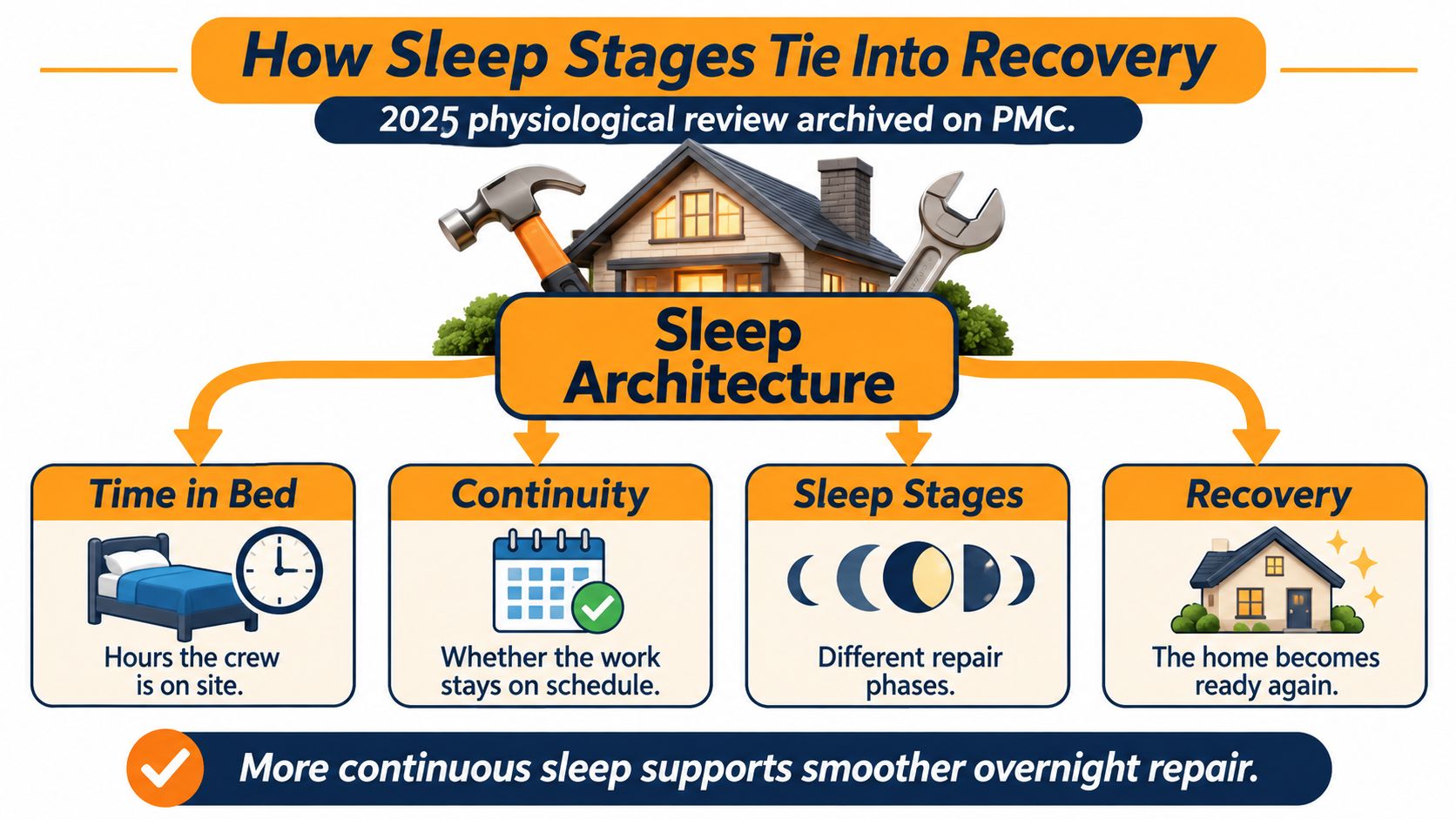
The information here comes from a 2025 physiological review archived as the PMC review of sleep architecture and aging. It describes how sleep structure changes with aging and how those changes are discussed in relation to recovery. A house-repair analogy makes the vocabulary easier to hold.
Think of time in bed as the hours a repair crew is on site. Sleep continuity is whether the work keeps going without repeated stoppages. Sleep stages are the different phases of work, and recovery is closer to the house feeling ready again the next day. A long visit with constant interruptions isn't the same picture as a steadier stretch of work.
What changes with aging in the review
According to the review, total sleep time generally declines with aging, nighttime awakenings increase, and N3 slow-wave sleep and REM sleep become shorter. N3 is the deepest stage of non-rapid eye movement sleep. REM is the stage most closely associated with vivid dreaming. Both are parts of normal sleep architecture, just different phases in the night.
The review links N3 sleep with growth-hormone secretion, muscle-protein synthesis, and tissue repair. Those are research terms for body processes, not things a home score can directly prove on a given morning. Put another way, the review presents deep sleep as one period when repair-related processes are active, which is why interrupted deep sleep gets attention in recovery discussions.
The same review associates insufficient slow-wave activity with altered cortisol regulation and increased inflammatory signaling, including IL-6 and C-reactive protein. Cortisol is often called a stress-related hormone, while IL-6 and C-reactive protein are markers researchers measure when studying inflammation. You don't need to memorize the names to follow the point. The review is connecting sleep structure with signals involved in stress balance and inflammation, not handing readers a home testing checklist.
Signals described for independent older adults
For independent older adults, the review highlights practical signals that are visible in everyday life. They're described as patterns to notice alongside continuity, rather than isolated numbers to chase.
- Repeated awakenings: waking often enough that the night feels broken into short pieces
- Reduced sleep efficiency: spending a smaller share of time in bed asleep
- Earlier-than-usual waking: surfacing well before the intended morning and staying awake
- Persistent daytime fatigue: feeling notably worn down after ordinary activity
Say someone has one restless night after a busy family day, then returns to a familiar rhythm. That's different from several weeks where awakenings increase, mornings come earlier than wanted, and a normal errand run starts feeling unusually draining. The first is a short interruption. The second is a change from baseline, and baseline is the comparison the review keeps returning to.
A single short night is one data point. A repeated change from someone's usual pattern is the part worth describing clearly.
The review describes a sustained deterioration in these measures as a possible sign that exercise load, pain, illness, medication effects, or circadian disruption may be exceeding recovery capacity, and it may warrant clinical review. It also notes that evening physical activity isn't automatically harmful, and appropriately timed exercise can preserve or improve deep sleep in some older adults. Intensity and individual response are part of that picture, which helps explain why one person's pleasant evening walk and another person's hard late workout shouldn't be lumped together.
Hours Continuity and a Steady Rhythm
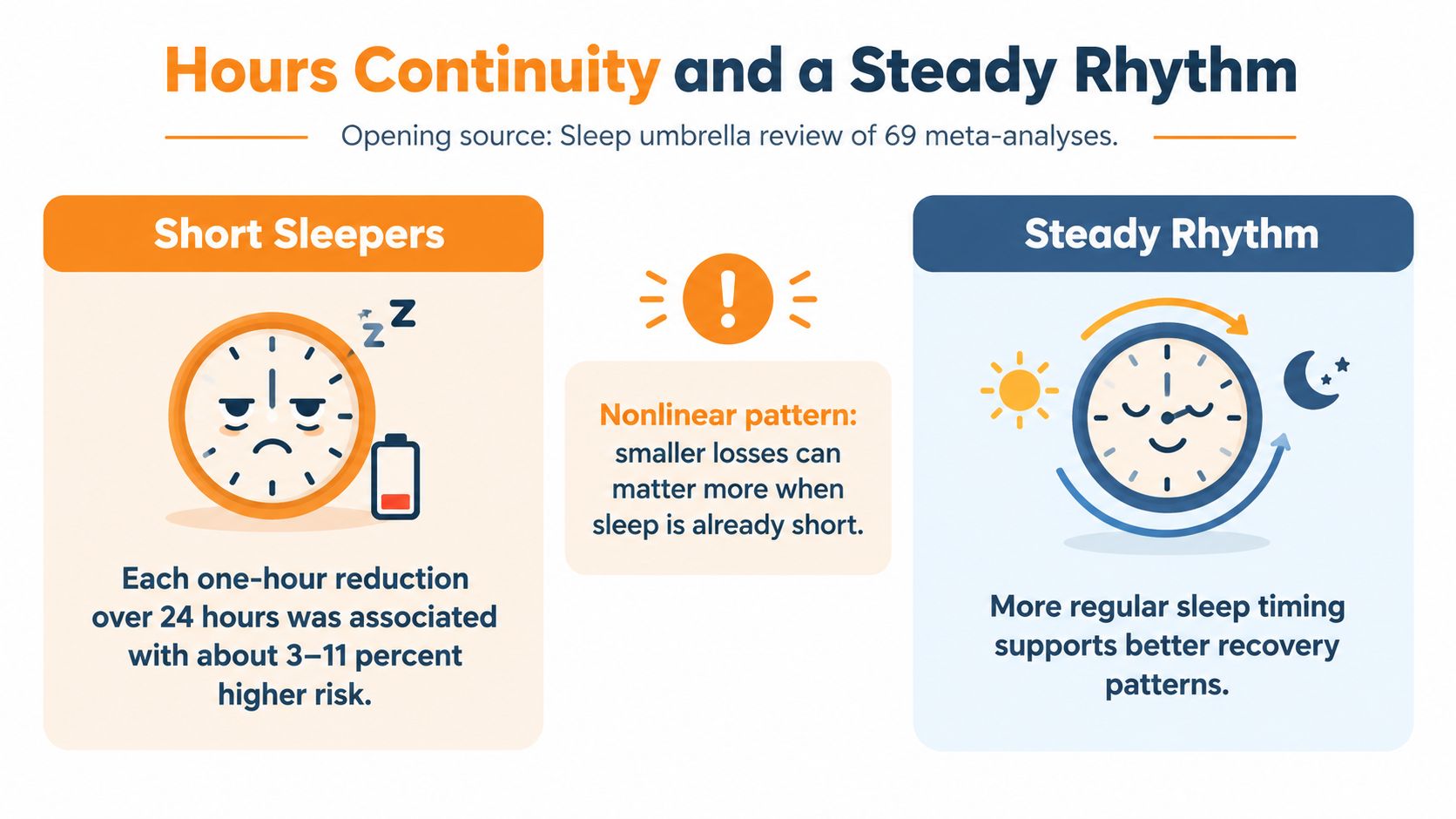
The Sleep umbrella review covering 69 meta-analyses found that sleep duration and health outcomes do not follow a simple “more is better” pattern.
Among short sleepers, each one-hour reduction in sleep over 24 hours was associated with approximately 3 to 11% higher risk across outcomes including all-cause mortality, coronary heart disease, osteoporosis, stroke, and type 2 diabetes. Among long sleepers, each additional hour was associated with approximately 7 to 17% higher risk for several adverse outcomes. These are associations observed across groups, not personal forecasts.
Three different questions
Sleep duration is only one part of the picture. It also helps to ask how unbroken sleep was and how regular its timing remained from night to night. A long stretch in bed can include frequent awakenings; a more moderate amount of sleep at familiar times may fit someone's usual pattern better.
Continuity means staying asleep through the night, while regularity describes how consistent sleep timing is. They are separate measures, like the length of a journey and how smoothly it proceeds. Looking at both alongside duration can show why two people reporting the same number of hours may describe very different nights.
Why baseline keeps showing up
Recovery is easier to interpret against a personal baseline: what is usual for someone over time. An early riser who wakes at a familiar hour and enjoys a morning walk has a different pattern from someone who suddenly wakes much earlier and stops doing activities they usually enjoy.
Consider two neighbors who each report six and a half hours in bed. One falls asleep at a similar time most nights, wakes briefly once, and gets through gardening and errands comfortably. The other has begun waking repeatedly, shifting sleep later on weekends, and feeling unusually sleepy during the day. Their reported duration is alike, but continuity, rhythm, and daytime experience differ.
The umbrella review describes persistent short or highly fragmented sleep as a reason to assess possible contributors, including sleep apnea, nocturia, pain, depression, or medication effects. Nocturia means waking to use the bathroom at night. These patterns do not diagnose a cause; they help explain why sleep duration alone may not capture the full picture.
Morning Walks and Evening Movement
This section begins with the PubMed record of a randomized crossover trial in adults aged 60 to 80 with subclinical or clinical insomnia. It compared coached exercise at 10:00 to 11:00 a.m. with coached exercise at 7:30 to 8:30 p.m. over two-week periods. Because it was a crossover trial, participants experienced both schedules, which makes the timing comparison easier to interpret.
Many readers hear a simple rule, don't exercise in the evening. The trial asked a narrower, more practical question. When the same general approach was scheduled in the morning or evening, did insomnia symptoms and sleep timing look different?
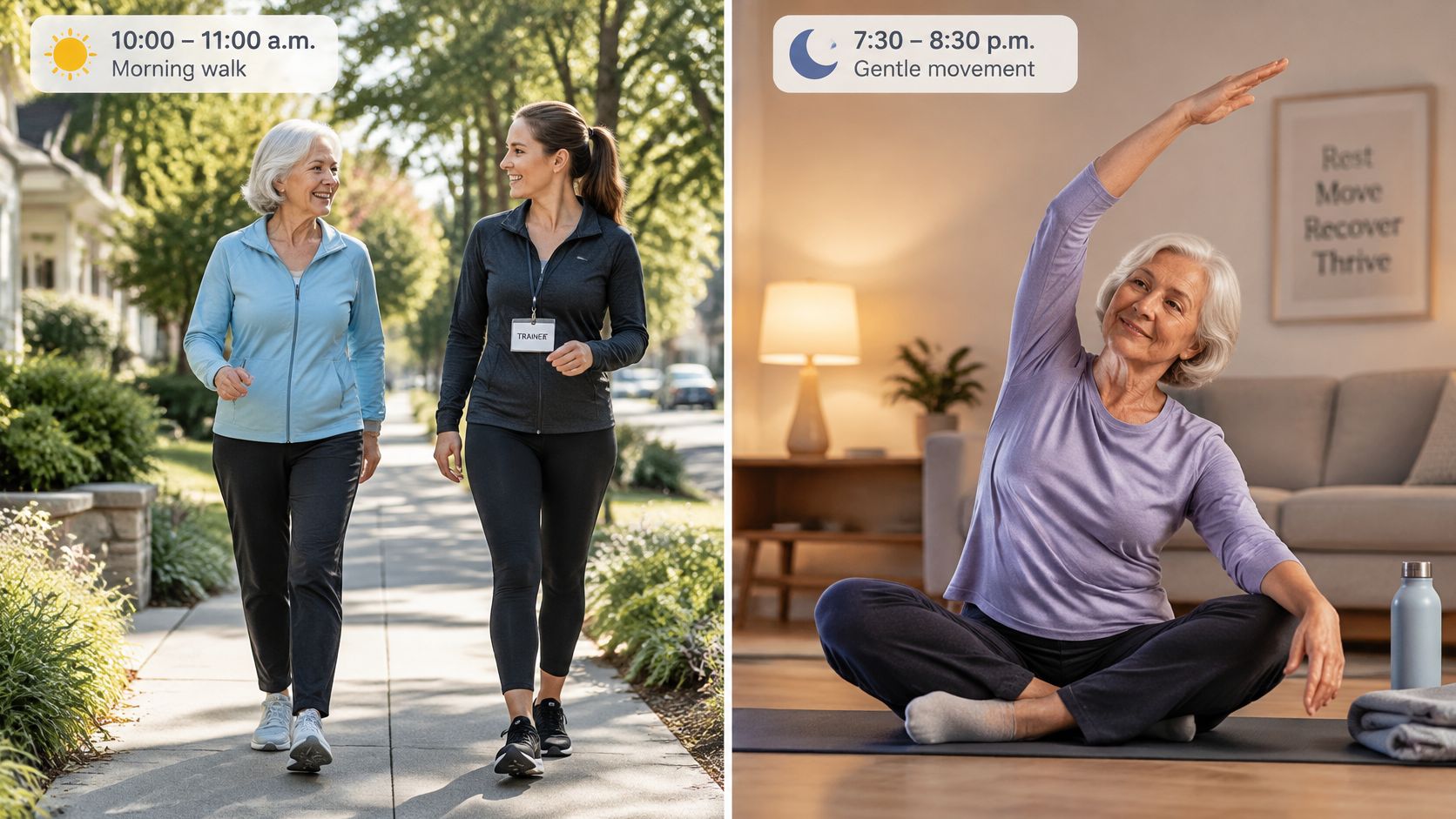
| Measure | Morning 10:00–11:00 a.m. | Evening 7:30–8:30 p.m. |
|---|---|---|
| Insomnia Severity Index | 11.87 (baseline 14.44) | 12.35 (baseline 14.44) |
| Sleep midpoint | about 4:13 a.m. | about 3:54 a.m. |
| Difference between schedules | not statistically meaningful | not statistically meaningful |
Reading the results carefully
Insomnia symptoms improved from a baseline Insomnia Severity Index score of 14.44 during both schedules, reaching 11.87 after morning exercise and 12.35 after evening exercise. The difference between morning and evening exercise was not statistically meaningful. That phrase is worth slowing down for. It means the study didn't find reliable evidence that one schedule beat the other on that score, even though the two averages weren't identical.
Sleep midpoint is the halfway point between falling asleep and waking. In the trial, it was approximately 4:13 a.m. after morning activity and 3:54 a.m. after evening activity. Based only on those times, the morning schedule's midpoint was later, not earlier. The source wording also describes a timing shift, so the safest reading is to report the recorded midpoints without building a strong direction claim on top of them.
Say a person gardens after dinner, comes inside, relaxes, sleeps at a familiar time, and wakes ready for a usual morning. That evening movement isn't automatically a problem in the story the trial tells. Contrast that with someone whose late, hard effort is followed by a wired evening, a much later night, and a flatter next day. Same broad category, evening activity, but very different intensity, timing, and next-day function.
What belongs in the timing picture
The trial write-up challenges a universal evening curfew. It places individual sleep timing, intensity, medication schedules, mobility limitations, and next-day function in the picture instead. Readers curious about working out late at night can keep that wider frame in mind, because a gentle stroll, balance practice, and vigorous training don't ask the same thing of the body late in the day.
The authors also note that larger trials are needed before personalized exercise timing recommendations can be established. That's a useful guardrail. A harmless schedule preference might look like enjoying evening movement while sleep and daytime energy stay familiar. A pattern worth showing a clinician would be different, such as persistent disruption paired with declining daytime function. The trial supports curiosity about timing, not a one-size answer for everybody.
Positive Routines Around the Same Clock
The routine ideas here are attributed to themes repeated across the NIH healthy-sleep discussion and the aging sleep reviews already introduced. They're framed as an observable day shape, not as new medical instructions. The shared thread is steadiness, similar anchors repeated often enough that sleep, movement, social time, and home life support each other.
Think of the clock less as a strict timetable and more as a set of familiar landmarks. Landmarks are easier to keep than a minute-by-minute plan, especially on days with appointments, family visits, weather changes, or a favorite class that doesn't meet every day.
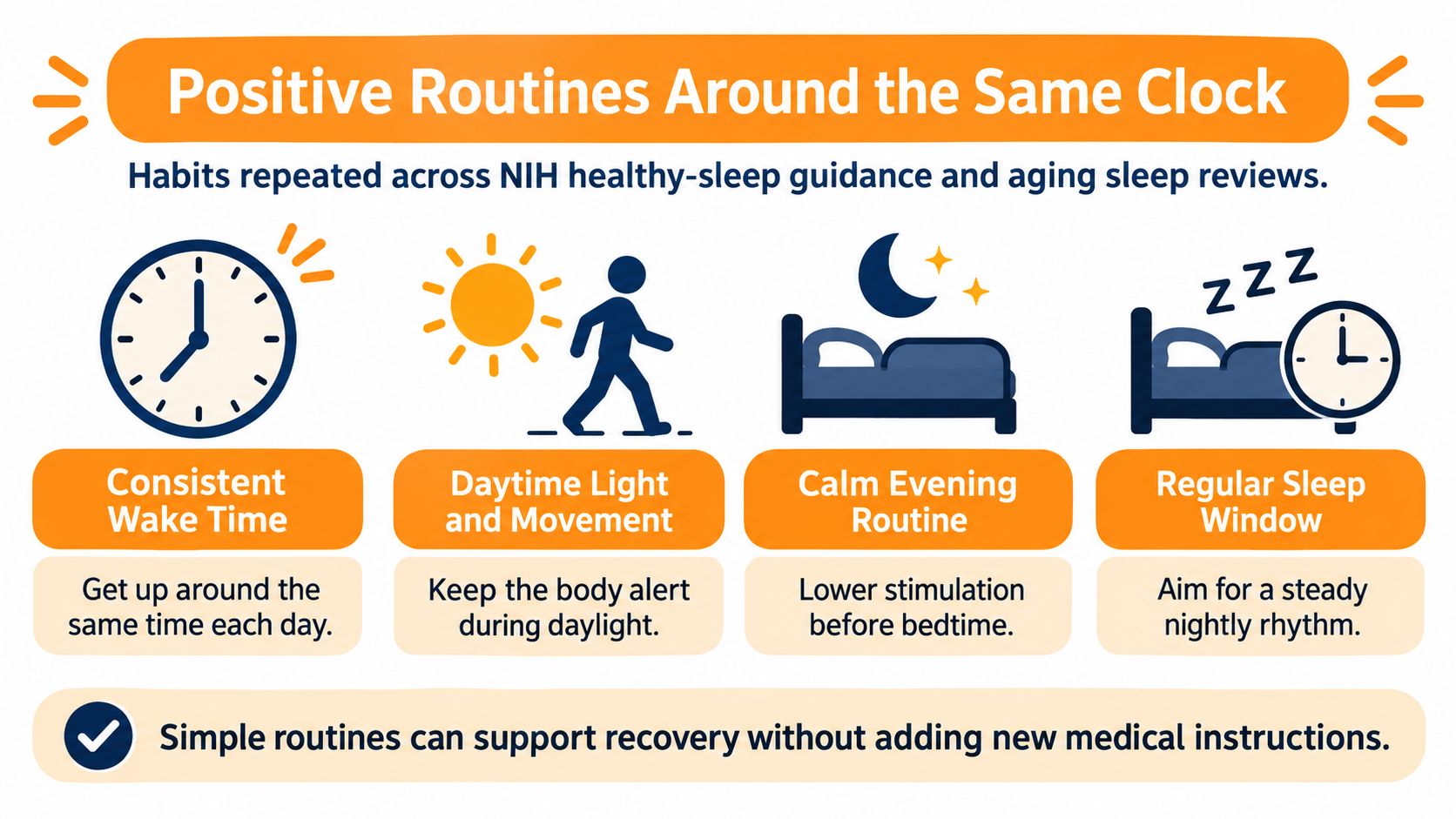
A friendly day shape in order
- Keep a similar bedtime and wake time most days. This matches the regularity feature measured in the large cohorts, where consistency, not only length, was part of the reported pattern. “Most days” leaves room for real life while still giving the week a recognizable rhythm.
- Get daylight and easy movement earlier when that fits the person's rhythm. A morning walk to get the mail, light gardening, or a stroll with a neighbor can anchor the active part of the day. It also pairs naturally with mobility and balance activities many independent older adults already enjoy.
- Leave room after harder effort so the evening can slow down. The timing trial didn't find evening sessions automatically worse, so this isn't a curfew. It's a buffer idea, finish, cool down, eat, visit, and let the pace change before bed.
- Keep the bedroom associated with sleep and a calm wind-down. Reading, gentle stretching, music, or a familiar getting-ready sequence can mark the transition. A late flood of bright screens and busy messages sends the opposite signal, that the day is ramping up again.
- Notice caffeine, heavy late meals, and long naps as pattern clues. These aren't rules invented here. They are items people often include when describing what the day before a restless or restful night looked like, which can make a personal pattern easier to see.
- Stay connected during the day. A short call, a shared walk, a club meeting, or lunch with family gives the day social rhythm. Those touchpoints often anchor wake times and activity without feeling like a health task, and they support the happiness and connection side of aging in place.
- Write one line in the morning about energy after ordinary activity. Keep it brief, for example, “Walked to the store, felt steady,” or “Slept in pieces, tired by noon.” One line is enough to compare days later without turning the morning into a numbers review.
What a fitting routine looks like
Imagine a person who wakes near the same time, opens the curtains, walks with a friend, practices a few balance exercises by the kitchen counter, and has a regular afternoon phone call. Dinner is unhurried, the evening gets quieter, and bedtime lands in a familiar window. Nothing in that picture requires perfection. Its strength is repeatability at home, on an ordinary week.
In the research language used throughout this guide, a fitting routine points toward sleep that's reasonably regular, not only long. The next day still has room for chosen activity, social connection, and the small tasks that make independent living feel like your own life. That positive frame keeps sleep and recovery connected to participation, confidence, and enjoyment, rather than reducing the night to a grade you wake up and pass or fail.
Reading Your Pattern and Sharing Updates
This section opens with the 2025 survey published in Disability and Rehabilitation Assistive Technology, covering 1,200 people aged 16 to 88. It found that 19.3% used a wearable to monitor sleep, and nearly 45% of users perceived benefits for sleep or stress. Yet users also reported longer sleep-onset latency, shorter total sleep time, and more severe insomnia symptoms than nonusers.
Sleep-onset latency just means how long it takes to fall asleep. The finding does not prove wearables caused poorer sleep, because people with existing sleep concerns may be more likely to buy and use a tracker. That alternative explanation is exactly why a friendly, factual reading matters. A device can be both popular with people who are worried about sleep and unable, by itself, to explain why their sleep looks different.
Recent reviews also report substantial heterogeneity in how commercial wrist-worn devices measure sleep and physical activity in older adults. Heterogeneity means the devices and methods vary a lot. A polished sleep score can therefore look more precise than it really is. It's an estimate built from signals such as movement and heart-related data, not a diagnosis and not a direct view inside the brain.
A calmer way to read it: one low night is a data point, while a repeated change from someone's own baseline is the conversation.
Variation that may simply be variation
Some patterns are easy to overread. A preferred earlier bedtime can be part of a stable rhythm. One evening walk that leaves next-day function intact can fit comfortably in a person's routine. A single restless night before travel, a celebration, or an early appointment also has obvious context. In each case, the surrounding story matters, when it happened, how often it repeats, and how the next day feels.
Trends help families stay grounded. Instead of reacting to every nightly score, they can ask whether bedtime has drifted, awakenings have become frequent, naps have grown longer, or morning energy has changed across several days. Those questions use tracking as a conversation starter. They don't ask an app to decide what the pattern means.
Signals the reviews say deserve a conversation
The cited reviews list repeated nighttime disruption, new daytime sleepiness, falls, confusion, or medication-related changes as reasons to talk with a clinician. That list isn't a diagnosis, and it isn't meant to sort readers into categories at home. It distinguishes ordinary variation from changes that may deserve professional context, especially when several appear together or daily function starts to shrink.
A simple three-night caregiver note can make that conversation clearer. Write down bedtime, awakenings, and morning energy for three nights, then keep it as a trend rather than a verdict. For example, “In bed 10:15, up twice, slow morning,” followed by two similar lines tells a more useful story than forwarding one red score at breakfast. Readers following related wellness signals may also explore a heart rate variability chart by age, while remembering that any single metric still needs the same trend-first caution.
Sharing can stay light. Rx360 is a modern wellness platform for independent older adults, designed to support active, independent living, and its Pilot Services include Support Circle Sharing and Fall Tracking. In this topic's terms, Support Circle Sharing lets loved ones receive updates while the person keeps familiar routines at home. Fall Tracking sits beside sleep and mobility as safety context, without interpreting what a sleep pattern means.
That boundary is healthy for everyone involved. Shared notes can help a daughter ask a better question, help a partner notice that three rough nights lined up with unusually tired mornings, or help a clinician hear a clearer timeline. They support judgment, conversation, and connection. They don't replace a clinician's judgment, and they work best when the person at the center stays in control of the story being shared.
If steadier nights, active days, and staying connected at home matter to you or someone you support, Rx360 offers a simple way to keep loved ones in the loop through Support Circle Sharing, alongside services such as Fall Tracking and Medication Reminders. Visit Rx360 to see how its wellness platform supports independent living while helping your support circle share timely updates without adding complexity to daily routines.
Lower-Risk Medication Plan Checklist
Below is a practical checklist and step plan you can implement into your daily life:
-
List all medications
Include prescriptions, over-the-counter drugs, supplements, sleep aids, creams, patches, eye drops, and inhalers.
-
Mark fall-risk drugs
Flag medicines that cause dizziness, sleepiness, confusion, blurred vision, low blood pressure, or low blood sugar.
-
Ask for a medication review
Bring the list to a pharmacist or prescriber.
-
Review after any warning sign
Request a new medication check after a fall, near-fall, new prescription, dose change, dizziness, or confusion.