A lot of older adults hear the same advice over and over: don't exercise late, or you'll ruin your sleep.
That rule is too blunt.
If you're aging in place, real life doesn't always leave you a perfect morning workout slot. You may spend daytime hours at appointments, helping a spouse, managing the house, pacing your energy, or feeling stiffer earlier in the day. For many people, evening is when the house finally gets quiet and movement feels possible. That matters, because the best exercise routine is often the one you can keep.
Working out late at night isn't automatically a mistake. What matters most is what kind of exercise you do, how hard you do it, and how close it lands to bedtime. Popular advice often skips that nuance. It also rarely speaks directly to older adults who want to stay active without giving up independence.
This guide takes a calmer, more practical view. The goal isn't to scare you away from evening movement. It's to help you make smart choices so late exercise can fit safely into your life, your home, and your routine.
Table of Contents
- Rethinking the Rules on Working Out Late at Night
- How Late Night Workouts Affect Your Sleep and Body
- Benefits vs Risks of Evening Exercise for Seniors
- Safe and Effective Late Night Workout Examples
- Your Post-Workout Cooldown and Sleep Hygiene Checklist
- How Rx360 Supports Your Independent Evening Routine
Rethinking the Rules on Working Out Late at Night
For years, the message has been simple: late workouts are bad for sleep. But simple advice can be misleading when it ignores daily life.
A more accurate way to look at it is this: late-night exercise isn't one thing. A brisk walk after dinner, a gentle yoga session, and an all-out treadmill interval workout place very different demands on the body. Lumping them together creates confusion.
That's especially important for older adults. Many people who want to remain independent don't have unlimited flexibility during the day. Evening may be the safest, least rushed, and most realistic time to move. A helpful summary from Ubie's doctor-reviewed note on nighttime workouts and sleep points out that popular advice often treats late workouts as universally disruptive, even though the main risk is high intensity close to bedtime. It also notes that moderate evening exercise often doesn't harm sleep and can even improve it for some people.
The older adult perspective matters
If you're in your 60s, 70s, or beyond, the question often isn't “What's the ideal workout time?” It's “When can I move consistently, safely, and without throwing off the rest of my day?”
That's a much better question.
Evening exercise can support independence because it may help you:
- Keep a routine: Regular movement supports confidence with daily tasks like stairs, carrying groceries, and getting up from chairs.
- Use the quiet hours well: Many people feel less distracted and less rushed later in the day.
- Reduce stiffness before bed: Light movement can make it easier to settle physically, especially if you've been sitting for long periods.
Moderate evening movement isn't the same as an intense late-night workout. That distinction is where most of the confusion starts.
Blanket rules can backfire
When people hear “never exercise at night,” some stop moving altogether on busy days. That's not a good trade.
From a physical therapy perspective, I'd rather see an older adult do a short, appropriate evening session than skip movement entirely because the timing isn't perfect. The safer path is usually to adjust the workout, not automatically cancel it.
What tends to work best is a practical middle ground:
- Keep evening sessions lower in intensity
- Finish early enough to allow your body to settle
- Watch your own sleep response over time
- Prioritize safety at home, especially if you feel tired or unsteady late in the day
That approach respects both science and real life.
How Late Night Workouts Affect Your Sleep and Body
Your body doesn't switch from exercise mode to sleep mode instantly. It has to come down in stages.
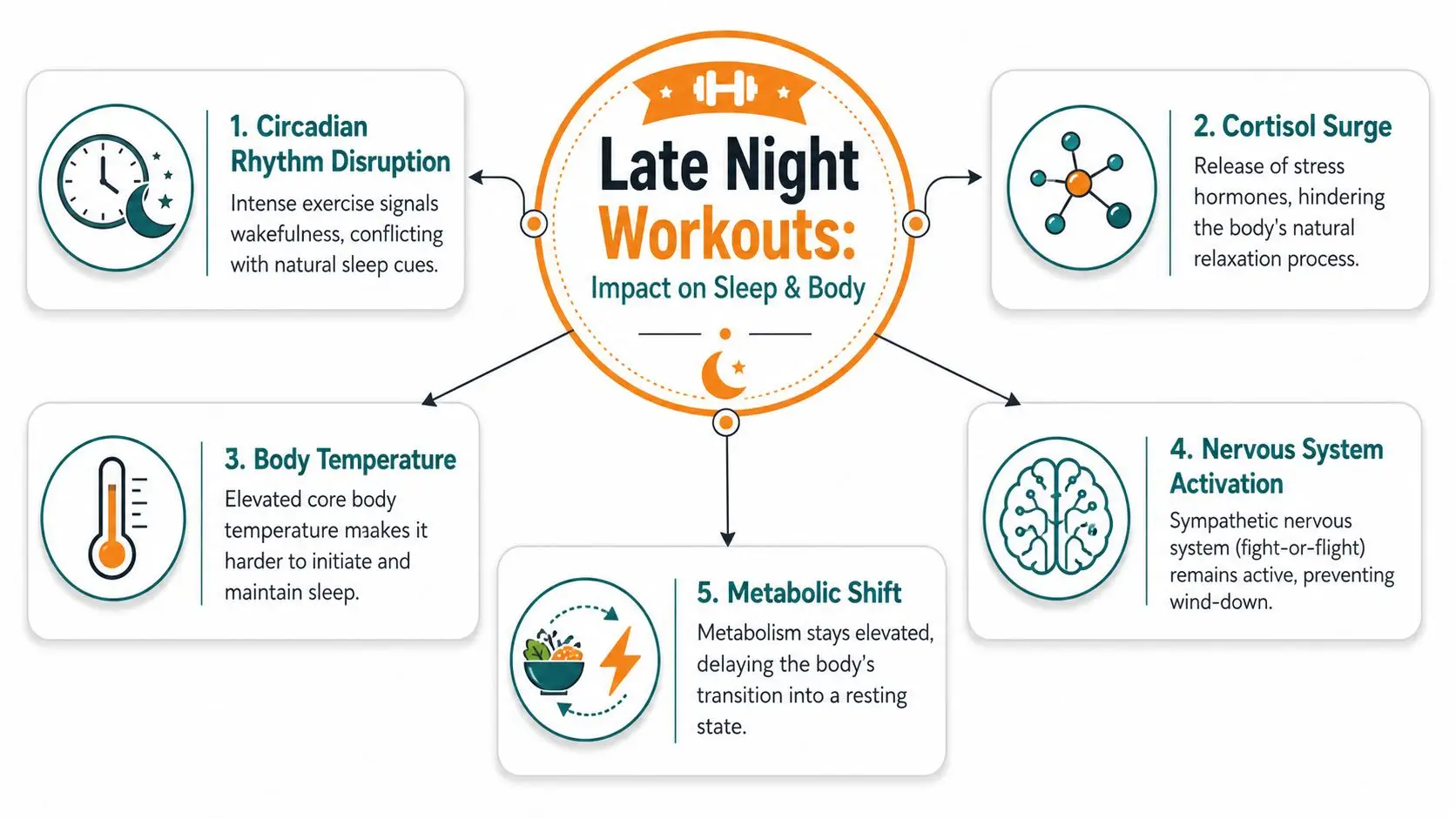
Think of exercise as turning up several internal dials at once. Your heart rate rises. Your nervous system becomes more alert. Your body temperature climbs. If the session is demanding, your body may act as though it still needs to stay awake and ready. That's great during movement. It's not so helpful when you want to fall asleep.
Your body needs a landing period
Two body systems matter a lot here.
First, there's your nervous system. A hard workout can leave you in a more activated state. Many people describe this as feeling “wired but tired.” They know they should be sleepy, but their body doesn't feel ready to power down.
Second, there's body temperature. Sleep usually comes more easily when the body cools. A systematic review of evening exercise found that short-term evening exercise can delay the melatonin rhythm and increase nocturnal core body temperature, while longer exercise durations can keep temperature high and returning to baseline only after about 30 to 120 minutes according to the systematic review on evening exercise, thermoregulation, and sleep. That helps explain why some people finish a workout and still feel too warm and alert to sleep.
What the research shows about timing
The clearest evidence says timing matters most when exercise happens close to bedtime.
A large study in Nature Communications analyzed about 4 million person-nights and found a dose-response pattern between later exercise and sleep disruption. When workouts ended in the window from 4 hours to 2 hours after habitual sleep onset, sleep onset became progressively later. In that study, maximal exercise was linked to a 36-minute later sleep onset if it ended 2 hours before habitual sleep onset and an 80-minute later sleep onset if it ended 2 hours after habitual sleep onset. The same study also linked later, higher-strain exercise with shorter sleep duration, lower sleep quality, higher nocturnal heart rate, and lower heart-rate variability. The practical takeaway from the authors was that finishing exercise 4 or more hours before sleep onset is the safest window for minimizing disruption, especially for higher-intensity sessions, as described in the 2025 Nature Communications study on exercise timing and sleep.
That's a strong message, but it doesn't mean all evening movement is a problem. It means intense workouts too close to sleep are the bigger issue.
A short video can make that easier to picture in real life.
Why this feels different from person to person
Some older adults tolerate evening activity well. Others notice even moderate effort keeps them awake. That difference can come from habit, medication timing, pain levels, conditioning, stress, and the kind of workout itself.
Here are common signs your session is too stimulating:
- You feel overheated: You finish moving but still feel warm long after the workout ends.
- Your mind stays busy: You get into bed and feel mentally “on.”
- Your pulse feels high: Even after sitting down, your body doesn't seem settled.
- Sleep shifts later: You repeatedly fall asleep later on workout nights.
Practical rule: If an evening session leaves you more energized than calm, the workout was probably too intense, too long, or too close to bedtime.
Benefits vs Risks of Evening Exercise for Seniors
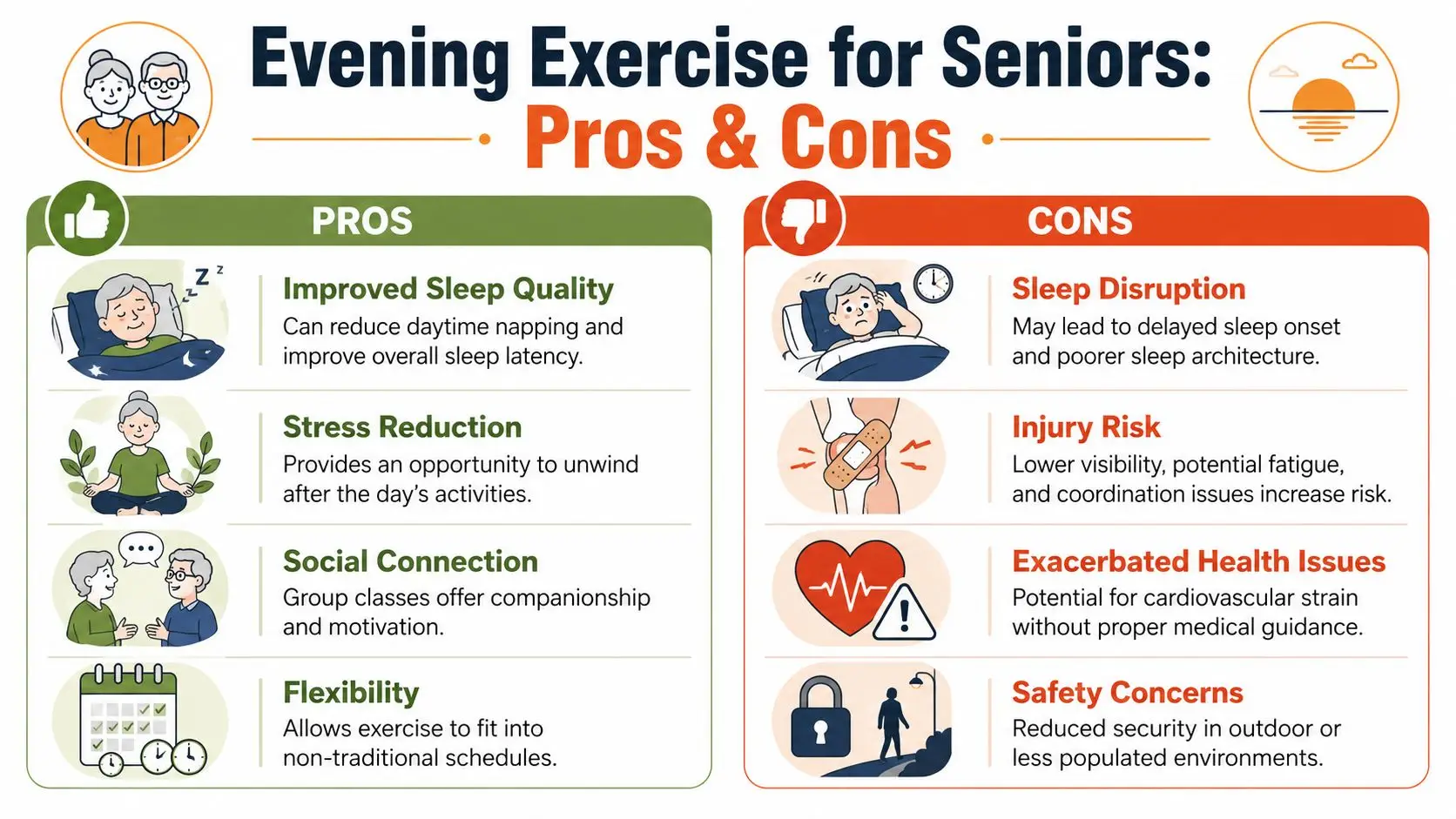
Evening exercise can be a very good fit for older adults. It can also be a poor fit if the session is too hard, too long, or done when you're already fatigued.
The goal is to weigh both sides impartially.
Why evening exercise can be a good fit
For some people, later movement is the only time that reliably happens. That alone gives it real value.
Evening sessions may help because they can:
- Support consistency: A routine you can repeat is more useful than a perfect plan you keep postponing.
- Create a transition: Light movement can help separate the day's stress from the bedtime routine.
- Feel more comfortable physically: Some adults feel less stiff later in the day than first thing in the morning.
- Work better socially: Family schedules, group classes, or walking with a spouse often happen after dinner.
If that sounds familiar, you're not doing something wrong by preferring evenings. You're adapting exercise to your life.
Where the risks start to rise
The risks usually increase when evening exercise becomes long, vigorous, or poorly timed.
A study of nighttime exercise found that many participants who exercised in the evening had poor sleep quality, defined as a Pittsburgh Sleep Quality Index global score above 5. It also found that evening sessions lasting more than 90 minutes were significantly associated with worse sleep. In the same study, moderate evening exercise had a correlation of r = 0.30 (p = 0.025) with poor sleep quality, while vigorous evening exercise had r = 0.25 (p = 0.038), as reported in the study on nighttime exercise duration, intensity, and sleep quality.
That doesn't mean a moderate evening workout is “bad.” It means you should pay attention to dose. Duration and intensity both matter.
For older adults, there are also practical risks that don't always show up in sleep studies:
- Fatigue-related balance problems: If you're tired late in the day, form can slip.
- Poor lighting: Hallways, garages, patios, and home gyms may be less forgiving at night.
- Late caffeine or large meals around exercise: These can complicate how your body settles.
- Overdoing it because you finally have time: That can turn a healthy habit into an exhausting one.
If you feel less steady at night, choose seated, supported, or very familiar exercises. Safety comes before intensity.
A simple decision filter
Use this three-part check before working out late:
| Question | Lower-risk answer | Higher-risk answer |
|---|---|---|
| How hard is the session? | Light to moderate | Vigorous or near-maximal |
| How long will it last? | Short and focused | Extended session |
| How do you feel tonight? | Alert, steady, comfortable | Overtired, achy, unsteady |
If you land in the right-hand column more than once, scale the workout down or move it earlier the next day. That kind of self-adjustment is smart, not lazy.
Safe and Effective Late Night Workout Examples
When older adults ask me about working out late at night, I usually suggest thinking in terms of settling, circulating, or maintaining, rather than “pushing.” Evening exercise should help your body feel capable, not revved up.
Below are practical options that work well at home with simple equipment like a chair, a yoga mat, a resistance band, or a stationary bike.
For relaxation and flexibility
These sessions are best when your goal is to loosen up and prepare for sleep.
Gentle stretch sequence
- Sit on a sturdy chair and take slow neck turns.
- Roll your shoulders back.
- Stretch your calves against the wall.
- Do a seated hamstring stretch with one leg extended.
- Finish with slow trunk rotations.
Move without bouncing. Hold each stretch at a comfortable edge, not into pain.
Chair yoga or mat-based mobility
A short guided chair yoga session can work well if you have arthritis, morning stiffness, or back tension. Focus on spinal mobility, hip opening, and breathing. Poses should feel relieving, not demanding.
Tai chi-style weight shifts
Stand near a kitchen counter and practice slow side-to-side weight shifts, gentle arm patterns, and controlled stepping. This can improve body awareness while keeping the pace calm.
For light cardio without overstimulation
Sometimes you want circulation and a sense of accomplishment, but not a workout that keeps you awake.
Try one of these:
- Easy stationary cycling: Keep the resistance low and your breathing comfortable.
- Indoor walking laps: Walk through the house or hallway at a natural pace with good lighting.
- Marching in place near support: This works well during bad weather or if you don't want to go outdoors.
A good test is the talk test. If you can speak in full sentences, you're probably in a reasonable range for late evening movement.
For strength without a sleep penalty
Strength work at night should be simple and controlled.
A good home circuit might include:
- Sit-to-stands from a chair: Use your hands if needed.
- Wall push-ups: Keep your body in a straight line.
- Standing heel raises: Hold the counter lightly.
- Resistance band rows: Sit tall and move slowly.
- Mini squats to a counter: Only as deep as feels steady.
Choose fewer repetitions than you might do earlier in the day. The goal is to maintain strength, not exhaust yourself before bed.
A late-night workout should leave you feeling pleasantly used, not depleted.
Late-Night Exercise Do's and Don'ts
| Activity Type | Recommendation | Why It Works (or Doesn't) |
|---|---|---|
| Gentle stretching | Recommended | Helps reduce stiffness and encourages a calmer transition toward bedtime |
| Chair yoga | Recommended | Low impact, easy to modify, and usually not overstimulating |
| Tai chi or balance practice near support | Recommended with caution | Supports control and awareness, but only if lighting and steadiness are good |
| Easy stationary bike | Recommended | Gives light cardiovascular work without pounding or speed |
| Light resistance band routine | Recommended | Helps maintain strength when done in a controlled, brief session |
| Long cardio session | Usually not recommended | Extended effort can leave you too warm and alert late at night |
| HIIT or sprint intervals | Not recommended | High intensity close to bed is more likely to keep the nervous system activated |
| Heavy lifting near bedtime | Not recommended for most people | Can be too stimulating and harder to recover from before sleep |
| New or complex exercises | Not recommended late | Fatigue increases the chance of poor form and missteps |
| Outdoor walking in low visibility | Sometimes not recommended | Safety depends on lighting, weather, sidewalks, and confidence |
If you're unsure where to start, begin with the gentlest option for one week and notice how you sleep that night. Your body will often tell you more than a generic rule can.
Your Post-Workout Cooldown and Sleep Hygiene Checklist
The workout itself is only part of the story. The time after it matters just as much.
If you finish moving and then jump straight into bright lights, television, email, or chores, you send your body mixed signals. It has no clear path from activity to rest.
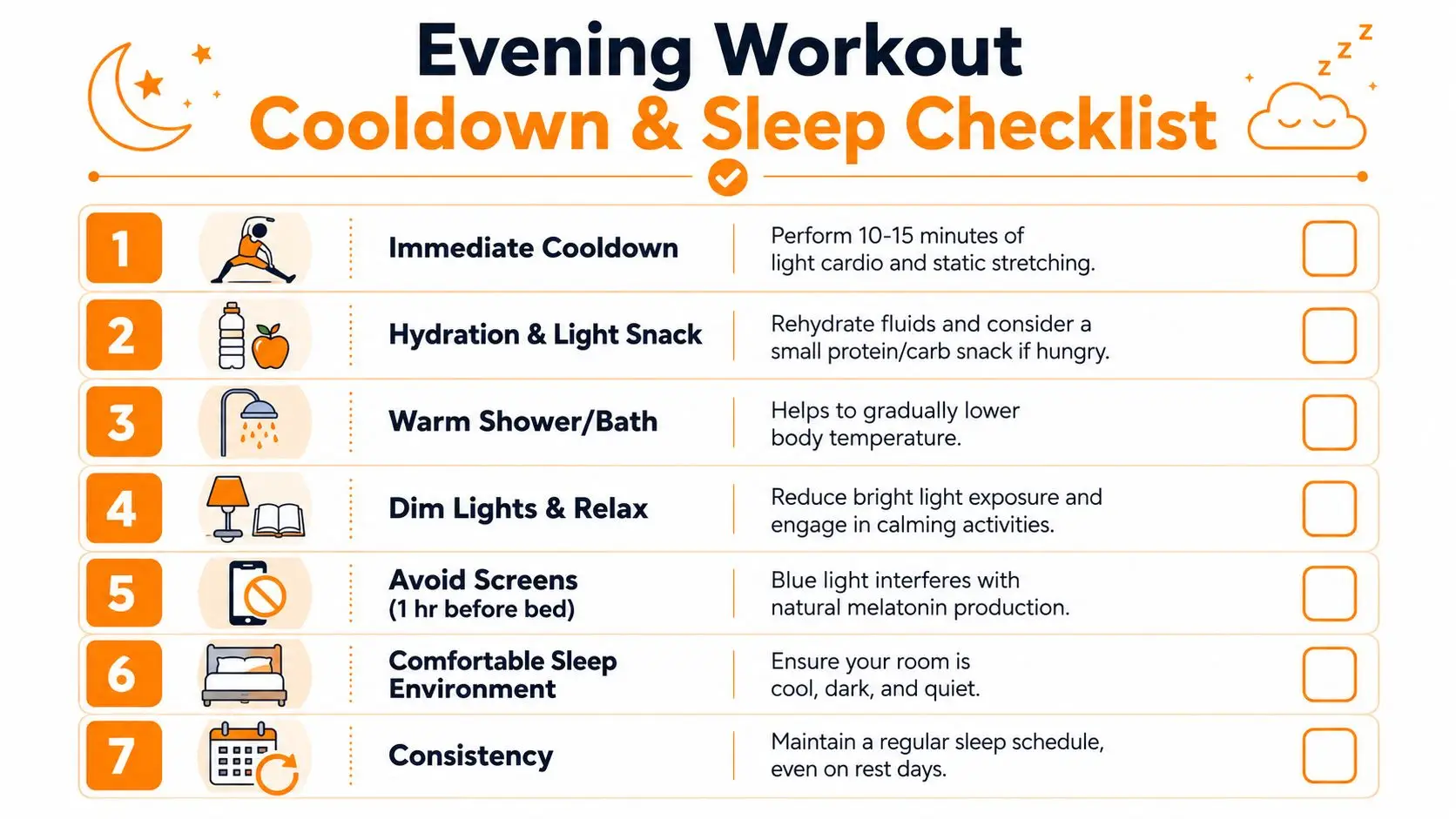
A cooldown that helps your body settle
A proper cooldown is not just “extra stretching.” It's your landing sequence.
A systematic review noted that after exercise, core body temperature can remain increased before returning to baseline in about 30 to 120 minutes, and that matters because sleep onset generally improves as the body cools.
Use this simple sequence:
- Slow the pace first: If you were biking or walking, ease down gradually instead of stopping abruptly.
- Stretch the muscles you used: Calves, thighs, hips, chest, and shoulders are common targets.
- Add breathing practice: Inhale gently through the nose, then exhale longer than you inhale.
- Sit for a few minutes: Let your heart rate and breathing settle before moving into bedtime tasks.
The bedtime checklist after evening exercise
Think of the next hour as a cueing process. You're telling the body, “Activity is over. Rest is next.”
Use this checklist:
- Dim the lights: Bright light can make winding down harder.
- Keep food light: If you're hungry, choose a small, easy snack instead of a heavy meal.
- Hydrate, but don't flood the system: Sip enough to recover without setting yourself up for repeated bathroom trips.
- Take a warm shower or bath if it relaxes you: Many people find it helps them feel looser and calmer.
- Put screens away: Phones, tablets, and exciting shows can keep your brain more engaged than you realize.
- Cool the bedroom: A comfortable sleep environment makes a difference.
- Keep your bedtime consistent: Routine helps your body know what to expect.
Evening habit to protect: The calmer your hour after exercise, the better your chances of sleeping well.
If you repeatedly struggle to fall asleep after workouts, don't assume exercise is the problem in general. Often the issue is the type of session or the wind-down afterward.
How Rx360 Supports Your Independent Evening Routine
Staying active at night can be part of healthy, independent living. It just helps to have a support system that doesn't interfere with autonomy.
That's where thoughtfully designed wellness technology can be useful.

Technology that respects independence
The best support tools don't nag. They unobtrusively make daily life easier and clearer.
For an older adult who prefers evening movement, a platform like Rx360 wellness support for aging in place can fit into that routine without making it feel medicalized. The value isn't in telling someone whether they “should” work out late. The value is in helping people stay aware of patterns, maintain routines, and stay connected to family or care partners in a low-friction way.
That can matter when evening habits are part of what keeps someone active and confident at home.
A better way to stay connected
Families often worry about two things at once. They want their loved one to stay independent, and they want reassurance that things still look normal day to day.
That's why connected wellness tools can be so helpful around an evening routine:
- They support awareness: Loved ones can feel more comfortable knowing daily routines remain intact.
- They reduce unnecessary check-ins: The older adult gets more freedom, not less.
- They make changes easier to notice: If a pattern starts to shift, families can respond early and calmly.
- They fit real life: Evening exercise, medication routines, winding down, and overnight rest all happen within the same lived rhythm.
For many households, that balance is the sweet spot. The older adult keeps ownership of their routine. Family members get peace of mind. Everyone stays more connected without constant hovering.
Rx360 helps older adults stay active, informed, and connected while aging in place. If you want a supportive way to maintain independence and give family added peace of mind, explore Rx360.
Lower-Risk Medication Plan Checklist
Below is a practical checklist and step plan you can implement into your daily life:
-
List all medications
Include prescriptions, over-the-counter drugs, supplements, sleep aids, creams, patches, eye drops, and inhalers.
-
Mark fall-risk drugs
Flag medicines that cause dizziness, sleepiness, confusion, blurred vision, low blood pressure, or low blood sugar.
-
Ask for a medication review
Bring the list to a pharmacist or prescriber.
-
Review after any warning sign
Request a new medication check after a fall, near-fall, new prescription, dose change, dizziness, or confusion.