You wake up and do three small things before breakfast. You notice how the night went and say so on the phone. You step on the scale, same morning each week. Your phone counts the walk to the mailbox and back without being asked.
None of that feels like health care. It's just a morning. Add those habits up over a month, though, and you have a record of sleep, weight and movement that a clinician would find useful and a family member would find reassuring. That record already has a name. It's patient generated health data, and it's part of how care happens even when nobody uses the phrase.
Table of Contents
- What Patient Generated Health Data Really Includes
- How Daily Observations Reach Your Care Team
- Seven Checks That Keep Data Trustworthy
- Privacy, Consent and Who Can See What
- Everyday Examples of PGHD Supporting Independence
- Limits, Gaps and Who Gets Left Out
- Confirm Your Next Step Before You Share Data
What Patient Generated Health Data Really Includes
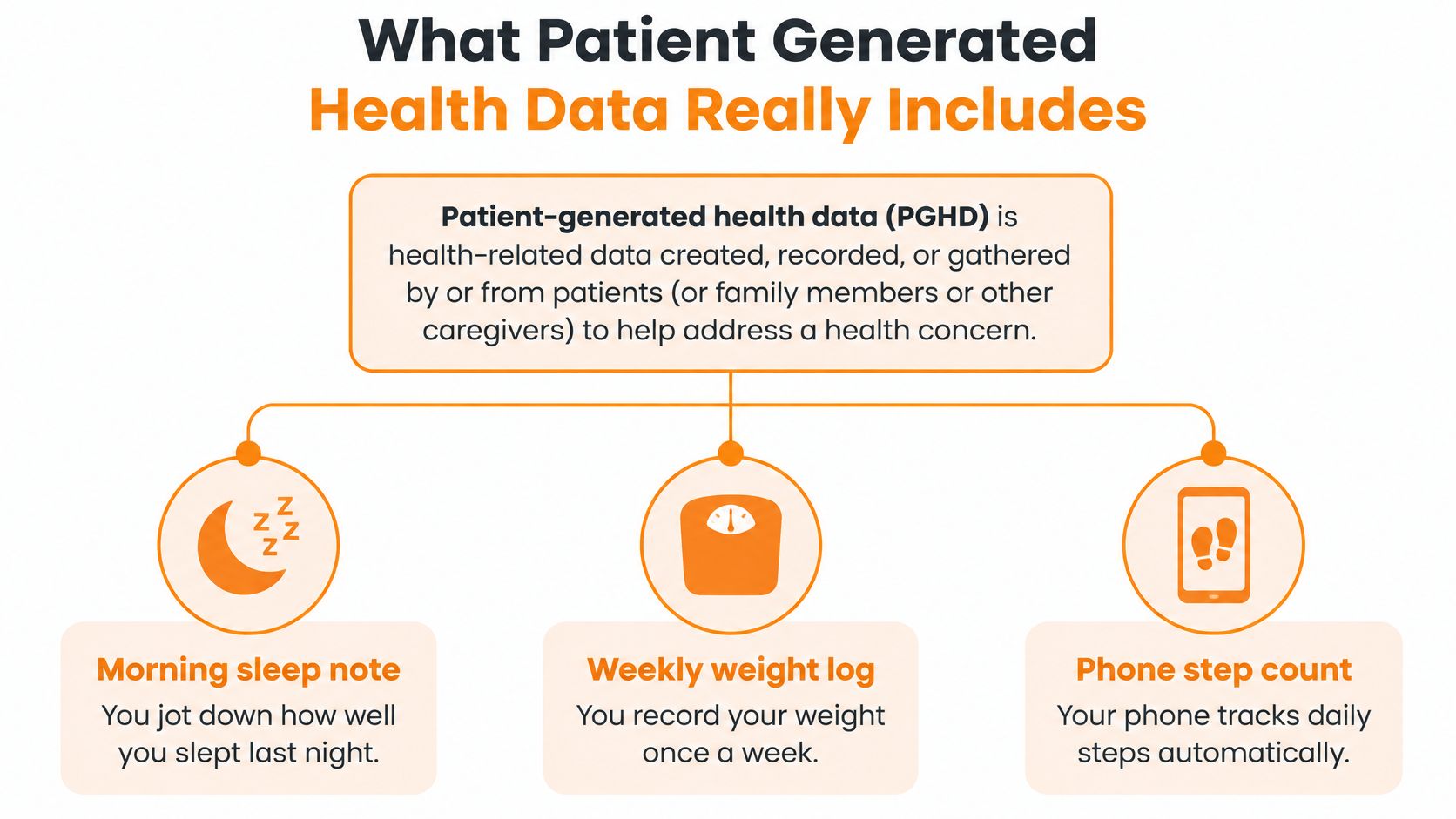
A note on the fridge can be part of a person's health record. So can a family member's message describing a change they noticed. The Office of the National Coordinator for Health Information Technology defines patient-generated health data as health-related information created, recorded, or gathered by patients, family members, or caregivers to address a health concern (ONC white paper on patient-generated health data). The definition centers on who creates or gathers the information, not on which device holds it.
That includes health and treatment history, biometric measurements, symptoms, and lifestyle choices. A paper diary of dizzy spells, a medication list updated after a pharmacy visit, and a note that a usual walk felt shorter all qualify. A smartwatch reading can belong in the same category, but wearing a device is not a requirement.
A smartphone can make recording and sharing easier. Many phones can capture steps, sleep, symptoms, or reminders. Whether those observations reach a care team depends on the workflow: who receives them, whether they can interpret them, and how quickly they respond.
| Type | Everyday examples | Usual source |
|---|---|---|
| Health history | Past conditions, current medication list, past procedures | Personal records, family memory, paper files |
| Biometric measurements | Weight, blood pressure readings, heart rate | Home devices and wearables |
| Symptoms | Dizziness, pain level, new tiredness noted in a diary | Patient or caregiver notes |
| Lifestyle choices | Meal patterns, alcohol use, smoking status | Self-report surveys |
| Activity data | Daily steps, time spent standing, walking pace | Phones and wearables |
| Sleep data | Bedtime, wake time, restless nights | Sleep trackers and journals |
| Questionnaires | Mood check-ins, daily wellbeing surveys | Phone apps and paper forms |
The variety matters. A care team may receive a handwritten page, a survey response, or readings from a device, and each format can require a different way to review and respond. In a 2019 survey at an academic health center, 3 of 22 clinicians (14%) said their clinical setting formally collected patient-generated health data as part of care delivery (study of PGHD use across health systems). That finding describes the surveyed clinicians, not every care setting.
A handwritten symptom diary and a wrist-worn tracker are both PGHD. Their usefulness depends on the context and reliability of the information, and on whether someone is responsible for reading it. If a person cannot record data, lacks a device, or does not know who will see it, that part of their experience may be missing from the record.
Heart rhythm readings show why context matters. A wearable can flag an irregular pattern, but a reader needs to know what was measured and when. Qaly's heart rhythm monitoring guide explains how a single-lead recording is taken and reviewed, useful context when sharing a strip of readings.
How Daily Observations Reach Your Care Team
A blood pressure note on the fridge helps only if the right person sees it and knows what to do. Patient-generated health data can reach a care team in two general ways: a person brings or sends observations, or a clinic collects them through a defined process, such as a portal questionnaire or monitoring program. Both routes can happen at the same time.
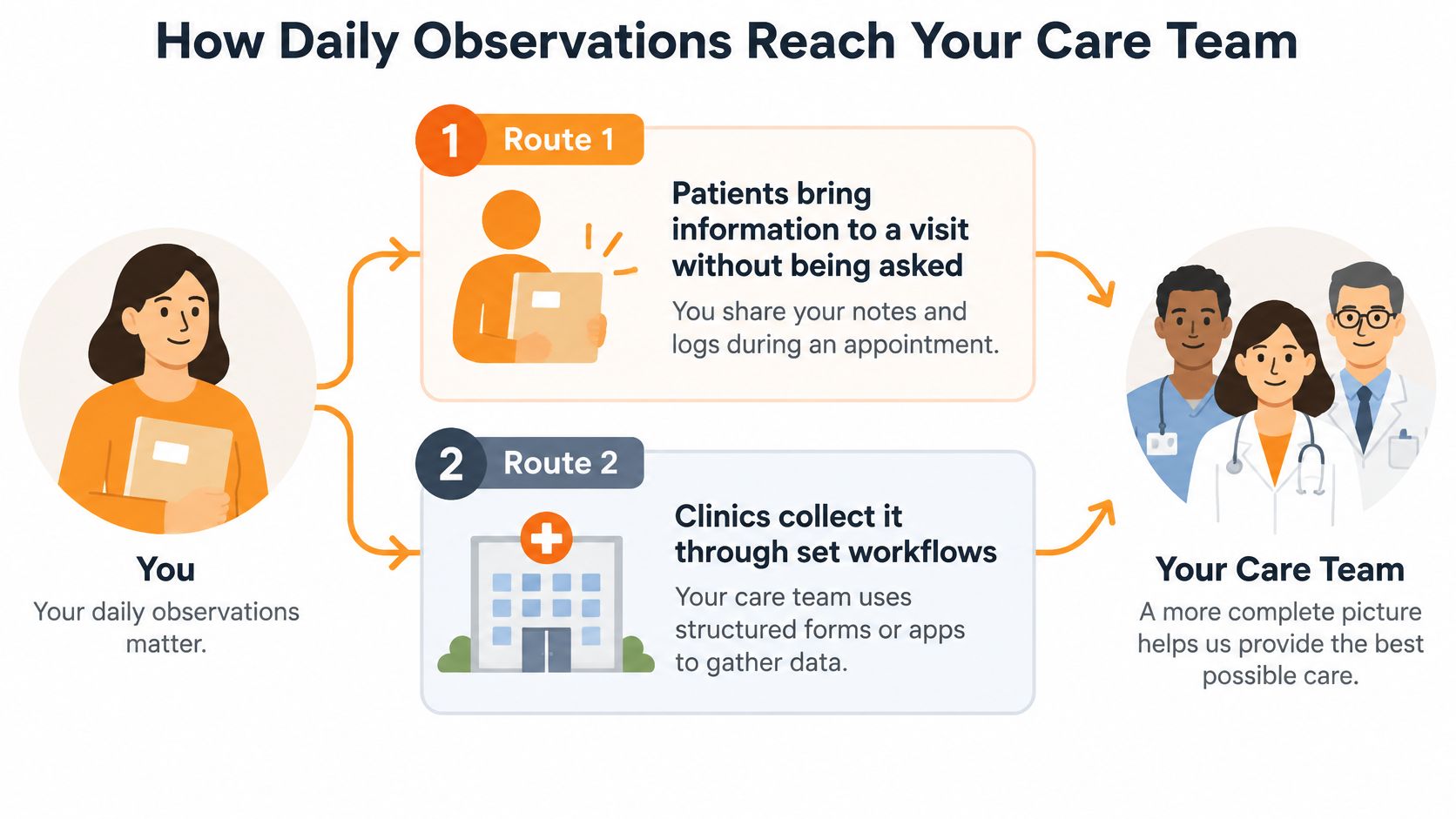
A file on a phone is only the starting point. For an observation to inform care, four steps need to connect:
- Someone records the observation. An older adult might jot down a symptom, or a caregiver might enter a home blood pressure reading. A simple note can be useful when it captures what happened.
- The context is saved with the number. Include the time, device, unit, and whether a person entered the value or a sensor recorded it. That context helps a later reader distinguish a resting reading from one taken after climbing stairs.
- It reaches a named person or clinic. Identify who is expected to receive it, such as a family caregiver, nurse, or care coordinator. If no one is assigned to receive the information, it can be overlooked.
- An agreed person reviews it and decides what happens next. The response might be a call, a note for the next appointment, or no action that day. What matters is that responsibility for review is clear.
Why shared standards matter more than shared enthusiasm
Data kept in one app may not be usable in another system. The Office of the National Coordinator describes Fast Healthcare Interoperability Resources (FHIR) as a standard for exchanging health information and has tested a guide for representing patient-reported outcomes (ONC patient-reported outcomes final report). In practical terms, labeled, structured values are easier to interpret and transfer than a photo of a screen.
The same agency's certification program requires the United States Core Data for Interoperability, a defined set of data classes and elements that includes laboratory results, medications, allergies, and clinical notes (ONC standards and technology overview). Shared definitions, together with patient matching, help organizations recognize which observations belong to the same person.
For a plain-language explanation of how records are structured and shared, read how electronic health records work. The everyday lesson is simple: a concise summary that a clinician can review is more useful than a pile of screenshots. Sharing data is only one part of the workflow. Someone must be able to read it, know when to respond, and notice when an expected observation is missing.
Seven Checks That Keep Data Trustworthy
Two references frame this section. One is a review of 19 studies that sorted data-quality problems by where they come from. The other is a quality framework naming seven aspects of data quality (JMIR mHealth and uHealth review).
The review grouped problems into device and technical factors, user-related factors and data-governance factors. Reported issues included incomplete, incorrect and heterogeneous data, while experts pointed to completeness, conformance, plausibility, and the timing or granularity of measurements as the dimensions worth judging. None of that is about whether someone cares enough. It's about whether the record can carry weight.
Failure points also cluster at capture, transmission and clinical review. A practical framework for this work evaluates whether data is accurate, accessible, consistent, complete, interpretable, timely and relevant, then stores provenance and context with every observation before anything escalates to family or a clinician (framework for assessing patient-generated health data quality).
| Quality aspect | Question to ask | Quick everyday check |
|---|---|---|
| Accessibility | Can the right people see it when they need it? | Confirm who has access and what they can view |
| Accuracy | Does the number match what actually happened? | Compare a device reading with a manual check now and then |
| Completeness | Are there gaps in the record? | Count missing days in a week |
| Consistency | Is it recorded the same way each time? | Use the same device, time of day and unit |
| Interpretability | Can someone understand what it means? | Label units and add a short note about context |
| Relevance | Does it connect to the question being asked? | Keep the measures tied to a clear goal |
| Timeliness | Is it recent enough to act on? | Check the timestamp before reading the trend |
Take the watch left on the charger for a day. Read at speed, the flat line looks like a collapse in activity. Read with context, it's a battery. A dropped signal during a storm, a week of measurements skipped for a hospital appointment, a change in routine after a grandchild's visit: each looks like decline if nobody writes down why the numbers changed.
A gap in the data is information too, but only if somebody records the reason for the gap.
Good record-keeping is unglamorous and specific. Note the device type, the measurement time, the unit, the collection method, and whether the value was typed in or sensed automatically. Checking stays part of the routine as well: users are solely responsible for verifying the accuracy of their Customer Data and must compare medication information against the official prescription labels from their pharmacy.
Privacy, Consent and Who Can See What
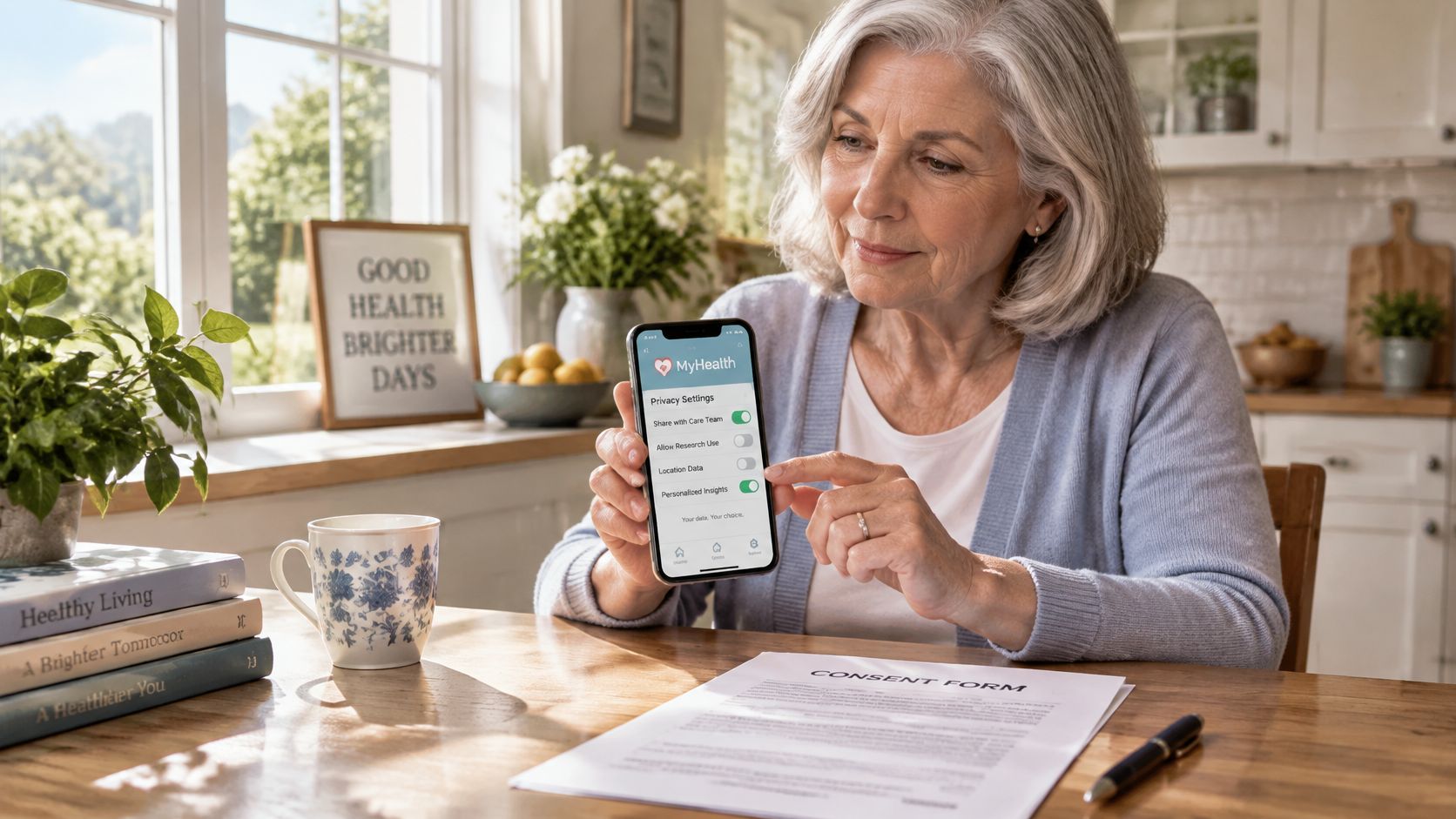
A notebook on the fridge is easy to check because everyone knows where it is and who can read it. Digital health information needs the same clarity. Before sharing patient-generated health data, ask who can see it, who is expected to respond, and what happens if nobody does. HIPAA generally regulates healthcare providers and health plans, limiting how they use or disclose protected information without patient permission except in specified circumstances. It also gives patients rights to access, download, and transmit their health information, as described in the FTC privacy series on consumer-generated health data.
HIPAA doesn't cover all health data. Information held by many apps and wearables may fall outside its protections, so an app's own privacy terms matter.
De-identification also has specific rules. Under HIPAA's Safe Harbor method, nearly all date elements tied to an individual, including dates of service, must be removed. Only the year may remain, so a properly de-identified file should not carry a specific visit date.
Retention is a separate question from access: how long an app keeps your entries does not tell you who may read them. Rx360's guide to data retention policies explains what to consider. Rx360 users own their Customer Data, and its license to use sensitive personal information for improving and marketing is limited to de-identified sensitive personal information.
Consent should also spell out the workflow. A 2025 analysis of PGHD monitoring discusses the need for clear agreements on who monitors data, who views it, how concerns are acted on, how records can be amended, and whether data has secondary uses. Without an agreed reader and response plan, a timely reading may still go unnoticed, while people who cannot or do not share data may be left out. Context helps too: a home blood pressure log can sit alongside lifestyle notes, with reference material such as foods that lower systolic readings kept nearby.
Everyday Examples of PGHD Supporting Independence
The routes above are already in use. In 2024, approximately two-thirds of U.S. hospitals enabled patients to electronically submit some form of patient generated health data to their electronic health record, according to ONC (ONC data brief on hospital APIs).

A retired teacher walks the same loop each morning and writes one line afterward: steady, a little wobbly, or needed the fence. Two weeks in, she notices the loop has now shrunk. She mentions it on a call with her daughter, who suggests a Saturday coffee and a walk together. The notes started a conversation. They didn't explain why her stride changed, and they were never meant to.
A man logs bedtime and wake time for a month because he's curious. The pattern shows his schedule drifting later on weekends and staying there by midweek. He takes the log to a routine check and mentions it. The log gave him something concrete to describe. It didn't measure sleep quality and it didn't tell him what to change.
A couple keeps a shared weekly note of calls with grandchildren, a Wednesday card game and the neighbor who drops by with tomatoes. The note isn't a health metric at all. Over a season it becomes the simplest way to see that a quiet stretch lined up with a cold snap and two canceled outings.
What these stories share: the data opened a conversation, and a person made the decision.
- It made a change visible. A pattern across days is easier to discuss than a vague feeling.
- It gave someone specific to talk to. The note had a reader, not just a storage location.
- It kept independence intact. Nobody was watched in real time, and nobody was told what to do.
Limits, Gaps and Who Gets Left Out
The sharing gap shows up clearly in national survey work. In the 2019 Health Information National Trends Survey, 4,159 people were analyzed and 29.9% had adopted a wearable device. Among those wearable adopters, only 46.3% had shared their data with a healthcare provider (analysis of consumer health technology adoption and sharing). Fewer than half carried the information into a care relationship, even though much of it was relevant to prevention and daily management.
Then there's the harder question of who produces clean data in the first place. Evidence in the physician literature indicates that only patients who are organized, digitally educated or supported by caregivers tend to generate consistently actionable information, and that older adults and people with cognitive impairment may need caregiver mediation to take part (review of PGHD implementation and equity concerns). Clinicians in the same body of work point to poor system integration, unreliable data, workflow burden and thin infrastructure as reasons they don't routinely use what arrives.
Missing data has causes, and almost none of them are disinterest.
Connectivity drops. A device is awkward to wear. A routine changes for a fortnight. Broadband isn't there. Someone can't see the screen well enough to log in. Treating an empty week as a lack of engagement gets the story wrong, and it can rank people by how neatly their lives fit a form.
Lower-burden routes exist and are worth naming: a phone check-in, a paper log mailed or photographed, a trusted person reporting on someone's behalf, intermittent measurements rather than daily ones, and interfaces in the language a person reads. Each one trades a little granularity for a lot of participation.
The distinction that ties this together is data availability versus data validity. Ten readings a day don't improve a decision when calibration, adherence and daily circumstances are unknown. More isn't the same as better, and a care team that knows the difference is easier to trust.
Confirm Your Next Step Before You Share Data
Before anything leaves your phone, work through five questions.
- What matters for my goal? Pick two or three measures that connect to something you care about, such as steadiness on walks, a consistent bedtime, or how often you see people.
- Who receives each type, and how fast do they respond? Name the person and the realistic timeframe. An unanswered inbox is worse than no inbox.
- What happens outside office hours? Know the answer before a Saturday evening reading, not after.
- Can family access be limited by data type? Activity might be shareable while other entries stay private.
- How do I withdraw consent or correct a wrong entry? Confirm the route now, while nothing is urgent.
Keep the frame simple: this information is a conversation starter with a care team, not a replacement for one. It shows patterns between visits. It doesn't diagnose, and it doesn't monitor anyone around the clock unless a specific arrangement says so.
Rx360 is one example of a wellness platform built for independent older adults, organized into Health Insights, Smart Technology and Connected Care, so loved ones get timely updates while healthcare providers stay part of the conversation. The pilot services are not medical devices and are intended for informational purposes only as a wellness tool. Privacy rights requests can be submitted by visiting Rx360's contact page.
The routines come first. A morning walk, a good night's sleep, a weekly call with people who matter, a note kept on the fridge. Data is only useful when it protects those things rather than crowding them out.
Rx360 brings health insights, supportive technology and trusted connections together so older adults can keep living on their own terms, with family and care teams staying informed without hovering. If this guide made you think about how your own daily notes could reach the right person, visit Rx360 to see how the platform organizes wellness signals, simple technology and connected care into one circle of support. Start with one routine you already keep, and build the sharing around it.
Lower-Risk Medication Plan Checklist
Below is a practical checklist and step plan you can implement into your daily life:
-
List all medications
Include prescriptions, over-the-counter drugs, supplements, sleep aids, creams, patches, eye drops, and inhalers.
-
Mark fall-risk drugs
Flag medicines that cause dizziness, sleepiness, confusion, blurred vision, low blood pressure, or low blood sugar.
-
Ask for a medication review
Bring the list to a pharmacist or prescriber.
-
Review after any warning sign
Request a new medication check after a fall, near-fall, new prescription, dose change, dizziness, or confusion.