You're sitting in an exam room with your mother. She's had back pain for weeks, hasn't been sleeping well, and now the doctor is considering a stronger medication. Before printing the prescription, the doctor turns to the computer, signs into a secure system, and reviews her recent medication history. For many families, that moment can feel unsettling. Is something wrong? Is your parent being flagged? Is this about law enforcement, insurance, or trust?
In Pennsylvania, that screen is often the Prescription Drug Monitoring Program, usually called the PA PDMP. It exists to help clinicians make safer decisions about controlled substances by giving them a fuller picture of what has already been prescribed and dispensed. For older adults, that matters because medication safety often depends on details spread across multiple offices, pharmacies, and specialists.
If you're a clinician, this system shapes part of your prescribing workflow. If you're an older adult or caregiver, it affects how your care team checks for duplication, risky combinations, and signs that a medication plan needs a closer look. The practical question isn't just whether the program exists. It's how it fits into everyday care, and how patients and families can be informed participants instead of passive observers.
Table of Contents
- An Introduction to Pennsylvania's Digital Safety Net
- What Is the PA PDMP and Why Does It Exist
- A Clinician's Guide to PDMP Compliance and Use
- Measuring the PDMP's Impact on Prescribing Habits
- Your Data Your Rights as a Patient and Caregiver
- The PDMP's Role in a Complete Circle of Care
An Introduction to Pennsylvania's Digital Safety Net
A common scene plays out every day in Pennsylvania. An older adult sees a primary care doctor for pain, anxiety, insomnia, or recovery after surgery. The patient may also have a cardiologist, a neurologist, and a specialist in another health system. A daughter manages the pill organizer. A son picks up refills. One pharmacy changed after a move. Another medication came from an emergency visit months ago.
No one in that situation is doing anything wrong. The problem is fragmentation.
When a clinician opens the PA PDMP, they're not peering into a mystery database for its own sake. They're checking whether today's prescription fits safely into the bigger picture. That can help catch overlapping opioid prescriptions, repeated benzodiazepine fills, or patterns that suggest the medication plan needs a conversation before another drug is added.
For older adults, that check can be especially important. Many already manage several prescriptions, and controlled substances can raise the stakes. Sedation, confusion, falls, and accidental duplication often happen when information is split between offices rather than shared in real time.
Practical rule: If your doctor checks the PDMP before prescribing, it usually means they're taking medication safety seriously, not treating you with suspicion.
The PA PDMP works best when people see it as part of care coordination. It doesn't replace a careful conversation with the patient. It doesn't replace medication reconciliation. It gives the clinician one more safety lens before making a prescribing decision.
Families trying to support aging in place often want exactly that kind of behind-the-scenes protection. If you're interested in how broader technology can support safer, more connected care at home, connected health solutions for older adults offer another view of how digital tools can strengthen day-to-day coordination.
What Is the PA PDMP and Why Does It Exist
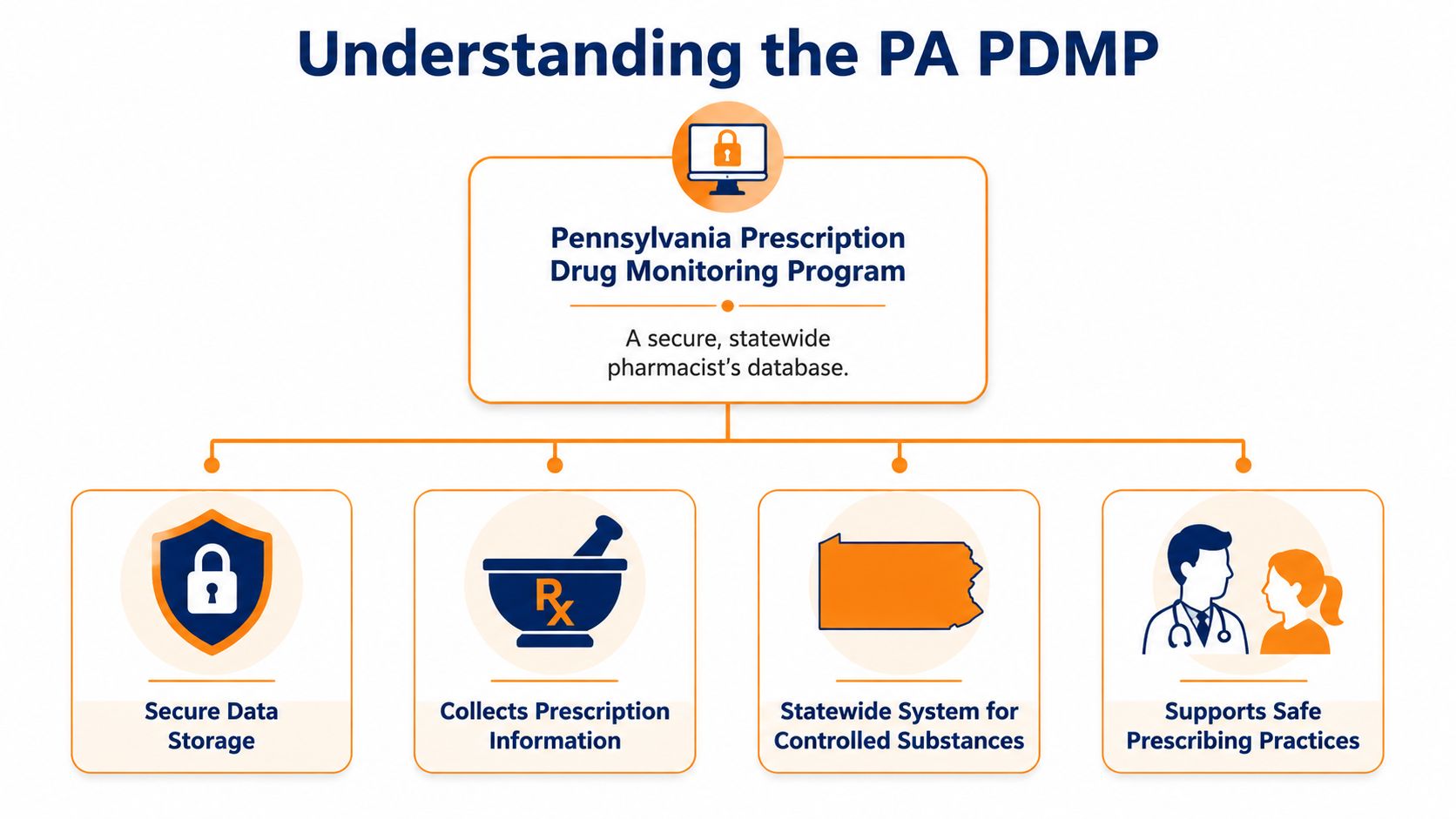
A daughter arrives at her father's next appointment with a paper list of medications folded in her purse. The list is missing the pain medicine he received after a recent procedure, and his specialist does not know that another doctor prescribed a sleep medication two weeks ago. The PA PDMP exists for moments like this. It gives authorized prescribers and dispensers a secure way to check recent controlled substance dispensing information before they add one more medication to the picture.
A simple way to think about it
The PA PDMP gathers part of a patient's controlled substance history into one secure place so a clinician does not have to rely only on memory, one pharmacy record, or an incomplete medication list. That matters when care is spread across hospitals, primary care offices, specialists, urgent care sites, and retail pharmacies.
For older adults, the value is practical. A medication plan can change fast after a fall, surgery, or hospital stay. If one clinician sees only one piece of that plan, the risk of duplication, unsafe combinations, or refill confusion goes up.
Common situations include:
- A new pain prescription after hospitalization
- An anxiety medication added by a specialist
- A refill request when the patient can't remember the last fill date
- A caregiver trying to confirm whether a medication is still active
The system is run by the Pennsylvania Department of Health. It is part of the state's effort to reduce avoidable harm tied to controlled substances while giving clinicians a better view of recent dispensing activity. Pennsylvania also shares PDMP data with many other states, which matters when patients fill prescriptions across state lines or receive care outside their home area, according to the Pennsylvania state profile published by the Office of Justice Programs.
What the system covers in Pennsylvania
The PA PDMP does not track every prescription in a medicine cabinet. It focuses on medications and related records where monitoring can improve safety, including Schedule II through V controlled substances. In Pennsylvania, the program also includes medical marijuana dispensing and naloxone administration records, as described by the Pennsylvania Department of Health PDMP overview.
That scope is easy to misunderstand, so one point helps. The PDMP is not a diagnosis tool, and it does not replace a careful conversation with the patient or caregiver. It is a decision support system. Clinicians use it alongside medication reconciliation, clinical judgment, and other clinical decision support tools used in safer prescribing.
For patients and families, the reason the program exists is bigger than compliance. It supports the circle of care. When everyone involved in an older adult's treatment has a clearer view of controlled substance use, it becomes easier to ask better questions, catch problems early, and make safer decisions together.
A Clinician's Guide to PDMP Compliance and Use
For clinicians, the PA PDMP is both a legal requirement in certain situations and a practical safety tool. The easiest way to think about it is as part of routine prescribing hygiene. It belongs alongside history-taking, medication reconciliation, and checking for contraindications.
Who has to use it
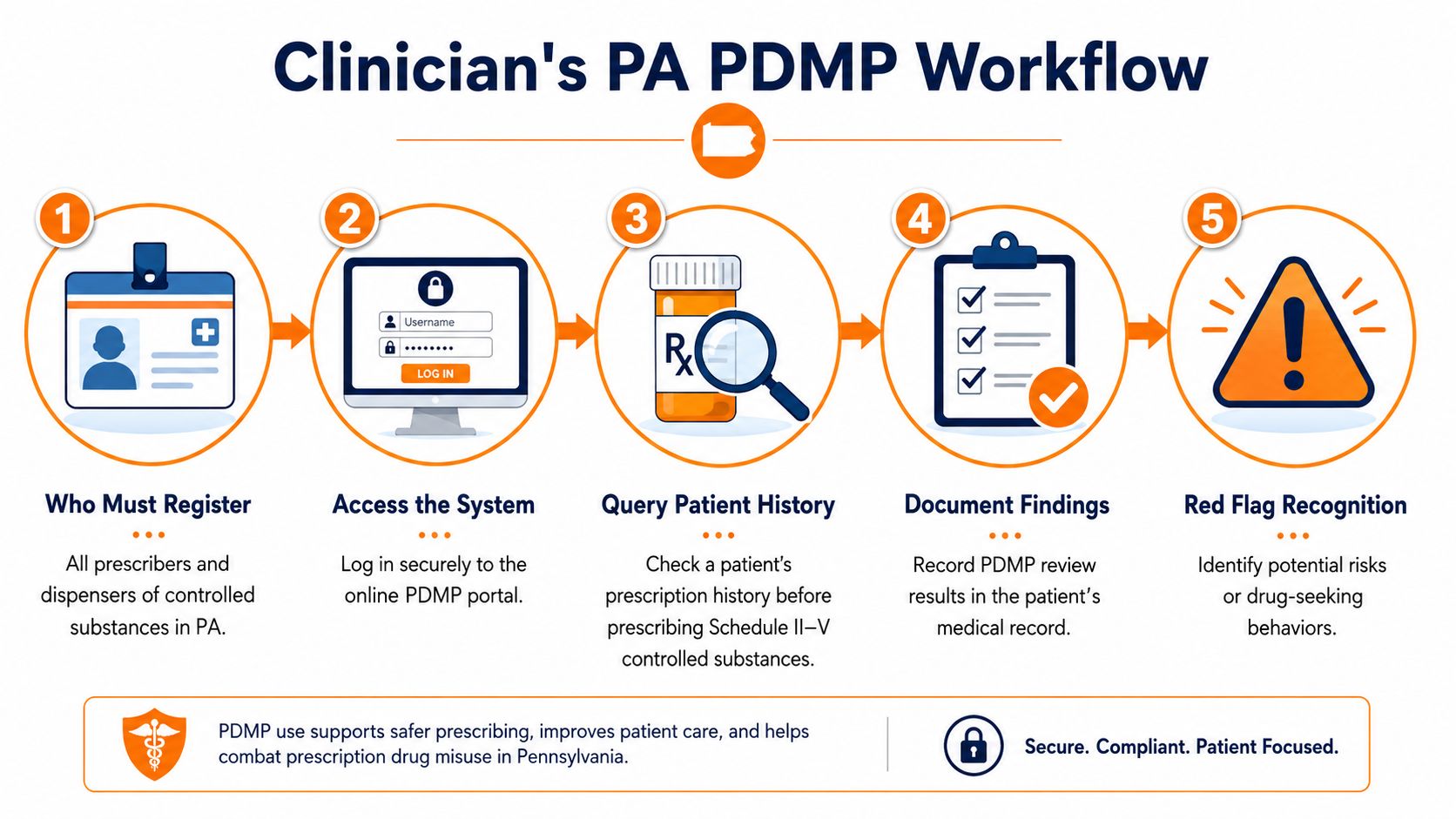
Pennsylvania requires all licensed prescribers authorized to distribute controlled substances to register and query the system for every patient's initial controlled substance prescription and for every opioid or benzodiazepine prescription dispensed after January 1, 2017, according to McNees Wallace & Nurick's summary of the Pennsylvania PDMP requirements.
That sentence carries a lot of practical meaning. It tells clinicians that this isn't limited to a narrow specialty. It also makes clear that Pennsylvania treats the first controlled substance prescription differently from casual refill assumptions. The expectation is that the prescriber checks the patient's history before moving forward.
The same legal summary notes that there are waivers in specific circumstances, including emergency department settings and certain situations involving patient observation or admission after an initial query. Those exceptions matter, but they shouldn't obscure the everyday rule. For most outpatient prescribing decisions involving these drugs, a query is expected.
What a practical workflow looks like
In a busy practice, compliance works best when it's operationalized instead of treated as an extra click at the end of the visit.
A workable flow often looks like this:
Confirm whether the prescription triggers a query.
Controlled substance starts, opioids, and benzodiazepines should put the PDMP on your radar immediately.Review the dispensing history before finalizing the order.
Don't wait until after counseling. The information may change the conversation.Look for context, not just red flags.
Multiple fills may reflect fragmented care, post-procedure treatment, or a recent transition between clinicians.Document what informed your decision.
If the record affected the plan, note that clearly in the chart.Use the result to guide care, not punish patients.
A concerning history should prompt questions, verification, and safer planning.
A PDMP query is most useful when it changes a vague assumption into a specific clinical conversation.
Some practices streamline this through EHR integration or embedded prescribing workflows. Others rely on portal access and team protocols. Either way, the goal is the same. The PDMP should be easy enough to use that it becomes routine, not sporadic.
Clinicians looking to make these checks more actionable often benefit from broader clinical decision support tools for medication-related workflows, especially when older adults receive care from multiple providers.
When clinical judgment still matters most
The PDMP won't tell you why a patient received a medication, whether they took it as directed, or whether a family member is now managing medications because cognition has changed. It won't show the nuance behind palliative care, cancer treatment, or a difficult taper.
That's why good use of the system requires restraint as much as vigilance.
A few reminders help:
- Don't treat a query result as a diagnosis. A pattern may be concerning, but it still needs clinical interpretation.
- Ask the patient to fill in the story. Older adults and caregivers often explain details the record can't.
- Coordinate before assuming misuse. Calling another prescriber may resolve what looks confusing on screen.
- Use the moment to educate. Many patients don't know why checks occur. A short explanation builds trust.
The strongest PDMP users don't just meet the rule. They turn the query into better care.
Measuring the PDMP's Impact on Prescribing Habits
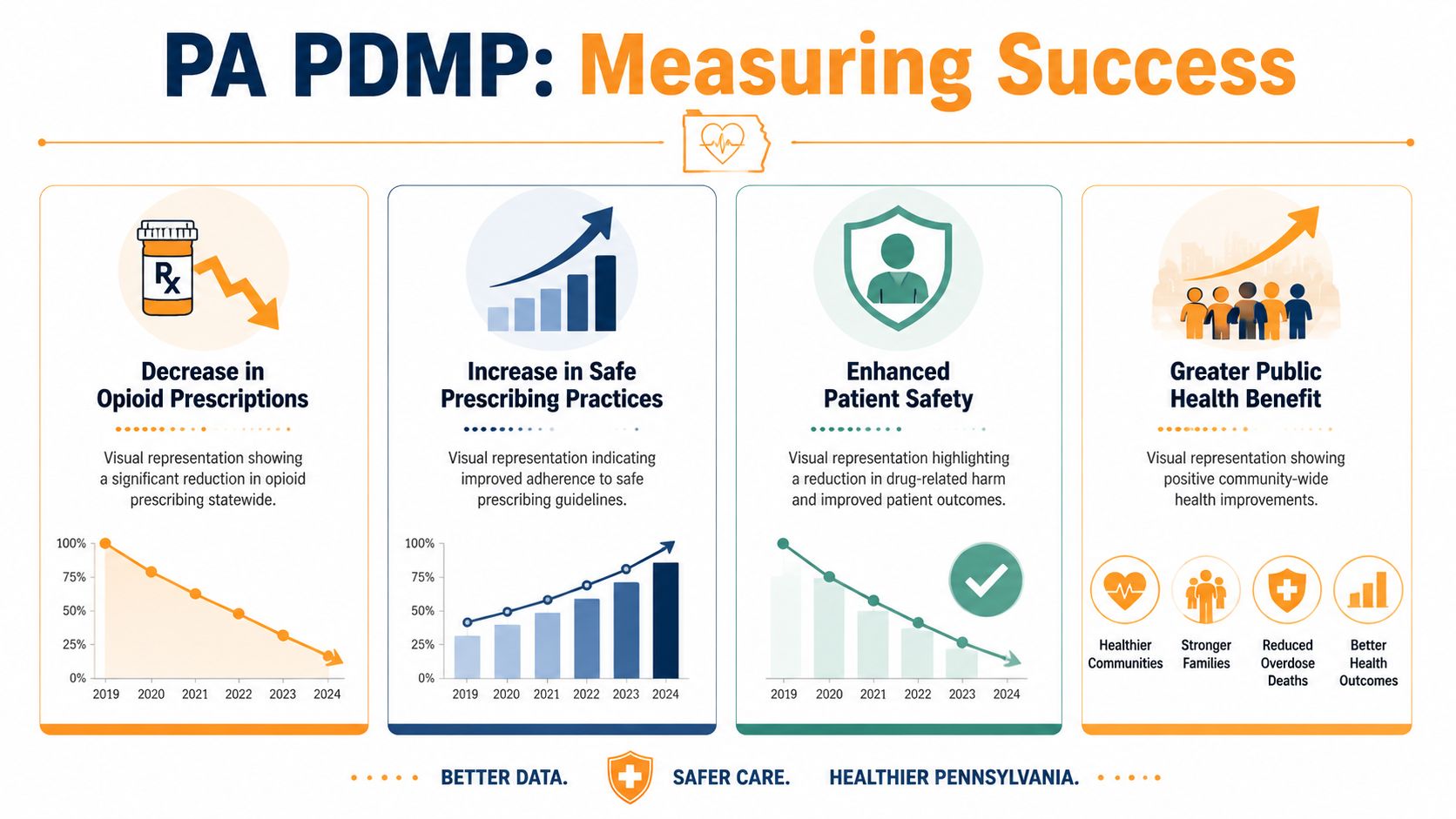
The most direct way to judge a monitoring program is to ask whether prescribing behavior changed after it was fully put into use. In Pennsylvania, the answer is yes.
What changed after statewide implementation
Following statewide implementation in early 2017, Pennsylvania recorded a 33% decrease in the overall quantity of opioid pills prescribed over the next three years, with an absolute reduction of 677,194 pills from Q1 2017 through Q1 2020, according to a peer-reviewed analysis published in the National Library of Medicine.
That decline was not evenly distributed across every prescribing pattern. The same analysis found that:
| Prescribing pattern | Reported change |
|---|---|
| Overall opioid pill quantity | 33% decrease |
| Oxycodone | 29% decrease |
| Hydrocodone | 39% decrease |
| Prescriptions exceeding 7 days | 43% decrease |
| Shorter-duration prescriptions | 27% decrease |
| Bulk prescriptions of 22 or more pills | 37% decrease |
| Smaller amounts | 21% decrease |
Those details matter because they show the strongest reductions occurred in areas that often carry higher risk, especially longer-term and higher-volume prescribing.
Why these prescribing changes matter
For families, these figures can sound abstract. In practical terms, they suggest clinicians changed behavior in ways that may reduce the chance of excess supply, prolonged exposure, and medication accumulation in the home.
For health systems and care teams, the data supports a more precise conclusion. The PA PDMP didn't just coincide with less prescribing in general. It was associated with stronger reductions in prescribing patterns that public health leaders have long viewed as more hazardous.
Key point: The clearest strength of the PA PDMP is that it appears to have curbed high-volume and longer-duration opioid prescribing, not only routine prescribing overall.
If you're focused on daily medication safety for older adults, broader medication management resources can help translate these system-level trends into concrete home routines such as refill tracking, medication reviews, and caregiver communication.
Your Data Your Rights as a Patient and Caregiver
A daughter sits beside her father at a follow-up visit. His doctor opens the chart, pauses to review the PDMP, and says, “I want to make sure we have the full medication picture before we change anything.” For many families, that moment raises immediate questions. What information is being reviewed? Who is allowed to see it? What can a patient or caregiver ask about that process?
Those questions matter because the PDMP sits inside the larger circle of care for older adults. It is one tool clinicians use to reduce medication risk, especially when several prescribers, pharmacies, or caregivers are involved. Patients and families do not need to stay on the sidelines while that happens. They can ask clear questions, confirm facts, and help the care team avoid mistakes.

What information goes into the system
As noted earlier, Pennsylvania's PDMP is built around dispensing information for controlled substances, along with certain related records such as medical marijuana dispensing and naloxone administration. For patients, the key idea is simple. The system shows what was supplied, not just what a clinician planned to prescribe.
That distinction can prevent confusion. A prescription written at a visit and a prescription filled are not always the same thing. The PDMP is meant to help a clinician check the part of the story that involves dispensing history.
In practice, that can help answer questions like these:
- Was a similar medication filled recently?
- Could a new prescription overlap with another controlled substance?
- Is there a recent dispensing record from another pharmacy or clinician?
- Does the broader safety picture include naloxone?
The PDMP does not replace a full medication review. It also does not explain the reason a medication was chosen, whether it worked, or how the patient responded at home. It is a record that adds one more lens, much like checking a map before driving to a place you have visited before. The map helps, but it does not tell you about road construction, weather, or who is in the car with you.
What patients can ask about privacy and access
Patients often want plain-language answers about privacy, and public reporting has shown that these questions have not always been explained clearly enough. WHYY's reporting on the delayed launch of Pennsylvania's monitoring database noted public concern about privacy, patient notification, and how transparent the system would be for people whose records appear in it.
That uncertainty makes one habit especially useful. Ask direct questions during the visit or at the pharmacy, before assumptions turn into worry.
Helpful questions include:
- Who on my care team can view this information for treatment?
- Why did you check the PDMP today?
- What did you see that affects my medication plan?
- If something looks wrong, how do we correct it?
- Can you explain your decision in plain language before we make a change?
A short explanation from the clinician can change the whole tone of the encounter. Older adults may hear “database check” and worry they are being suspected of wrongdoing. In many cases, the check is a routine safety step, like reviewing allergies before prescribing an antibiotic.
How caregivers can turn PDMP checks into safer care
Caregivers often notice what no database can show. They see the duplicate pill bottles in the kitchen. They notice new sleepiness after a refill. They remember that one specialist changed a dose while another prescribed something similar.
That makes the caregiver's role practical, not passive.
Here is a useful way to approach common situations:
| Situation | Helpful caregiver action |
|---|---|
| A new controlled substance is being considered | Bring an updated medication list and ask whether recent dispensing history was reviewed |
| Several specialists are involved | Ask which clinician is responsible for coordinating the full medication plan |
| The older adult uses more than one pharmacy | Tell the care team directly, even if the prescriptions seem unrelated |
| A medication name sounds unfamiliar | Ask where and when it was dispensed, then compare it with the bottles at home |
| The patient feels judged by the PDMP check | Explain that it is often used as a routine safety check to prevent overlap and confusion |
Families can also watch for day-to-day warning signs after a medication change, including unusual drowsiness, confusion, balance problems, or signs that two similar medicines are being taken at once. Those observations give the PDMP context. The record shows what was dispensed. The family often sees how the plan is playing out.
For older adults, the strongest position is an informed one. A patient who understands why the PDMP is checked, and a caregiver who knows what to ask next, can help turn a regulatory tool into better coordination, safer prescribing, and more confident care decisions.
The PDMP's Role in a Complete Circle of Care
The PA PDMP is valuable, but it isn't a complete answer to medication safety, addiction risk, or overdose prevention. A database can improve visibility. It can't, on its own, provide treatment, build trust, arrange follow-up, or make sure an older adult has support at home.

Why the PDMP helps but isn't enough by itself
Public discussion in Pennsylvania has pointed to an uncomfortable truth. Despite success in reducing overprescribing, overdose deaths in the state continued to rise, which shows that PDMPs alone can't solve the crisis without integration into broader care and treatment pathways, according to PublicSource's reporting on the limits of the tool.
That doesn't mean the PDMP failed. It means the tool has a defined job.
It can help a clinician spot risk. It cannot make sure the patient gets substance use treatment, medication review after discharge, counseling about tapering, transportation to follow-up appointments, or family support when memory problems complicate self-management.
For older adults, this distinction matters a lot. Risk often grows from several issues at once: pain, insomnia, isolation, cognitive changes, multiple prescribers, and a home medicine cabinet that no single clinician sees in full.
What a real circle of care looks like
A stronger model is a circle of care where the PDMP is one input among several.
That circle usually includes:
- A prescribing clinician who checks the record and explains what it means
- The patient who shares symptoms, concerns, and what they're taking
- A caregiver or family member who notices changes at home and helps reconcile bottles
- A pharmacist who catches duplication, timing issues, and confusion at pickup
- A care coordinator or practice team member who helps connect the dots after visits
Good medication safety happens when data, conversation, and follow-through all line up.
In that model, the prescription drug monitoring program Pennsylvania uses becomes more than a compliance task. It becomes an early-warning tool inside a broader human system. That's especially important for older adults who want to remain independent without navigating medication complexity alone.
The best outcome isn't just fewer risky prescriptions. It's a patient who understands the plan, a family that knows what to watch for, and a care team that communicates before small problems become emergencies.
Rx360 helps older adults, families, and care teams stay connected around day-to-day wellness, medication awareness, and coordinated support. If you want a simpler way to strengthen that circle of care while preserving independence, explore Rx360.
Lower-Risk Medication Plan Checklist
Below is a practical checklist and step plan you can implement into your daily life:
-
List all medications
Include prescriptions, over-the-counter drugs, supplements, sleep aids, creams, patches, eye drops, and inhalers.
-
Mark fall-risk drugs
Flag medicines that cause dizziness, sleepiness, confusion, blurred vision, low blood pressure, or low blood sugar.
-
Ask for a medication review
Bring the list to a pharmacist or prescriber.
-
Review after any warning sign
Request a new medication check after a fall, near-fall, new prescription, dose change, dizziness, or confusion.