

You may be reading this because a parent had a recent fall, because your own home suddenly feels less simple than it used to, or because a hospital discharge made the future feel more urgent. Most families don't start with a neat checklist. They start with a knot in the stomach and a basic question: “Can we make home safe enough without giving up independence?”
That question matters because home is rarely just a building. It's routine, privacy, pets, neighbors, familiar light switches, favorite chairs, and the comfort of knowing where everything is. Good aging in place solutions protect those ordinary things while reducing avoidable risk.
What helps most isn't buying a random set of products. It's building a plan that matches the person, the home, the budget, and the support available nearby. That's especially important if you live in a rural area, need affirming care, or expect your needs to change over time.
Table of Contents
- Why Planning to Age in Place Matters Now
- Understanding the Four Pillars of Aging in Place
- Creating Your Personalized Aging in Place Plan
- Choosing the Right Home and Tech Solutions
- Assembling Your Human Support Network
- Financing Your Aging in Place Strategy
- Putting It All Together Sample Scenarios
Why Planning to Age in Place Matters Now
A daughter notices her father has started leaving the porch light on all day because the hallway feels too dark at night. He is still cooking, still paying his bills, still saying he is fine. But a few routines have become harder, and the family can feel the difference before they can name it.
That is usually how this begins. Not with one dramatic event, but with small signs that home no longer fits as easily as it used to. Planning early gives families more choices. Waiting for a crisis usually shrinks them.
Many older adults want to remain at home for as long as they can. The problem is that many homes were never set up for changing balance, vision, strength, memory, or transportation needs. A house can be full of comfort and history and still create daily friction. Stairs become tiring. Reaching into a tub feels less stable. A long drive to the pharmacy becomes harder in a rural area where alternatives are limited.
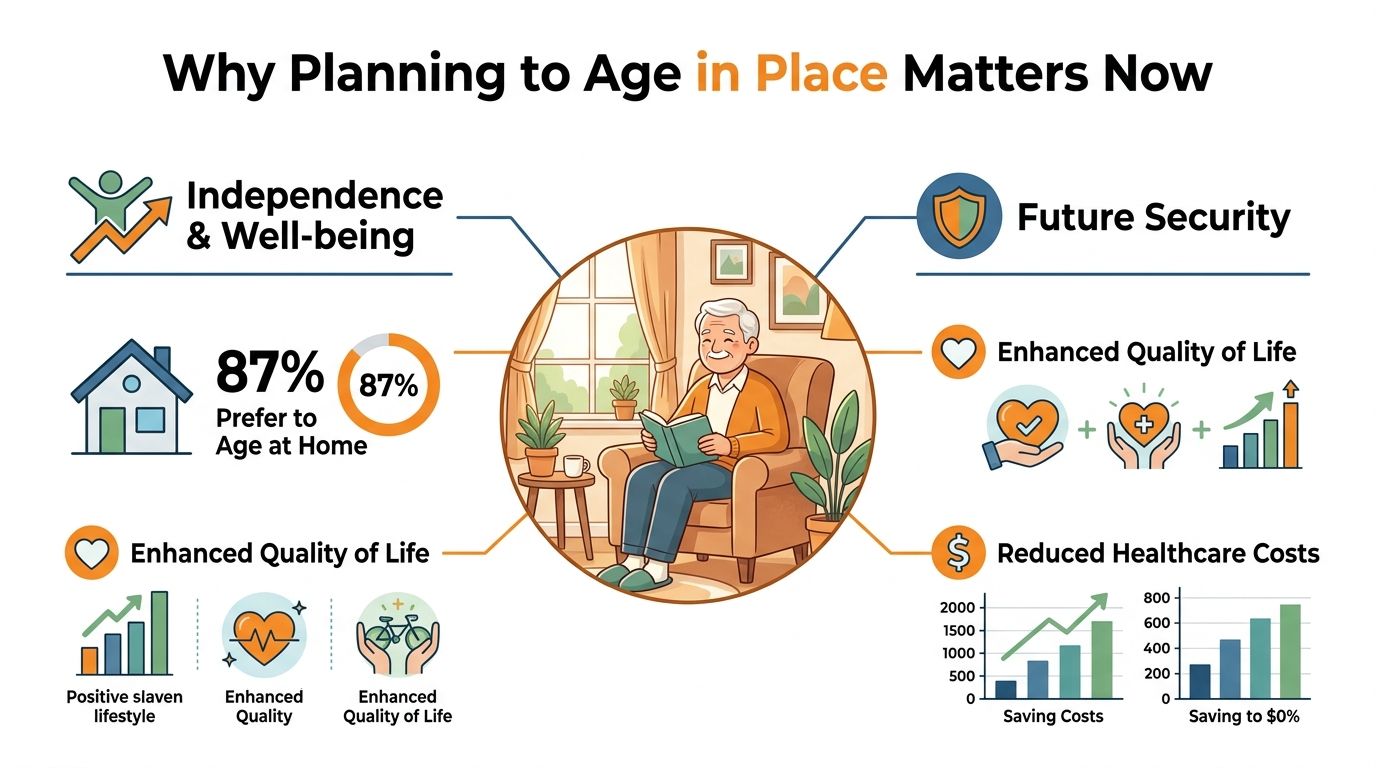
Independence starts with honest preparation
Families often assume aging in place is mostly about buying equipment. In practice, it works more like building a house on a good foundation. You start with the person, not the product.
Ask simple questions first. What parts of the day feel easy? What now takes extra effort? Where does the person feel least steady, least confident, or most isolated? A quick review of mobility and home safety concerns, such as these fall risk assessment tools for older adults, can help families spot trouble before an injury forces rushed decisions.
Small changes can protect a lot of independence. Better lighting, a safer bathroom setup, a written medication routine, rides to appointments, and a backup plan for bad weather or power outages all reduce strain. One fix rarely solves everything. Layers of support do.
Practical rule: If a task feels “a little harder lately,” treat it as a planning signal, not a personal failure.
Early planning also gives families time to match solutions to real life. That includes factors many guides skip. A person living in a city may be able to use delivery services and public transit. A person in a rural community may need a very different plan because home care workers, broadband access, and specialty appointments are harder to get. Cost matters too. A family with savings, a fixed income, or limited insurance coverage will not build the same plan, and that is fine. The goal is not a perfect setup. The goal is a workable one.
Good planning protects dignity
Aging in place does not mean doing everything alone. It means keeping as much choice and familiarity as possible while adding support where it helps most.
For one person, dignity means bathing safely without needing supervision. For another, it means staying in the same church community, keeping a garden, or avoiding a move far from neighbors and family history. Good planning respects those priorities. It also makes room for the practical realities of caregiving, budget limits, and unequal access to services.
If you remember one idea from this guide, keep this one. Aging in place solutions work best when they fit the person's actual routines, health needs, location, relationships, and finances. That is how a long list of options becomes a plan that supports independence instead of complicating it.
Understanding the Four Pillars of Aging in Place
Aging in place can feel overwhelming because the options come from different worlds. Some are carpentry decisions. Some are healthcare decisions. Some are family decisions. A simple framework keeps those choices from becoming a pile of disconnected tasks.
A simple way to organize your options
I encourage families to sort aging in place solutions into four pillars.
The first is home environment modifications. These are physical changes that make daily movement safer and easier. Think grab bars near the toilet, a shower seat, a handrail on both sides of stairs, lever-style door handles, a ramp, or moving a sleeping area to the first floor.
The second is smart and assistive technology. These tools add reminders, communication, monitoring, or convenience. Examples include a medical alert button, an automatic pill dispenser, motion-sensing lights, a video doorbell, voice-controlled speakers, or a watch with fall detection.
The third is in-home care and community services. This pillar covers people and programs. It can include companion care, personal care assistance, home health visits ordered by a clinician, meal delivery, adult day programs, transportation services, and care management.
The fourth is financial and legal planning. Families map out how to pay for changes and who can act if support is needed. That can mean reviewing insurance, gathering benefit information, updating powers of attorney, and deciding which improvements should happen first.
A grab bar and a personal emergency response system solve different problems. One reduces risk during a transfer. The other helps after something has already gone wrong.
That distinction matters. Families often overspend on technology when a simpler home fix would remove the hazard in the first place.
At-a-glance guide to the four pillars
| Pillar | Focus Area | Examples |
|---|---|---|
| Home environment modifications | Safety and accessibility in the physical space | Grab bars, step-free entry, raised toilet seat, brighter lighting |
| Smart and assistive technology | Reminders, alerts, communication, convenience | Medical alert device, smart speaker, medication reminder, video doorbell |
| In-home care and community services | Hands-on help and social support | Companion visits, home health aide, transportation service, meal delivery |
| Financial and legal planning | Affordability and decision-making readiness | Budget worksheet, benefits review, power of attorney, phased spending plan |
Families also benefit from separating fall prevention from fall response. Better lighting, removing loose rugs, and bathroom upgrades are prevention. A wearable alert device or check-in system is response. Both matter. If you want a practical way to think through hazards before choosing equipment, this guide to fall risk assessment tools can help you frame the conversation.
Pillars work best when they support each other
A ramp without transportation may still leave someone isolated. A medication app won't help if vision changes make the screen hard to read. Paid care can be excellent, but it works better when the home layout lets the helper assist safely.
That's why random lists of “best products” often disappoint. They focus on objects. Real planning focuses on fit. When the four pillars are considered together, families can decide what must happen now, what can wait, and what isn't necessary at all.
Creating Your Personalized Aging in Place Plan
The best plan starts with the person's day, not a catalog. Before buying anything, look closely at how life functions in the home. Morning routines, bathing, meal prep, stairs, medication habits, errands, loneliness, and backup help all tell you more than a product description ever will.
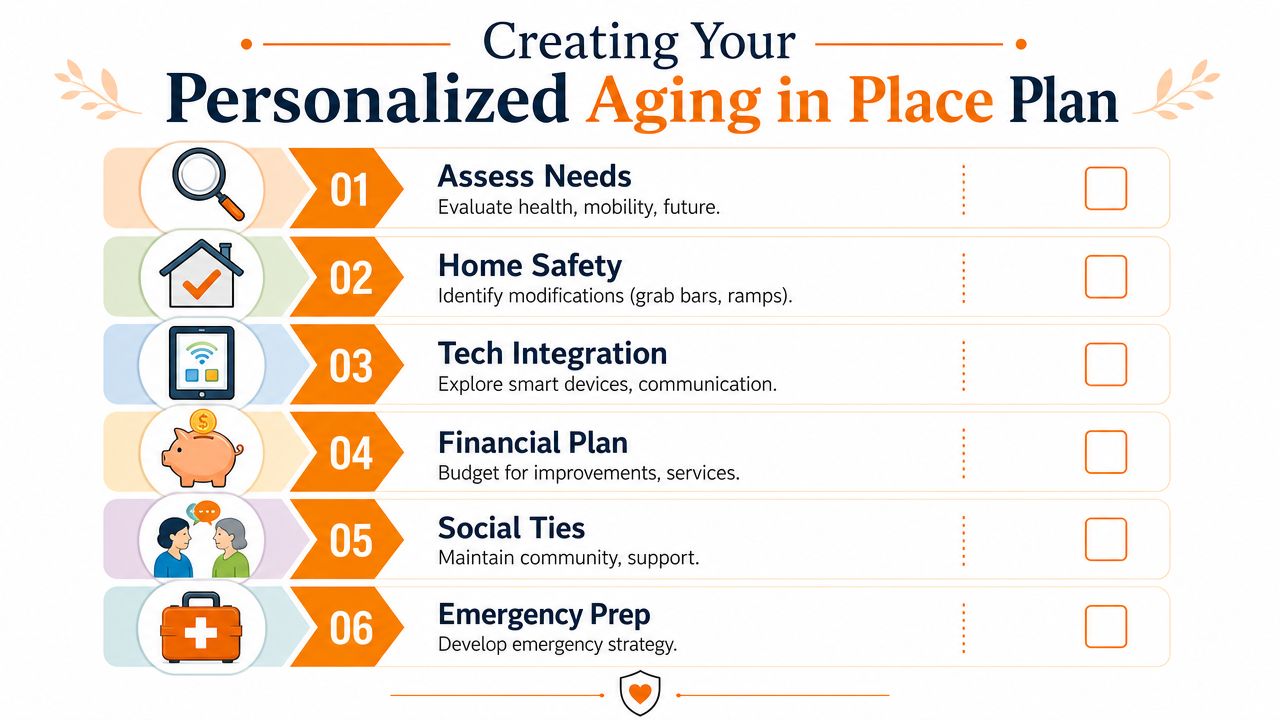
Start with daily life, not products
I usually tell families to walk room by room and ask plain questions.
- Getting around: Is standing from the bed, toilet, or sofa harder than it used to be? Are stairs tiring or painful? Is there any place where balance feels shaky?
- Personal care: Is bathing safe without help? Can the person reach towels, soap, and clothing without twisting or rushing?
- Health routines: Are medications taken correctly and on time? Are there conditions like arthritis, low vision, memory changes, or shortness of breath that affect daily tasks?
- Meals and hydration: Is the kitchen still workable? Are pots too heavy, shelves too high, or labels too small to read comfortably?
- Social connection: Who checks in regularly? Is the person seeing friends, attending faith activities, or speaking with family often enough to notice changes early?
- Emergency readiness: If the power goes out or a fall happens, what's the plan? Who gets called first, and how?
Write the answers down. Keep the list simple. “Hard to step into tub.” “Misses evening pills sometimes.” “Won't drive after dark.” That short list becomes the spine of the plan.
Include access, identity, and support realities
Some families need to ask another layer of questions that many mainstream guides skip. Marginalized groups face systemic discrimination in housing and healthcare access, and research on aging in place and healthcare equity notes that LGBTQIA+ older adults may avoid home care because of fear of bias, while disabled or formerly homeless older adults may have limited access to Permanent Supportive Housing programs.
That affects planning in concrete ways. If affirming care matters, ask agencies how they train staff, handle complaints, and match caregivers. If housing has been unstable in the past, case management and transportation support may matter as much as a shower chair.
The right question isn't only “What does this person need?” It's also “What might keep them from safely using the help that exists?”
Location matters too. A person in a small town may not have the same menu of aides, therapists, handypersons, and ride services available in a suburb or city. If services are limited, build more redundancy into the plan. That might mean family call rotations, a neighbor key holder, mail-order medications, or choosing equipment that works without complicated setup.
A useful personalized plan often fits on one page:
- Top risks right now
- Changes needed in the home
- Tools worth trying
- People who can help
- Budget priorities
- What to review again in three to six months
That final review point matters. Aging in place solutions should function like a living document. Needs change. Good plans change with them.
Choosing the Right Home and Tech Solutions
Once you know the daily trouble spots, selection gets easier. You're no longer shopping for “senior products.” You're solving specific problems such as slippery bathing, missed calls, nighttime disorientation, or difficulty opening doors.
In this context, many families either overspend or underbuy. A thoughtful middle path usually works best.

Home changes that match real risk
For bathroom safety, think in levels.
Good: A nonslip bath mat, brighter bulbs, and a handheld showerhead.
Better: Grab bars placed where transfers occur, a shower chair, and a raised toilet seat.
Best: A low-threshold or curbless shower, wider entry, and enough turning space for future mobility equipment if needed.
For entrances, the same approach works.
- Good: Motion lights and a secure rail.
- Better: A second rail, better contrast on steps, and easier-to-use locks.
- Best: Step-free access with a stable surface from car to doorway.
DIY can work for simple changes like removing trip hazards, improving lighting, or reorganizing storage. But installations that bear weight, such as grab bars or railings, should be done correctly. Poor placement can create a false sense of safety.
Tech that helps instead of complicates life
The best technology disappears into routine. If a device requires repeated troubleshooting, frequent charging, or a confusing app, many older adults stop using it. Simplicity isn't a luxury. It's part of safety.
When comparing tools, ask:
- Ease of use: Can the person operate it on a tired day, not just a good day?
- Visibility and sound: Are alerts loud enough and screens readable enough?
- Privacy: What data is collected, who sees it, and how is consent handled?
- Backup plan: What happens if Wi-Fi drops, power fails, or the device isn't worn?
- Longevity: Will this still suit the person if needs increase?
A basic alert button may be enough for someone active and cognitively sharp. A more connected setup may fit a family that wants wellness insights and easier communication between relatives and care partners. The difference isn't “simple versus advanced.” It's whether the setup matches the person's habits and support system. For a broader look at how devices can support autonomy without taking over daily life, this article on tech-enabled independence offers useful decision points.
Buy the least complicated solution that reliably solves the problem.
That advice saves money and frustration. A voice assistant can be wonderful for reminders, music, and hands-free calls. It's less useful if the person has hearing changes, distrusts microphones, or never speaks commands naturally. A smartwatch with fall detection sounds appealing, but it only helps when it's charged, worn, and tolerated.
The right choice often feels boring. That's a compliment. Boring tools that fit routine tend to stay in use.
Assembling Your Human Support Network
The strongest home setup can't replace people. Someone still has to notice subtle changes, bring soup after an illness, drive to a follow-up visit, or realize that unopened mail and missed calls signal trouble.
Families sometimes assume support means hiring a full-time caregiver. Often it starts with a much smaller network built on clear roles.

What Sarah built for her mother
Sarah's mother wanted to stay in her apartment after recovering from pneumonia. She didn't need nursing care every day, but she did need structure.
Sarah divided support into jobs instead of vague promises:
- Family check-ins: Sarah called every evening. Her brother handled grocery orders and bill reminders.
- Neighbor backup: A trusted neighbor kept a spare key and agreed to check in if calls went unanswered.
- Paid help: A companion came twice a week for laundry, meal setup, and a walk outside.
- Clinical support: Her primary care office managed follow-up appointments and medication questions.
- Transportation: A local ride service covered medical visits when family couldn't.
That network reduced stress because each person knew what they were responsible for. Nobody had to guess.
A care manager can be helpful when the situation is more complex, especially if family lives far away or disagrees about next steps. If you want a practical overview of how professionals coordinate moving parts, this guide to elderly care management is a useful reference.
When geography makes support harder
In some places, assembling help is much more difficult. Rural older adults face severe shortages of providers, limited transportation infrastructure, and inadequate caregiver workforce support, according to the National Association of State Health Policy toolkit on rural aging in place.
That reality changes the plan. Families may need to rely more on circles of informal support, church communities, volunteer drivers, pharmacy delivery, telehealth when appropriate, and regional agencies that serve multiple towns. It also means planning farther ahead. If an aide is hard to hire, waiting until a crisis can leave dangerous gaps.
Sometimes the best support plan isn't bigger. It's clearer, more local, and easier to activate quickly.
Human support also includes social life. Regular conversation, meaningful activity, and being known by others are protective. A weekly card game, senior center lunch, porch visit with a neighbor, or family video call can reveal problems early and make home feel worth staying in.
Financing Your Aging in Place Strategy
Money worries can stop good planning before it starts. Families often assume they must either pay for everything at once or do nothing. In reality, most workable plans are phased. Safety first, convenience second, future-proofing third.
The key is to match each expense to its purpose. A rail at the front steps may be urgent. Replacing all cabinetry probably isn't.
Questions families ask most often
Does Medicare pay for home modifications?
Usually, families find that Medicare coverage is limited for things like ramps, bathroom remodeling, or broader accessibility work. That's why it's important to ask before buying and to separate medical equipment from home renovation.
What about Medicaid?
Medicaid rules vary by state, and some people may qualify for home and community-based supports depending on eligibility and program structure. This is one reason local aging agencies and benefits counselors are so valuable.
Can long-term care insurance help?
Sometimes, depending on the policy. Read the trigger language carefully. Families often discover that a policy covers certain services but not every household expense tied to aging in place.
Are there non-insurance options?
Yes. Some families use personal savings, home equity strategies, veterans-related benefits when applicable, local grants, or community programs through Area Agencies on Aging. Availability depends on where you live and your circumstances.
How to build a workable budget
A practical aging in place budget often works better when it's split into buckets.
| Budget bucket | What goes here | How to think about it |
|---|---|---|
| Immediate safety | Items that reduce present risk | Fund these first |
| Monthly support | Recurring services and subscriptions | Estimate what must continue |
| Future changes | Upgrades that may be needed later | Plan, but don't rush |
| Legal and planning costs | Documents and professional guidance | Protect decision-making early |
Start by listing what the person needs this month to stay safe at home. Then list what would reduce strain on family. Then identify what can wait unless health changes.
A few grounded questions help:
- What problem are we paying to solve right now?
- Will this cost repeat every month or is it one time?
- If we spend here, what risk does it remove?
- Is there a public, nonprofit, or benefits-based option we haven't checked yet?
Families also benefit from naming a point person for paperwork. Someone has to collect policy documents, benefits letters, account contacts, and legal forms in one place. Without that step, even good resources can go unused.
A financial plan doesn't need to be elegant. It needs to be clear enough that the next decision feels possible.
Putting It All Together Sample Scenarios
Real plans make more sense when you can picture them in an actual home. These examples show how different needs lead to different combinations of aging in place solutions.
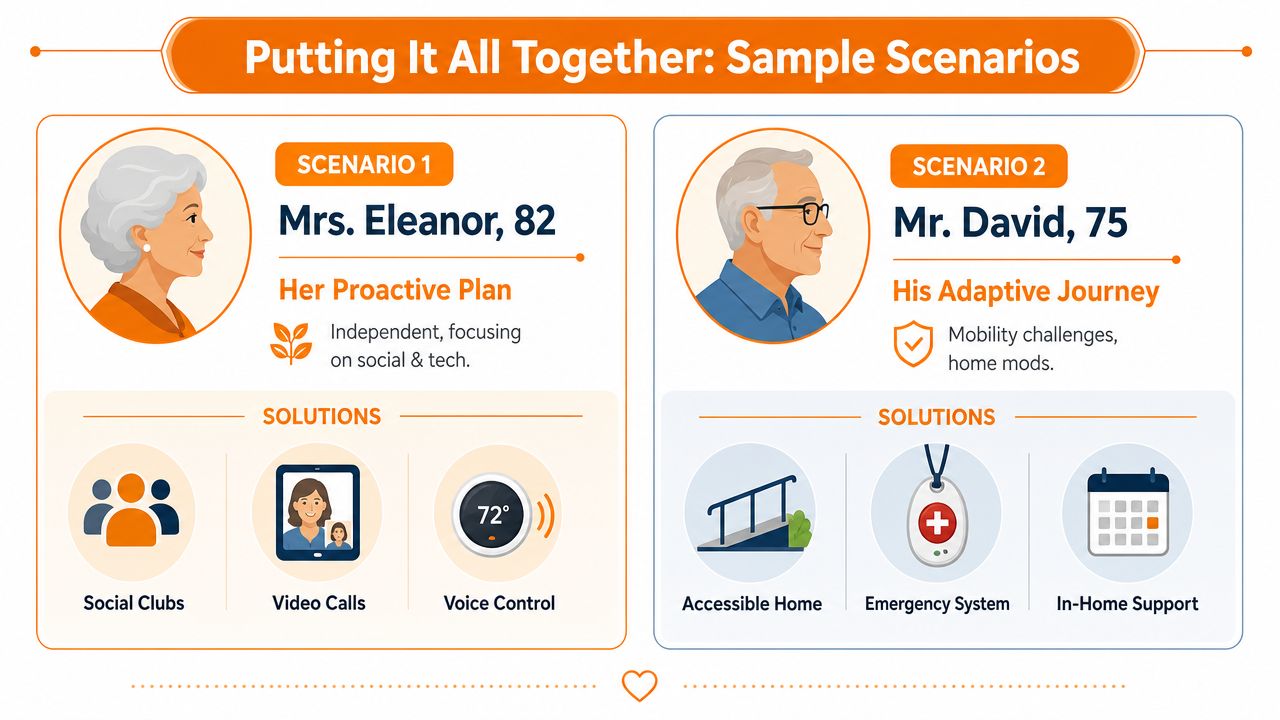
David with arthritis but strong routines
David is active, cooks for himself, and wants to keep gardening. His main problem is arthritis in his hands and knees. That affects jars, doorknobs, stairs, and getting in and out of the tub.
His plan looks like this:
- Home: Lever handles, railings, improved lighting, and a safer shower setup
- Tech: Voice assistant for reminders and calls, simple wearable alert device
- Human support: Daughter checks in twice a week, neighbor helps with heavy yard tasks
- Financial approach: Prioritize bathroom and entry changes first, delay cosmetic upgrades
David's checklist is straightforward. Reduce painful hand movements. Lower fall risk in the bathroom. Keep favorite routines going with lighter support, not major disruption.
Maria living alone with memory concerns
Maria manages well most days but has started missing medications and repeating stories. Her family lives in another city. She's socially warm and does better when someone checks in often.
Her plan is different:
- Home: Clear labels, simplified storage, better lighting, removal of trip hazards
- Tech: Medication reminders, easy video calling, door and entry awareness tools
- Human support: Scheduled companion visits, family call calendar, transportation backup
- Financial approach: Focus first on recurring support and organization tools before larger renovations
Maria's plan puts more weight on routine and observation. She may not need major structural changes yet. She does need systems that help others notice when something is off.
A good plan doesn't make two people use the same tools. It gives each person the least burdensome support that still keeps life safe and stable.
You can use these scenarios as a template for your own checklist:
- Top three risks in the home
- Top three tasks getting harder
- Who notices changes first
- Which supports are urgent
- Which purchases can wait
- When the family will review the plan again
If you're ready to turn concerns into a clear support plan, Rx360 offers a modern way to help older adults stay independent while keeping family and care teams connected. It's designed to support autonomy, simplify wellness awareness, and make everyday aging in place feel more coordinated and less overwhelming.
Lower-Risk Medication Plan Checklist
Below is a practical checklist and step plan you can implement into your daily life:
-
List all medications
Include prescriptions, over-the-counter drugs, supplements, sleep aids, creams, patches, eye drops, and inhalers.
-
Mark fall-risk drugs
Flag medicines that cause dizziness, sleepiness, confusion, blurred vision, low blood pressure, or low blood sugar.
-
Ask for a medication review
Bring the list to a pharmacist or prescriber.
-
Review after any warning sign
Request a new medication check after a fall, near-fall, new prescription, dose change, dizziness, or confusion.