
Patient engagement is the active involvement of patients, and often their families or caregivers, in decisions about their own care and in how care is designed, delivered and evaluated. It isn't a portal login, a satisfaction survey or a stack of handouts. It's a relationship, and like any relationship it can be tested by asking a simple question: when did someone ask what matters to me, and then change something because of the answer?
Most of us have sat in an exam room and nodded along to a plan we didn't fully understand, then walked out and done something else. That gap, between what's decided and what happens at home, is where patient engagement lives. Understanding it matters most for people who plan to stay in their own homes as they get older, because independence is built out of dozens of small, daily decisions that only the person living them can weigh properly.
The concept has real evidence behind it. A 2018 systematic review screened 20,957 studies involving patients in care design, delivery or evaluation, and found 48 that met its outcome criteria. Among those, 35 reported enhanced care or service delivery, 15 produced policy or planning documents, 11 developed education or practical tools, and 5 strengthened governance, according to the review published in Implementation Science. The same review cautioned that tying engagement directly to health outcomes is difficult, which is exactly why it's worth learning to recognise authentic engagement when you see it.
Table of Contents
- What Patient Engagement Means
- The Engagement Ladder From Listening to Co-Designing
- How Shared Decisions Work, Step by Step
- Why Engagement Connects to Healthy Aging and Independence
- How Engagement Gets Measured Beyond Logins
- Who Gets to Take Part
- Everyday Examples and Who Controls the Information
- Spot Real Engagement in Your Own Care Team
What Patient Engagement Means
Start with the plainest version. Patient engagement means the person receiving care helps shape it. Not just receives it, not just agrees to it, but helps shape it. The Agency for Healthcare Research and Quality describes it as an active partnership involving patients, their families or representatives, and healthcare professionals across the healthcare system, in its patient engagement report.
Here's an analogy that makes the difference click. At a football match, you can sit in the stand and watch the game, or you can be on the pitch helping to call the plays. Both are valid on a given afternoon. Only one of them means you had a say in what happened.
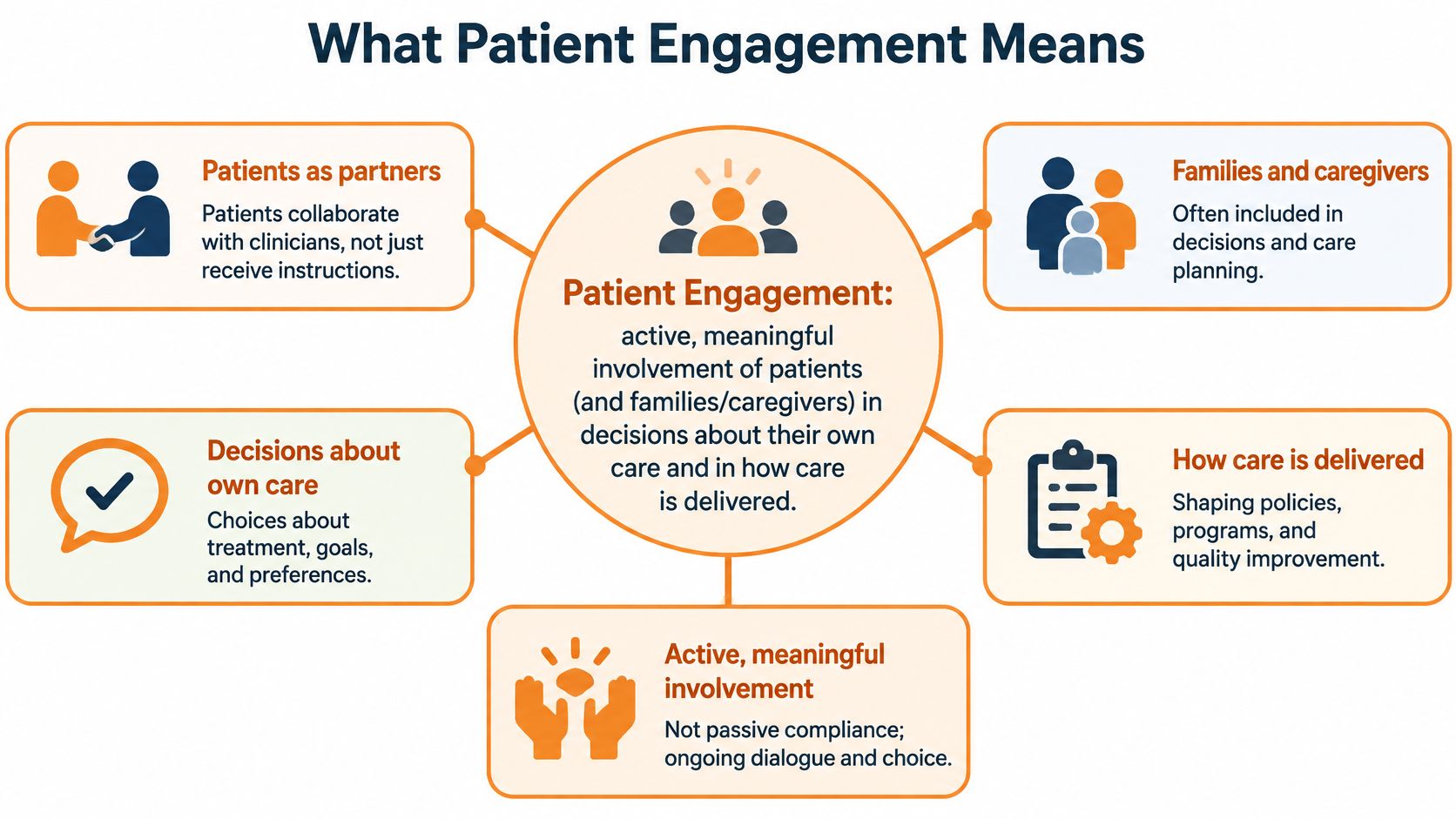
AHRQ's framework is careful about one word: continuum. Engagement runs from giving basic input at one end to deep participation through shared decision-making and collaborative care partnerships at the other. That makes it a process rather than a single action you either do or don't do. You might be at the shallow end with one clinician and the deep end with another, in the same month.
One-Way Information vs a Real Conversation
One-way communication moves details from professional to patient. A leaflet handed over at the desk, a printed plan, a text reminder. Useful, but not engagement.
Engagement adds the patient's own perspective, goals, preferences and circumstances to the same conversation, sitting right alongside the professional's knowledge and the evidence. The information flows both ways, and the second direction changes something.
Families and caregivers are recognised participants in this model, and AHRQ's framework keeps the patient in charge of how involved they are. If a daughter comes to appointments, the question of how much she decides isn't a side issue. It's part of the engagement itself.
The Engagement Ladder From Listening to Co-Designing
It helps to picture engagement as a short ladder rather than a switch. Five rungs, each one a bit more influence than the last. None of them is a measure of a person's worth or willingness, and no one is expected to stand on the top rung all the time. The rungs describe what happens, not how good anyone is.
| Engagement level | What the person does | Example in everyday care |
|---|---|---|
| 1. Receiving information | Reads and understands instructions | Clinician explains a plan and checks that it makes sense |
| 2. Giving input | Shares symptoms, preferences and feedback | Patient describes what matters most at a visit |
| 3. Shared decision-making | Weighs options and trade-offs with a clinician | Choosing between two approaches together |
| 4. Self-management partnership | Tracks daily tasks and reports back | Logging routines so the care team can review them |
| 5. Co-designing services | Helps set priorities and shape how care works | Patient panel reviews a new service before launch |
The lower rungs are still real. Someone who reads a plan carefully and asks a clear question is doing something valuable. But deeper rungs hand the person more control over what happens next, and that's where engagement starts to feel different from being managed.
Where the Ladder Usually Stops
The awkward truth is that most of the ladder is rarely climbed. A 2018 systematic review in Research Involvement and Engagement searched 9,490 citations, examined 2,777 full-text articles, and found only 23 trials that actively engaged patients or community representatives in patient-oriented interventional research, as reported in the review of patient engagement in research.
Participation was small when it happened: between 2 and 24 patients or community representatives per study, with 83% of the trials based in the United States or United Kingdom. Only 3 of 23, or 13%, engaged children, and 6 of 23, or 26%, engaged minority populations. The authors estimated that meaningfully active patient engagement appeared in far less than 1% of the 371,159 trials in their dataset. In other words, the top rungs are described far more often than they're practised.
That's why it's worth noticing which rungs your own visits include. Next time you're in a consultation, ask yourself afterwards: was I told, was I asked, or did we decide something together? The answer tells you more than any leaflet will.
How Shared Decisions Work, Step by Step
Shared decision-making is a rung patients can reach first, and it has a clear shape. AHRQ defines it as a collaborative process where patients and clinicians consider evidence, professional experience, and the patient's values, goals, preferences and circumstances together, in its guidance on shared decision-making. The same guidance describes the mechanics: discuss the options, explain the trade-offs, invite the person to say what matters most, then agree a path forward.
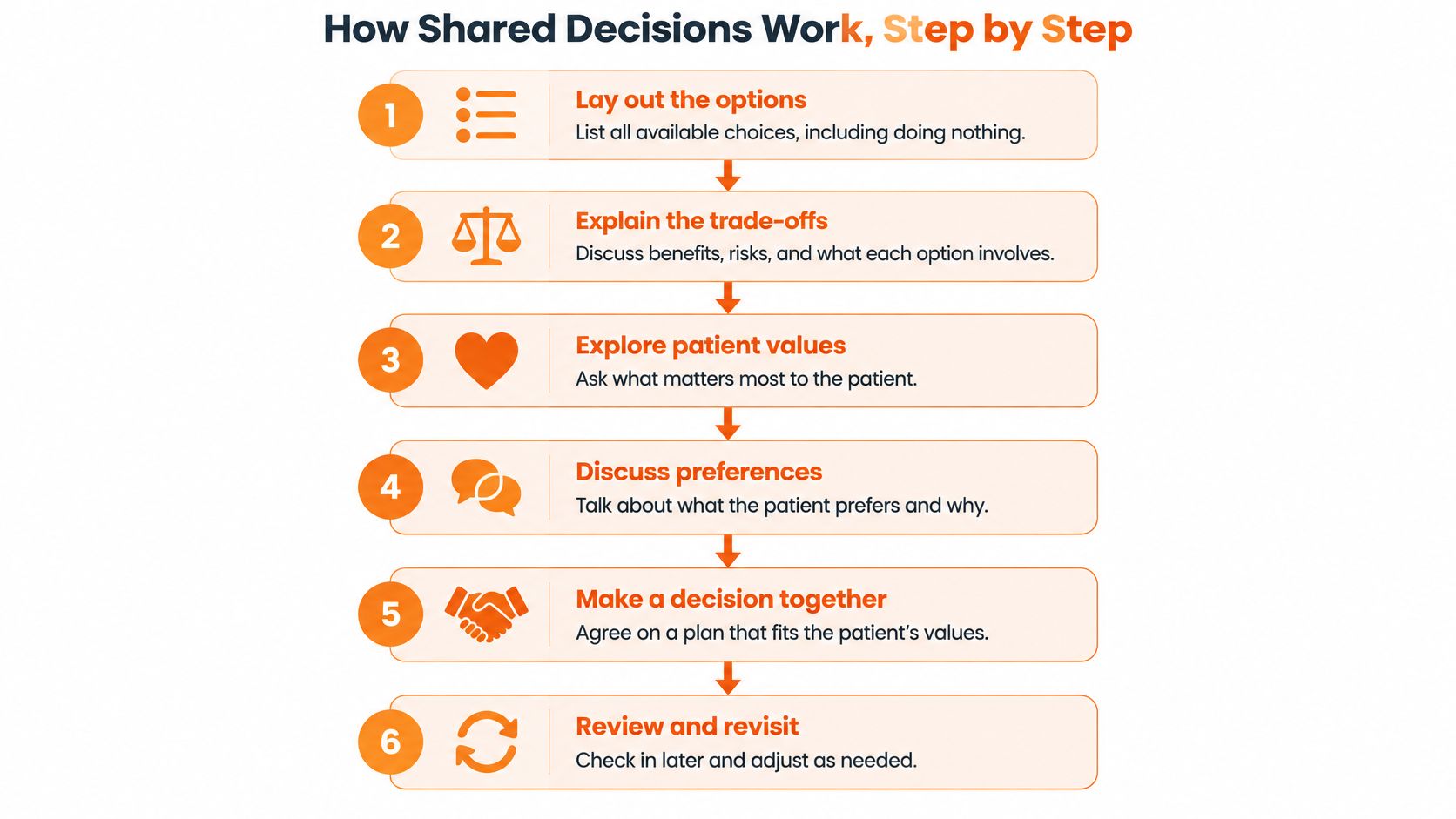
Here is that process broken into six steps you can picture happening in a real conversation.
- Lay out the options. All of them, including the option of waiting and watching. If you only hear one path, you haven't been offered a choice yet.
- Explain the trade-offs. What each option takes, what it gives back, and what it rules out. Plain language, not jargon, and enough time to take it in.
- Ask what matters most. This is the step that separates engagement from a sales pitch. The nurse or clinician asks about your goals and daily life before steering anywhere.
- Put evidence and experience side by side. Research findings, the professional's experience and your own circumstances all count. None of them automatically outranks the others.
- Agree on something achievable. AHRQ's materials note that the plan should reflect what's realistic for you, including your confidence and preferences. An ambitious plan you can't follow is worse than a modest one you can.
- Check back and adjust. Set a point to revisit. Plans that never get reviewed tend to die.
Practical rule: if you leave a conversation without knowing what the other options were, book a follow-up and ask. That one question opens the whole process.
Decision aids, option grids and short checklists can carry a lot of this weight. So can clinical decision support tools, which help clinicians bring relevant evidence into the room at the right moment. You can read about the clinician side of that in this overview of clinical decision support tools, and knowing the tools exist makes it easier to ask for a written comparison.
Bringing It to a Real Visit
Say a 74-year-old is deciding how to structure her week around two priorities: keeping her balance steady and seeing people. One version of the week is a daily walk with a neighbour. Another is a class twice a week that needs a lift each way. Time, comfort and how much a daughter can help all go into the conversation.
Family members can have an important role here, and the patient decides how much of a role. AHRQ's framework includes allowing the person to choose the level of family participation rather than assuming it.
Before your next appointment, three questions are worth carrying in:
- What are my options? Ask for the full list.
- What are the trade-offs? Ask what each one involves day to day.
- What matters most to me? Say it out loud before a plan is set.
Why Engagement Connects to Healthy Aging and Independence
Aging well isn't mainly about a medical chart. The World Health Organization defines healthy ageing as developing and maintaining the functional ability that enables well-being in older age, in its work on ageing. Functional ability combines a person's physical and mental capacities with the physical, social and policy environments around them.

WHO names five capabilities that shape that ability: meeting basic needs, learning and making decisions, being mobile, building and maintaining relationships, and contributing to society. Read the middle one again. Learning and making decisions is written into the definition of aging well. Patient engagement, at its best, is that capability applied to your own care.
Consider a woman in her late seventies who keeps three things fixed in her week: a daily walk around the block, a Tuesday coffee group, and a Sunday phone call with her granddaughter. Those are wellness routines she chose. None of them appear on a prescription. All of them depend on mobility, relationships and decisions about how her days are shaped, which is precisely the territory WHO's definition covers.
The Routines Worth Protecting
Positive routines are the practical machinery of independence. Sleep that runs on a steady schedule. Movement that includes balance work, not just walking. Cognitive activity that involves other people, like a card game or a class. Social connection treated as a real ingredient in health rather than an optional extra.
Supportive environments carry some of the weight. WHO points to safe and accessible public buildings, transport and walkable places as part of the picture, which is why a well-lit footpath and a bus that runs on time are aging-well issues and not just municipal ones.
Engagement starts when someone asks which routines you want to keep, rather than which ones you can safely give up.
Try this on a quiet afternoon. Write down three routines you value, then note beside each one who or what helps make it possible. A neighbour who drives, a grandchild who calls, a park within walking distance. You've just mapped your own support circle, and you'll know exactly what to mention at your next conversation about your week.
How Engagement Gets Measured Beyond Logins
Measuring engagement is harder than it looks, because the easy numbers tell you about activity and the harder ones tell you about influence. Evidence syntheses have evaluated engagement work using Patient Activation Measures, adherence, self-rated health, hospitalization, disease-specific clinical measures, quality of life and service utilization, according to the umbrella review of digital-health interventions. The same review notes the evidence base is heterogeneous and that engagement itself is often measured less rigorously than the outcomes it's meant to affect.
That review also reported a pooled improvement in medication adherence of standardized mean difference 0.65, with a 95% confidence interval of 0.22 to 1.08, alongside possible improvements in quality of life and HbA1c, though effects varied by tool and outcome.
| Measure type | Examples | What it tells you |
|---|---|---|
| Activation | Patient Activation Measure | How confident and involved a person feels |
| Behavior | Completed self-management tasks, adherence | Whether planned actions actually happen |
| Self-reported | Self-rated health, quality of life | How the person describes their own wellbeing |
| Service use | Hospitalization, avoidable utilization, escalation response time | How care flows through the system |
| Clinical | Disease-specific clinical measures | Condition-specific changes tracked by clinicians |
Mechanism vs Outcome
Picture a bakery that counts shop visits as proof of loyalty. Visits tell the owner someone walked in. They don't tell her the bread was good. Healthcare dashboards have the same blind spot: message counts and portal logins prove a person touched the system, not that the system responded well.
Evidence maps raise a specific caution. Many studies report adherence or satisfaction without measuring the engagement process itself. When the how and the what get blended, you can't tell which part did the work.
A cleaner way to look at it: first how people take part, then what changed. Closed-loop design follows the same logic. Present information clearly, ask what the person understood or wants, prompt the next step, and route exceptions to a caregiver or clinician instead of letting them disappear. That's good process, and it holds whether the person uses a screen, a phone or a paper notebook.
Who Gets to Take Part
A patient portal that assumes a laptop, broadband and fluent English works like a building with only one entrance, and it's upstairs. Some people walk straight in. Others never find the stairs.
In a cohort of 250,345 adults aged 50 and older, 61% activated a patient portal and 54% logged at least one session over 2011 to 2024, according to analysis of electronic health record data. Participation was lower among people aged 65 and older, Black patients, people who preferred a language other than English, and those with less education. Age, language and schooling all predicted who got through the door.
Vendor surveys sketch similar habits from the other direction. An athenahealth survey of 1,000 U.S. patients found that 59% made or changed appointments digitally in 2024, 44% requested medication refills digitally, and 61% used an online patient portal, per athenahealth's patient engagement index. Those figures come from a company that sells digital tools, so read them as a snapshot of portal-minded habits, not a national census.
The infrastructure itself is largely built. A data brief on hospital patient engagement capabilities reported that 99% of U.S. hospitals enabled patients to view health information electronically, 96% enabled downloads, and 84% enabled transmission to a third party.
Access and involvement sit on different floors of that same building. A 2025 study reported that 24.9% of participants demonstrated good engagement in healthcare decision-making, according to the study in PubMed Central. Systems can offer the doorway while few people reach the room where decisions happen.
Unwilling vs Excluded
Low digital activity doesn't automatically mean low interest in care. It can mean an interface that's hard to read, patchy connectivity, privacy worries, low confidence with a device, or a plain preference for talking to a person.
That distinction changes what a good response looks like. Offer more than one route in. Phone calls, in-person visits, paper summaries and a family member helping with logistics all keep engagement open to more people, and the person should be the one choosing which route to use.
A care plan written for the person in front of you, with their circumstances built in, is worth more than a polished form nobody can open. This overview of person-centered care planning shows how that kind of planning gets put together in practice.
Everyday Examples and Who Controls the Information
Engagement gets easier to recognize when you watch who holds the pen. Three ordinary scenes show the idea at different levels, and each one turns on the same quiet question: who decided?
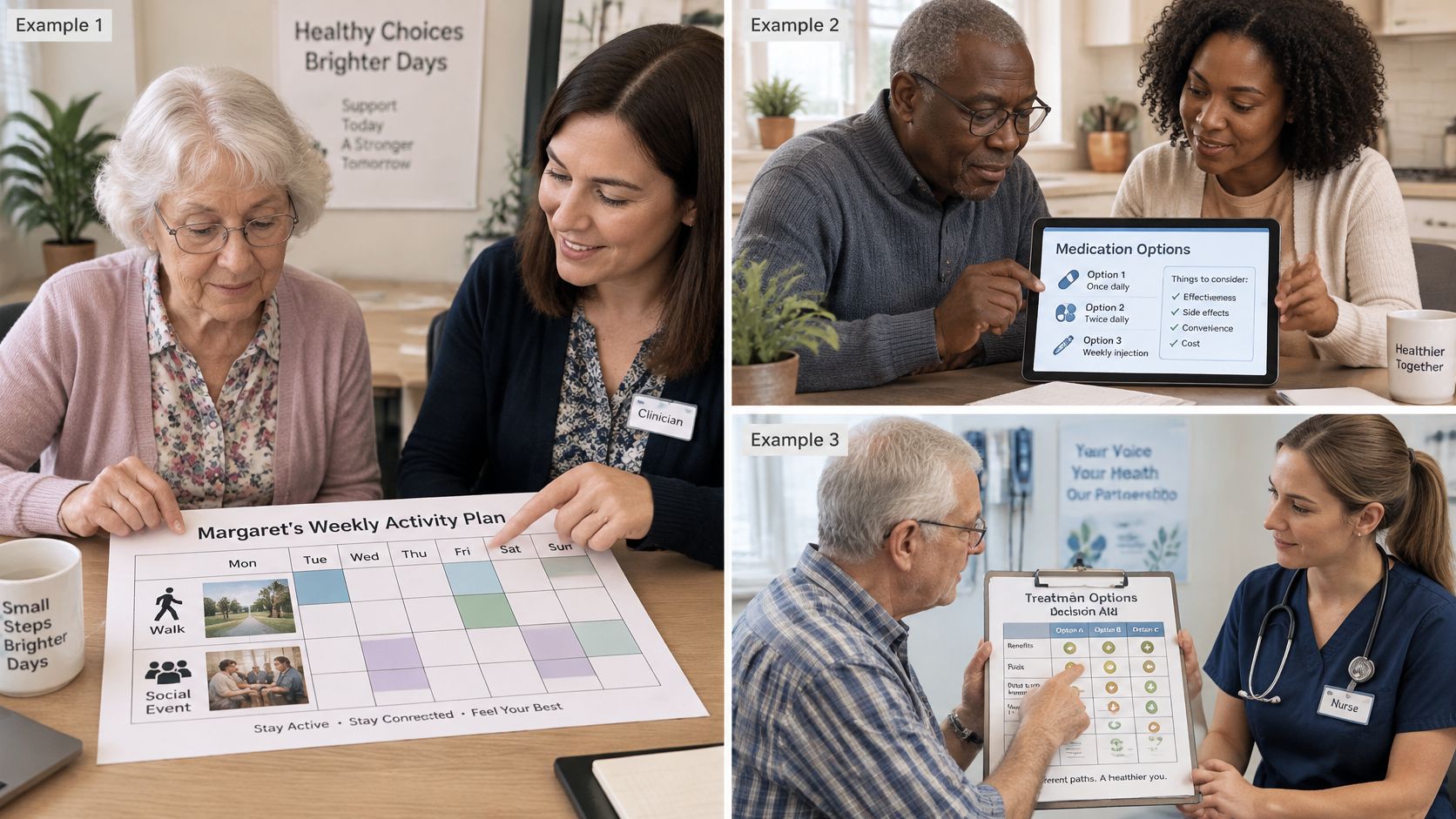
Scene one: being asked. Margaret, 72, sits down with her clinician to review her week. Rather than being handed a schedule, she is asked which routines she wants to keep. She picks the morning walk and the Thursday social group and drops the rest. Her clinician writes the preferences down and offers a paper copy, since small print on a portal is tiring for her. That is engagement at the input and shared-decision rungs, and it took about four minutes.
Scene two: choosing what gets shared. Her son receives a summary only after Margaret agrees to share it. When he calls, his first question is what kind of help she would like, not what the plan says. That is the family rung, with Margaret holding the pen. If language, hearing, vision or confidence with an app changes the situation, the choice should still be hers, including the choice to use a person rather than a screen.
Scene three: adjusting. A nurse reads a portal message, learns the plan does not fit Margaret's schedule, and adjusts it with her. That is a feedback loop, and it is the rung most likely to be skipped in a busy week.
Questions Worth Asking About Your Own Information
Control over information is part of engagement, and it is easy to leave to default settings. Any care provider or service can answer four plain questions:
- What is shared? Which details leave the room, and in what form.
- With whom? Named people, not "your care team" as a vague collective.
- Why? The purpose behind each share.
- How do I change my mind? The actual route for updating or withdrawing a choice.
With Rx360, choice is the mechanism. If a medication taker user opts in to Support Circle Sharing, their Customer Data is shared with their designated caregivers and loved ones. Users own their Customer Data, the electronic information submitted to the Pilot Services, and participation in the Rx360 pilot is voluntary. Users are also responsible for checking that medication information matches the official prescription labels from their pharmacy. For records held by a clinic or pharmacy, people can ask the provider for a copy; this guide to accessing your health records explains what to request.
Take five minutes this week to check what you have agreed to share and who can see it. Then check whether the answer still matches what you would choose today.
Spot Real Engagement in Your Own Care Team
The most common misunderstanding about patient engagement is that it's the patient's job. Use the portal, follow the plan, ask better questions. Recent work describes it instead as a collaborative process where patients, caregivers and professionals co-produce care, as set out in research on digital patient engagement. The same source warns that engagement turns tokenistic when professionals control the agenda or hold on to decision-making power.
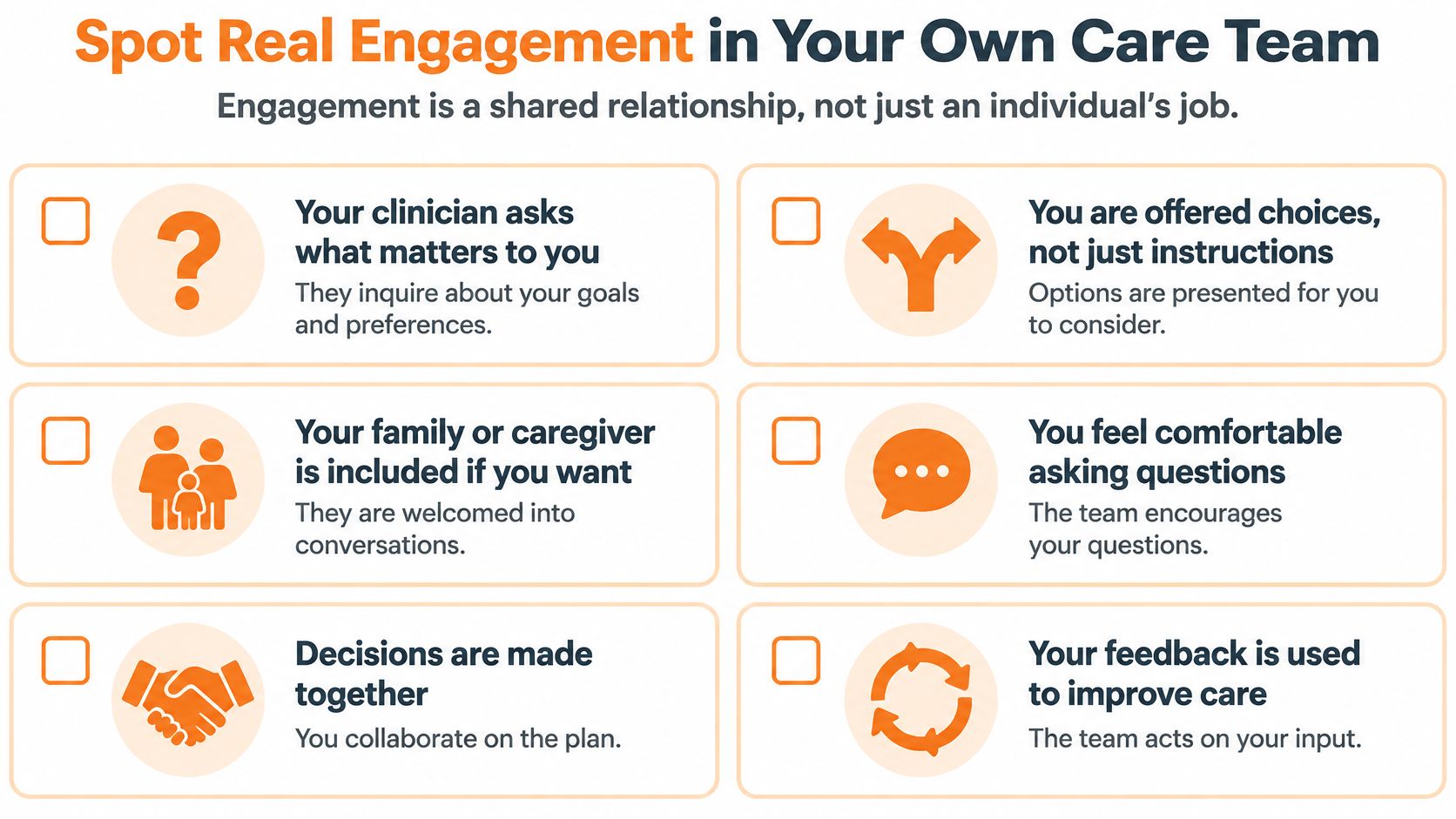
A new tool can also make things worse. If it shifts paperwork onto patients and caregivers without making anyone more responsive, more technology produces less engagement, not more. The test isn't whether a system exists. It's whether using it changes anything.
Here are five checks to run against your own care team.
- Are my options explained, or just decided? If you hear one path only, ask what else was considered.
- Am I asked what matters before the plan is set? Timing is everything. A question asked after the decision is decoration.
- Can I choose how much family is involved? That choice belongs to you, and it can change month to month.
- Does my feedback change something I can see later? Real engagement leaves a visible trace, like a schedule that moved or a routine that got adjusted.
- Is there a phone or in-person option? If screens aren't your preference, a different route should exist without penalty.
One question covers most of the ground: "What would happen if I said no to this?" The answer shows whether a real choice is on the table.
It's also fair to hold the field to a high standard. Recent reviews identify weak standardization and limited long-term evaluation of engagement methods, including wearable, gamified and cost-effectiveness outcomes, which means the evidence on which approaches best support daily independence is still thin. You don't need to wait for perfect evidence to ask better questions. Bring these five checks to your next conversation and see which ones get a clear answer.
Rx360 is built for independent older adults who want to stay in the driver's seat, which is why its platform brings Health Insights, Smart Technology and Connected Care together around one support circle. The Pilot Services are not medical devices and are intended for informational purposes only as a wellness tool, so the point is simple: keep the routines you love, and let the people you trust stay in the loop when you choose. Visit Rx360 to see how the platform keeps independence and connection in the same picture.
Lower-Risk Medication Plan Checklist
Below is a practical checklist and step plan you can implement into your daily life:
-
List all medications
Include prescriptions, over-the-counter drugs, supplements, sleep aids, creams, patches, eye drops, and inhalers.
-
Mark fall-risk drugs
Flag medicines that cause dizziness, sleepiness, confusion, blurred vision, low blood pressure, or low blood sugar.
-
Ask for a medication review
Bring the list to a pharmacist or prescriber.
-
Review after any warning sign
Request a new medication check after a fall, near-fall, new prescription, dose change, dizziness, or confusion.