Open the care plan of almost anyone over 70 and you'll usually find the same three things: a list of diagnoses, a medication schedule, and a set of tasks someone is meant to complete. What you rarely find is an answer to a much simpler question. What does a good Saturday look like for this person?
That gap matters more than it sounds. A plan built only from problems tells everyone what's wrong and nothing about what's worth protecting: the early walk, the Thursday garden club, the crossword before breakfast. Person centered care planning flips the order. The person's own goals come first, and the supports, safety measures and appointments arrange themselves around those goals.
What follows walks through the whole thing at a friendly pace. What the term means, the six principles underneath it, a step-by-step way to build one, how safety gets worked out with the person rather than over their head, and the handful of indicators that show whether a plan is alive or just filed away.
Table of Contents
- What Person-Centered Care Planning Really Means
- Core Principles and the Legal and Ethical Backdrop
- How to Build a Plan, Step by Step
- Balancing Independence and Safety
- Who Takes Part and What to Ask Each Person
- Putting Plans to Work at Home, in Clinics and Senior Living
- Tools That Keep Plans Current Without Taking Over
- Measuring Progress and Fixing What Stalls
- Start Your Own Plan This Week
What Person-Centered Care Planning Really Means
A fixed tour bus follows the same route for everyone. A custom itinerary starts with where you want to go, then works out the transport. Person-centered care planning follows that second approach: the person's goals guide the plan, while support is arranged around them.
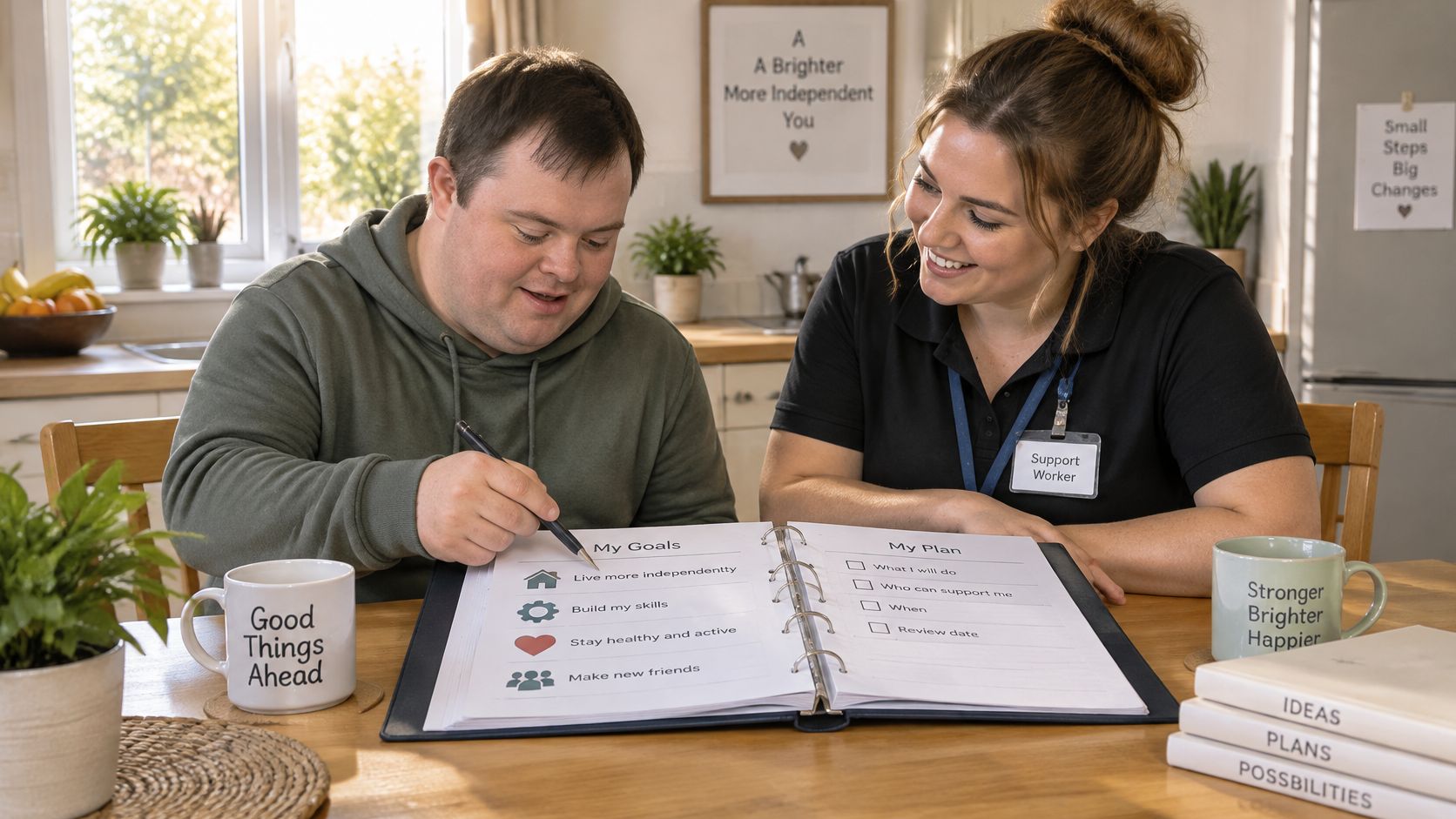
Person-centered care planning is a written account of what matters to a person, including their routines, interests, relationships and picture of a good week, alongside practical support for health needs, medications and daily tasks. It gives the people involved a shared reference, while keeping the person's own priorities at the center.
The approach has developed over time. Its roots reach back to Carl Rogers' client-centered therapy in the 1950s, and later planning models included Personal Futures Planning in 1987, MAPS and Circles in 1989, and Essential Lifestyle Planning in 1992, as this account of person-centeredness in health systems describes. In the United States, the Centers for Medicare & Medicaid Services proposed person-centered planning requirements for selected home- and community-based services in 2011 and issued final rules in 2014. A systematic review found 417 articles containing a definition of patient-centeredness, with more than 80% published after 1999.
The practical shift is simple: a plan should reflect a person's strengths, preferences, needs and desired outcomes, not only diagnoses or service tasks.
Start with one sentence in the person's own words: Up before the sun, garden by eight, call with my sister at lunch. That sentence becomes a guide for deciding which supports belong in the plan and how they can help the person keep living the day they value.
Core Principles and the Legal and Ethical Backdrop
A care plan gives a person's goals a practical place in decisions about support. A systematic review examined nearly 3,000 publications on person-centered care for older adults published between 1990 and 2014, then included 132 nonduplicate sources. Across those sources, researchers found 15 descriptions of person-centered care and 17 recurring principles, with six domains standing out (Journal of the American Geriatrics Society review).
| Principle | What It Looks Like in a Plan | Question to Ask |
|---|---|---|
| Whole-person care | Routines, interests and relationships appear alongside health tasks | What does a good week look like for this person? |
| Respect and value | The plan uses the person's own words | What does this person want others to know about them? |
| Choice | The person can compare options and choose what fits | Which options does this person actually have? |
| Dignity | Help protects privacy and self-image | How would this person like to be helped with this task? |
| Self-determination | The person sets goals and decides what changes first | Who decides what happens next? |
| Purposeful living | Goals connect to meaningful activities and roles | What activity gives this person a sense of purpose? |
Use each principle as a practical check. Whole-person care makes room for a morning routine, a garden and a friendship alongside medication times. Respect means writing I like my tea strong and my walks early, rather than replacing that preference with a clinical shorthand.
Choice requires options the person can select among. A 2025 study of 2,928 people with intellectual and developmental disabilities found that 54.0% chose their personal goals between 2020 and 2024, while 46.0% did not (Journal of Developmental and Physical Disabilities study). The figures show that stating a principle does not guarantee it is reflected in practice.
Dignity can shape how help with bathing or dressing is offered. Self-determination clarifies who chooses a goal and what changes first. Purposeful living connects plans to roles that matter to the person, such as mentoring a neighbor or running a book club.
Autonomy also raises a legal and ethical question: how can support protect a person's choices while addressing safety? CMS's 2014 final rules provide a regulatory backdrop for person-centered planning in selected home- and community-based services. In each plan, the practical question remains: who decides when the person can make that decision for themselves?
How to Build a Plan, Step by Step
A scoping review that screened 436 records and included 30 studies found that older adults describe person-centered integrated care in consistent terms: continuity of relationships and information, smooth transitions between services, quick access to effective treatment, self-care support, respect for preferences, and genuine involvement of carers and families (BMJ Open). The takeaway is straightforward. A plan behaves best as a running conversation, not a form you fill in once and file.
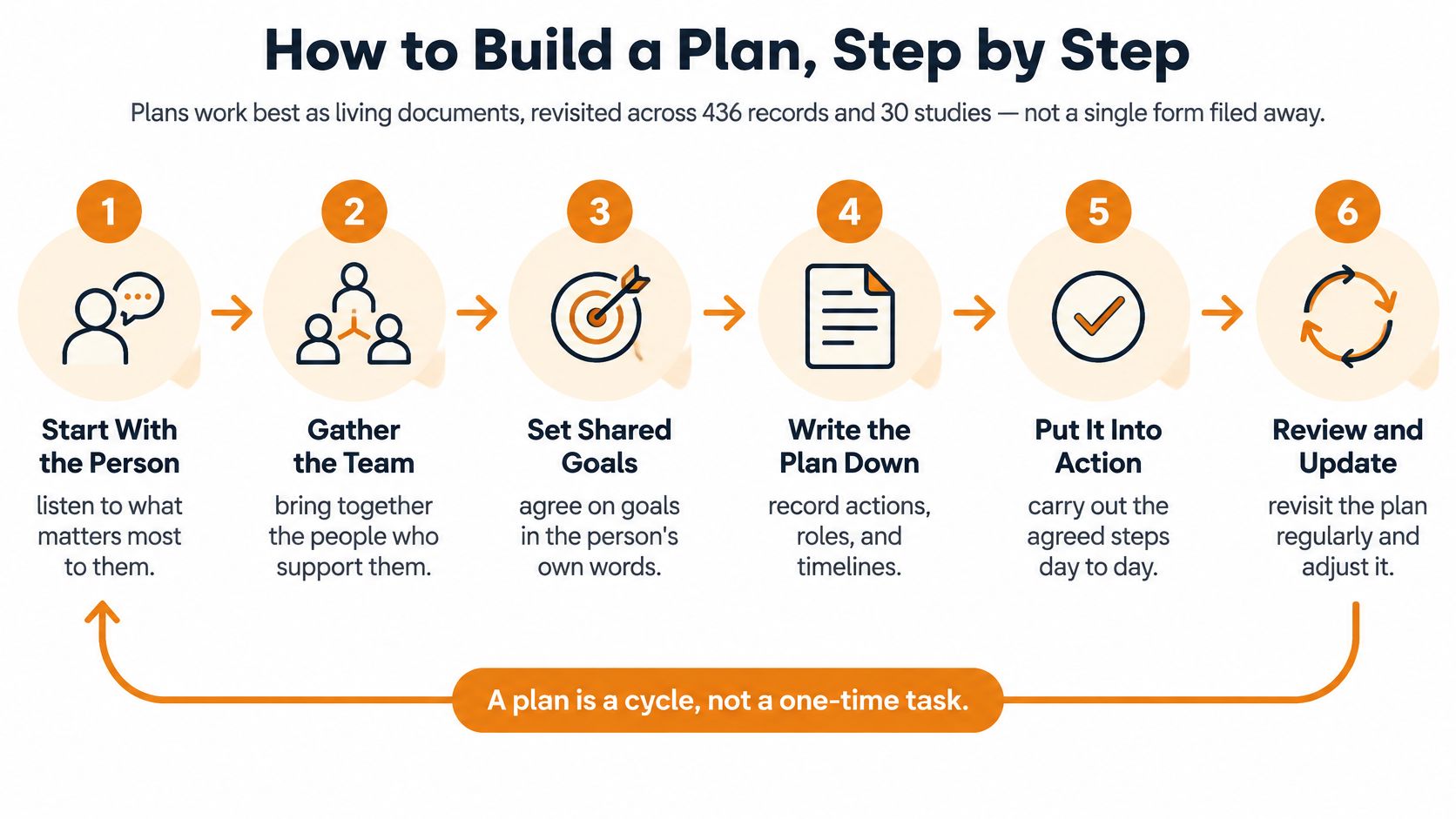
- Start with an open conversation. Ask what they want more of this year, not what's gone wrong. The usual slip is opening with a risk checklist before the person has said a word about their week.
- Record goals, preferences, strengths and routines to keep. Use the person's own phrasing. The slip is translating I want to get back to my Tuesday card game into client expresses interest in social engagement.
- Talk through needs and possible risks together. Note what the person already handles alone, because that list is longer than most families expect. The slip is turning a risk conversation into a permission hearing.
- Agree actions, one owner each, and a review date. Names, not departments. The slip is writing team will follow up, which means nobody will.
- Share it only with the people the person chose. Consent is specific, not a blanket yes at intake. The slip is defaulting to the full distribution list out of habit.
- Review after meaningful changes. A new living arrangement, a fall, a shift in interests, a different caregiver. The slip is having no review date at all, so the plan becomes history.
What goes on the one page. Keep it short enough to read over coffee:
- The good-day sentence in the person's own words.
- Goals and routines to protect, including the small ones.
- Strengths and what they already manage alone.
- Agreed actions with one owner each.
- Who may see the plan.
- A review date plus the triggers that call for an earlier one.
A plan is working when the person can explain it in their own words without reading it off the page.
Balancing Independence and Safety
Here's the assumption worth questioning: that a person who values independence is automatically taking a risk somebody else should be managing. Implementation research keeps landing on the same tension, and it rarely resolves by picking one side.
A qualitative systematic review of person-centered care in community settings analyzed 12 studies from a range of countries and extracted 122 findings, of which 106 were classified as unequivocal and 16 as credible (BMC Geriatrics). Among the implementation issues reported were limited knowledge and skills, and negative attitudes toward shared decision-making. Read plainly, the obstacle is often not the older adult's willingness to plan. It's the comfort level of the people around them.
A workable plan treats safety as a negotiated outcome instead of a reason to override preference. Four moves do most of that work:
- Separate the hazards from ordinary life. A loose rug in the hallway is a fixable hazard. Walking the neighborhood alone on a Tuesday is a life, and it carries risk like everything else.
- Write down the trade-offs the person has chosen, in their words, including the risks they've said they accept.
- Note what they manage independently and what help they'd welcome, which is often narrower than what's offered.
- Set review triggers. A fall, a hospital stay, a change in thinking or memory, or a concern raised by a family member.
Use a structured fall risk assessment tool when balance or mobility is the question, then bring the result back into the conversation rather than around it.
Safety work that skips the person tends to produce a plan everyone follows except the one it's about.
Family members and clinicians can read the same signal in completely different ways, so the plan should state who gets asked, who decides and how quickly the team responds.
Who Takes Part and What to Ask Each Person
A plan with one name on it is a wish list. A plan with a name beside every action is a working document, and the older adult sits at the center of that group rather than at the end of it.
A U.S. National Academies evidence summary of person-centered home- and community-based services looked at 12 qualitative studies published from 2006 through 2023, most of them conducted in Europe and Canada. The barriers it listed are practical rather than philosophical: insufficient multidisciplinary teamwork, time pressure, environmental constraints and limited coordination in how resources get allocated. The supports it named are equally practical, including respecting older adults' autonomy and building clearer ways for people to speak up (National Academies summary).
| Role | Typical Contribution | How They Keep the Plan Current |
|---|---|---|
| Older adult | Sets goals, preferences and boundaries | Confirms changes in their own words |
| Family member or loved one | Shares history, routines and day-to-day observations | Passes on changes they notice, with the person's permission |
| Primary care clinician | Reviews health needs and discusses options | Records the person's goals next to health discussions |
| Care coordinator or case manager | Organizes referrals, follow-ups and review dates | Holds the review date and shares the updated plan |
| Home health or care staff | Supports the daily routines the person has chosen | Notes routine changes at each visit |
| Senior living staff | Helps with community activities and shared spaces | Updates activity notes after group events |
Prompts That Open Real Conversations
Use these with the whole team, and jot them in a notebook you carry:
- What do you enjoy doing every day?
- What would you never want to give up?
- How much risk feels right for you?
- What do you want help with, and what do you prefer to do alone?
- Who needs to see the updated plan?
A simple rule keeps the whole thing from stalling. Whoever talks to the person most often should be the one who keeps the shared plan up to date, because they hear the change first.
Putting Plans to Work at Home, in Clinics and Senior Living
Say a retired teacher wants to keep her Thursday garden club and her morning walk. That one goal looks different depending on where she lives and who's supporting her, which is why a plan needs a little flexibility built in.
In a study of person-centered planning in older-adult care homes in England, researchers interviewed 22 practitioners across 21 semi-structured interviews conducted between September and December 2022. 19 of the 22 (86.4%) named understanding the person as a dimension of person-centered planning (Journal of Advanced Nursing study). The sample was limited to practitioners in English care homes, so treat the figure as an illustration rather than a worldwide estimate. Still, it says the part staff consider central is knowing who they're planning with.
| Setting | Where Planning Usually Starts | Practical Strategy | Sign It Is Working |
|---|---|---|---|
| Home, aging in place | Everyday routines and the person's own priorities | Keep a simple shared calendar of walks, calls and social plans | The person can describe the plan and keeps the routines they chose |
| Primary care clinic | Visits and the goals the person brings to them | Record goals next to health discussions and set one agreed follow-up date | The next visit starts from the goals the person already named |
| Senior living community | Daily life and community activities | Build the plan around group walks, shared meals and hobby classes | The person joins activities they picked and staff can see the plan at handoffs |
At home, the plan begins with what the person already does on purpose, and family members support it with a shared calendar of walks, phone check-ins and social plans. In the clinic, the goal gets written next to the health discussion with one follow-up date the person agreed to. In senior living, staff build around community life and then ask how the person is enjoying each activity.
Exercise, routines and social connection turn up again and again as the wellness goals a plan can carry. Good home health care coordination makes those goals portable, so the walk survives a change of setting.
Tools That Keep Plans Current Without Taking Over
The best tools are the ones the person already trusts. A shared notebook on the kitchen counter. A printed one-page plan on the fridge. A phone calendar with a reminder for the morning walk, set by the person rather than pushed at them.

Connected platforms can extend that habit without replacing it. Rx360 organizes its work around three areas, Health Insights, Smart Technology and Connected Care, with the older adult holding the controls over what gets shared.
More monitoring doesn't automatically produce more person-centered care, and that's where well-meaning setups go wrong. Implementation research describes the tension directly: monitoring can undermine autonomy unless the individual controls its purpose, visibility and response (person-centered planning implementation research). A missed routine shows the problem nicely. It could be harmless variation. It could be an emerging illness. It could feel like surveillance, and family members and clinicians may each read it differently.
Three Questions Before Any Tool Goes In
- Who can see my information?
- Can I change or turn off each feature?
- Who responds when an alert goes off?
If a tool can't answer all three in plain language, it isn't ready to hold someone's plan. When it can, clinical decision support tools give the care team somewhere useful to take a change instead of leaving it sitting in an app.
Measuring Progress and Fixing What Stalls
A systematic scoping review of 181 integrated-care studies across 26 countries found that 67% included care coordination or personalised care planning, 91% used multidisciplinary delivery and 47% integrated services across sectors. Overall, 88% reported positive outcomes, most often at the patient level. Measurement was the weak spot: acceptability was assessed in only 21% of studies, feasibility in 19% and fidelity in 9% (AHRQ Integration Academy).
That gap explains why a satisfaction survey tells you so little. A plan can please everyone in the room and still never be followed once everyone leaves.
| Indicator | What to Record | Example |
|---|---|---|
| Goal concordance | Whether actions match the goals the person named | A walking goal is met three times this month |
| Referral completion | Whether agreed referrals were booked and attended | A requested community class was joined within two weeks |
| Time to response | How long the team takes to act on a concern | A family question was answered the same day |
| Plan review completion | Whether the plan was revisited on the agreed date | The review happened after a change in living arrangements |
| Preference fidelity | Whether choices reflect the person's stated preferences | The person's preferred meal times were kept in the plan |
What Stalls a Plan and What Unsticks It
Most plans don't fail loudly. They drift: no review date, ownership listed as the team, updates living in one person's inbox.
- Skills and confidence: start with one goal the person named this week rather than rewriting the whole document.
- Time pressure: keep one shared page, updated in place, so nobody retypes a summary.
- Coordination across services: put a standing review date in the calendar of whoever holds the plan.
- Training gaps: a ten-minute weekly huddle sticks better than a course nobody has time to attend.
Training does move the needle. A randomized controlled trial published in 2021 tested structured training for person-centered care planning in community mental-health programs. At 12 months, trained organizations improved over control organizations with an adjusted between-group coefficient of 1.10 (standard error 0.50; p = 0.03), rising to 1.47 at 18 months (p = 0.01), a medium-to-large effect size of 0.71 (Psychiatric Services trial).
Progress looks like a person who can tell you what changed and why, using their own words.
Then ask the person directly. Once a month, invite them to rate from one to five how much say they had in their plan that month, and record the number next to the indicators, so the next review starts from what they said.
Start Your Own Plan This Week
Three small moves get a plan moving before the week is out.
- Write the good-day sentence. One line, in the person's own words, at the top of the page.
- Pick one goal and one routine to protect, then set a review date inside the next month. A goal without a date tends to stay a nice idea.
- Decide who sees it, and keep the list short. Write names rather than roles, so nobody has to guess later.
Check the permissions one by one before anything is shared: who can see the information, which features can be turned off, and who responds if an alert goes off. On our platform, if a medication taker user opts in to Support Circle Sharing, their Customer Data is shared with their designated caregivers or loved ones, and users own their Customer Data.
Then talk the plan through with a trusted clinician or care coordinator, and take any health question to that care team rather than working it out from a guide. Note the date and what the person said beside the plan.
A plan that gets revised is a plan that's working. Goals change, seasons change, and the document should change with them. A plan is a habit of listening, written down.
Rx360 is a modern wellness platform built on a simple idea: the older adult stays in the driver's seat, and the people who care about them stay in the loop. Health insights, supportive technology and connected care sit in one place, so a plan rooted in someone's own goals can stay current between visits, across family members and through the everyday changes that matter. Visit Rx360 to see how the platform supports independent living without taking over.
Lower-Risk Medication Plan Checklist
Below is a practical checklist and step plan you can implement into your daily life:
-
List all medications
Include prescriptions, over-the-counter drugs, supplements, sleep aids, creams, patches, eye drops, and inhalers.
-
Mark fall-risk drugs
Flag medicines that cause dizziness, sleepiness, confusion, blurred vision, low blood pressure, or low blood sugar.
-
Ask for a medication review
Bring the list to a pharmacist or prescriber.
-
Review after any warning sign
Request a new medication check after a fall, near-fall, new prescription, dose change, dizziness, or confusion.