
An estimated share of emergency department patients return frequently, and they account for a substantial portion of visits. That pattern points to an escalation problem: a smaller group may need more coordinated support, rather than a general warning for everyone to avoid the emergency room.
For a family, the useful question is not how to keep Mom away from emergency care. It is how to judge whether staying home remains safe, and who can help make that decision at 9 p.m. on a Sunday. When symptoms are urgent or you are unsure, call 9-1-1 or contact a clinician for guidance rather than delaying needed care.
A practical routine gives everyone clearer next steps: keep warning signs where the family can see them, check in regularly, and set follow-up points after a visit. Then review the month together, including emergency visits and whether the person's health, safety, and ability to manage at home are holding steady. Reducing emergency room visits works best as a way to catch changes early and respond at the right level, not as a rule to stay away.
Table of Contents
- Why Some Emergency Visits Are Avoidable
- Warning Signs and Where to Turn First
- A Weekly Routine That Catches Changes Early
- Sleep and Social Connection as Everyday Signals
- Medication and Follow-Up Checkpoints After a Visit
- Metrics That Show Whether Your Plan Works
- Set Up Your First Monthly Review
Why Some Emergency Visits Are Avoidable
The U.S. Agency for Healthcare Research and Quality estimates that 13% to 27% of emergency department visits could be managed in physician offices, clinics or urgent-care settings rather than in a hospital emergency department. A national analysis cited by AHRQ estimated that redirecting those potentially avoidable visits could save approximately $4.4 billion annually.
Read that carefully and you'll notice what it doesn't say. It doesn't say a quarter of the people in the waiting room shouldn't be there. AHRQ's point is narrower and more useful: some visits involve conditions that are preventable or treatable through accessible primary care and better management of chronic conditions. The visit was the right call at the moment it happened. The avoidable part came earlier.
AHRQ tracks emergency visits for three groups of conditions as measures of potentially preventable emergency care:
- Selected asthma conditions, where breathing troubles often build over days rather than minutes
- Dental problems, where pain that starts as a dull ache becomes an infection that can't wait
- Mental-health, alcohol or substance-use conditions, where a slide is visible to family long before it becomes a crisis
Those three are worth studying because they're slow. Teeth hurt for weeks. Inhalers start getting used more often. Sleep and mood drift before anyone names it. That gap, between the first small change and the emergency, is where a family can work.
What this changes at home: the goal isn't fewer emergency trips in the abstract. It's noticing a change on Tuesday, while Tuesday's clinician appointment is still an option.
For someone aging in place, the practical version of prevention is unglamorous. Notice earlier. Keep follow-up steady. Coordinate the people who care about the person so two of them aren't each assuming the other made the call. That's why prevention here looks like practical access, earlier warning and coordinated support, not a lecture about using the emergency room less.
Warning Signs and Where to Turn First
Before routines and trackers, you need one page every family member can find at 2 a.m. The table below sorts changes into four levels and gives each level a first place to turn. Every example is a general warning pattern, not a diagnosis, and your own clinician sets the details of your plan.
| Level | Example signs | Where to turn |
|---|---|---|
| Emergency now | Chest pain, trouble breathing, sudden weakness or face drooping, new confusion, a fall with a head injury | Call 9-1-1 right away |
| Same-day concern | A new symptom that worries you but feels less urgent, or a fall without injury | Call your clinician's office or after-hours line the same day |
| Routine change | Gradual shifts in sleep, appetite, mood, mobility or energy over several weeks | Note it in your log and raise it at your next scheduled visit |
| Not sure | Something new that you cannot place | Call your clinician's line; if in doubt, call 9-1-1 |
How to read the four levels
The top row is short on purpose. These are the signs that belong to the emergency system, not to a voicemail box, and the stroke warning signs are the clearest example of why speed matters more than certainty. Sudden weakness or a drooping face isn't a wait-and-see symptom.
The same-day row covers the ambiguous middle. A fall without injury is the classic case: nothing appears broken, but the reason for the fall matters, and a clinician who knows the medication list can weigh in before the evening. Calling the office isn't an overreaction. It's using the cheaper of the two doors.
The routine row holds the changes families notice first and discuss last. A parent who now naps at 11 a.m., eats half a plate, or takes the stairs one step at a time is showing you a trend, not an emergency. Write it down and bring it to the next scheduled visit, where there's time to look at it properly.
The not-sure rule and your backup number
The bottom row is the one that decides how the whole system performs. When something is new and you can't place it, call. A clinician's office would rather hear from you at 4 p.m. than from the emergency department at 4 a.m., and a two-minute call settles most of these.
The rule that covers everything else: if you're in doubt, you call. If it feels like an emergency, you call 9-1-1 and don't drive yourself.
For the hours when the clinic line is closed, write down a named backup contact and the number to reach them, then keep it with the chart. A plan that only works during business hours isn't a plan.
Two things to be clear about. In an emergency, call 9-1-1 immediately. Rx360's SMS notifications aren't a life-safety or emergency notification system and don't replace emergency services or caregiver supervision, and our pilot services aren't designed for medical emergencies or urgent situations. Treat every alert as a nudge to check in, never as a substitute for a call. Put the chart on the fridge or in a phone note, and make sure the person who visits on Tuesdays has a copy.
A Weekly Routine That Catches Changes Early
Short, regular check-ins do something a crisis conversation can't: they create a record. A record can be compared, shared and handed to a clinician. It also settles family arguments, because "she seems more tired lately" becomes "she's been up three times a night since the 6th."
The routine below is designed to survive a busy week, which is the only test that matters. Here's the shape of it.
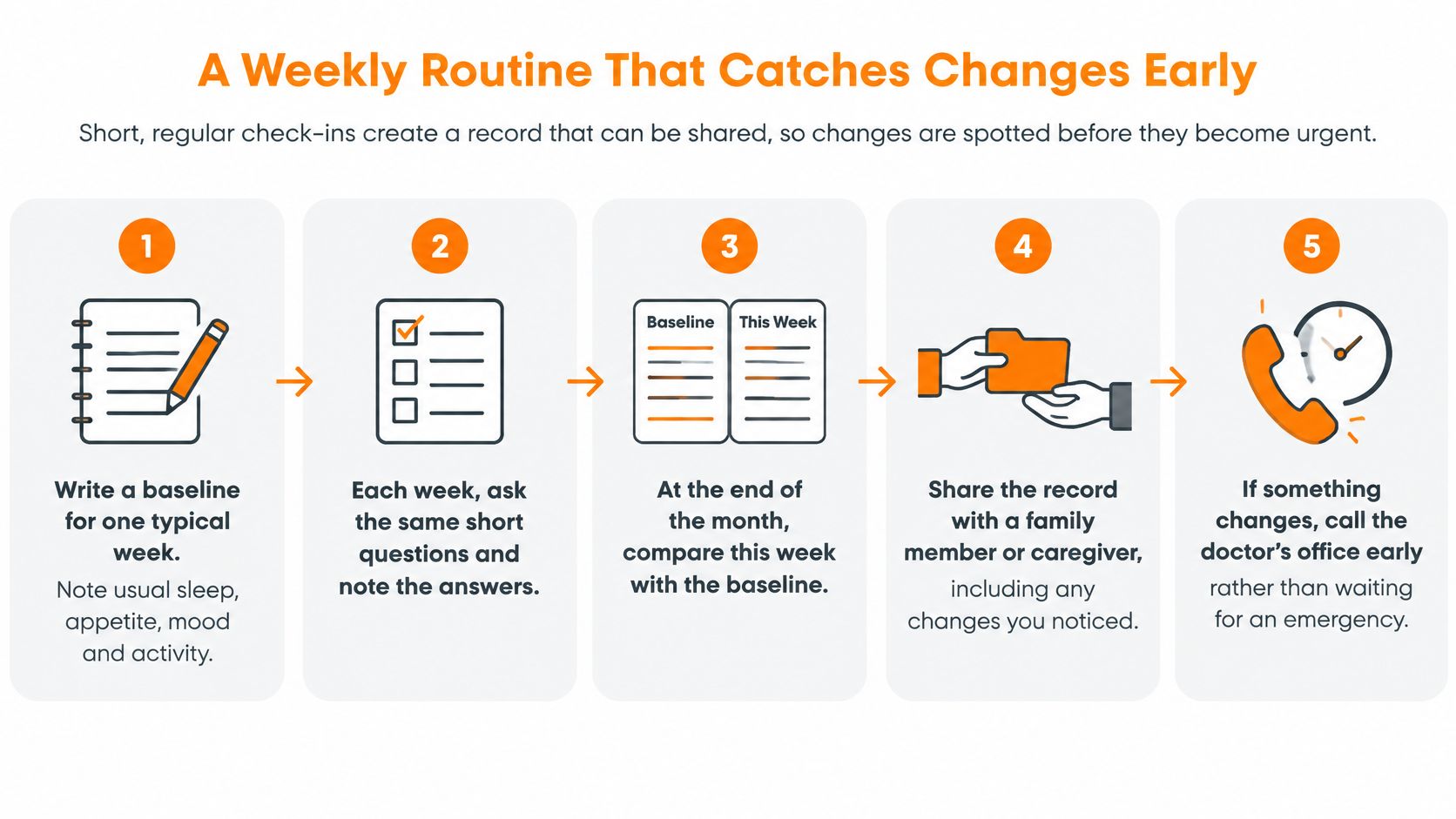
- Write a baseline for one typical week. Usual sleep hours, how far you walk, energy and mood on a 1 to 5 scale, and when you eat. Without a baseline, every observation is an opinion.
- Run a 30-second daily check. Sleep quality, appetite, mood, steadiness on the stairs, anything new. Ask the same five things every day so the answers stay comparable.
- Log each change with a date, a time and one line. "Tuesday, 8 a.m., dizzy on the third step, sat down, fine after a minute." One line gets written. A paragraph doesn't.
- Hold a 10-minute weekly review with someone in your circle. Look for anything that shows up on three or more days. One rough night is noise. Three rough nights is a pattern worth a phone call.
- Compare the week against the four levels. The chart turns a page of notes into a decision about which call to make, and how soon.
- If a change lands in the same-day or routine level, call that week and bring the log. Dates give a clinician something to work with. Impressions give them a shrug.
- Pair the check with something you enjoy. Morning coffee, a call with a grandchild, the first ten minutes of the news. Habits stick when they're attached to something pleasant rather than to worry.
What a good week looks like
A daily check that finishes in under five minutes. A weekly review that happens even when nothing has changed, because the quiet weeks are what make the loud ones legible. A log a clinician can scan in half a minute and understand.
Success isn't a week with no symptoms. It's a week where the information exists, in writing, and at least one other person knows where to find it.
Sleep and Social Connection as Everyday Signals
A disrupted night can be an early clue that someone's health or routine is changing. Research on older adults has found an association between insomnia symptoms and emergency visits, but the linked study citation does not support the specific figures previously attached to it. The useful takeaway is narrower: sleep is an observable signal, not proof of what is causing a change or a reason to delay care.
A journal by the bed can make patterns easier to notice. Write down whether sleep felt restful and whether anything about the usual routine changed. That gives the person, their family, and their clinician a clearer starting point for a conversation.

Steady routines can support better sleep: keep a consistent wake time, allow time to wind down without screens, get daylight outdoors in the morning, and take a daily walk. If sleep has been getting worse, review these sleep habits that support older adults with a clinician rather than trying to solve the problem alone.
Loneliness and isolation aren't the same signal
Loneliness describes feeling a lack of connection; social isolation describes limited social contact. They may overlap, but they are not interchangeable. A 2022 study of long-term-care residents reported an association between loneliness and unplanned emergency visits. It also found that social isolation was not linked to whether residents had any visit, though among residents who did go, socially isolated residents were more likely to have repeated visits.
The broader evidence is less conclusive. A meta-analysis in Innovation in Aging found no statistically significant overall association between social isolation and emergency visits, and results varied greatly across studies. That mixed picture means connection should not be presented as a proven way to prevent visits.
Keep connection in the routine because it matters to well-being, while treating a change in sleep or social contact as a reason to check in, not a diagnosis. A standing phone call, walking group, volunteer shift, or shared meal can help someone stay connected. Record a brief note about sleep and connection, then look for changes alongside other health signals. If you are unsure whether a change needs urgent attention, call for medical advice; for an emergency, call 9-1-1 immediately.
Medication and Follow-Up Checkpoints After a Visit
The first week after a visit is a practical time to check whether the plan is working at home. Review the medication list, clarify the written instructions and warning signs, schedule follow-up, and check that prescriptions, food, transportation, and equipment are available. If symptoms change, contact a clinician for guidance rather than treating fewer emergency visits as the goal.
A review of transitional-care research found that low-complexity interventions were associated with lower odds of emergency visits (OR 0.68, 95% CI 0.48 to 0.96). A randomized trial of an emergency-to-home transitions program found no significant reduction in 30-day revisits (AOR 0.97, 95% CI 0.72 to 1.30), even though follow-up and knowledge of warning signs improved. Better preparation can help, but it does not guarantee fewer visits.
| When | Checkpoint | What to confirm |
|---|---|---|
| Day 1 | Medication list reviewed | Each medicine's name, dose, and purpose are written down |
| Days 2 to 7 | Phone or home check | Prescriptions collected and transportation arranged |
| Within 7 days | Primary-care or specialist visit | Appointment date and clinician are confirmed |
| Day 30 | Visit and symptom review | Any emergency or urgent visits and their reasons are recorded |
| Day 90 | Full plan review | Chronic-condition check-ins completed and caregiver load discussed |
Better follow-up and better warning-sign knowledge are useful measures, even when visit numbers do not fall. Track both so the review shows what is improving and where the plan still needs attention.
Keep one shared medication sheet, on paper or in a note everyone can access. List each medicine, its dose and purpose, and who gives reminders. A single, current list makes it easier to spot a missed prescription or a possible duplicate dose. For more on building a routine, see this guide to medication adherence monitoring.
Before leaving a visit, confirm four things: the next appointment date, the current medication list, warning signs to watch for, and whom to call if something changes. If the situation is an emergency, call 9-1-1 immediately.
Metrics That Show Whether Your Plan Works
The measurement lesson comes from AHRQ's review of case management for frequent emergency department users. A systematic review of 12 studies involving 960 patients found that eight reported emergency-department reductions ranging from 31% to 83%, while two found no statistically significant reduction. That spread is the finding. Implementation and patient selection matter more than the label on the program.
Which is why visit volume alone tells you almost nothing. A month with four visits and a month with one can reflect a plan that's working, a plan that's collapsing, or a rough flu season. You need five measures, reviewed together.
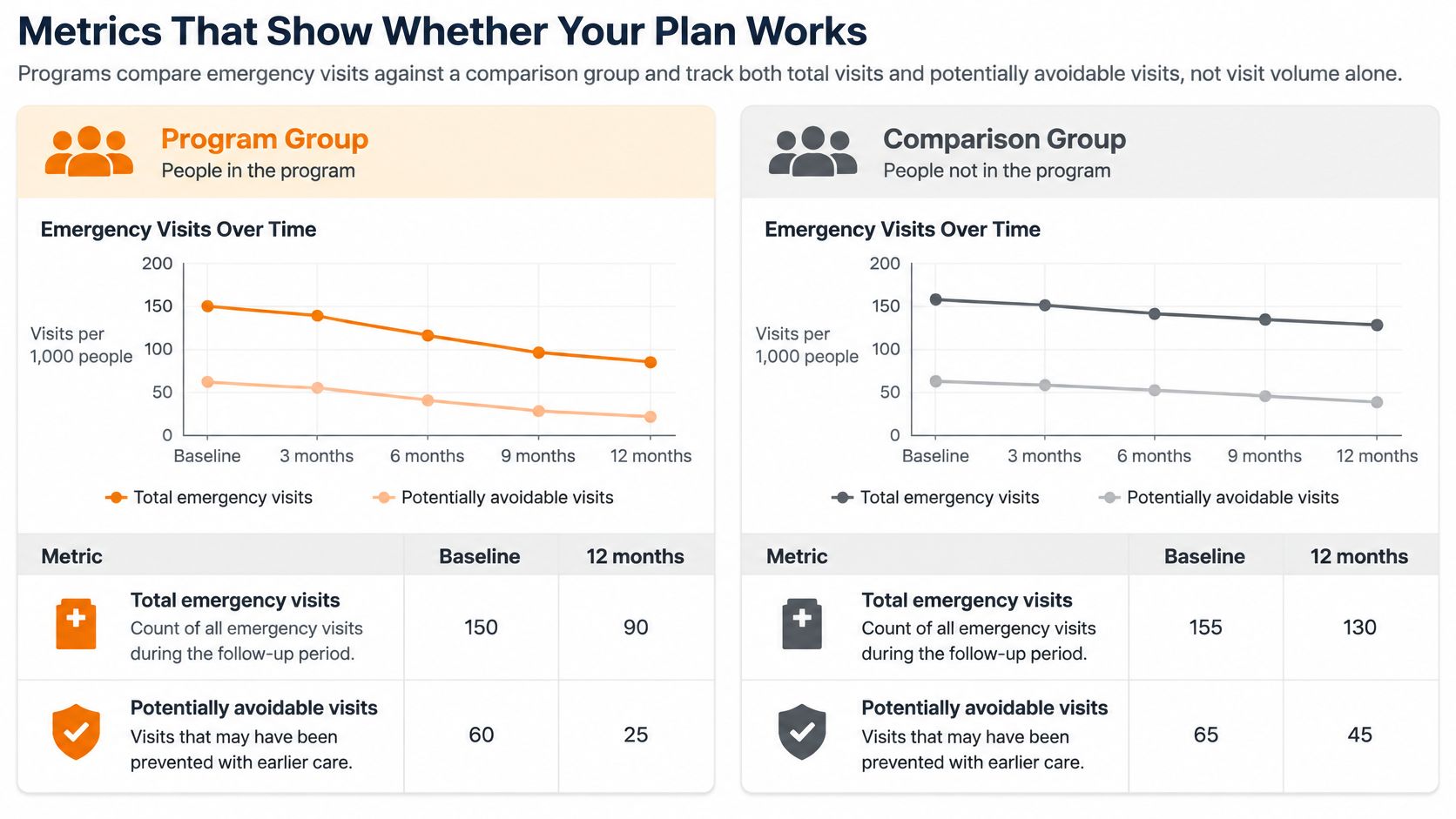
| Measure | How to count it | Watch for |
|---|---|---|
| Total emergency visits | Count per month from your log and visit notes | A single month can swing for reasons unrelated to the plan |
| Potentially avoidable visits | Mark visits reviewed with a clinician | Planned visits do not count as avoidable |
| Follow-ups kept within 7 days | Appointments completed out of those booked | A kept appointment is progress, not proof of fewer visits |
| Medication problems logged | Missed, confusing or duplicated doses noted in the log | Rising counts can mean earlier catches, so read them alongside visits |
| Unmet needs | Transportation, food or equipment gaps noted each week | Address gaps early, since they often drive later visits |
The traps that make good numbers lie
Relying on memory instead of a written log is the first one, and it's the most common. Counting planned emergency encounters as avoidable is the second, and it inflates the problem. Comparing one month with the month before is the third, because a single month is weather, not climate.
Then come the balancing measures, which deserve equal weight. Signs of a change that got missed. Caregiver burden, assessed candidly rather than politely denied. Delayed care that was needed. A program that cuts visits by making people afraid to call isn't working, and only these measures will tell you.
Keep the monthly summary to a single line: visits this month, how many were planned, how many were unplanned, follow-ups kept, open gaps. Look at three months of that line before drawing a conclusion.
Set Up Your First Monthly Review
The one action to take this week is to put a 20-minute monthly review on the calendar, recurring, with a name attached to it. Everything else in this guide feeds into that meeting, and a meeting that isn't scheduled doesn't happen.
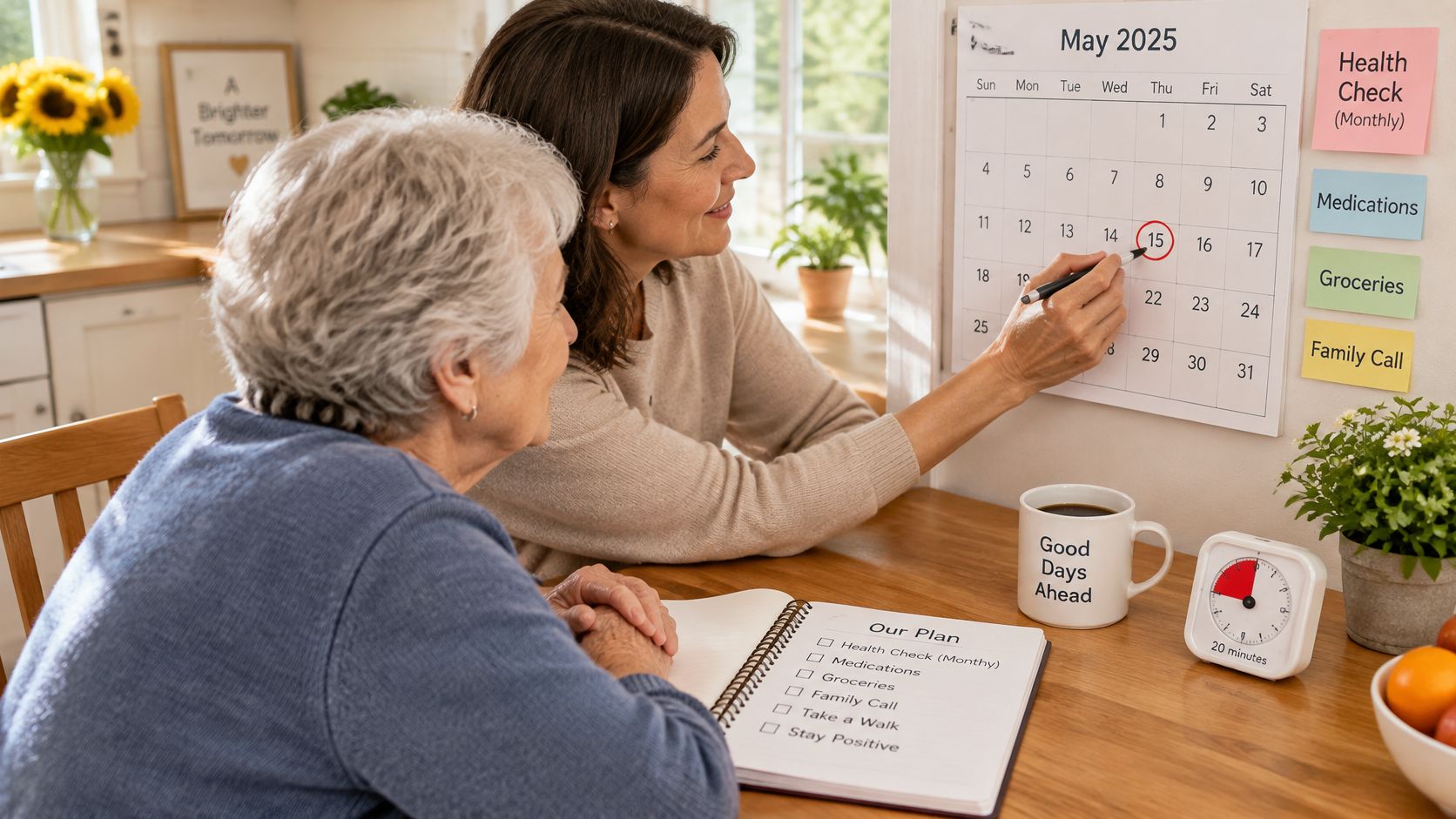
- Pick a day and a 20-minute slot. The first Sunday of the month works because it's memorable. Put it on the same calendar that holds the appointments.
- Invite the person who is part of the plan. Agree in advance who sees the log and who doesn't, so nobody has to negotiate privacy mid-crisis.
- Bring the last four weekly logs and the one-line monthly summary. Four weeks of notes is enough to see a trend and short enough to read in the meeting.
- Name one routine to keep and one to adjust. One of each, no more. The review is a check-in on what's working, not a performance appraisal.
- Check that the follow-up appointments are still booked. A missed appointment is one of the unmet needs the metrics track, and it's the easiest gap to close once you see it.
- Send the summary to your clinician if they've asked for it. A dated one-pager before an appointment saves ten minutes in the room.
Our platform groups this work into three areas, Health Insights, Smart Technology and Connected Care, so a morning medication reminder, a fall alert and a shared family log can live in one place instead of three notebooks and a phone call nobody made.
Keep the tone conversational. The point of the review is to protect independence and stay connected to the people who matter, not to build a file. And when something feels urgent, the chart and emergency services are still the first call, not the agenda.
Rx360 brings health insights, supportive technology and trusted connections into one circle of support, so the daily check, the medication sheet and the family conversation stay in the same place. If someone you love is aging in place and you'd like earlier warning without surveillance, visit Rx360 and set up the log and the support circle together. For medication takers, onboarding help from a representative at our wellness kiosk, or otherwise, is available at no charge.
Lower-Risk Medication Plan Checklist
Below is a practical checklist and step plan you can implement into your daily life:
-
List all medications
Include prescriptions, over-the-counter drugs, supplements, sleep aids, creams, patches, eye drops, and inhalers.
-
Mark fall-risk drugs
Flag medicines that cause dizziness, sleepiness, confusion, blurred vision, low blood pressure, or low blood sugar.
-
Ask for a medication review
Bring the list to a pharmacist or prescriber.
-
Review after any warning sign
Request a new medication check after a fall, near-fall, new prescription, dose change, dizziness, or confusion.