
Almost half of older adults in a large international review were living with poor sleep quality. That is a wide group, not a small club of people who already use the word insomnia. Sleep hygiene for elderly adults is the set of everyday habits around timing, daylight, movement, evening intake, and the bedroom. It is a starting point, not a cure. The pages below stay with what published guidance and reviews report, then add a two-week way to see whether nights changed. Try one change at a time.
Table of Contents
- What Sleep Hygiene Really Covers for Older Adults
- Sleep Hygiene Targets at a Glance
- How to Build a Bedtime Routine That Sticks
- Daylight and Night-Time Setup
- Signs That Call for a Clinician Visit
- Tracking Sleep Changes Over Two Weeks
- Your Next Step This Week
What Sleep Hygiene Really Covers for Older Adults
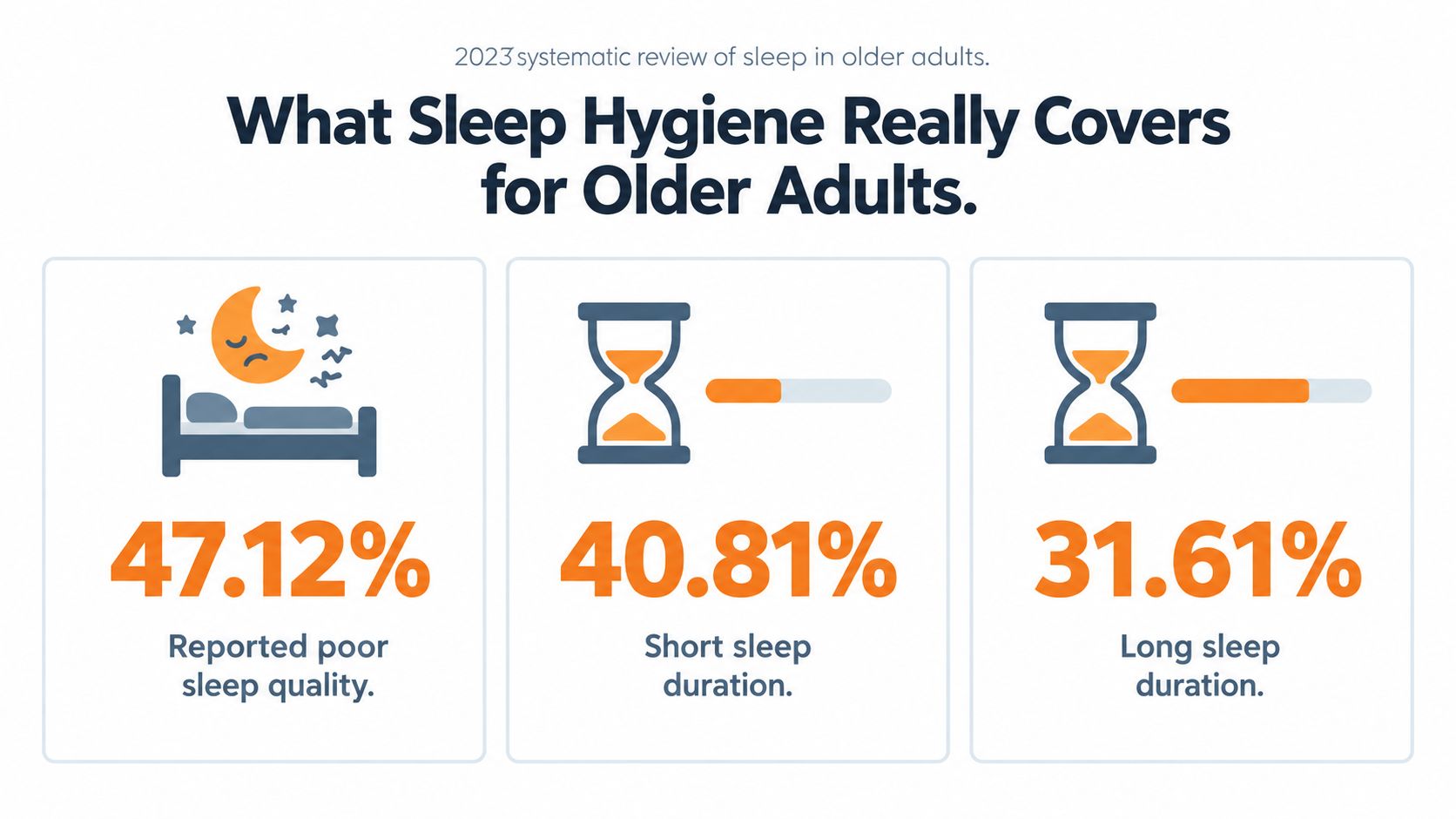
The 2023 systematic review and meta-analysis examined several distinct sleep measures in older adults. It estimated that 47.12% had poor sleep quality, 40.81% had short sleep duration, 31.61% had long sleep duration, and 21.15% had insomnia symptoms. These figures describe different measures, not one shared definition of “sleep problems.” They are pooled estimates, and the studies varied in country, measurement method, and participants. Treat them as a broad map, not a prediction for any one person.
For a U.S. comparison, the 2024 brief by the CDC National Center for Health Statistics reports that 27.2% of adults aged 65 and older averaged fewer than 7 hours of sleep in a 24-hour period. That measure is about sleep duration. It does not tell us whether a person's sleep felt restful or whether they woke during the night.
Sleep hygiene covers everyday patterns around sleep and wake times, activity during the day, evening stimulants, the sleep space, and nighttime disruptions. These habits can be a useful starting point for older adults seeking steadier days, whether or not they have insomnia. They are not a cure for every sleep concern. Try one routine change at a time, then track sleep for two weeks to see whether it helped.
Persistent changes in sleep length, frequent waking, or increased daytime sleepiness are reasons to speak with a clinician. This is especially important when sleep changes affect medication routines, mobility, mood, or daily activities.
Sleep Hygiene Targets at a Glance
The rows below come from CDC guidance on sleep and from National Institute on Aging notes on sleep and older adults. Read the table as a weekly scorecard, not a pass-fail test. Two public sources give slightly different nightly ranges, and both are listed so you can see the overlap.
| Habit | Guideline | Source |
|---|---|---|
| Nightly sleep | 7-8 hours for adults 65 and older | CDC |
| Nightly sleep | 7-9 hours for older adults | NIA |
| Sleep and wake times | Same times every day, including weekends and travel | NIA |
| Exercise timing | Finish regular exercise at least 3 hours before bed | NIA |
| Screens | Turn off electronic devices at least 30 minutes before bed | CDC |
| Caffeine | Avoid in the afternoon or evening | CDC |
| Large meals and alcohol | Avoid before bedtime | CDC and NIA |
| Naps | Avoid naps in the late afternoon or evening | NIA |
| Bedroom | Keep quiet, cool, relaxing, and dark | CDC and NIA |
The NIA frames the schedule as regularity, not one exact bedtime for everyone. A grandparent with a standing morning class, or someone whose work still shifts, can set a wake time that fits that life and then keep it steady. The CDC range sits inside the NIA range for many people. If you already sleep near 7 hours and feel steady in the day, you don't have to chase 9.
Score the week in three marks:
- Hit: You kept the habit on most days.
- Partial: You kept it some days and missed it on others.
- Miss: It rarely happened.
Circle the two or three rows you miss most often. Those rows become the routine in the next part. A long list of new rules is harder to keep than a short one you can actually repeat.
How to Build a Bedtime Routine That Sticks
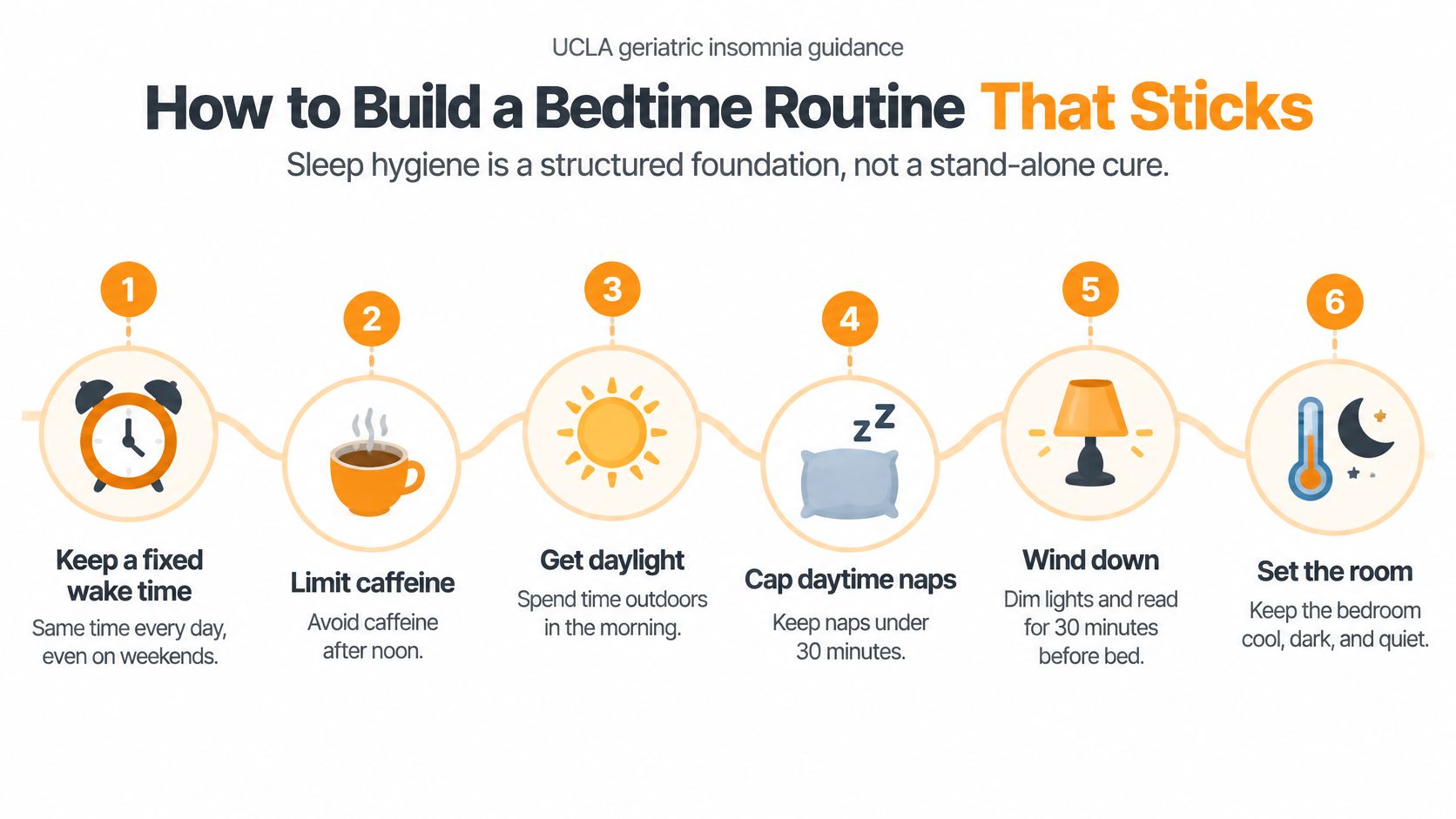
A bedtime routine gives the body familiar cues, but it is a starting point, not a cure for every sleep problem. UCLA geriatric insomnia guidance describes sleep hygiene as one part of care. Education about sleep habits alone may have less effect than cognitive behavioral therapy for insomnia, especially when other health conditions are involved.
Seven steps you can actually repeat
- Choose a wake time that fits your life, then keep it steady on weekends too. Regular timing can help keep your body clock from shifting.
- Give yourself a calm wind-down before bed. Dim the lights, put screens away, and try paper reading or gentle stretching.
- Keep vigorous activity earlier in the day. Regular movement still matters, just avoid placing it close to bedtime.
- Save the bed for sleep. If you stay awake for a long stretch, move to a dim, quiet spot and return when you feel sleepy.
- Keep your usual time in bed after a poor night. Spending extra time awake in bed can make it harder to associate the bed with sleep.
- Set an evening cutoff for caffeine, nicotine, alcohol, and extra fluids. Alcohol may make you drowsy at first, then disrupt sleep later. A heavy late meal can also affect rest; read more about whether eating before bed affects sleep.
- Make nighttime movement safer. Keep a clear path and use a night light that does not require a bright lamp.
A retired teacher who sleeps late on weekends may find it harder to fall asleep at the usual time on Sunday night. Keeping the wake time steady can limit that shift, while bedtime can remain personal.
Try one or two changes first, rather than rebuilding the whole evening at once. Notice whether falling asleep, waking during the night, or feeling rested in the morning changes. Sleep habits are useful clues, not proof that a health problem has been solved.
If insomnia continues, the UCLA guidance describes other approaches, including stimulus control, sleep-restriction or sleep-compression therapy, relaxation, and cognitive restructuring. A clinician should guide sleep restriction or compression when untreated sleep apnea, seizure risk, unstable bipolar illness, severe daytime sleepiness, or fall risk is present. These therapies are not a do-it-yourself way to shorten the night.
Daylight and Night-Time Setup
The bedroom targets for quiet, cool, and dark already sit in the table above, from National Institute on Aging sleep-habit guidance. This part only adds the household pieces a table can't show: daylight, a safe path at night, and when you drink.
Morning light in a real kitchen
Daytime light is part of the body-clock pattern that later-life sleep notes connect with regular schedules. Mei, a retired nurse, used to drink her morning tea at an indoor desk. She moved the same mug to the back porch at 8 am. The tea didn't change. The light did. A window seat works if a porch isn't practical. The point is earlier light, not a perfect sunrise.
A path you can walk half asleep
Night mobility is a setup job, not a willpower job. A plug-in or motion-sensor night light between the bed and the bathroom keeps the path visible without a bright overhead. Glasses and a glass of water can live on the nightstand so you aren't hunting in the dark. Loose rugs get secured or moved, because a clear floor is part of staying independent at home.
One couple swapped a bright bedside lamp for a dim amber one and moved the television out of the bedroom. The room got easier to settle in because the bright cues left with the TV. They didn't buy a new mattress to make that change.
Drinks earlier, notes for later
Evening guidance names excess fluids alongside caffeine and alcohol. Moving most drinks earlier in the day is a routine change, not a fix for every bathroom trip. If waking to use the bathroom is frequent, note the pattern and mention it to a clinician rather than trying to solve it alone.
Which of these changes would take less than ten minutes today? A night light, a rug, or where you sit with morning tea is enough for a first try.
Signs That Call for a Clinician Visit
Sleep complaints are common in later life, but persistent problems may need more than routine changes. A 2018 review of sleep in later life reported that formal insomnia disorder affected approximately 5% to 8% of older adults. Broader complaints, such as difficulty falling or staying asleep, or waking without feeling restored, ranged from 30% to 60%. Sleep habits can support better rest, but they do not address every cause.

The same review found that obstructive sleep apnea, defined as an apnea-hypopnea index of at least 15 events per hour, occurred in roughly 6% to 17% of adults overall and reached as high as 36.5% in older adults. Restless legs, pain, mood, medicines, and other health factors can also disrupt sleep. These patterns do not identify a diagnosis on their own. For background on one related topic, see magnesium and sleep apnea, then discuss concerns with a clinician.
| Observation | Why it matters | Suggested next step |
|---|---|---|
| Loud snoring or witnessed breathing pauses | Sleep apnea is one possible factor identified in research on older adults | Describe the pattern to a clinician soon |
| Repeated urges to move the legs at night | Restless legs may disrupt sleep and is worth mentioning | Note when it happens and how often |
| Daytime sleepiness that affects driving, safety, or mood | Sleepiness can affect falls risk and daily independence | Contact a clinician promptly |
| New or increased sleep medicine, including over-the-counter aids | Sedating medicines can raise the risk of falls and oversedation | Review use with a prescriber or pharmacist before making changes |
| Frequent waking to use the bathroom, or new pain at night | These problems can fragment sleep and may have medical causes | Mention the pattern at a routine check-in |
A routine change is a useful starting point, not a test that rules out a health problem. Ask for professional advice about repeated nighttime movement, loud snoring, witnessed breathing pauses, or substantial daytime fatigue. If someone at home notices these patterns, record what happened and share the details at an appointment.
Tracking Sleep Changes Over Two Weeks
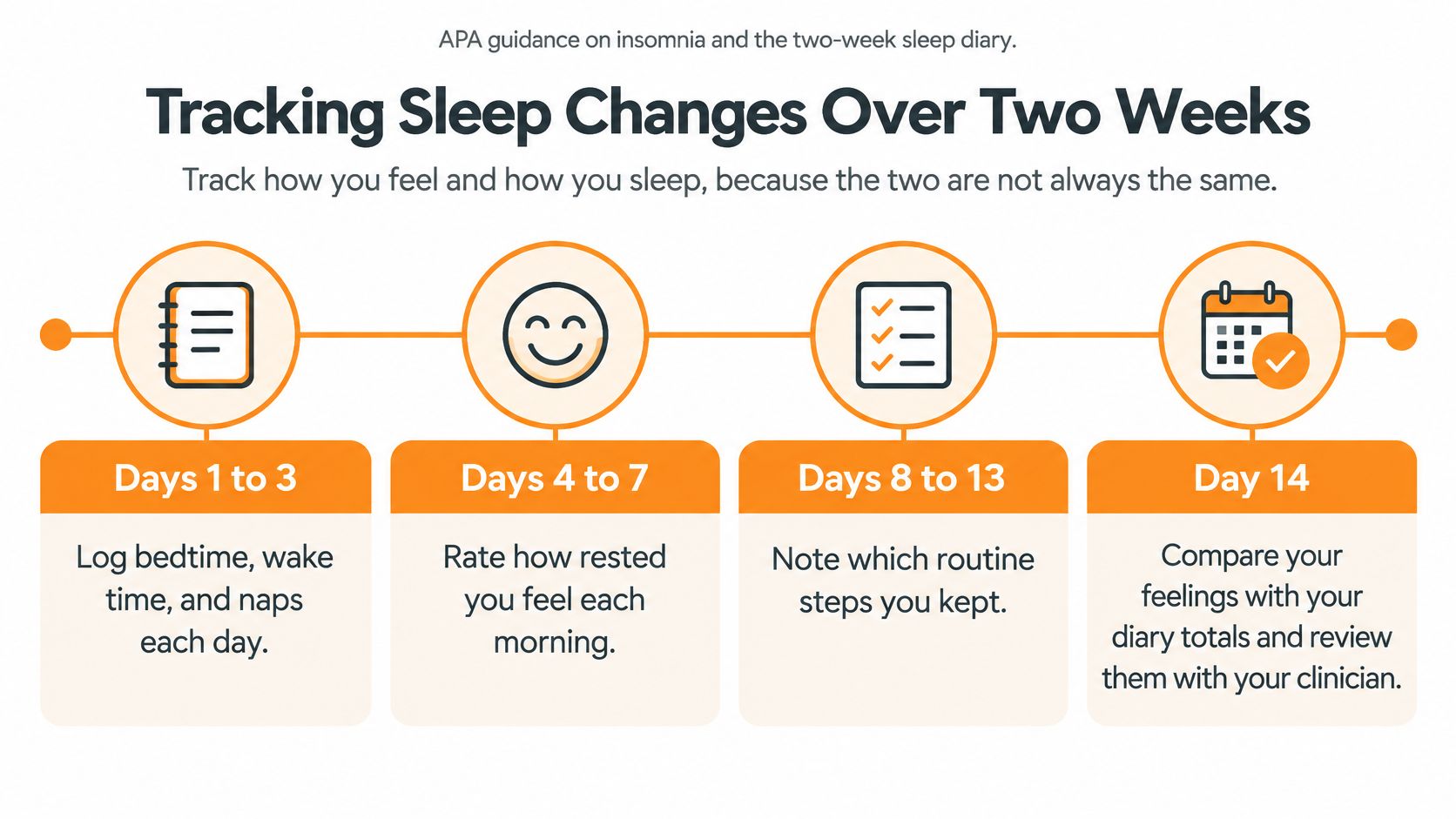
A sleep diary kept for two weeks can show whether a routine change is helping. The APA guidance on insomnia recommends tracking sleep before and during a change. Research on sleep education for older adults is still limited: a 2025 scoping review found 33 eligible studies among 1,452 records. Stronger improvements appeared when education was paired with approaches such as CBT-I, physical activity, music, or light therapy. A diary helps separate how rested you feel from what your sleep schedule shows. It can also make changes in daytime alertness easier to notice.
| Diary field | What to record | Example entry |
|---|---|---|
| Bedtime | The time you got into bed | 10:15 pm |
| Sleep onset | Rough minutes to fall asleep | About 30 minutes |
| Awakenings | How many times you woke and for how long | 2 times, about 10 minutes each |
| Final wake time | The time you got up for good | 6:30 am |
| Out-of-bed time | Time spent up during the night | 15 minutes in the kitchen |
| Naps | Start time and length | 20 minutes at 1 pm |
| Caffeine and alcohol | What you had and when | Coffee at 9 am, one glass of wine at 6 pm |
| Exercise | Type, length, and time of day | 25-minute walk at 10 am |
| Falls or near-falls | Any stumble or slip, even if you caught yourself | None this week |
Sleep efficiency is estimated by dividing total sleep time by time in bed, then multiplying by 100. For example, eight hours in bed with about six hours of sleep equals 75%. Treat the number as a way to spot a pattern, not a pass-or-fail score. If time in bed keeps far exceeding time asleep, discuss the pattern with a clinician. The explanation of what sleep debt means can add context, but it is not a target you need to reach on your own.
Along with sleep times, note whether you met your wake-time target, nap limit, and wind-down routine. Record daytime alertness, unplanned naps, missed activities, nighttime wandering, and any falls or near-falls. These details help show whether a change affected daily life, not just the night. Sleep-hygiene habits are a starting point, not a cure. If sleep remains poor or safety concerns appear, share the diary with a clinician.
Bring the completed diary to an appointment. If a family member helps keep it, agree on what to record and respect the older adult's choices about sharing it.
Your Next Step This Week
Sleep hygiene is a starting point, not a cure. Choose one or two routine changes and try them for two weeks. A short list you can keep is more useful than a long list you abandon.
Start with the habit from the targets table that is hardest to maintain. Set a consistent wake time, including weekends, and make one bedroom change that takes less than ten minutes. Each morning, complete the diary. On day fourteen, review whether you followed the plan, how your sleep changed, and whether daytime alertness or safety concerns shifted.
If sleep remains poor, or a signal from the clinician table appears, arrange a conversation with a clinician and bring the diary. The record can help show what changed and what did not.
Caregivers can help note patterns, with the older adult's consent. Rx360 offers consent-based updates that let people share information with chosen loved ones and care providers while retaining control over what is shared. Small, tracked changes can support steadier days and aging in place.
Rx360 also brings health insights, daily signals, and connected care into one place. Sleep timing, nighttime notes, and consent-based updates can help keep chosen supporters informed without taking over the older adult's routine.
Lower-Risk Medication Plan Checklist
Below is a practical checklist and step plan you can implement into your daily life:
-
List all medications
Include prescriptions, over-the-counter drugs, supplements, sleep aids, creams, patches, eye drops, and inhalers.
-
Mark fall-risk drugs
Flag medicines that cause dizziness, sleepiness, confusion, blurred vision, low blood pressure, or low blood sugar.
-
Ask for a medication review
Bring the list to a pharmacist or prescriber.
-
Review after any warning sign
Request a new medication check after a fall, near-fall, new prescription, dose change, dizziness, or confusion.