
You're clearing the breakfast table when a familiar question comes up: did you take your medicine, or did you only move the bottle beside your cup? Perhaps you're the person wondering, or perhaps you're a loved one trying to check in without making every conversation about medication.
Medication adherence monitoring creates a record that can help make those conversations more concrete. But a refill, a bottle opening, and a swallowed tablet aren't the same event. Understanding that difference makes the numbers easier to read and leaves room for the person's own explanation.
Table of Contents
- Why Medication Adherence Monitoring Matters
- Monitoring Methods Compared at a Glance
- How the Adherence Numbers Are Calculated
- What Research Shows and Where It Stops
- Why a Missed Dose Often Has a Story Behind It
- How to Set Up Alerts Without Overstepping
- Confirm Your Plan Before You Start
Why Medication Adherence Monitoring Matters
The World Health Organization's 2003 report on adherence to long-term therapies reported that rigorous reviews found average adherence among patients with chronic diseases in developed countries was approximately 50%, with generally lower adherence in developing countries. That's a population-level benchmark, not a score for any particular person or medicine.
Medication adherence monitoring means keeping an ongoing record of medication-related activity so a person and their chosen supporters can understand patterns over time. The record might come from a diary, pharmacy transactions, or a connected container. What it means depends on what was recorded.
Say someone has collected a prescription and put the bottle in the kitchen. The refill confirms that medicine was obtained. It doesn't describe what happened at breakfast.
A full fridge isn't a meal
A refill is like a full fridge: it shows that food arrived, not whether anyone ate it. Looking inside later may tell you something about what's left, but it still won't explain every meal.
The WHO also framed adherence as a multidimensional issue, involving patients, healthcare providers, health systems, and treatment design. Forgetfulness is only part of that picture. A monitoring record becomes more understandable when everyday circumstances sit beside the recorded events.
For someone aging in place, the relevant context might include a changing morning routine, time away with friends, or difficulty getting to the pharmacy. These are details of an independent life, not distractions from it.
A useful distinction: Monitoring describes recorded activity. Understanding the person requires a conversation.
Questions that make monitoring understandable
Before considering a monitoring idea, these questions help clarify its scope:
- What does it record? A purchase, a personal confirmation, a container opening, or another event?
- Who sees it? The person alone, selected loved ones, or members of a care team?
- What happens next? A private reminder, a question, or a notification to someone else?
Those answers reveal more than a promise of better tracking. They explain how the technology will fit into daily life and how much control the person will retain.
Monitoring Methods Compared at a Glance
A review of medication-adherence measurement methods distinguishes medication access, medication-taking behavior, and ingestion. These are separate layers, much like buying groceries, preparing dinner, and eating the meal.
Monitoring methods and what each one sees
| Method | What It Records | Main Strength | Main Limit |
|---|---|---|---|
| Self-report (diary or questionnaire) | What the person says they took | Quick, low cost, no device needed | Recall error and social-desirability bias |
| Pill count | Tablets left in the container at a check | Simple, no technology needed | Little detail on timing; leftovers can mislead |
| Pharmacy refill records | When medicine was picked up | Objective record that already exists | Shows access, not whether a dose was taken |
| Electronic monitoring (smart caps, connected dispensers, electronic blister packs) | Timestamped container openings or device events | Adds timing, dose-taking patterns, and missed-dose streaks | An opening is a proxy; it doesn't prove swallowing |
| Digital pills and biosensors | Ingestion or body-signal events | Targets events beyond container access | Device-specific accuracy and practical limits aren't established by the evidence discussed here |
What the familiar methods contribute
Self-report gives the person a voice. A diary or questionnaire can include information that a sensor can't supply, although remembering past activity and wanting to give an acceptable answer can affect responses. A scoping review covering 71 studies identified the five-item Medication Adherence Report Scale, MARS-5, as the most accurate self-report measure within that review.
Pill counts compare what remains with what would be expected. They don't reconstruct the sequence of events: tablets removed together can look similar to tablets removed regularly.
Pharmacy records describe access to supply. They're useful for examining refill continuity, but collecting medicine and using it are different activities.
What connected devices add
Smart caps, connected dispensers, and electronic blister packs attach timestamps to events. That makes it possible to examine sequences rather than relying only on a total at the end of a period.
Still, someone could open a container without removing anything, or remove medicine for later use. A device log needs those exceptions to be understandable. For readers interested in the scheduling side, our explanation of medication timing provides related background.
Digital pills and biosensors address a different measurement layer. Their inclusion in a comparison doesn't establish that every device detects ingestion reliably or suits everyday use; the evidence discussed here doesn't support a device-by-device assessment.
The matching question is straightforward: which stage needs to be understood? A refill question calls for supply records, while a routine question calls for information about daily events. No single method provides the whole story.
How the Adherence Numbers Are Calculated
A guide to selecting medication-adherence measures explains that medication possession ratio can exceed 100%, while proportion of days covered cannot exceed 100% and is the refill-based measure endorsed by the U.S. Centers for Medicare & Medicaid Services. The difference comes from how each calculation handles overlapping supplies.
Adherence metrics and how to read them
| Metric | How It Is Calculated | What It Tells You | Watch For |
|---|---|---|---|
| Medication possession ratio (MPR) | Days' supply from fills and refills divided by days in the period | Overall supply obtained across the period | Early refills can create overlapping supply |
| Proportion of days covered (PDC) | Covered days, counting overlap once, divided by days in the period | Share of days with medicine available | A coverage measure, not a record of ingestion |
| Dose-taking compliance (event data) | For a window-based measure, recorded openings inside the prescribed window divided by prescribed doses | How recorded events align with the schedule | The event-matching rule must be stated |
| Dosing-time variability | Spread between scheduled times and recorded times | Consistency of recorded timing | The number alone doesn't establish the significance of a timing change |
| Missed-dose streak | Longest run of consecutive doses without qualifying recorded events | Clusters of gaps in the record | Exceptions and missing device data need context |
Why early refills change the result
MPR adds up the supply obtained through fills and refills, then divides it by the length of the selected period. Think of it as counting all the supply brought home during that interval.
For a hypothetical example, someone obtains a 30-day supply and refills it before the previous supply would run out. The overlapping tablets increase the amount obtained, even though the calendar hasn't gained extra days. That explains how MPR can rise above the full period of use.
PDC asks a different question: on which days was supply available? Each calendar day counts only once, even when an early refill leaves extra tablets on hand. It's closer to marking covered squares on a calendar than adding everything in the cupboard.
Neither calculation establishes what someone swallowed. They describe supply through different counting rules.
Reading event-based measures
Electronic-event metrics shift attention from supply to the sequence of recorded activity. A dose-taking measure requires a definition of a qualifying event, including how the software matches openings to scheduled doses.
Dosing-time variability summarizes how recorded times are spread around the schedule. A missed-dose streak identifies a run of scheduled doses without matching events. Neither label explains whether someone was traveling, using another container, or following an updated schedule that hadn't reached the software.
A dashboard percentage is the result of a counting rule. Understanding the rule is part of understanding the percentage.
These reading habits help keep comparisons consistent:
- Choose the period first. Identify the dates included before interpreting the result.
- Compare like with like. Use equivalent periods and unchanged definitions when comparing months.
- Treat a gap as a question. Look for context before assigning meaning to an absent event.
A number describes a pattern in records. It isn't a verdict on the person whose name appears beside it.
What Research Shows and Where It Stops
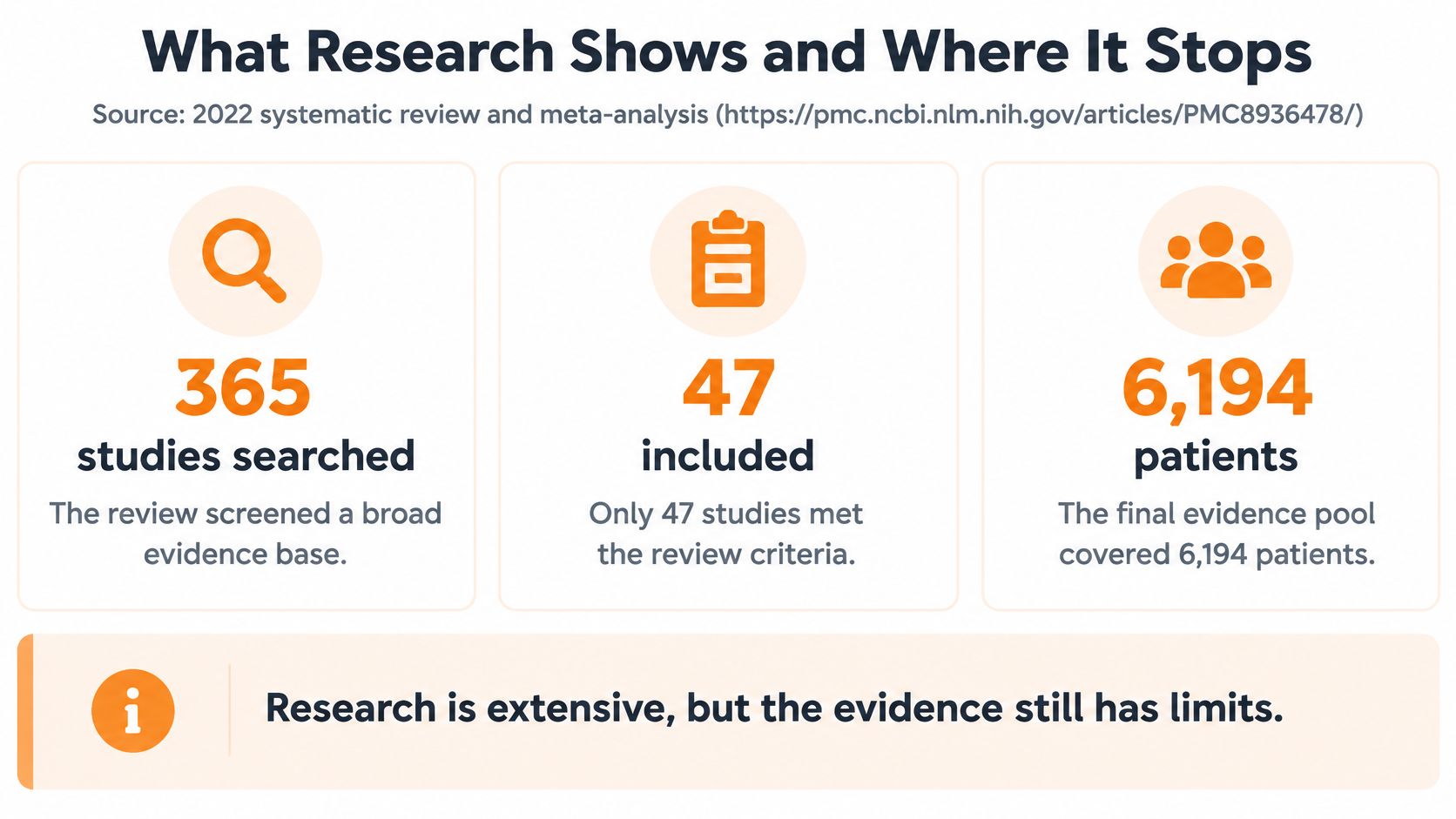
Source: The 2022 systematic review and meta-analysis of electronic adherence monitoring searched 365 studies and included 47 studies involving 6,194 patients; adherence outcomes were available from 27 studies with 2,584 participants, and the pooled standardized mean difference favored monitoring at 0.93, with a 95% confidence interval of 0.69 to 1.17.
Those figures describe a substantial evidence base, but the narrower adherence-outcome group matters. Not every participant in the full review contributed to the pooled adherence calculation.
Improvement isn't the same as a universal result
A standardized mean difference allows researchers to combine outcomes measured on different scales. It isn't a percentage-point increase, and it doesn't mean every participant improved by the same amount.
The pooled result supports electronic-monitoring interventions as a way to improve measured adherence across the conditions studied. It doesn't isolate the device from everything delivered alongside it. Programs can include reminders, feedback, education, and follow-up, so recording events and helping someone respond are not interchangeable activities.
Where confidence becomes more limited
A 2025 systematic review of mobile apps for chronic kidney disease found 9 eligible studies from 231 relevant articles, with low-certainty evidence and short interventions. Questions about usability, provider costs, security, and the ideal combination of features remained unresolved.
That review concerns a particular condition and type of technology. It doesn't erase the broader electronic-monitoring findings, but it illustrates why a promising adherence result isn't proof of durable benefit for every group of older adults.
- Different measures complicate comparisons. Questionnaires, refill records, and electronic events capture different aspects of adherence.
- Short interventions leave long-term questions. An improvement during a study doesn't establish that it will continue.
- Health outcomes require separate evidence. Better recorded adherence doesn't, by itself, demonstrate fewer hospital stays or less medication-related harm.
There isn't a single accepted measurement standard that makes all adherence results interchangeable. The strongest reading is therefore specific: monitoring-based interventions have evidence for improving adherence, while proof of sustained health outcomes for older adults remains incomplete.
The records can support a conversation. They shouldn't be treated as a final score on wellness, independence, or the quality of someone's daily life.
Why a Missed Dose Often Has a Story Behind It
Say it's Tuesday evening, a bottle still looks full, and the reason has nothing to do with forgetting. A review examining gaps across the medication journey describes how digital interventions concentrate on daily routines while prescription, pickup, storage, and refill stages remain understudied.
Perhaps the person couldn't arrange transportation. Perhaps the packaging was difficult to open, or the instructions didn't make sense. A record of absent activity doesn't choose among those explanations.

The journey has more than a daily checkpoint
Looking across the journey makes the possible barriers more visible:
- Prescription. Instructions or medication changes may be unclear to the person receiving them.
- Pickup. Cost, transportation, pharmacy access, or opening hours can interrupt collection.
- Storage. Container design and dexterity limitations can affect access at home.
- Daily routine. Confusing labels, unwanted effects, or a deliberate informed choice may explain nonuse.
- Refill. A gap can begin before the next bottle reaches the kitchen.
These are different situations, even when software displays the same missed-event label. Another reminder doesn't explain a transport problem, and a louder alert doesn't make a cap easier to open.
Context changes the conversation
Objective records can identify a missing event without explaining why it is missing. Even a confirmed omission doesn't tell the observer whether the barrier involved access, understanding, physical difficulty, or a personal decision.
A small amount of context can make the record more informative: a refill delay, an updated medication list, time away from home, or the person's own explanation. That information doesn't need to become a detailed account of every movement.
Person-centered interpretation: A missed event is a clue to investigate, not evidence of a character flaw.
More alerts aren't automatically more useful. False alarms and punitive messages can undermine trust, particularly when an informed decision is treated as disobedience.
A respectful monitoring conversation asks what got in the way. It also leaves room for the person to explain their choices without having to defend their independence.
How to Set Up Alerts Without Overstepping
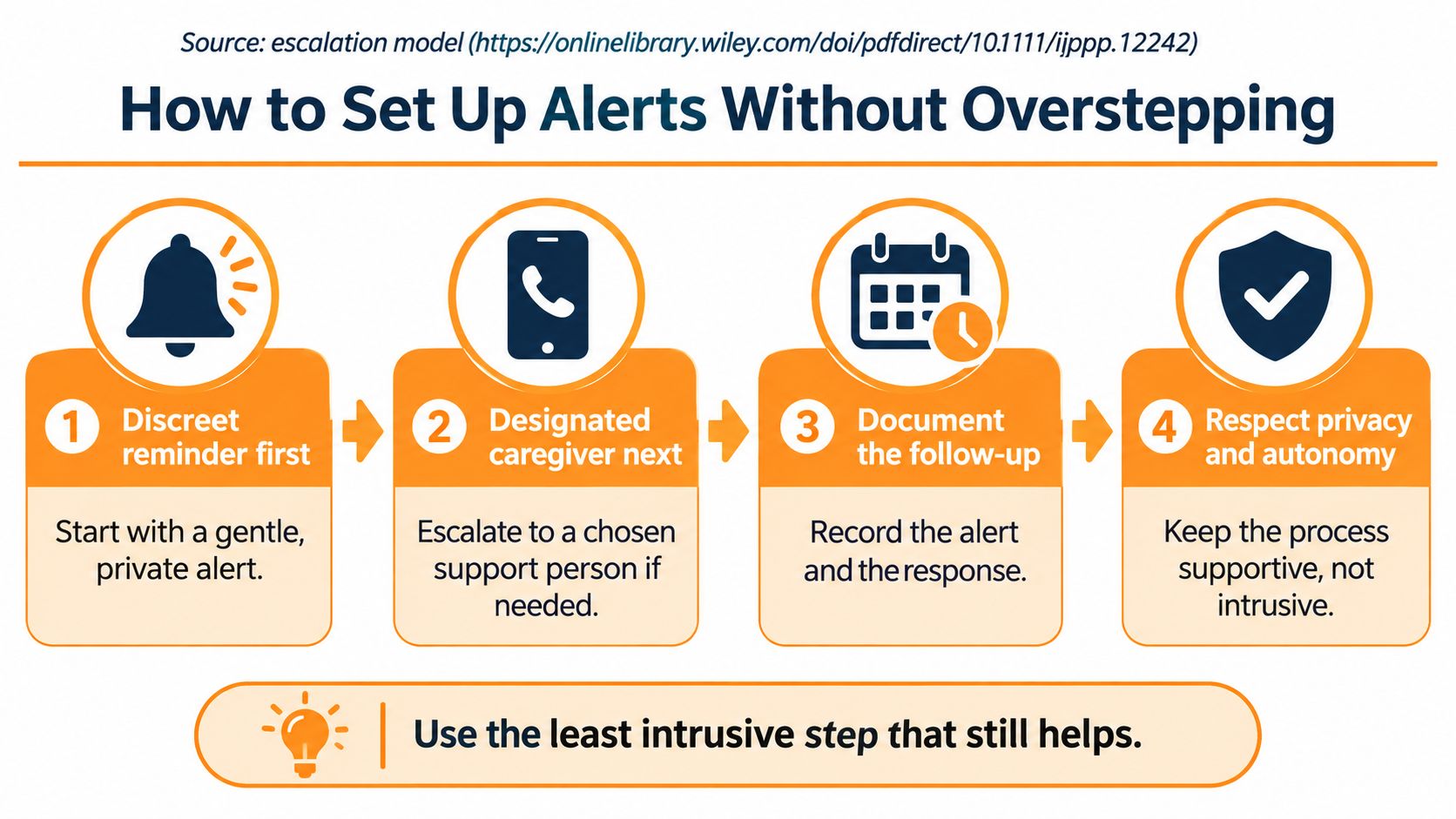
A systematic review of electronic multi-compartment medication devices found an intervention with significantly greater adherence, reporting an odds ratio of 3.78, a 95% confidence interval of 1.62–7.26, and P=0.001, while warning that study limitations prevented firm conclusions about long-term benefit. A tiered escalation model translates the emphasis on actionable feedback into a practical workflow, rather than a guarantee of results.
The idea is to start privately, involve a chosen supporter only under an agreed rule, and route recurring patterns for human review. An odds ratio isn't a percentage-point improvement, and it doesn't establish that any particular alert sequence will produce the same result.
An example of agreed escalation
Escalation tiers and who sees what
| Tier | Trigger | Who Is Notified |
|---|---|---|
| 1 | A single missed dose | The person, through a discreet reminder and confirmation tap |
| 2 | A missed-dose rule agreed in advance | A designated caregiver, and only if the person opts in |
| 3 | Repeated misses that form a pattern | A care coordinator or clinician for review |
This is an organizational example, not a medication-specific response plan. Notification thresholds differ by medication and regimen; a single late event and repeated omissions of a higher-risk therapy aren't equivalent situations.
A setup workflow that keeps choices visible
Agree on the monitoring scope with the person. Identify which existing scheduled doses will be included and which alerts they want to receive. This defines the technology's role without changing medication instructions.
Set a discreet reminder and an understandable confirmation tap. Our guide to good alarm sounds discusses the sound-selection side of reminders.
Write the sharing rule before enabling it. Specify which missing-event condition will notify a designated caregiver, rather than leaving the person to discover the rule through unexpected messages.
Route repeated patterns to the agreed care coordinator or clinician for review. Recording who received the alert and whether anyone responded keeps responsibilities visible.
Revisit the settings with the person every few months. This is a suggested review cadence for preferences and usability, not a clinical threshold. Routines and chosen support arrangements can change.
Privacy and ease-of-use checks
For Rx360, these responsibilities and data arrangements apply:
- Medication accuracy. Users are solely responsible for verifying their Customer Data and must compare medication information against official prescription labels from their pharmacy.
- Sharing choice. If a medication taker opts in to our Support Circle Sharing, their Customer Data is shared with designated caregivers and/or loved ones.
- Kiosk onboarding. We manage Customer Data collected from medication takers onboarded through our wellness kiosk, and it isn't shared with the host pharmacy. The pharmacy isn't a provider of the Pilot Services and has no access unless the customer separately provided the same information to it.
Practical usability checks are separate from those policies:
- Readable display. Check that the person can comfortably read the text.
- Simple interaction. Use few taps and one main device where the setup allows.
- A test run. Let the person try the reminder, confirmation, and sharing sequence before relying on it.
The aim is an understandable process with named responsibilities, not an expanding chain of notifications.
Confirm Your Plan Before You Start
Monitoring is easier to interpret when the record, the response, and the person's choices line up. For privacy rights requests involving Rx360, our contact page provides a direct route to submit them.
A written starting plan can stay brief. It needs to describe the question being asked and what people have agreed to do with the answer.
A starting plan to discuss together
- Name the stage you want to understand. Is the question about pickup, storage, or the daily routine?
- Choose a method that records that stage. A storage question, for example, won't be answered merely by a refill transaction.
- Name the metric. Use a supply measure for refill coverage or an event-based measure for recorded timing, with its definition written down.
- Record who receives which alert and under what condition.
- Review the records together each month. Treat this as a suggested learning routine, adjusting preferences and documenting exceptions rather than changing medication instructions.
Keep the boundaries clear
Participation in our pilot is voluntary. Our SMS notifications are not a life-safety or emergency notification system, and they don't replace emergency services or caregiver supervision.
Our platform is organized into Health Insights, Smart Technology, and Connected Care. A practical question to bring to onboarding is how reminders, sharing choices, and escalation responsibilities fit across those areas.
For families discussing involvement, our guide to connected care for families offers related background. The decision about participation and sharing remains with the person.
Start with a manageable scope, keep the person involved, and treat the first month as a learning period. The useful result is a record everyone understands, with space for explanations that a dashboard can't supply.
Our Pilot Services include Medication Dashboards, Medication Reminders, and optional Support Circle Sharing for designated caregivers and loved ones. Visit Rx360 to explore how these tools fit into an approach to medication adherence monitoring that keeps independence and connection in view.
Lower-Risk Medication Plan Checklist
Below is a practical checklist and step plan you can implement into your daily life:
-
List all medications
Include prescriptions, over-the-counter drugs, supplements, sleep aids, creams, patches, eye drops, and inhalers.
-
Mark fall-risk drugs
Flag medicines that cause dizziness, sleepiness, confusion, blurred vision, low blood pressure, or low blood sugar.
-
Ask for a medication review
Bring the list to a pharmacist or prescriber.
-
Review after any warning sign
Request a new medication check after a fall, near-fall, new prescription, dose change, dizziness, or confusion.