
Aging in place means remaining in your own home and community safely, independently, and comfortably as age, income, or ability changes. In 2024, 95% of surveyed U.S. adults wanted to age in place, while 44% of adults aged 50 and older expected to move at some point. (The John A. Hartford Foundation survey; AARP's 2024 Home and Community Preferences Survey)
But what happens when someone's home feels right, yet getting around the neighborhood or reaching the support they need becomes harder? Aging in place isn't just about staying put. It's about keeping a workable support system around you as life changes, so familiar routines and connections can continue with the right adjustments.
Table of Contents
- What Aging in Place Means and Why It Matters
- Five Areas That Keep Independence Going
- Daily Habits That Support Independence
- Home Changes and Safety Checks
- Technology, Privacy and Care Coordination
- Benefits, Challenges and Real-World Examples
- Common Questions About Aging in Place
- Start Your Aging in Place Plan This Week
What Aging in Place Means and Why It Matters
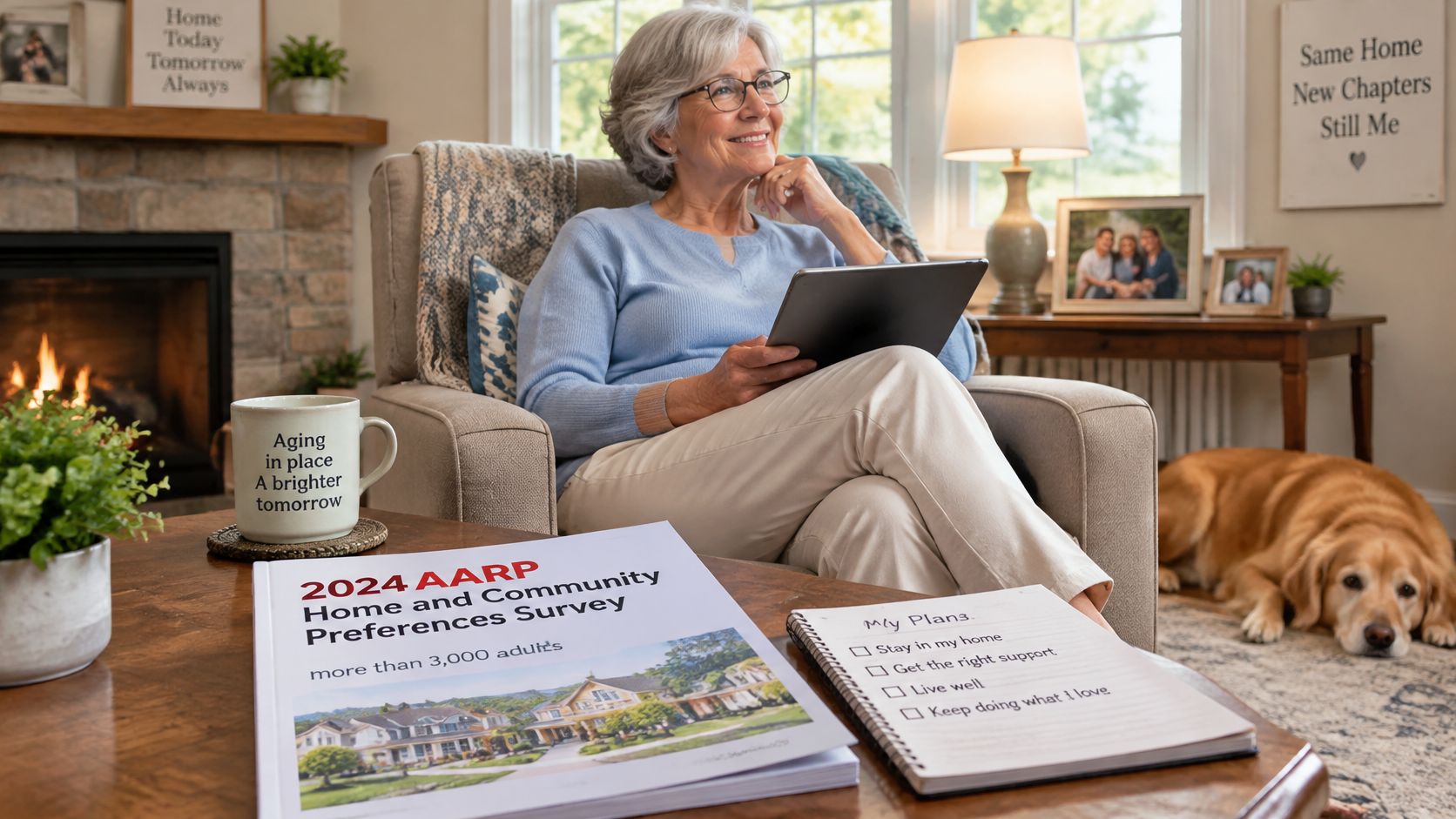
The 2024 AARP Home and Community Preferences Survey of more than 3,000 adults found that 75% of adults aged 50 and older wanted to remain in their current homes, and 73% wanted to stay in their current communities. Those preferences make sense: home can hold daily routines, familiar surroundings, and connections with neighbors and family. But wanting to stay and being able to stay aren't the same thing.
Think of your home like a favorite jacket. If it can be adjusted as your needs change, it may keep fitting comfortably. If it can't, even a place you love can start to feel like something you've outgrown. Housing, neighborhood access, services, transportation, healthcare access, and support systems all play a part in whether staying home remains a practical choice.
Consider three parts of the definition. Safe means everyday surroundings don't keep catching you off guard, such as an entryway that's hard to move through in poor lighting. Independent means managing daily routines on your own terms, with help available when you choose or need it. Comfortable means the place still feels like yours, not like a space that has been reshaped around someone else's preferences.
The desire to stay is widespread, but people also see obstacles. The John A. Hartford Foundation survey included 5,023 adults, including 2,516 people aged 65 and older, and found that 95% of surveyed U.S. adults wanted to age in place in 2024. AARP's survey found that 44% of adults aged 50 and older expected to move at some point. Those figures point to a gap between the home people hope to keep and the circumstances they may face.
A separate 2024 U.S. News survey found that 50% of respondents said their homes were completely or somewhat ready to support them as they aged, down from 59% in 2023. (U.S. News survey report)
| Aging in place survey figures | Year | Figure |
|---|---|---|
| Surveyed U.S. adults who wanted to age in place, John A. Hartford Foundation | 2024 | 95% |
| Adults 50 and older who wanted to remain in their current homes, AARP | 2024 | 75% |
| Adults 50 and older who wanted to stay in their current communities, AARP | 2024 | 73% |
| Adults 50 and older who expected to move at some point, AARP | 2024 | 44% |
| Respondents whose homes were completely or somewhat ready to support them, U.S. News | 2024 | 50%, down from 59% in 2023 |
A simple starting point is to ask yourself: Can I get in and out easily? Can I reach help quickly? Do the people and services I rely on still reach me here? The answers don't have to be perfect. They can help you spot what would make your home and community work better for you.
Five Areas That Keep Independence Going
The World Health Organization frames healthy aging around functional ability, or what a person can do in daily life, rather than age alone. That ability reflects both a person's capacities and the surroundings they live in, including the home, community, relationships, policies, and support services. (WHO's healthy-aging framework)
The WHO identifies five areas that support functional ability:
- Meeting basic needs: Having a comfortable place to sleep and a way to get everyday essentials.
- Learning, growing, and making decisions: Choosing a weekly class or hobby that keeps curiosity in the routine.
- Being mobile: Using a level entryway or an accessible route to make getting around easier.
- Building and maintaining relationships: Keeping in touch through a regular call or a shared activity.
- Contributing to society: Taking part in a neighborhood group or choosing a volunteer shift that feels meaningful.
These areas overlap in ordinary ways. A well-lit hallway can make it easier to move around at home. A nearby bus stop can make it easier to reach a class, see a friend, or run an errand. The environment doesn't have to do everything; small changes can help people use the abilities and connections they already have.
The WHO report says 81.0% of older adults had high or sufficient functional ability, while 4% had a significant loss of functional ability in its referenced analysis. Those measures underline why a person's circumstances matter alongside personal capacity. A supportive setting can preserve options, while barriers can make ordinary tasks harder.
Try this self-check: Which of the five areas feels strongest for you right now, and which one could use a small boost?
Daily Habits That Support Independence
The National Institute on Aging says older adults generally need seven to nine hours of sleep, the same as other adults, although many don't get enough. It also summarizes a study of nearly 8,000 people in which adults in their 50s and 60s who reported sleeping six hours or less per night had a higher later risk of developing dementia. These are findings about sleep duration, not a prescription for a particular routine. (National Institute on Aging information about healthy aging)
Everyday movement can fit into routines without turning the day into a training plan. A short walk, gentle strength work, or an activity that challenges balance may be easier to stick with when it's enjoyable and built into the week. A regular phone call, a coffee with a neighbor, or a group class can also give social connection a place on the calendar.
If you like tracking routines, a daily habit tracker can help you notice what you're doing and what feels manageable. Keep the list simple:
- Keep a familiar rhythm: Aim for similar wake and sleep times.
- Move a little: Get outside or spend a few minutes moving.
- Connect with someone: Send a message, make a call, or say hello in person.
- Notice what's working: Write down one thing that felt easier this week.
The point is to find habits that fit your life, not to turn wellness into another chore. Which one feels easiest to start this week?
Home Changes and Safety Checks
AARP's 2024 Home and Community Preferences Survey found that 43% of adults aged 50 and older expected to modify their homes to accommodate future physical needs. Among those anticipating changes, 72% planned bathroom updates, 71% planned entryway or interior-access improvements, and 39% planned kitchen upgrades. The table shows how those plans break down.
| Home changes adults expect to make | Share expecting this change | Examples named in the research |
|---|---|---|
| Bathroom | 72% of those expecting modifications | Grab bars, slip-resistant flooring |
| Entryway or interior access | 71% of those expecting modifications | Entry steps, railings, doorway clearance |
| Kitchen | 39% of those expecting modifications | Easier-to-reach storage, kitchen upgrades |
| Any home modification | 43% of adults 50 and older | Overall expectation across all areas |
A room-by-room walk-through works like a pre-flight check. You move through the house in the order you use it, noting each spot where you pause, reach awkwardly, or feel less sure of your footing. No renovation decisions yet. The goal is a short list of places that deserve attention, written plainly enough to share with family or a contractor later.
- Check the lighting: Walk the stairs, hallways, and the path from bedroom to bathroom after dark. Mark any stretch that feels dim.
- Look around the bathroom: Note where grab bars might help and whether the floor gets slippery when wet.
- Review doorways and floor space: See whether furniture narrows your walking routes and whether each door passes easily.
- Inspect entry steps and railings: Ask whether the main entrance feels straightforward while carrying groceries.
- Check kitchen storage: Identify shelves that put everyday items out of comfortable reach.
For a more structured pass through the same rooms, fall-risk assessment tools can sort your observations into categories you can act on one at a time.
A small first step: Pick one room this week, walk it slowly, and write down one change worth considering.
Technology, Privacy and Care Coordination
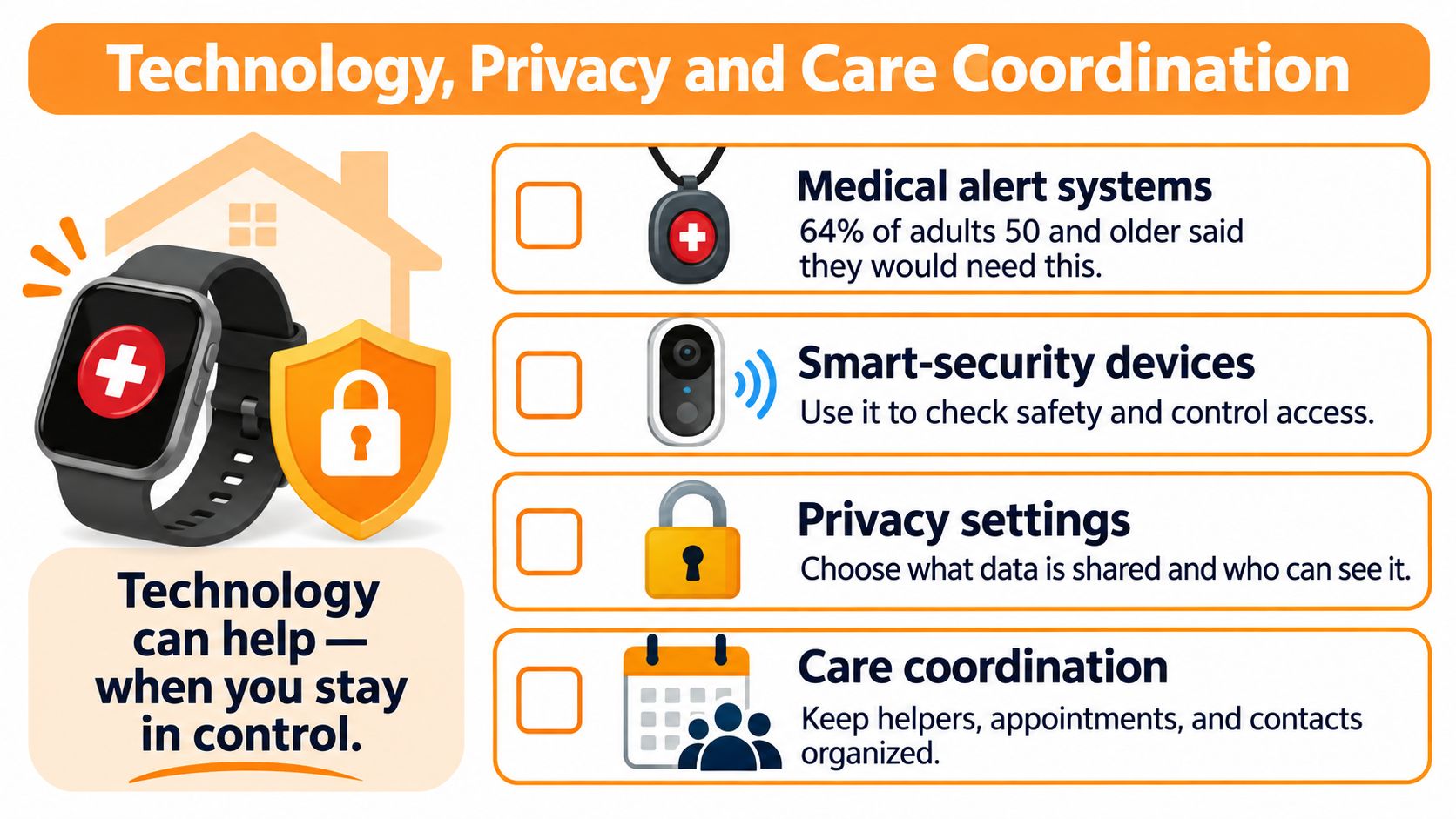
AARP's 2024 survey found that 64% of adults aged 50 and older said they would need a medical alert system to live safely and independently, while 44% said they would need smart-security features. Technology can help people stay connected to support, but it works best when the person using it has a clear say in what it does and who receives information. (AARP's 2024 report on aging-in-place policies and communities)
Privacy concerns, the learning involved, and fear of becoming dependent on a tool can all slow adoption, even when people value reminders and caregiving support. Before adding a device or service, consider these questions:
- Who sees my data, and can I change that?
- Who receives alerts, and in what order?
- Is there a human review step?
- What happens if the device fails or the power goes out?
- Can I turn features on and off?
Then make the human side of the plan clear. Keep an updated contact list that names the people you want involved, agree on when someone should be contacted, and write down the services you use. If you're organizing those connections, a guide to connected care for families can help you think through how information and support fit together.
An alert should have a useful purpose, such as prompting a trusted person to check in. Constant notifications can become noise, so agree on which changes matter and who should respond. The aim is timely, proportionate support, not a sense of being watched.
Benefits, Challenges and Real-World Examples
A familiar home works a bit like a well-worn pair of shoes: it fits your routines without you having to think about it. The AARP survey and the WHO healthy-aging framework point to a similar balance. Familiar surroundings and habits support autonomy, while the conditions around a home decide whether daily life runs smoothly or picks up friction. A neighbor who knows your usual routine, a kitchen laid out the way you like it, or a community space you enjoy can all keep you connected to everyday life. The test is whether the support system around those routines can adjust when needs or circumstances change.
Money shapes that test too. Older adults who consider relocating often point to rent or mortgage payments, home maintenance, and property taxes as the expenses weighing most heavily on the decision. Staying put can ease some of those pressures, though it brings its own bills in the form of upkeep, modifications, and repairs that a fixed income has to absorb.
Technology adds a different kind of trade-off. Privacy concerns, the effort of learning a new tool, and worry about becoming dependent on it can all slow adoption, even when people value reminders, household assistance, and caregiving support. A device that feels confusing or intrusive often ends up in a drawer, however useful its features sound on paper.
| Area | Possible benefit | Possible challenge |
|---|---|---|
| Home design | Familiar routines in a space that can be adapted | Modifications and maintenance can require planning |
| Community | Neighbors and familiar places can support connection | Services or transportation may not reach every household |
| Technology | A medical alert system may offer a way to connect with help | Privacy settings and learning demands can affect comfort |
One person weighing home changes might plan bathroom grab bars or slip-resistant flooring, updates that came up in AARP's survey. Another might weigh a medical alert system against privacy concerns, asking who receives information and how the device works before choosing whether to use it. Neither path is universal. A workable plan starts with the person's own preferences and then fits the practical details around them, the same way you adjust a recipe to the cook rather than asking the cook to adjust to the recipe.
Common Questions About Aging in Place
Is aging in place the same as never moving?
The WHO framework describes healthy aging through functional ability and the interaction between a person and their surroundings. Aging in place means being able to remain safely and comfortably in a home and community as needs change, not making a promise never to move.
Do people want to age in place?
The John A. Hartford Foundation's 2024 survey found that 95% of surveyed U.S. adults wanted to age in place. AARP's 2024 survey found that 75% of adults aged 50 and older wanted to remain in their current homes. Those figures show strong interest, while individual plans can differ.
What does healthy aging mean to the WHO?
The WHO identifies meeting basic needs, learning and making decisions, mobility, relationships, and contributing to society as areas of functional ability. Its referenced analysis found 81.0% of older adults had high or sufficient functional ability.
How much sleep do older adults need?
The National Institute on Aging says older adults generally need seven to nine hours of sleep, the same as other adults.
Should technology replace human contact?
No single answer fits everyone. Technology may help coordinate support, but privacy and learning concerns can make some tools feel less suitable. Human connection remains an important part of a support system.
Start Your Aging in Place Plan This Week
A useful plan doesn't need to cover every possible future situation at once. Start with what you can notice and organize now, then revisit it as your home, routines, and support network change.
- Walk through your home: Use the room-by-room checklist above and write down two changes you'd like to explore.
- List your contacts and options: Note the people, services, and transportation choices you'd use in an everyday situation and an urgent one.
- Choose one daily habit: Pick a routine from the list and try it for two weeks. Notice whether it feels realistic and useful.
Rx360 is a modern wellness platform for independent older adults, designed to support active, independent living. Its Family Connection feature keeps loved ones close when they're far away. You can compare Rx360 with other tools and services by considering how well each option fits your preferences, privacy needs, and existing support.
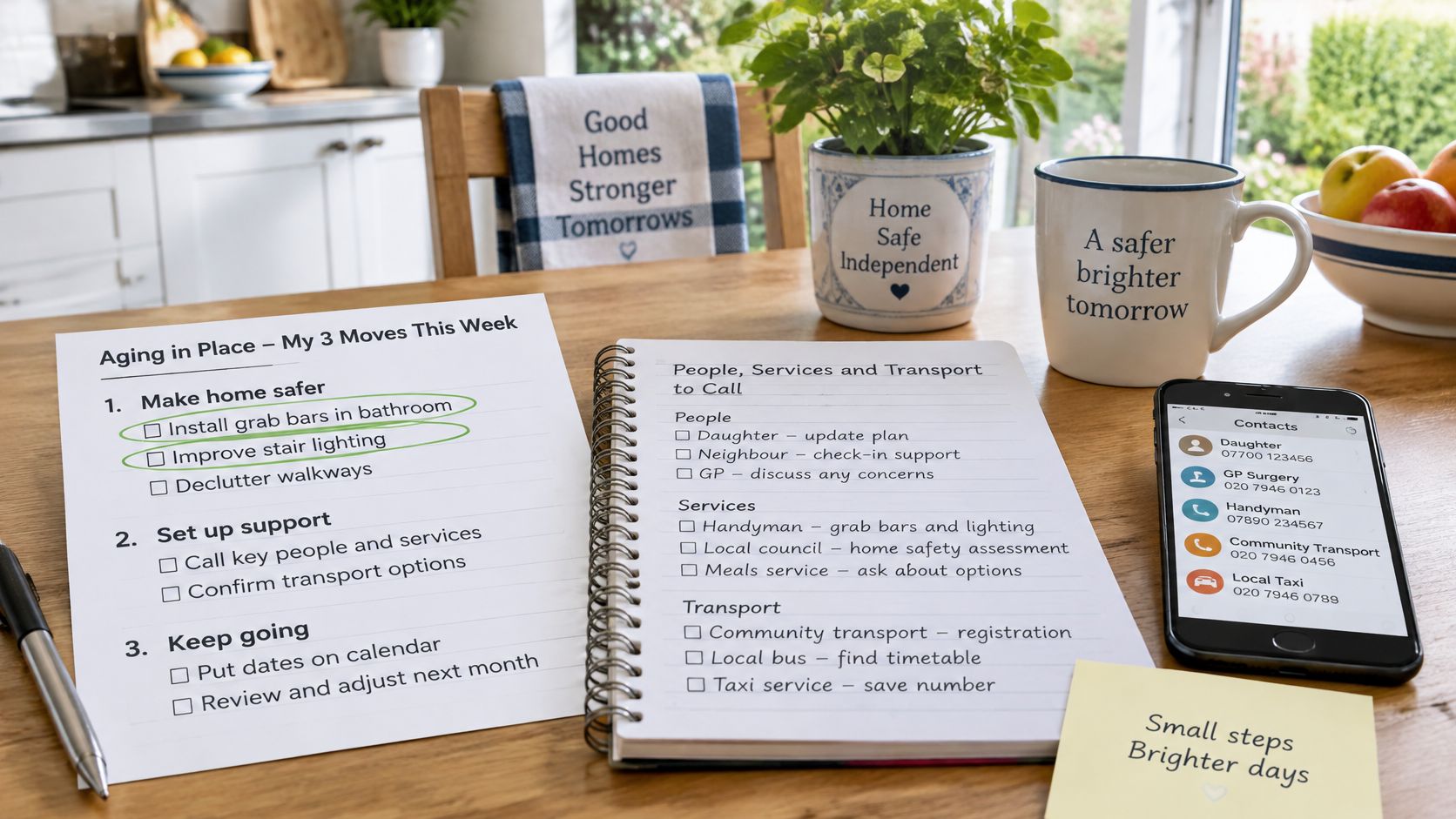
A yearly review can help keep your plan useful as life changes. Check whether the home still feels easy to use, whether your contacts and services are current, and whether your routines still fit.
Rx360 brings together health insights, supportive technology, and trusted connections to support active, independent living. Its Family Connection feature helps keep loved ones close when they're far away. Visit Rx360 to see whether it fits the way you want to stay connected while aging in place.
Lower-Risk Medication Plan Checklist
Below is a practical checklist and step plan you can implement into your daily life:
-
List all medications
Include prescriptions, over-the-counter drugs, supplements, sleep aids, creams, patches, eye drops, and inhalers.
-
Mark fall-risk drugs
Flag medicines that cause dizziness, sleepiness, confusion, blurred vision, low blood pressure, or low blood sugar.
-
Ask for a medication review
Bring the list to a pharmacist or prescriber.
-
Review after any warning sign
Request a new medication check after a fall, near-fall, new prescription, dose change, dizziness, or confusion.