
You're standing in the kitchen with a discharge packet in one hand and your phone in the other. A nurse is due sometime this week, the pharmacy has a question, and your parent just wants to get back to a normal morning routine. Nobody's doing anything wrong. The pieces just aren't moving together yet.
That's the everyday problem home health care coordination is meant to solve. It's not about adding more people or more apps. It's about giving each handoff a named owner and a deadline, so information doesn't drift while everyone assumes someone else has it.
Table of Contents
- What Home Health Care Coordination Really Means
- Who Does What on a Home Care Team
- How a Care Handoff Moves From Hospital to Home
- Where Handoffs Break Down and How to Spot Them
- Metrics and Benefits That Show Coordination Is Working
- Privacy, Consent and Rules Worth Knowing
- Checklists, Templates and One Step This Week
What Home Health Care Coordination Really Means
This section draws on USAging's 2025 AAA National Survey and a 2025 review on aging in place, which named inadequate affordable services and shortages of trained personnel as major barriers and noted that family caregivers provide most long-term support for U.S. older adults with functional or cognitive impairments, as summarized by Johns Hopkins Bloomberg School of Public Health.
Say an older adult comes home after a hospital stay. A family member knows the daily routines, a home health nurse holds the visit plan, the primary care office has the longer history, and the pharmacy has the current medication list. Each person holds one true piece. Coordination is the work of linking those pieces so appointments, updates and services move together.

Think of an orchestra conductor. The conductor doesn't play every instrument. The conductor keeps timing, cues each section, and makes sure everyone is working from the same music. Home care works in a similar way, even when there's no single conductor and the family shares that role.
The Three Parts to Keep Straight
- People: Who is involved, and who owns each task?
- Information: What does each person need to know, in plain language?
- Timing: When does the next step happen, and how will everyone know it happened?
Coordination also reaches beyond visits. Meals, transport, benefits help and housing repairs often decide whether a home routine is workable day to day. Community organizations are part of that picture, and in 2024, 38% of U.S. Area Agencies on Aging provided care-transition services, according to that USAging survey.
For many older adults, the goal is simple and positive. They want to age in place, keep their independence, sleep in their own bed, move safely around the home, and stay connected with people they enjoy. Coordination supports those goals when the home, the people and the services are working from one shared plan.
Who Does What on a Home Care Team
When an older adult's needs change, several people may have a part to play. Coordination works best when each handoff has a named owner: who notices the change, who passes it on, and when the next person should respond.
The 2025 AARP national caregiving report found that 70% of caregivers monitored the care recipient's health conditions, 64% communicated with healthcare providers, and 58% advocated with providers, community services, or government agencies. The same report found only 58% considered coordinating care with healthcare professionals easy, meaning roughly two in five found it difficult.
Those tasks often overlap. A family caregiver might track appointments and call the pharmacy, while a nurse who notices a change during a visit alerts the primary care office. For each task, agree on who owns the next step and when it should happen. Duties vary by agency and setting, so the table shows typical patterns rather than fixed rules.
Who Does What on a Coordinated Home Care Team
| Role | Main Job | How They Usually Stay in Touch |
|---|---|---|
| Older adult | Shares goals, preferences and day-to-day changes | In person and by phone |
| Family caregiver | Monitors changes, tracks appointments and passes updates along | Phone, text and shared calendar |
| Home health nurse or therapist | Assesses needs, teaches routines and reports changes | Visits and agency records |
| Primary care physician | Reviews the overall plan and approves changes | Phone, patient portal or fax |
| Pharmacist | Answers questions about prescriptions and medication lists | Pharmacy calls and records |
| Care coordinator or case manager | Connects services, tracks follow-ups and keeps one plan current | Team meetings and shared notes |
| Community partner | Provides meals, transport, benefits or housing help | Referral forms and phone calls |
The older adult's preferences shape whether the plan fits everyday life, from meal routines to visitors and activities. Write those preferences down so the team can follow them without guessing.
Write down one point of contact for each part of the plan. A name and phone number on the fridge prevents a lot of searching later.
Name a backup contact, too. If the usual family contact is at work or traveling, the team should know who receives updates and who owns the next step.
How a Care Handoff Moves From Hospital to Home
This section comes from research on primary-care practices coordinating home and community-based services, which found 86% of practices reported performing some coordination, and among those practices, 91% followed up with patients, 84% helped with applications, and 83% made service referrals.
Those percentages point to something useful. Follow-up, application help and referrals are three different jobs. A good handoff treats them as separate steps, each with an owner, rather than one vague promise to keep in touch. That's also the practical idea behind efforts focused on reducing hospital readmissions, where the transition itself needs attention.
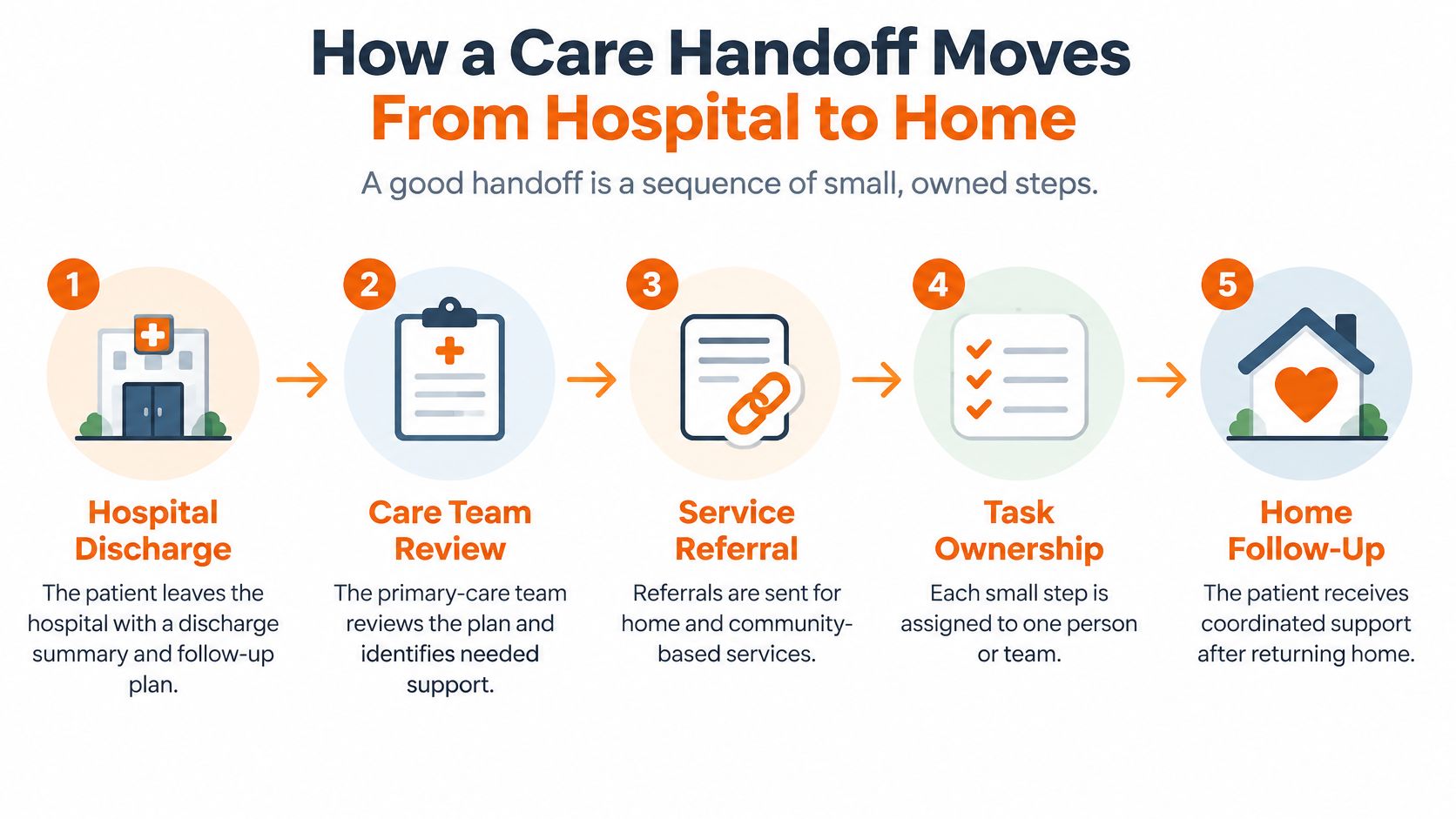
Seven Small Steps
- The referral arrives. One person is named as owner, so the referral doesn't sit in a shared inbox with no next step.
- First contact happens early. The team checks how the person is settling in, whether medications are available, who is helping at home, and which appointments are coming up.
- Lists are compared. The hospital discharge list, the routine from before the hospital stay, and the medicines physically in the home are placed side by side.
- The first home visit happens. The home health team sees the actual living space, routines and support available.
- Follow-up is scheduled. Calls and family updates get dates, not just good intentions.
- Open items get an owner and deadline. An unanswered question goes to a named person with a day attached to it.
- The outcome is recorded. What was decided is written down and sent back so the primary care office sees the same result.
Cost and eligibility checks belong early, around step two. In that same primary-care research, 57% described coordination as difficult, with patient cost identified by 65% and eligibility requirements identified by 63%. Checking those details early prevents a referral that can't start.
A finished handoff doesn't feel dramatic. The family knows who is coming, when they're coming, what changed, and who to contact with a question. The plan is written in one place, and the next step has a name beside it.
Where Handoffs Break Down and How to Spot Them
This section is based on a TechTarget analysis of home health interoperability, which reported that nearly 80% of U.S. Medicare-certified home health agencies used an EHR by December 2023, yet only 28% electronically exchanged information with outside providers at the point of care, and just 18% could integrate received data into clinical workflows.
That gap surprises many families. Having a record isn't the same as coordinating care. A note can exist in one system while the person visiting the home never sees it, or sees it too late to use it.

Home-based care is exposed to this problem because staff work across scattered settings. They rely on a mix of phone calls, faxes, portals and state-specific documentation requirements. Adding another app doesn't automatically fix that if the app becomes one more place information sits alone.
Four Breakdowns to Watch For
- Late information: An update arrives after the visit it was meant to inform.
- No owner: Everyone sees a question, but nobody is assigned to answer it.
- Duplicate work: Two providers ask the same questions because they can't see each other's notes.
- A change that stops halfway: A medication change reaches one office but never reaches the family member helping at home.
A calmer way to think about this is an escalation path. It has four parts. What's the signal that matters, who receives it, what's the response deadline, and how does the outcome get back into the shared record?
Simple test: When a concern comes up, can you name the person who will act on it and the day they'll do it? If not, that link needs attention first.
You don't need technical knowledge to ask those questions. You are checking whether an observation has somewhere clear to go. Missed visits, changes in appetite or sleep, a fall, or trouble with a daily routine are all easier to handle when the receiving person is named ahead of time.
Metrics and Benefits That Show Coordination Is Working
A handoff is working when someone receives the information, takes the next step by an agreed deadline, and reports the outcome. Tracking a few measures can show where that chain holds and where it stalls.
Coordination Metrics and Reference Points
| Metric | What It Tells You |
|---|---|
| Days from referral to first contact | How quickly the handoff starts |
| Unplanned hospitalizations after home health admission | Whether the transition to home is holding steady |
| Hospitalizations judged avoidable | Whether the transition plan addressed the person's needs |
| Closed-loop referrals (acknowledged and resolved) | Whether requests return with an outcome |
| Duplicate assessments across providers | Whether teams can use shared information |
Timing matters after discharge. A systematic review on home-health initiation reported that, among patients discharged to self-care, starting home-health services three to seven days after discharge was associated with 39% higher odds of rehospitalization than starting within two days. A team can use 48 hours as a practical target for first contact, with a named person responsible for meeting it.
Medication reconciliation offers another way to track a handoff. An AHRQ summary of medication reconciliation research described an analysis of 212 patients aged 50 and older that identified 1,389 medication discrepancies. Of those, 566, or 40.7%, were judged potentially capable of contributing to an adverse drug event. Clear ownership of medication-list updates helps the next person know what to check and when.
Communication also affects care at home. A 2024 qualitative study in JMIR Formative Research cited estimates from Canada and the United States that 4.2% to 13% of people receiving home care experience adverse events, and linked insufficient communication and coordination with those events.
For referrals and duplicate assessments, the team may not have an established benchmark. Start by recording whether each referral was acknowledged and resolved, and how often people repeat an assessment. Review those measures regularly, assign an owner to follow up, and set a deadline for acting on what the numbers reveal. Medication routines can be one part of that review; medication adherence monitoring focuses attention on whether prescribed routines are being followed.
Privacy, Consent and Rules Worth Knowing
This section is based on federal health-privacy rules, including the HIPAA Privacy Rule, and on the state documentation requirements noted in the interoperability analysis discussed earlier. Federal rules set a baseline, and states add their own documentation requirements, so forms and consent steps can look different from place to place.
You don't need to memorize regulations to ask good questions. Four plain questions cover most situations when you're considering a provider, an agency or a platform, including how electronic health records work in everyday sharing.
Four Questions to Ask
- Who can see the information: Which people and organizations have access?
- What can they see: Is it the full record, or only certain updates?
- How is it shared: By portal, phone, fax, app notification, or another method?
- Who can change the settings: How is a choice recorded, and how can it be withdrawn?
Sharing with family or other caregivers usually depends on an explicit choice. With us, if a medication taker user opts in to Support Circle Sharing, their Customer Data is shared with their designated caregivers and/or loved ones. The key words are opts in and designated, and you can ask any organization how it records that kind of choice.
It's also worth separating updates from emergencies. Our SMS notifications are not a life-safety or emergency notification system and do not replace emergency services or caregiver supervision. That distinction is worth checking with any service that sends alerts.
Keep a written copy of every consent form you sign, with the date on it.
A few habits make privacy easier to manage. Know how to request a copy of records, and know how to exercise privacy rights through an organization's published contact details. With us, users can exercise their privacy rights by visiting our contact page or by contacting Rx360. Checking a platform's privacy policy and sharing settings before enrolling is a reasonable, factual step.
Checklists, Templates and One Step This Week
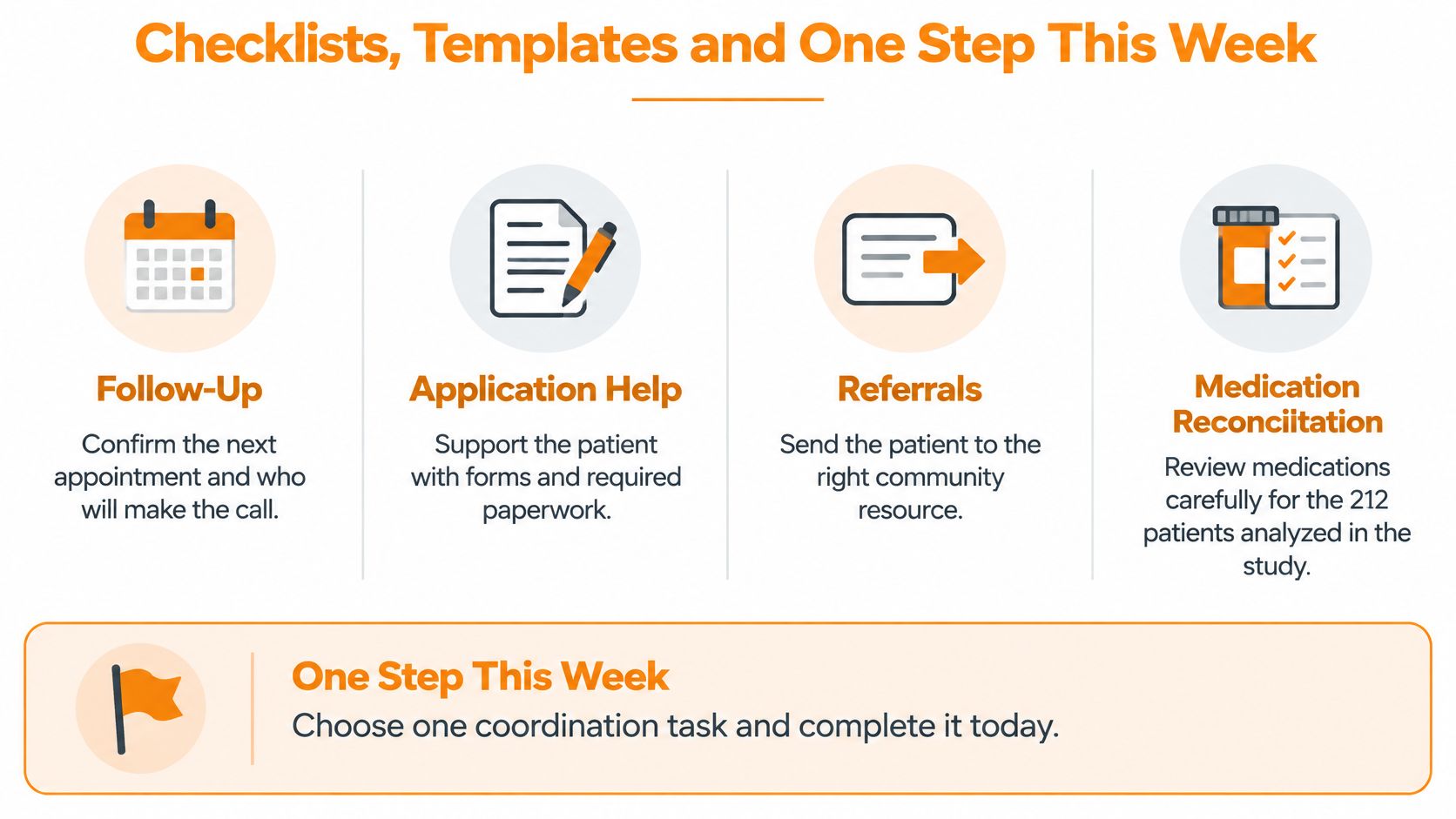
This section draws on the primary-care coordination research that treats follow-up, application help and referrals as separate tasks, and on the medication reconciliation analysis of 212 patients described earlier. Most of the work is simple to describe. The right person needs the right update at the right moment.
You can copy the checklist below into a notebook or a shared note. It isn't medical guidance. It's an organizing tool for names, dates and open questions that you can bring back to the care team.
A Copyable Coordination Checklist
- Medication list compared: The discharge list, the earlier routine and the medicines physically in the home are checked side by side.
- First contact dated: A first-contact date is set within 48 hours of referral, with a named owner.
- Appointments listed: Upcoming follow-ups are written down with who will provide transport.
- Community help noted: Meals, transport, benefits or housing help already in use are listed in one place.
- One update channel chosen: The family picks one main way updates will travel.
- Review date set: A date is chosen to look at open items together.
A Short Family Update Template
- Date:
- What changed:
- What was done:
- What is still open:
- Who owns it:
- Next update will come on:
That format keeps updates short and easier to act on. Instead of a long message thread, each update shows what's resolved and what isn't. It's also kinder for the person receiving it at work or in another time zone.
Technology can support this kind of organization when it works as a shared, time-stamped record with clear escalation rules, rather than a stack of notifications nobody owns. We describe Rx360 as bringing together health insights, supportive technology, and trusted connections into a unified ecosystem. Our Pilot Services include Medication Dashboards, Medication Reminders, Support Circle Sharing, Location Tracking, and Fall Tracking, and you can compare any platform description against the checklist above.
For one step this week, pick a single open item. Name the person who takes the next step, write the date it should happen, decide how the result reaches the family, and add it to the next review. If you have general questions about Rx360, its platform, or its mission, or a partnership inquiry, our contact page accepts those questions. Health or treatment questions belong with the care team who knows the person.
If you're working to keep family, caregivers and care providers connected around daily routines at home, Rx360 offers a wellness platform built around health insights, supportive technology and trusted connections for independent older adults. Visit us to see how a support circle can help everyone stay on the same page while your loved one stays in charge of daily life.
Lower-Risk Medication Plan Checklist
Below is a practical checklist and step plan you can implement into your daily life:
-
List all medications
Include prescriptions, over-the-counter drugs, supplements, sleep aids, creams, patches, eye drops, and inhalers.
-
Mark fall-risk drugs
Flag medicines that cause dizziness, sleepiness, confusion, blurred vision, low blood pressure, or low blood sugar.
-
Ask for a medication review
Bring the list to a pharmacist or prescriber.
-
Review after any warning sign
Request a new medication check after a fall, near-fall, new prescription, dose change, dizziness, or confusion.