You're visiting a parent, talking with a partner, or looking around your own home when small frustrations start adding up. The laundry basket is awkward on the stairs, the bathroom feels dim at night, and arranging a repair takes more effort than expected. Someone suggests buying a device, but it's not yet clear what would help.
Working out how to support independent living starts with those ordinary moments. The aim isn't to take over someone's day. It's to make the things they want to do easier to arrange, while keeping them in charge.
Table of Contents
- A Six-Step Path to Supporting Independent Living
- How to Assess Needs Before You Change Anything
- How to Make the Home Safer Without Overhauling It
- How to Build Routines That Keep You Moving
- How to Keep Sleep, Mind and Social Life Steady
- How to Add Discreet Tech Without Losing Privacy
- How to Coordinate Care, Medications and Paperwork
- Pick Your Support Level and Start This Week
A Six-Step Path to Supporting Independent Living
Independent living involves more than a suitable home. It also involves everyday routines, reliable people, clear responsibilities, and a way to adjust when something stops working.
Think of the setup as a sequence rather than a shopping list. Understanding daily life comes before choosing equipment; choosing equipment comes before deciding who maintains it or responds when it sends an alert.
The six steps at a glance
| Step | Main goal | First action |
|---|---|---|
| 1. Assess needs | Find what already works and what is getting harder | Walk through one normal week with the person |
| 2. Modify the home | Reduce trip and fall risks | Check lighting, rugs and the bathroom first |
| 3. Build routines | Keep movement, sleep and social time steady | Choose two anchor habits tied to existing daily moments |
| 4. Add discreet tech | Add support without constant surveillance | Pick one tool tied to one specific need |
| 5. Coordinate care | Keep family and clinicians on the same page | Name one point of contact for each area |
| 6. Plan for contingencies | Protect money, decisions and access | Gather key documents and agree on who to call |
Say an adult child wants to order a monitoring device immediately. During a week of conversations, they discover that the bigger frustration is getting groceries upstairs, while the person already has a dependable way to call for help. A delivery arrangement and a better storage setup address the actual problem.
The steps can overlap. Someone can clear a walking route while arranging a conversation about longer-term changes.
Starting point: Ask what the person wants to keep doing, then organize support around that activity.
Assessment and small home adjustments are accessible places to begin today. Neither requires committing to a renovation or signing up for a platform, and both give the support circle something concrete to work on.
How to Assess Needs Before You Change Anything
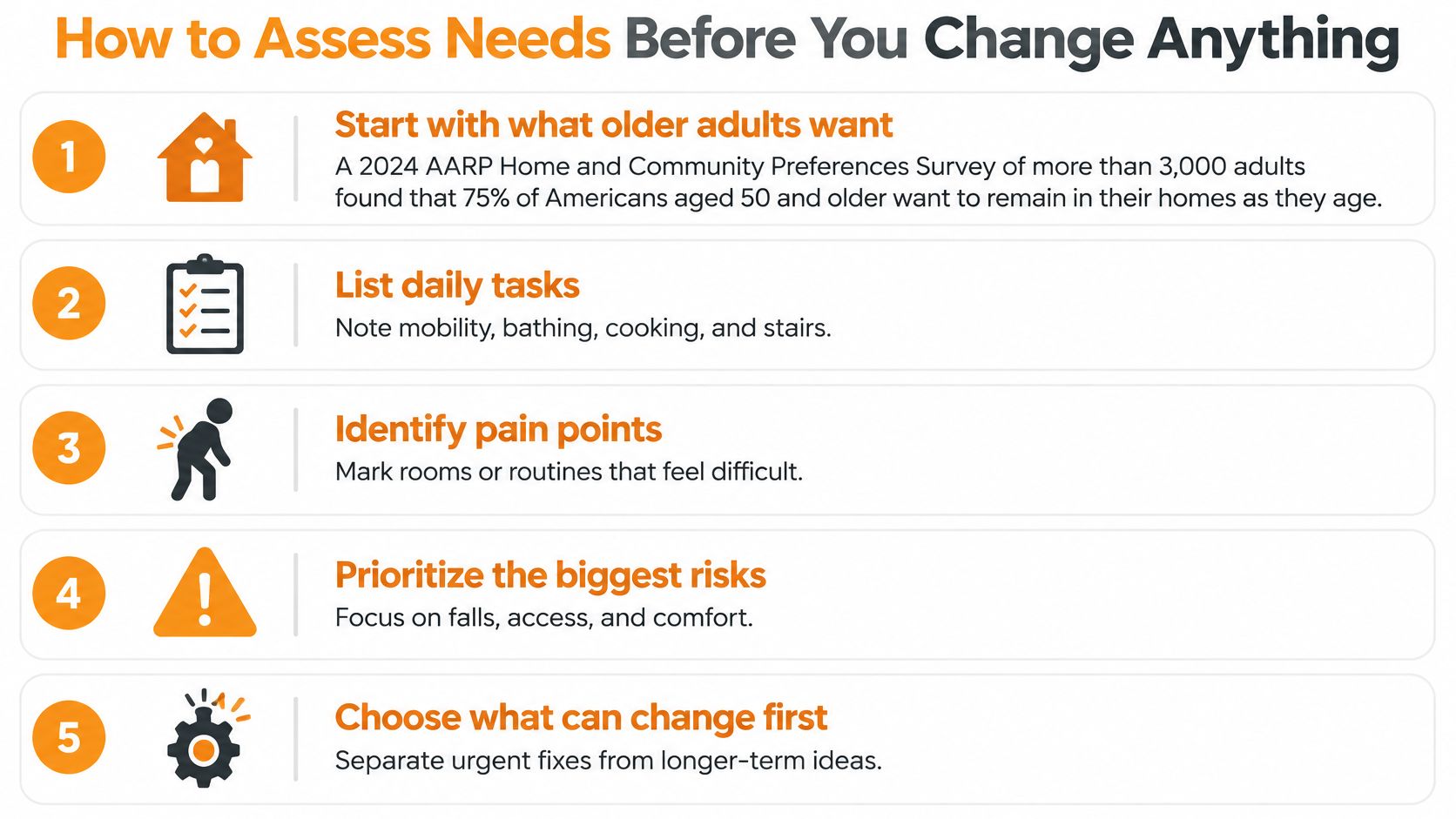
The 2024 AARP Home and Community Preferences Survey, involving more than 3,000 adults, found that 75% of Americans aged 50 and older want to remain in their current homes and 73% want to remain in their communities, although 44% believe moving will eventually be inevitable.
That gap makes a useful conversation starter. Wanting to stay doesn't mean every part of the current arrangement works, and accepting help doesn't mean giving up the decision to stay.
Look at a normal week, not a demonstration
A person may manage a task when someone is visiting but find the repeated effort inconvenient. Ask about the whole routine, including preparation, cleanup, transport, and anything they've stopped doing.
- List everyday tasks. Talk through stairs, bathing, cooking, laundry, shopping, and arranging medication refills. Note what takes longer, gets postponed, or requires help.
- Ask about slips and near-falls. Include moments when someone caught themselves on furniture or avoided a room because it felt awkward. Record what happened without trying to diagnose the cause.
- Ask about everyday visibility and sound. Can they read appliance controls and labels? Hear the doorbell? Find comfortable footwear that stays securely on?
- Protect enjoyable activities. Include gardening, visiting friends, cooking favourite meals, and getting outside. These belong on the assessment, not just chores.
- Write priorities in the person's words. A short list such as easier laundry, brighter bathroom, and getting to the library is more usable than a broad label like needs more support.
The distinction between an observation and a response matters. Difficulty carrying laundry doesn't automatically mean someone needs another person to do all their washing. Moving supplies, changing the basket, or arranging help only with carrying are different possibilities.
Keep observations separate from conclusions
A shared note can have simple columns for the task, what feels difficult, and what the person wants to try. Leave space for an option they reject and why; that can prevent the same unwanted suggestion returning at every conversation.
For a more structured discussion, these fall-risk assessment tools provide additional context. They aren't a substitute for an individual professional assessment.
Revisit the conversation every few months, or when the person says an arrangement no longer fits. Keep it collaborative rather than turning daily life into a test.
How to Make the Home Safer Without Overhauling It
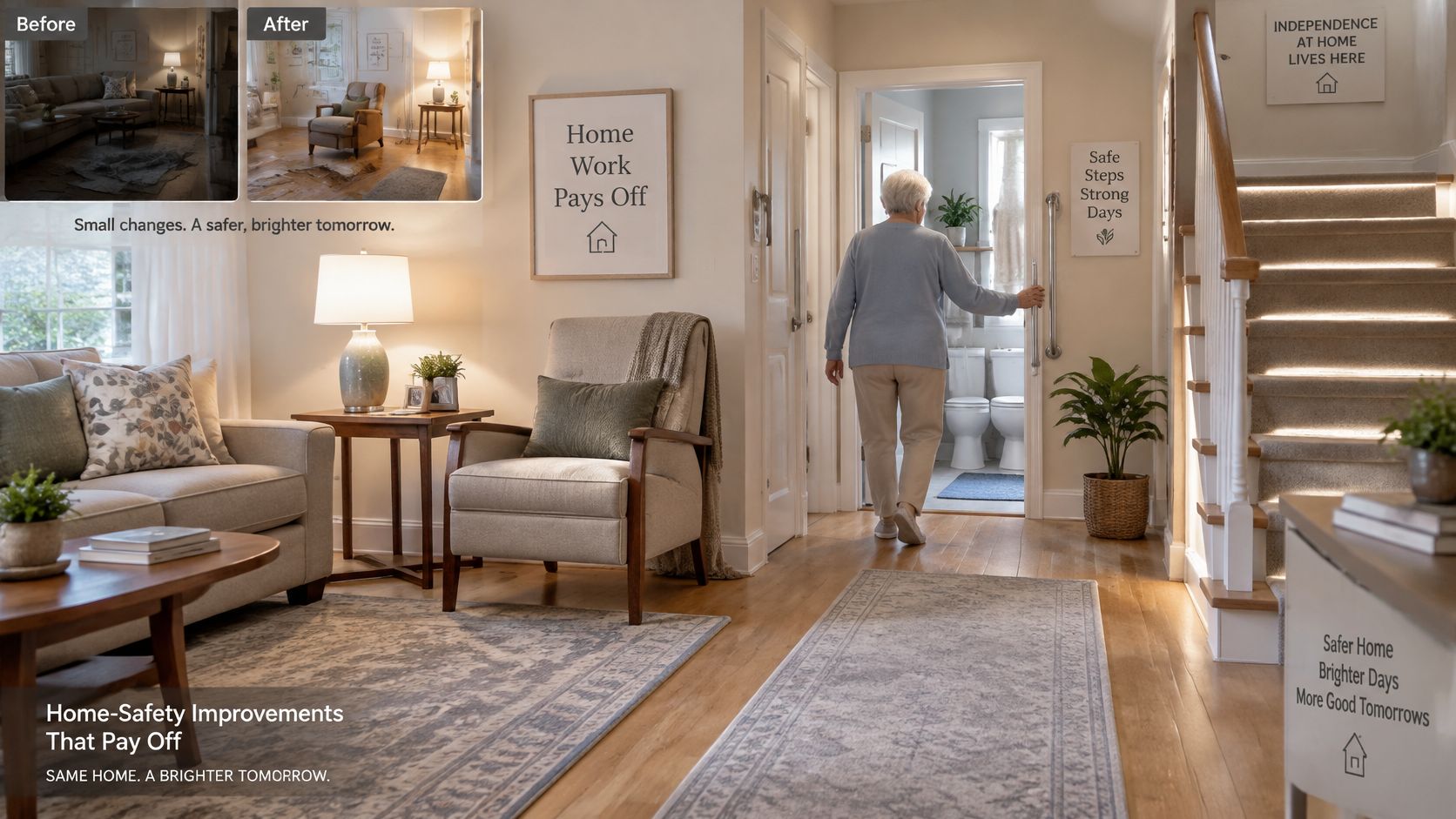
A dark route to the bathroom or a loose rug can turn an ordinary trip into a fall. A home-safety assessment can identify practical changes that may reduce that risk, without requiring a full renovation.
Start with the routes used most
- Clear walking paths. Move trailing cables, unstable stacks, and furniture that narrows a route. Remove loose rugs or secure suitable ones with compatible nonslip backing, including in rented homes.
- Make lighting reachable. Plug-in night lights can brighten the route between bed and bathroom without rewiring. Stair lighting should be operable from both ends, and cords should stay out of walking areas.
- Check the bathroom setup. Purpose-made grab bars, suitable nonslip surfaces, and a stable shower seat serve different needs. Fixed bars need appropriate structural anchoring, so ask a qualified installer to assess placement.
- Review stair handrails. Handrails on both sides offer more places to hold. In a rental, discuss fixed installation with the property owner rather than improvising a removable substitute.
- Bring frequently used items within reach. Place everyday supplies between waist and shoulder height where practical. Rearranging a shelf is a simple change that needs no building work.
Adhesive grips may make some handles easier to grasp, but they cannot support body weight. Tension rods and ordinary towel rails are not grab bars. Purpose-built freestanding supports also need a suitability and stability check.
Give every job an owner
A 2025 home-modification poll found that 38% of U.S. adults aged 65 and older expected to need additional modifications. 30% said they could not make modifications themselves, and 29% identified finding someone to do the work as a challenge.
A useful change can stall between identifying it and getting it done. Choose a named point of contact, with the older adult's agreement, to track each job. Record who will request permission, gather quotes, agree on payment, book installation, and check the finished work. Share only the details the older adult wants shared, and agree who may contact the installer.
Ask trusted contacts for installer recommendations, then check qualifications, insurance, scope, and written costs. The AARP livable-communities research insights report that 72% of adults aged 50 and over rated trustworthy, affordable home-repair contractors as very important.
A home modification is finished when the person can use it as intended, not when the installer leaves.
Try the revised setup together. Check reach, comfort, and convenience before arranging another change. A room-by-room approach keeps the work manageable and lets the person decide which improvements to take on first.
How to Build Routines That Keep You Moving
A useful activity routine fits the person's week, not the other way around. Start with activities they already enjoy or feel comfortable doing, then choose realistic times and places for them.
The World Health Organization's physical-activity guidance describes aerobic activity, strengthening, and balance work as distinct parts of an older adult's weekly activity. These are population-level categories, not an individualized exercise prescription.
Weekly activity targets for older adults
The WHO physical-activity fact sheet gives typical weekly targets of 150–300 moderate-intensity minutes or 75–150 vigorous-intensity minutes, strengthening on 2 or more days, and multicomponent balance and strength activity on 3 or more days for older adults.
| Activity type | WHO guidance | Everyday example |
|---|---|---|
| Moderate aerobic | 150 to 300 minutes a week | Brisk walking, cycling on flat ground, dancing |
| Vigorous aerobic | 75 to 150 minutes a week, as an equivalent option | Hill walking, swimming laps, fast stair climbing with a rail |
| Muscle strengthening | 2 or more days a week, major muscle groups | Sit-to-stand from a chair, resistance bands, carrying groceries |
| Balance work | 3 or more days a week | Heel-to-toe walking near a counter, standing on one foot with support, tai chi |
The examples show different activity types, not a requirement to try each one. Intensity depends on the effort involved and the person doing the activity, so a familiar walk may feel moderate to one person and vigorous to another.
Make the calendar usable
Use a regular part of the day as a cue. A walk might follow morning coffee; a familiar strength routine could fit on selected afternoons. Agree on the schedule with the older adult, and name one person to check whether transport, a class booking, or another practical detail needs handling.
- Choose a workable setting. Record the route, venue, or class, not just the activity.
- Keep equipment accessible. Store resistance bands or walking shoes where they are easy to find and won't obstruct a walkway.
- Include company if wanted. A walking group or class can combine activity with time spent with others.
- Mark participation. A paper tick can show that an activity happened without turning the calendar into a scorecard.
These daily habit tracker ideas can help organize reminders while keeping the activity itself at the centre.
For example, a week might include familiar weekday walks, an established strength routine on selected afternoons, and a suitable balance-focused class. Leave room for weather, transport, and personal preference. If the older adult wants to change the plan, adjust it together rather than treating a missed entry as failure.
How to Keep Sleep, Mind and Social Life Steady
These are general routine ideas, not a treatment plan or claims about improving memory, mood, or sleep. They provide a way to organize enjoyable activities alongside household tasks.
A calendar filled only with appointments and chores leaves out much of what makes staying at home appealing. Include things the person looks forward to, with enough unplanned time that the schedule still feels like theirs.
Give enjoyable habits a place
- Keep a familiar sleep routine. A regular wake-up time, morning daylight when convenient, and a quiet, dim bedroom are options to discuss. Choose arrangements that suit the household rather than creating a rigid bedtime checklist.
- Arrange a standing social contact. This could be a weekly call, coffee with a neighbour, a class, or a shared outing. Let the person choose both the company and the format.
- Make room for mental activity. Reading aloud, puzzles, a language app, music, or trying a recipe offer different kinds of engagement. Keep an activity because it's enjoyable, not because someone has promised a cognitive benefit.
- Ask an open question. A weekly conversation about what felt good and what felt hard can reveal practical frustrations. Listen before suggesting a solution.
A social arrangement needs ordinary logistics. Record who books transport, whether the venue is accessible, and what happens if the usual companion can't attend.
Keep the calendar personal
Use the same paper calendar for walks, calls, classes, and favourite activities. Write entries in the person's preferred language and format, with lettering they can comfortably read.
A habit can attach to an existing moment: reading after lunch, calling a friend after a regular programme, or preparing the bedroom after the evening wash-up. The cue makes the plan specific without requiring another notification.
Keep the choice visible: An invitation, a reminder, and an obligation aren't the same thing.
If an activity keeps getting skipped, ask whether the timing, transport, company, or activity itself is the problem. Replacing an unwanted class with a preferred outing respects the purpose of the plan: a satisfying everyday life.
How to Add Discreet Tech Without Losing Privacy
More monitoring doesn't automatically mean more independence. A review of autonomous-living technologies describes tensions among privacy, autonomy, safety, and cost, and identifies customizable settings, understandable detection, and user access to data as important design considerations; it also notes that evidence involving older adults remains limited and exploratory.
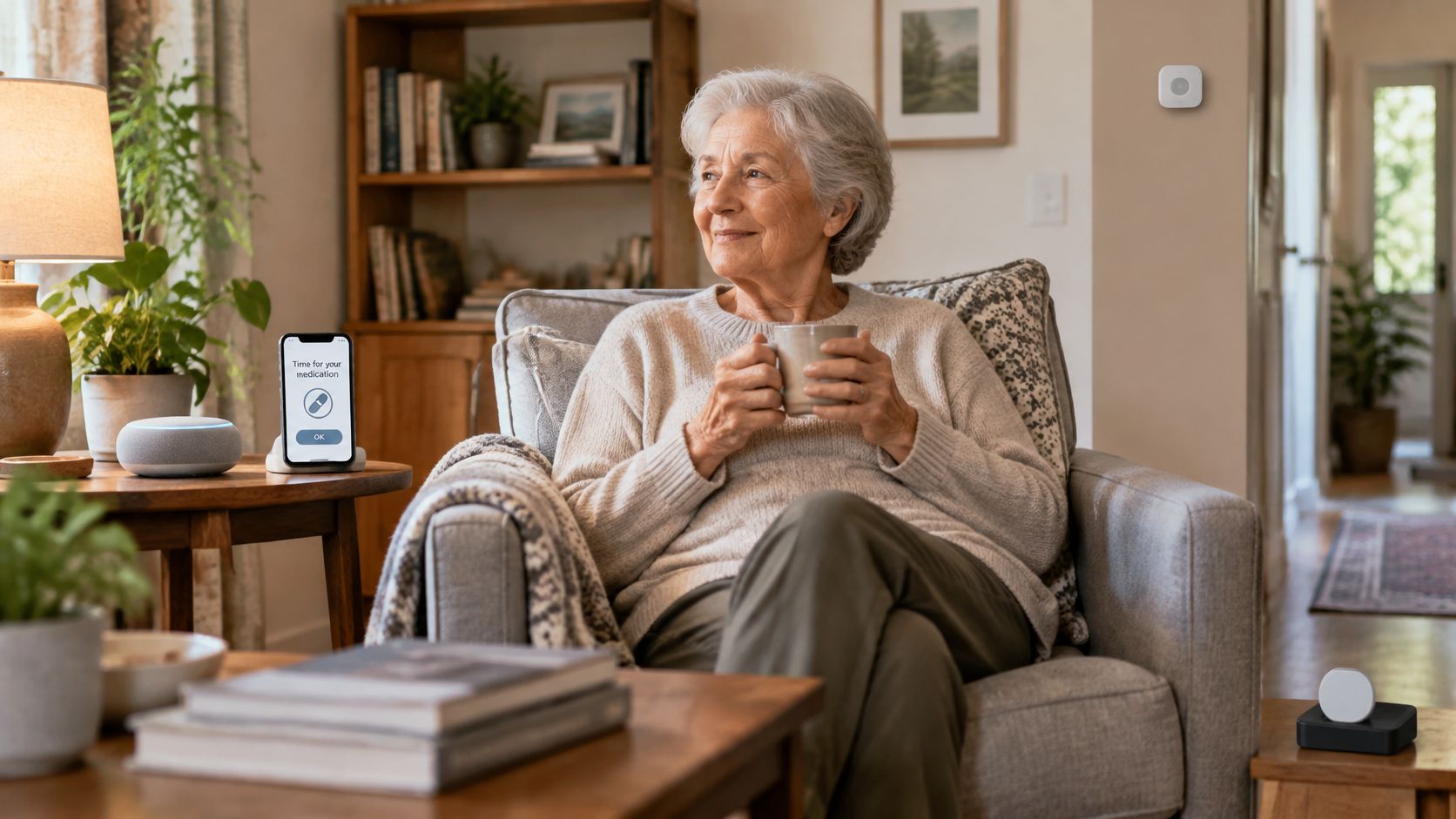
A device may be physically discreet while sharing far more information than someone expects. The meaningful question is what it reveals, not whether visitors can see it.
Decide the sharing rules before installation
- Name the need. Emergency calling, a private reminder, and a daily activity update are different jobs. Start with the job rather than a bundle of features.
- Choose the information and recipients. Agree on what gets shared, who can see it, and how long it remains available.
- Separate alert levels. Some reminders may belong only to the person. Other agreed events may notify a family contact, while routine information may need no notification.
- Discuss refusal without pressure. If the person declines a feature, consider an agreed alternative, such as a call or an accessible phone. Don't enable it later.
- Set a review date. Check whether the settings still match the person's preferences and whether recipients still need access.
Rx360 is one wellness platform to compare against these requirements, alongside a basic emergency-calling device, private phone reminders, or a no-device arrangement. Check its actual settings rather than assuming every sharing preference is supported.
Test the ordinary details
Ask the provider to explain what the tool detects and what it cannot establish. An activity signal may indicate that something happened without explaining who did it or why.
Check whether the user can review information, delete it where supported, revoke access, and understand an alert in plain language. Also establish charging, connectivity, maintenance, and cancellation responsibilities.
Before installation, have an in-person conversation wherever practical. Demonstrate the proposed setup with the person present, including how to turn a feature off.
How to Coordinate Care, Medications and Paperwork
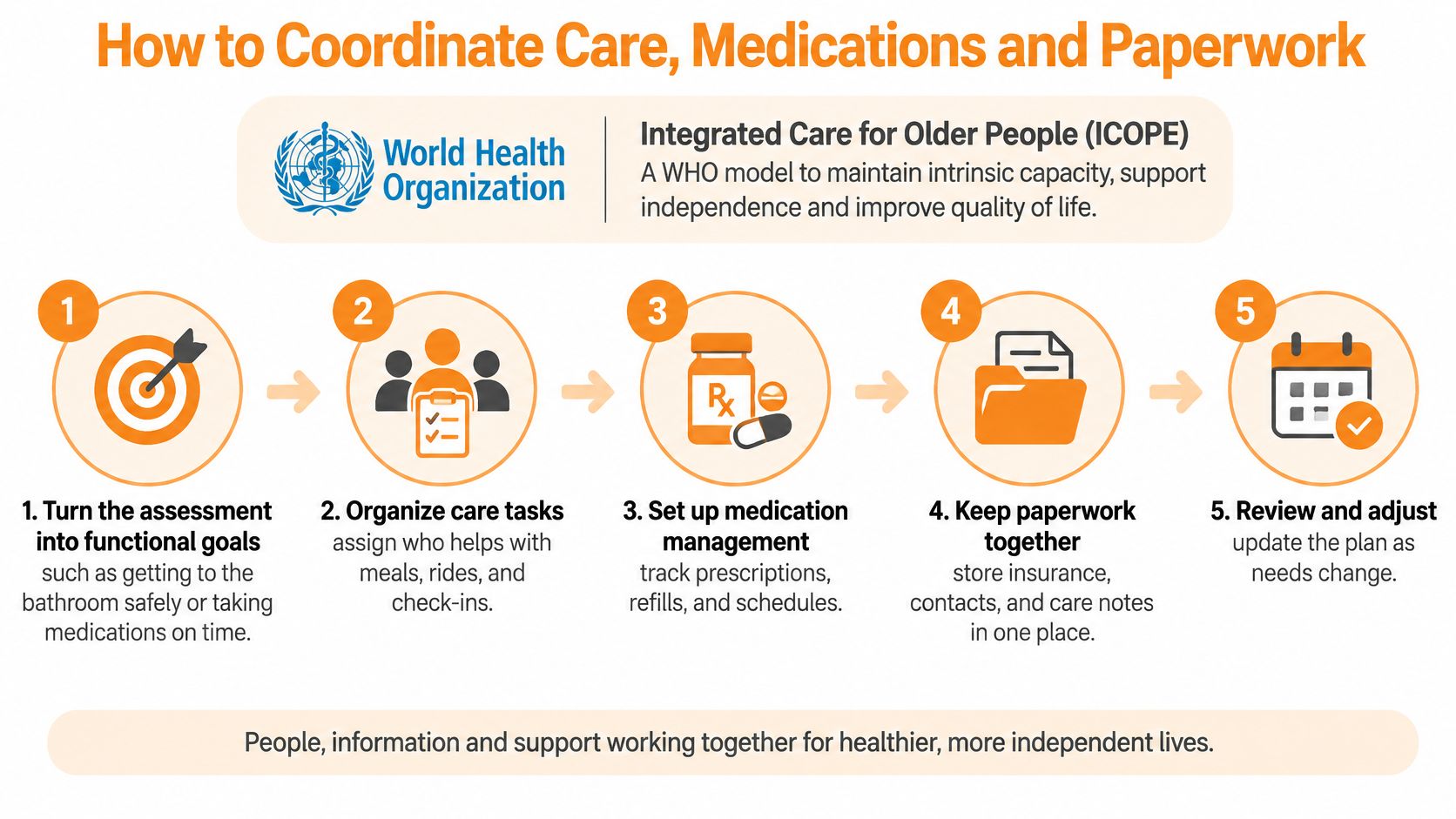
The WHO Integrated Care for Older People framework describes person-centred, coordinated care with continuity across homes, clinics, hospitals, and long-term-care settings. Its organizational principle is useful here: link the person's priorities to responsibilities and follow-up, rather than collecting information without arranging action.
The coordinator doesn't become the decision-maker. Their job is to keep agreed tasks moving and make it clear who handles each question.
Turn priorities into assigned tasks
Use a short flow: personal goal → practical task → named contact → follow-up date. For a goal such as continuing library visits, that might mean arranging transport, identifying a backup driver, and confirming the booking.
- Name an overall contact. This person tracks outstanding arrangements, with the older adult's agreement.
- Assign specialist questions appropriately. Installers handle installation questions; clinicians handle clinical questions; the coordinator connects people rather than answering everything.
- Close the loop. A referral isn't complete because someone sent it. Confirm that the receiving service made contact and that the person knows the next step.
Useful questions include whether preferred activities continue, whether routines are being disrupted, how quickly agreed concerns receive a response, and whether helpers can sustain their commitments. Formal care reviews may also consider avoidable emergency visits and caregiver burden, rather than counting messages or device readings alone.
Keep essential records usable
Maintain a current medication list with names, doses, prescriber, and pharmacy, and bring it to appointments. Medicine changes belong with the prescriber; this is an organization step, not medication advice.
For paperwork, gather existing powers of attorney for health and finances, advance directives, insurance details, and relevant contacts. Requirements differ by jurisdiction, so document preparation and legal authority need appropriate professional guidance.
Keep account-access information securely, separate from an openly displayed contact sheet. An emergency fund, if feasible, also needs an agreed purpose and clear permission for access.
These elderly care management approaches provide further context for organizing responsibilities. Whatever system is used, avoid referrals nobody follows and alerts nobody has agreed to answer.
Pick Your Support Level and Start This Week
The levels below are planning examples, not assessed categories or prescribed check-in schedules. They describe ways to organize help without assuming that accepting assistance means surrendering control.
The practical distinction is how many arrangements need coordinating. Someone who handles daily tasks comfortably may still want help with repairs; someone receiving regular assistance may continue making all their own decisions.
Support levels and check-in rhythms
| Support level | What it can look like | Focus | Check-in rhythm |
|---|---|---|---|
| Self-directed | Handles most tasks alone, with few gaps | Quarterly assessment and emergency contacts | Every 3 months |
| Mostly independent | Needs help with occasional tasks | Weekly check-in and shared medication list | Weekly |
| Supported independence | Relies on a circle for several tasks | Coordinated plan with one named contact | Every 2 weeks and after any change |
These rhythms describe planning conversations, not emergency coverage or the frequency of practical assistance. A person may need daily help with a task while preferring less frequent meetings about the overall plan.
Choose a manageable starting checklist
- Self-directed. Put a quarterly review on the calendar, complete a home fall-prevention review, and keep emergency contacts accessible. Decide who, if anyone, should receive a copy.
- Mostly independent. Agree on a weekly call, share the current medication list with a chosen family contact only with permission, and arrange suitable grab bars and lighting in frequently used rooms.
- Supported independence. Schedule twice-monthly coordination check-ins, name an overall service coordinator, and record a backup contact. Confirm who provides any more frequent assistance the person already relies on.
An unanswered planning call shouldn't leave everyone guessing. Agree beforehand whether the next step is another call, contacting the backup person, or using an established urgent-help arrangement.
Support levels can change with circumstances, including travel, a house move, or a helper becoming unavailable. Treat adjustments as ordinary household planning rather than a verdict on someone's independence.
Choose the arrangement that fits today. This week, begin with the first action in the opening table: walk through a normal week together and write down what the person wants to make easier. Then consider whether a wellness platform belongs in that support circle, based on a clear need and agreed sharing boundaries.
Rx360 offers a wellness platform that brings together health insights, supportive technology, and connection with loved ones and care providers. Visit Rx360 to explore how it could fit an independent-living plan built around everyday routines, clear responsibilities, and the older adult's choices.
Lower-Risk Medication Plan Checklist
Below is a practical checklist and step plan you can implement into your daily life:
-
List all medications
Include prescriptions, over-the-counter drugs, supplements, sleep aids, creams, patches, eye drops, and inhalers.
-
Mark fall-risk drugs
Flag medicines that cause dizziness, sleepiness, confusion, blurred vision, low blood pressure, or low blood sugar.
-
Ask for a medication review
Bring the list to a pharmacist or prescriber.
-
Review after any warning sign
Request a new medication check after a fall, near-fall, new prescription, dose change, dizziness, or confusion.