You're probably here because someone handed you a rehab note, discharge summary, or therapy update and one phrase jumped out: FIM score.
Maybe your father is recovering after a stroke. Maybe your spouse is coming home after a long hospital stay. Maybe your mother seems “better” in the rehab gym, but you're still wondering whether she can safely manage the bathroom at night, take medications correctly, or move around the kitchen without falling.
That uncertainty is common. Families often receive a number without enough explanation of what it means in daily life. As an occupational therapist would tell you, the functional independence measurement is useful, but it only becomes meaningful when you connect it to real tasks, real routines, and real safety concerns at home.
Table of Contents
- Understanding Your Loved One's FIM Score
- Decoding FIM Domains and Scoring
- How to Interpret a FIM Score in the Real World
- FIM in Action for Aging in Place
- FIM Compared to Other Assessment Tools
- Limitations of FIM and Tips for Families
Understanding Your Loved One's FIM Score
A family I worked with once sat across from me holding a discharge packet full of medical terms. They were relieved that their loved one had improved, but they kept circling one line in the report: “FIM.” They asked the same thing many families ask. “Is this good or bad?”
That's the right question, but the better one is, good for what?
The Functional Independence Measure, often shortened to FIM, is a standardized way for rehab teams to describe how much help a person needs with everyday life. It gives doctors, nurses, occupational therapists, physical therapists, and case managers a shared language. Instead of saying “she's doing better,” the team can describe how much help she needs with dressing, walking, communication, problem solving, and other daily tasks.
Recovery isn't just about strength; it's about function. Can your loved one get from bed to chair? Can they manage toileting with privacy and safety? Can they understand instructions, remember steps, and make safe choices when no therapist is standing beside them?
Practical rule: Don't read a FIM score as a grade. Read it as a picture of how much care your loved one still needs.
The FIM is especially helpful during inpatient rehabilitation because it helps the team track change over time and plan for what happens next. A score can support decisions about discharge, caregiver training, equipment, and home setup. It can also help families ask better questions instead of relying on vague reassurance.
If you're already trying to coordinate appointments, home routines, and support after discharge, it helps to think about FIM alongside broader elderly care management planning. The score is one piece of a much larger care picture.
The number is only the starting point
When families get overwhelmed, I usually bring them back to one simple idea. The FIM does not measure your loved one's worth, motivation, or future potential. It measures the level of help needed for daily activities right now.
That shift matters. Once you understand that, the score becomes less intimidating and more practical. You can start asking the kinds of questions that protect someone at home:
- Which tasks are still unsafe alone
- When does someone need supervision instead of hands-on help
- Which problems show up only when the environment is less controlled
Those questions are where real caregiving begins.
Decoding FIM Domains and Scoring
A daughter watches her father walk from the bed to the chair with only a little help and thinks, "Maybe he can manage at home." Then she learns he still needs cueing to find the bathroom, remember his walker, and judge whether the floor is wet. That is why the FIM is broken into parts. It does not only ask, "Can he move?" It asks, "How much help does he need across the tasks that make a day safe and manageable?"
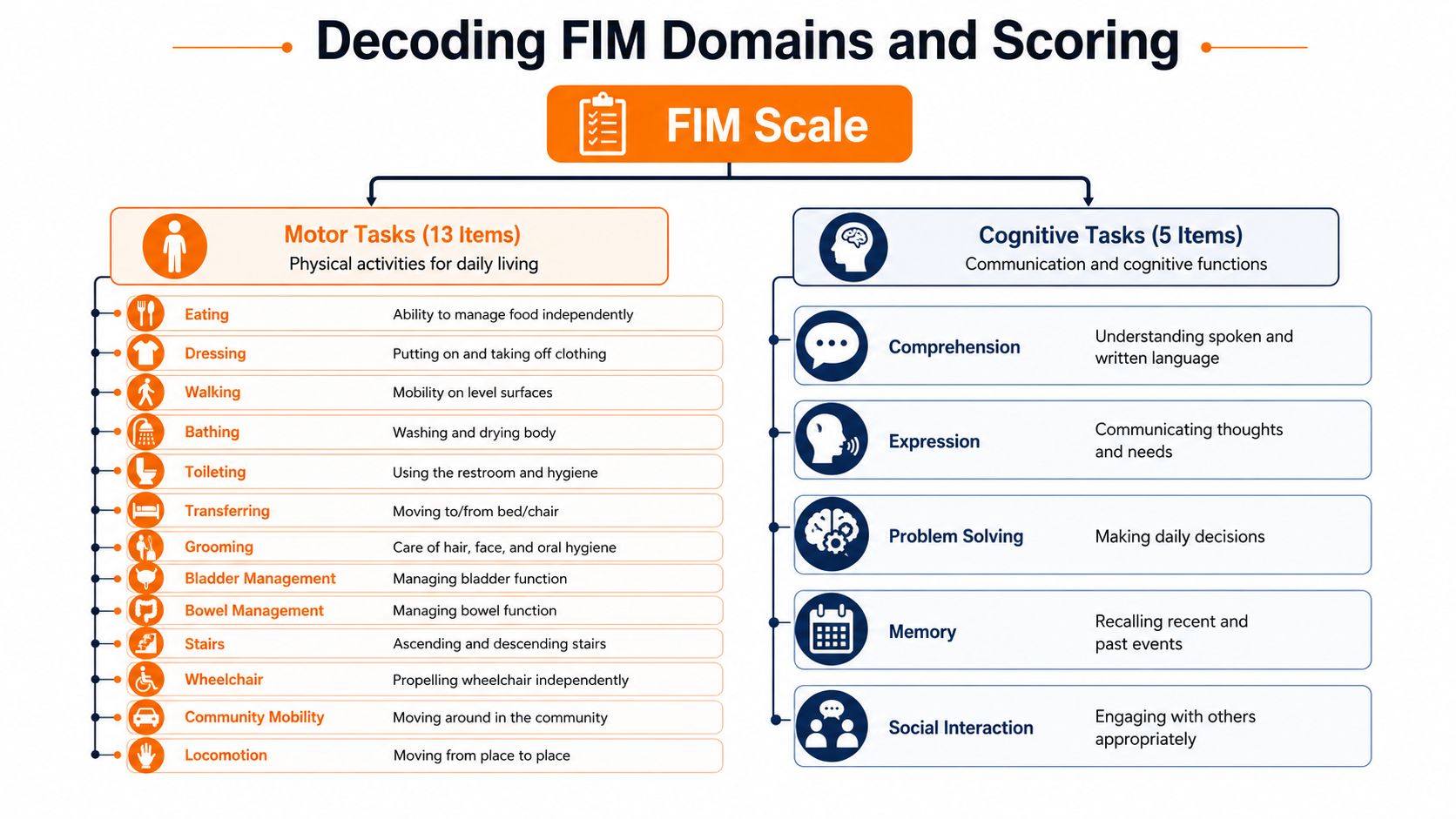
The FIM includes 18 items. There are 13 motor tasks and 5 cognitive tasks. Each item is scored on a 7-point scale, and the total score ranges from 18 to 126, reflecting the person's overall burden of care, as described in the Physio-Pedia overview of the Functional Independence Measure).
The two parts of the FIM
The motor section covers the physical work of daily living. It looks at self-care, bladder and bowel management, transfers, and mobility. Families usually hear those labels and need translation, so here is the practical version. Can your loved one eat without hands-on help? Can they get dressed in the right order? Can they stand, pivot, and sit down without losing balance? Can they get to and from the toilet safely, day and night?
The cognitive section covers communication and everyday decision-making. It looks at comprehension, expression, social interaction, problem solving, and memory.
This part is easy to underestimate.
A person may look much better because they are stronger, walking farther, or getting out of bed more easily. At the same time, they may still miss steps, forget safety rules, or make risky choices when no one is beside them. Families often discover that a primary challenge at home is not lifting. It is cueing, supervising, repeating, and checking. That gap between a "good" score in one area and the support still needed in real life is one reason discharge planning should connect the FIM with actual caregiving systems, including medication routines, alerts, and coordination tools such as Rx360.
The 7 levels of help
Each FIM item gets its own score. The scale works like a ladder. As the number rises, the person is doing more of the task safely and needing less help from another person.
Here is the scale in family-friendly terms:
Total assistance
Your loved one does only a small part of the task. Another person provides most of the effort.Maximal assistance
They participate, but they still need a great deal of hands-on help.Moderate assistance
They do a meaningful share of the task, but another person is still helping through much of it.Minimal assistance
They do most of the task and need a small amount of physical help for balance, lifting, or steadying.Supervision or setup
No hands-on lifting is needed, but someone must watch, cue, prompt, or prepare what they need.Modified independence
They complete the task without another person's physical help, but they may need extra time, a device, or a different method.Complete independence
They do the task safely, consistently, and without help, cueing, or equipment.
The difference between 4 and 5 matters more than many families expect. A 4 means physical contact is still needed. A 5 means no lifting help, but the person may still be unsafe alone. For aging in place, that distinction can shape the whole care plan. One score may point to transfer training and grab bars. Another may point to supervision schedules, reminder systems, and tools that help family caregivers track whether routines are being followed.
A loved one can score high in one area and low in another. Someone may eat independently but still need close help with bathing, toileting, memory, or problem solving.
That is why therapists study the pattern of scores, not only the total. For families, that pattern gives the clearer picture of daily life: where a person is steady, where they need cueing, and where they are still at risk if home support is too light.
How to Interpret a FIM Score in the Real World
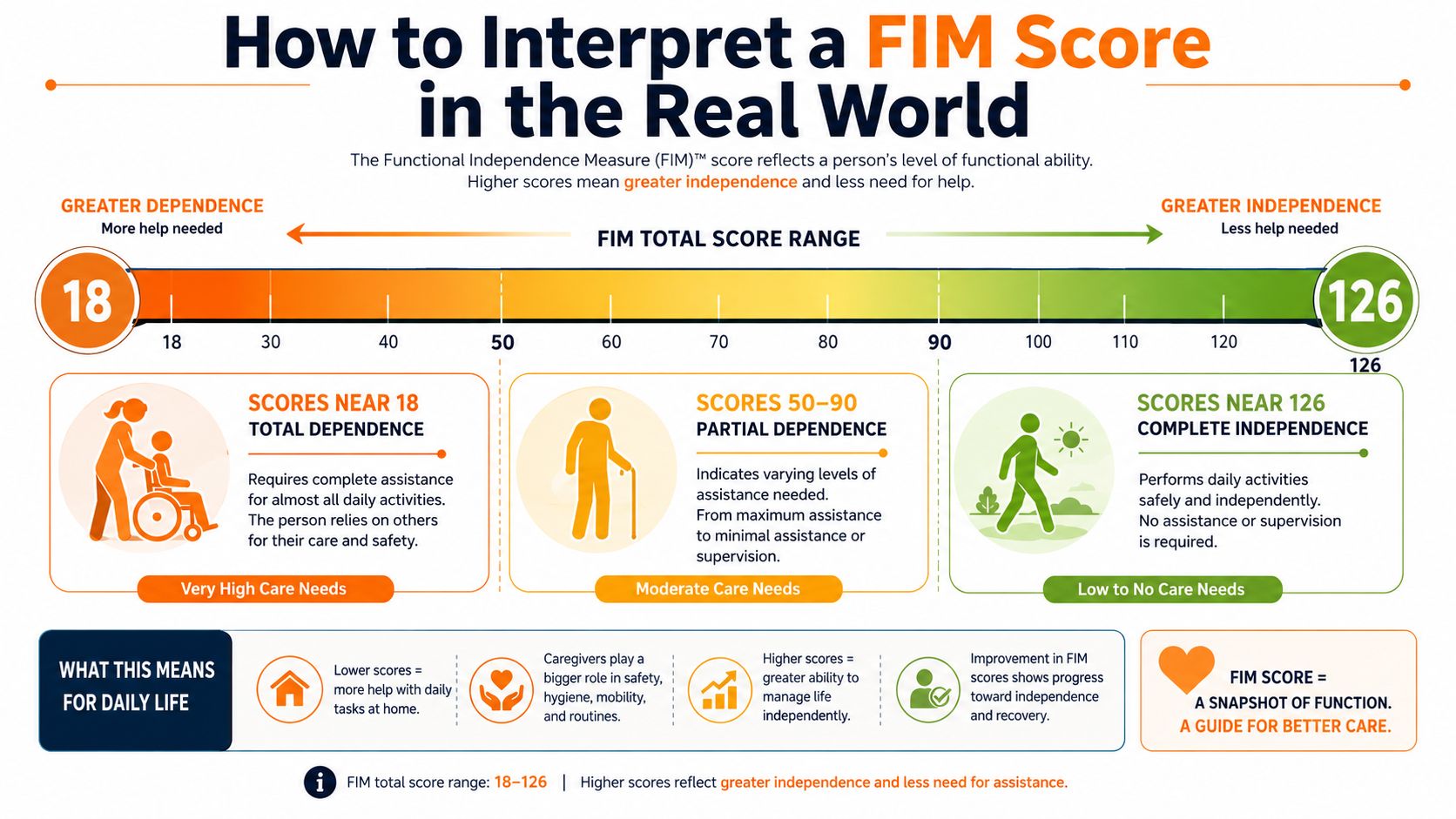
A total FIM score gives a quick sense of the overall burden of care. But in real life, families don't care for a number. They care for a person moving through a day.
What the total score tells you
Think of the full scale like a broad map.
Scores closer to the lower end suggest that the person needs substantial support for many daily tasks. In practical terms, that may mean frequent physical help, close supervision, and a high caregiving load across the day.
Scores in the middle usually mean a mixed picture. The person can often do some parts of daily life but still needs assistance, cueing, setup, or monitoring in others. This is the range where families often feel the most confused, because a loved one may appear “much better” but still be unsafe in key situations.
Scores closer to the upper end suggest greater independence. Even then, the question remains the same: independent with what, under what conditions, and how safely?
Why the first score matters
In rehabilitation, the first FIM assessment is important because it creates the baseline. A baseline FIM assessment must be completed within 72 hours of admission to a rehabilitation facility, and that starting point helps the team tailor treatment planning and connect higher scores with better discharge outcomes to home settings, according to the EBSCO rehabilitation summary on FIM.
That early score does two helpful things for families.
First, it shows where the person started. Without that, later progress is hard to understand. A discharge score means much more when you know what the admission picture looked like.
Second, it helps the team set realistic goals. If a loved one needs hands-on help at admission, the therapy plan may focus on safer transfers, dressing, toileting, and communication before discharge. If they start at a higher level, the team may focus more on endurance, consistency, and judgment in daily routines.
Don't ask only, “What is the score now?” Ask, “Which tasks improved, and which ones still create the most burden for caregivers?”
That question usually opens a more useful conversation than the total number alone.
A score can show progress. It can suggest direction. But it still doesn't tell you whether your loved one will remember to lock wheelchair brakes, notice a wet bathroom floor, or take the right pills at the right time once they're home. Those are everyday risks that often matter most.
FIM in Action for Aging in Place
When a rehab team prepares someone for discharge, the FIM helps organize the conversation. It can guide recommendations about equipment, caregiver help, and the level of assistance likely needed at home. That's valuable.
But aging in place introduces a tougher question. Can your loved one manage safely when the environment is no longer structured like rehab?

Why a good rehab score may not mean safe at home
One of the most misunderstood FIM ratings is 6, called modified independence. On paper, that often sounds reassuring. Families hear “independent” and think the person is ready to manage alone.
That's not always true.
A key gap exists between a FIM score of 6 and real-world safety. Data cited in the PMC discussion of activity patterns and monitoring needs notes that 75% of older adults with this score may still require environmental monitoring to help prevent falls or medication errors.
That makes clinical sense. A person may complete a task with a walker, grab bar, pill organizer, or extra time and still be at risk in the home. They may do well in a quiet therapy gym but become unsafe when the phone rings, the dog moves underfoot, the bathroom floor is damp, or fatigue sets in late in the day.
Modified independence often means “able to do the task under certain conditions.” It doesn't always mean “safe without oversight.”
What families should look for after discharge
If your loved one is returning home, watch for the mismatch between capacity and consistency. Many people can do a task once with focus. The harder question is whether they can do it reliably, safely, and at the right time every day.
Look closely at these situations:
Nighttime mobility
Trips to the bathroom are often harder than daytime walking. Lighting, urgency, and fatigue change everything.Medication routines
Swallowing a pill isn't the same as remembering the correct dose and schedule.Transfers under pressure
Getting up from a chair during therapy is different from standing up quickly when the doorbell rings.Distracted decision making
Some people function well one-on-one but struggle when several things happen at once.
Families planning long-term support often need tools that go beyond discharge paperwork. That's where broader connected health solutions for home support become part of the discussion. The goal isn't to reduce independence. It's to protect it.
A FIM score can help start the plan. It shouldn't be the final word on whether someone is safe living at home.
FIM Compared to Other Assessment Tools
Families sometimes hear about another tool called the Barthel Index and wonder whether it means the same thing as the FIM. They overlap, but they aren't identical.
The easiest way to think about it is this: both tools look at day-to-day function, but the FIM usually gives a more detailed picture of how much help is needed, especially when thinking, communication, and supervision are part of the problem.
Where the FIM gives more detail
The FIM breaks function into more parts and uses a more granular assistance scale. That can help a rehab team describe the difference between hands-on help, setup, supervision, and independent performance with a device.
The Barthel Index is often simpler and quicker to understand. It focuses on practical daily activities and mobility. That can make it useful in some settings, especially when the main question is physical function.
If you want to understand how clinicians think about fall risk alongside daily function, it can help to review other fall risk assessment tools used in care planning. Functional ability and fall risk are related, but they aren't exactly the same.
FIM vs. Barthel Index At a Glance
| Feature | Functional Independence Measure (FIM) | Barthel Index |
|---|---|---|
| Main focus | Burden of care and level of assistance needed across daily function | Basic daily activities and mobility |
| Scope | Physical tasks plus cognitive and communication areas | Primarily physical daily activities |
| Detail level | More detailed descriptions of assistance | Simpler overview |
| Scoring style | Uses a 7-level assistance scale for each item | Uses a simpler item-based scoring approach |
| Best for | Rehab settings where the team needs a nuanced picture of help, supervision, and safety needs | Situations where a faster snapshot of ADL performance is useful |
| What families often learn from it | Exactly where hands-on help ends and supervision begins | Whether the person can manage core physical daily tasks |
A family doesn't need to choose a favorite tool. What matters is understanding what each tool can and can't tell you.
If the report uses the FIM, pay attention to the details within each item. If it uses the Barthel Index, ask what might be missing about judgment, communication, or supervision needs.
Limitations of FIM and Tips for Families
The FIM is helpful, but it isn't perfect. That's especially important for older adults who want to stay in their own homes.

Where the FIM can miss important details
The cognitive part of the FIM includes 5 items, but it may not catch subtle executive function problems that create real safety risks at home. The Stroke Engine overview of the Functional Independence Measure notes that this cognitive subscale can lack sensitivity for the kinds of higher-level deficits that matter in aging in place.
That means a person may sound conversational, answer questions politely, and still struggle with the hidden demands of home life. They might have trouble sequencing a meal, noticing a hazard, shifting attention, or solving a new problem when routine breaks down.
This is one reason families sometimes feel surprised after discharge. The report may look encouraging, while home life quickly reveals challenges that didn't fully show up in a structured rehab environment.
Questions to ask the rehab team
When you hear a FIM score, don't stop at “What number is it?” Ask for examples.
Use questions like these:
- What does this score mean for bathing, toileting, and dressing at home
- Which tasks need supervision, even if physical help isn't needed
- Where is the biggest fall risk
- Does my loved one need cues for safety, sequencing, or memory
- What changes in the home would make the biggest difference
- What should we watch for during the first week after discharge
- Which task worries you most if no one is nearby
Ask the team to describe one ordinary morning at home. That often reveals more than a number does.
The best way to use a functional independence measurement isn't to memorize the scale. It's to turn the score into a care conversation. Families do best when they connect the clinical picture to real routines, real spaces, and real support needs.
A clear score helps. A clear plan helps more.
If you're helping a loved one stay independent at home, Rx360 offers a practical way to stay connected without making daily life feel medical or intrusive. It brings together wellness insights, thoughtful technology, and family visibility so older adults can keep their routines while loved ones feel more confident about safety, support, and everyday changes that matter.
Lower-Risk Medication Plan Checklist
Below is a practical checklist and step plan you can implement into your daily life:
-
List all medications
Include prescriptions, over-the-counter drugs, supplements, sleep aids, creams, patches, eye drops, and inhalers.
-
Mark fall-risk drugs
Flag medicines that cause dizziness, sleepiness, confusion, blurred vision, low blood pressure, or low blood sugar.
-
Ask for a medication review
Bring the list to a pharmacist or prescriber.
-
Review after any warning sign
Request a new medication check after a fall, near-fall, new prescription, dose change, dizziness, or confusion.