

A small food choice can have a surprisingly big connection to brain health. One widely shared report claims that eating seven walnuts daily may reverse brain shrinkage by 4.3% in 90 days, compared with the 0.5% annual loss of brain volume associated with aging, according to a reported Harvard study shared here. That kind of claim gets attention for a reason. It suggests that brain support doesn't always begin with something dramatic. Sometimes it starts with what's on the breakfast table.
For older adults and the people who care about them, that idea matters. Brain health is closely tied to daily life. It affects remembering appointments, following conversations, managing medications, driving safely, and feeling steady in familiar routines. Families often look for ways to help without taking over. Food can be one of the gentlest places to begin.
Walnuts stand out because they offer nutrients the brain uses every day, and they're easy to add to meals without turning life upside down. If you've ever wondered whether the phrase Walnut Benefits Brain is real science or just another nutrition headline, the answer is that there is meaningful evidence worth understanding. The details can feel technical, but the practical message is simple. Walnuts may be a useful, realistic habit for supporting memory, focus, and long-term cognitive wellness.
Table of Contents
- A Simple Step Toward a Sharper Mind
- The Brain-Boosting Nutrients in Walnuts
- Evidence of Walnut Benefits for the Brain
- How Many Walnuts to Eat for Cognitive Health
- Simple Ways to Add Walnuts to Your Daily Routine
- A Caregivers Guide to Supporting Brain Health with Walnuts
- A Small Habit for Lasting Cognitive Wellness
A Simple Step Toward a Sharper Mind
Many people assume brain support has to be complicated. It doesn't. One of the most encouraging ideas in nutrition is that a simple, repeatable habit may help support memory and focus over time.
Walnuts are a strong example of that. They're familiar, affordable for many households, shelf-stable, and easy to work into ordinary meals. You don't need special equipment, a restrictive eating plan, or a perfect routine. You just need a practical way to make one brain-friendly food show up often enough to matter.
For older adults, this matters because consistency is often more helpful than intensity. A complicated plan can create stress and get dropped after a week. A handful of walnuts beside yogurt, oatmeal, or fruit is easier to repeat. Repetition is what turns intention into support.
Practical rule: Choose habits that are easy to continue on busy days, low-energy days, and forgetful days.
Family caregivers can help here too. The goal isn't to police food or make a loved one feel managed. The goal is to make good choices easier. A bowl on the counter, a small container in the fridge, or walnuts already chopped for softer foods can lower the effort required.
That's one reason the idea of walnut benefits for brain health is so appealing. It connects science to everyday independence. Better brain support isn't only about test scores or lab language. It's about staying oriented, handling daily tasks, and feeling more like yourself.
A helpful way to think about walnuts is this. They're not a magic fix, and they don't replace medical care. But they can be part of a steady foundation. The brain, like a house, lasts longer when you keep up with small maintenance instead of waiting for visible damage.
The Brain-Boosting Nutrients in Walnuts
A walnut carries several nutrients the brain uses every day. For older adults and the family members who shop, cook, or share meals with them, that matters because brain health is rarely about one dramatic change. It is usually supported by small, repeatable choices that help with memory, focus, and daily steadiness over time.
Why the brain responds to food choices
The brain is busy from morning to night. It needs a steady supply of energy, healthy cell membranes, and protection from the wear that builds up with age. Food cannot solve every memory concern, but it can provide some of the materials the brain relies on to keep its cells working and communicating well.
Walnuts stand out because they bring together fats and plant compounds that support several parts of that process. A simple way to organize it is by function. The brain benefits from structural support, protection, and smoother signaling between cells. Walnuts contribute in each area.
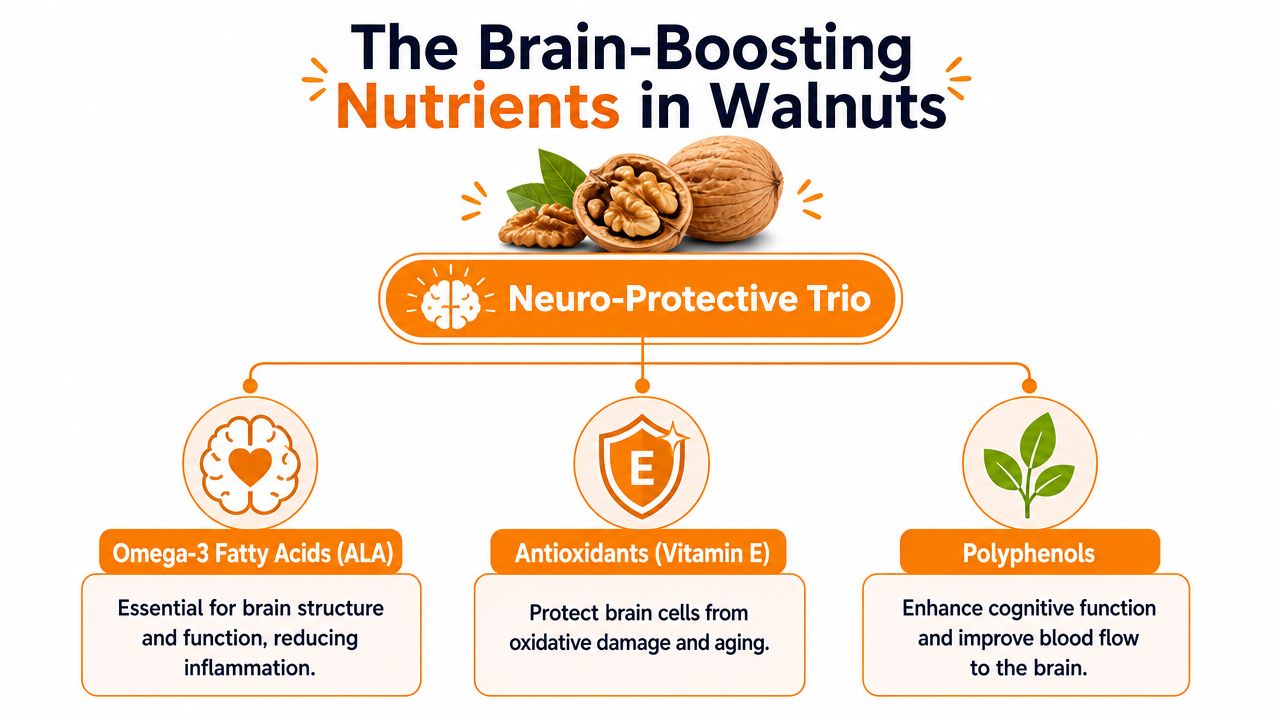
The neuro-protective trio
Three nutrient groups explain much of the interest in walnuts and brain health.
Omega-3 ALA: Walnuts are uniquely the only nut providing an excellent source of omega-3 alpha-linolenic acid at 2.5 g per ounce, a detail highlighted in University of Reading coverage on walnuts and brain function. Brain cells depend on healthy fats as part of their outer membrane, which helps them stay flexible and function properly.
Antioxidants: Normal metabolism creates oxidative stress over time. You can compare it to the gradual wear that affects any machine used every day. Antioxidants help limit that strain, which may help protect brain cells as the years go on.
Polyphenols: These plant compounds are linked with protective effects in the body and may help create a healthier setting for brain cells to do their work and communicate efficiently.
If you want more meal ideas built around aging well, Rx360's senior nutrition resources for older adults and caregivers offer practical guidance for everyday eating.
Why walnut oil deserves attention too
Whole walnuts get most of the attention, but walnut oil adds another useful angle. Some early research has looked at how compounds from walnuts may affect acetylcholine, a brain chemical involved in learning and recall. That matters because memory depends on brain cells sending clear messages back and forth.
A report discussing walnut oil notes that it may inhibit acetylcholinesterase by about 50% and stimulate neurite outgrowth, while a 2025 mouse study described there found increased choline acetyltransferase activity and decreased acetylcholinesterase, according to this walnut oil overview. In plain language, that suggests support for the brain's messaging system, especially the pathways involved in memory.
The practical takeaway is straightforward. Walnuts may support brain structure, help protect cells, and aid healthy communication between them.
For an older adult, that can connect to everyday goals such as staying organized, following conversations, and handling familiar routines with more confidence. For caregivers, it offers a gentle way to support independence together. Adding walnuts to shared meals or snacks can become one small act of care that feels supportive rather than controlling.
Evidence of Walnut Benefits for the Brain
What the human research suggests
Strong claims about brain foods are everywhere. The more useful question is simpler. What have researchers seen people do or feel after eating walnuts?
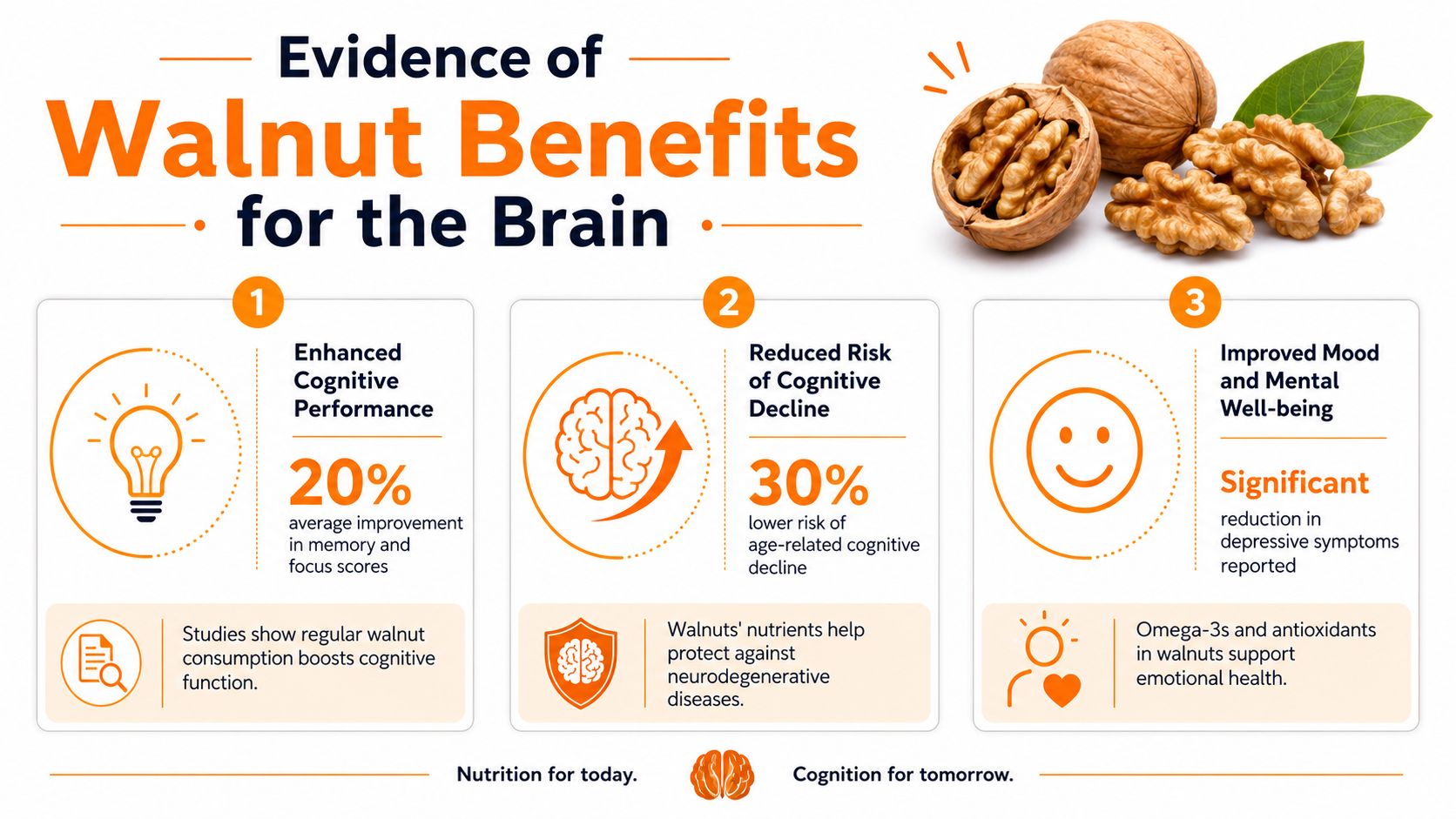
Human studies point to two practical areas. Some findings suggest support for attention and memory in daily tasks. Other research has explored whether regular walnut intake may relate to healthier brain aging over time. That does not turn walnuts into a miracle food. It does make them a reasonable food to include in a brain-friendly routine.
One helpful example comes from a controlled breakfast study in healthy young adults. Participants who ate a walnut-containing breakfast performed better on some later cognitive tasks, including memory and reaction speed, than those who ate a calorie-matched breakfast without walnuts. The pattern matters. A meal can shape the brain's workload much like good fuel helps a car run more smoothly on a long drive. For older adults, that idea connects to ordinary moments such as keeping up with conversation, staying focused during appointments, or moving through a morning routine with less mental drag.
These findings help answer a couple of common questions.
| Common question | What the evidence suggests |
|---|---|
| Do walnuts only matter after months or years? | Some research suggests changes in cognitive performance can appear within the same day, depending on the meal and the task being measured. |
| Are walnuts only relevant for serious memory decline? | Research has also looked at everyday brain functions such as attention, working memory, and reaction time. |
A caregiver may wonder what to do with that information. The simplest takeaway is to treat walnuts as one supportive habit, not a test to pass. Adding them to a breakfast or snack can be a shared routine that feels normal and respectful, which often matters just as much as the food itself for long-term follow-through.
What animal research adds
Brain research in people has limits. It is hard to watch long-term brain changes up close, and studies cannot control every part of daily life. Animal studies help fill in some of those missing pieces by showing what may be happening inside the brain.
Research in mice has linked walnuts with less oxidative stress, lower inflammation, and better performance on learning and memory tasks. Those mechanisms are useful because they give a biological explanation for the human findings. Oxidative stress is a bit like rust on delicate machinery. Over time, it can interfere with how well the system runs. Nutrients in walnuts may help reduce some of that wear.
Mouse studies provide useful clues, though they do not serve as direct proof for older adults living at home. The value is in how the pieces fit together. Human studies suggest effects on mental performance. Animal studies show plausible ways walnuts could support brain cells and communication pathways.
That combination gives families a practical middle ground. You do not need perfect certainty about every mechanism before choosing a healthy food that is easy to repeat. For older adults who are also balancing blood sugar, heart health, or other concerns, it helps to fit walnuts into a broader plan for nutrition support with chronic conditions.
For many families, food naturally involves a team effort. A daughter can keep a small container of chopped walnuts ready for oatmeal. A spouse can add them to yogurt at breakfast. An older adult can decide which version feels enjoyable and easy to stick with. That kind of shared routine supports cognitive wellness in a way that also protects independence and peace of mind.
How Many Walnuts to Eat for Cognitive Health
What the study amounts look like in real life
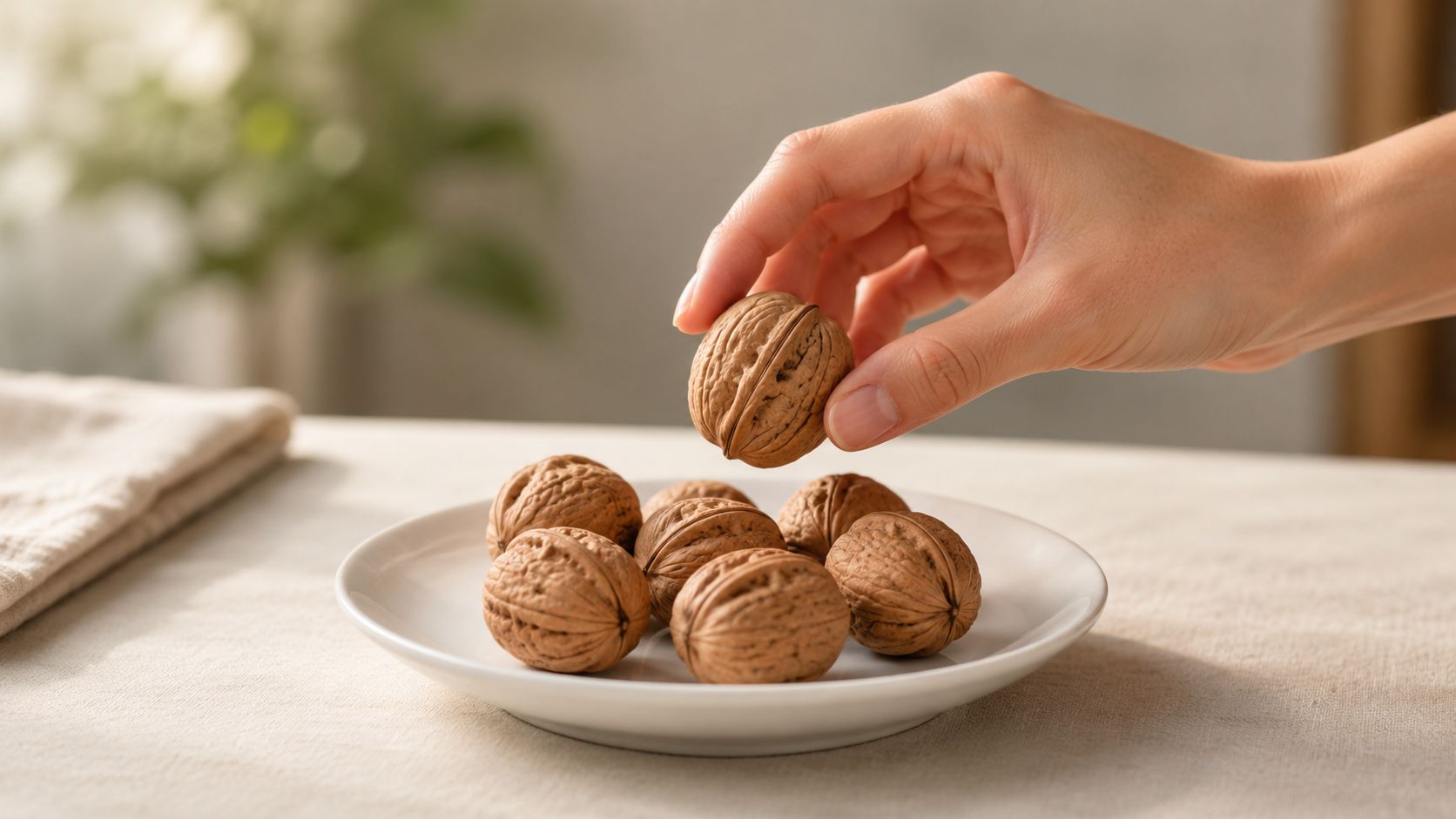
A practical target is a small handful of walnuts on most days of the week.
Earlier research discussed in this article used a serving around 50 grams, or about 1.5 ounces. In daily life, that translates to a modest handful. For an older adult or a family caregiver, that is often easier to remember than a number on a scale.
The goal is regularity, not precision. A repeatable portion works like setting the same pill organizer spot each day. You are reducing guesswork so the habit takes less mental effort.
Walnuts also fit best when they have a clear place in the day. Adding them to oatmeal, yogurt, or fruit is often easier than treating them as one more food to remember. For households already balancing diabetes, heart concerns, or other medical needs, it helps to place walnuts inside a broader plan for nutrition support with chronic conditions.
For caregivers, this can be a quiet way to support independence. Pre-portioning a few containers for the week, or keeping chopped walnuts near a familiar breakfast food, makes the choice simpler without turning meals into a project.
A simple safety checklist
A helpful serving size is one that feels comfortable to chew, easy to repeat, and realistic for the rest of the diet.
- If chewing is hard: Chop walnuts finely or stir crushed walnuts into oatmeal, yogurt, or applesauce.
- If weight or appetite is a concern: Consider using walnuts in place of chips, cookies, or other less nourishing snacks.
- If there is a nut allergy history: Avoid walnuts unless a clinician confirms they are safe.
- If medications or medical conditions are involved: Ask a doctor or dietitian about walnuts, especially with swallowing problems, digestive limits, or special diets.
Some people prefer walnuts in the morning because routines are steadier then. Others do better with them as a planned afternoon snack prepared by a spouse, adult child, or home aide. Either approach can work.
What matters most is choosing a pattern that supports daily life, helps the older adult stay engaged in their own routine, and gives the family one small habit they can maintain together.
Simple Ways to Add Walnuts to Your Daily Routine
A walnut habit is only helpful if it fits the day you already have. For older adults, the best routine is usually the one that asks for the fewest extra decisions. For family caregivers, that often means choosing one predictable moment and making it easy to repeat.
Breakfast is a strong starting point. As noted earlier, research has linked walnuts at breakfast with better thinking performance later in the day. The practical takeaway is simpler than the study details. Morning routines tend to be steadier, so adding walnuts then can feel more automatic.
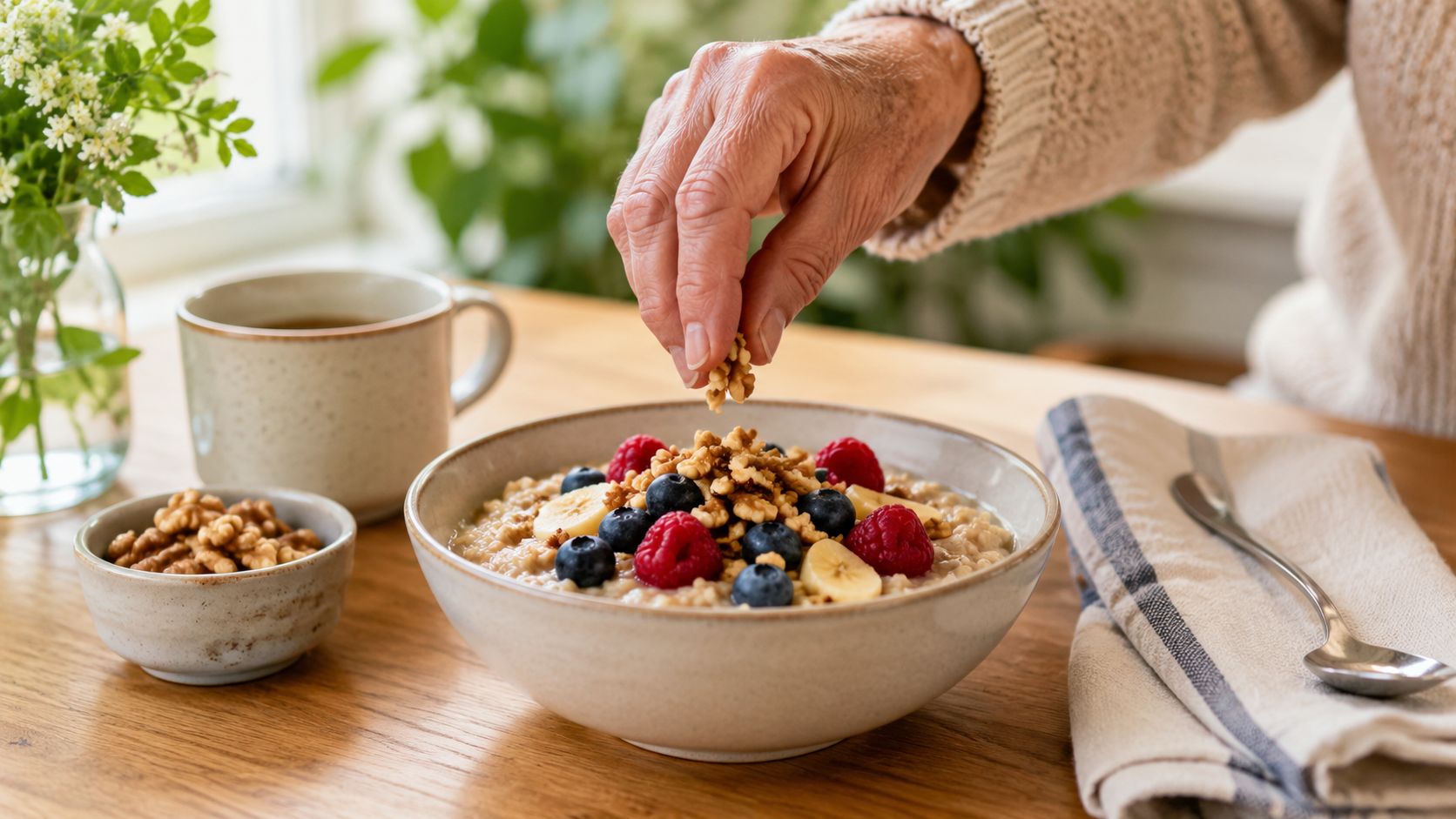
You do not need a new meal plan. Integrating walnuts into foods already on the menu is often more effective than reinventing your kitchen. A routine works a lot like a path in the grass. The more often you use the same route, the easier it becomes to follow.
Here are a few simple ways to make that path clear:
- Oatmeal upgrade: Stir chopped walnuts into warm oatmeal with berries or sliced banana.
- Yogurt bowl: Add walnuts to plain or lightly sweetened yogurt for crunch and staying power.
- Salad topper: Sprinkle a small handful over a lunch salad.
- Soft food mix-in: Fold finely chopped walnuts into applesauce, cottage cheese, or hot cereal.
- Simple snack cup: Keep a small pre-portioned container near the kettle, coffee maker, or favorite chair.
Another helpful strategy is to pair walnuts with something that already happens every day. Tea in the afternoon. A morning crossword. The end of a walk. These cues reduce the need to remember from scratch, which can lower stress for both the older adult and the person helping with meals.
A short setup can make the habit easier to keep:
- Keep walnuts where they can be seen.
- Pair them with a regular meal or snack.
- Prepare the next day's portion the night before.
“If it's already on the table, it's easier to choose.”
This is important for caregivers because support often works best when it feels respectful and low-pressure. Adding walnuts to oatmeal before serving, or setting out a snack cup beside a familiar chair, can support independence without turning food into a debate. Families looking for more small, practical ideas can explore these caregiving tips for daily routines.
A Caregivers Guide to Supporting Brain Health with Walnuts
Support without taking over
Small food choices can protect something big. For many older adults, the primary goal is staying steady in daily life. Remembering appointments, following conversations, preparing a simple meal, and feeling confident at home all matter.
That is why walnuts can be useful in caregiving. They are familiar, easy to recognize, and simple to serve. A bowl on the table or a spoonful stirred into breakfast can come across as a warm household habit. That kind of approach helps preserve dignity, which often shapes whether a new routine is accepted.
The science matters here, but the caregiving lesson is practical. As noted earlier, research on walnuts has raised interest in their possible role in cognitive support. Families do not need to turn that idea into a high-pressure project. Steady, ordinary routines usually work better than waiting until a period of worry or confusion.
Practical ways families can help
A good caregiving routine works like a handrail on a staircase. It offers support while still letting the person take the steps themselves.
Here are a few ways to make walnuts easier to include while keeping the older adult involved in the choice:
- Set up simple portions: Place a day's amount in a small container so there is one less decision to make.
- Adjust the texture: Finely chop walnuts for someone with dentures, tender gums, or slower chewing.
- Make it social: Share the same snack at the table so the older adult feels included, not singled out.
- Use familiar meals: Add walnuts to foods that already feel comfortable, such as oatmeal, yogurt, or soft cereal.
- Follow preferences: If whole walnuts are unappealing, use chopped pieces or walnut butter where the taste is gentler.
Families who want more respectful routine ideas can browse these caregiving tips for older adults and families.
Words matter, too.
A gentle script can reduce friction if a loved one hesitates:
“I've been adding these to breakfast because they may support memory. Want to try them with me?”
That phrasing leaves room for choice. It invites participation instead of creating a test to pass. For an older adult, those small moments of choice can protect confidence. For a caregiver, they can lower tension around meals.
The broader goal is collaboration. When food changes feel shared and familiar, families often find it easier to support brain health while also protecting independence and peace of mind.
A Small Habit for Lasting Cognitive Wellness
Walnuts are appealing for one reason above all others. They turn a complicated topic into a manageable habit. The brain needs support from many directions, but food is one place where people can act today without waiting for a perfect plan.
The walnut benefits brain conversation is worth paying attention to because it connects real nutrients with practical routines. Walnuts offer omega-3 ALA, antioxidants, and polyphenols. Research has linked them with better reaction time, memory performance, and protective effects in models of cognitive decline. Just as important, they're easy to fold into meals older adults already eat.
For families, walnuts can become more than a nutrition tip. They can be part of a respectful, shared routine that supports independence rather than threatening it. A bowl of oatmeal, a small snack container, or a breakfast habit repeated across the week may seem modest. But modest habits are often the ones that endure.
If you're looking for one encouraging place to start, this is a good one. A few walnuts, eaten regularly, may help nourish not just the brain, but the confidence and peace of mind that come with staying sharp for daily life.
Rx360 helps older adults stay independent while keeping families and care teams connected with simple, supportive wellness tools. If you want practical guidance that supports aging in place without adding complexity, explore Rx360.
Lower-Risk Medication Plan Checklist
Below is a practical checklist and step plan you can implement into your daily life:
-
List all medications
Include prescriptions, over-the-counter drugs, supplements, sleep aids, creams, patches, eye drops, and inhalers.
-
Mark fall-risk drugs
Flag medicines that cause dizziness, sleepiness, confusion, blurred vision, low blood pressure, or low blood sugar.
-
Ask for a medication review
Bring the list to a pharmacist or prescriber.
-
Review after any warning sign
Request a new medication check after a fall, near-fall, new prescription, dose change, dizziness, or confusion.