

Activities of daily living are the basic self-care tasks, such as bathing, dressing, toileting, transferring, continence and feeding, that people do each day to live independently. You probably did several of them before breakfast without giving them a second thought.
That's exactly why they're so useful to understand. When you can name what is activities of daily living in plain language, it's easier to notice which routines feel easy, which take a little more time, and where a small change at home might make your day smoother.
Table of Contents
- The Core Activities of Daily Living at a Glance
- How Daily Living Tasks Show Up in a Normal Morning
- Where ADLs End and IADLs Begin
- How ADLs Are Scored With the Katz Index
- Why Daily Living Skills Matter for Aging in Place
- Signs of Change Worth Noticing and Sharing
- Everyday Habits That Support Independence at Home
- Start Noticing One Routine This Week
The Core Activities of Daily Living at a Glance
The information here comes from the history and description of activities of daily living and the Katz Index, which lists bathing, dressing, toileting, transferring, continence, and feeding as the basic self-care tasks required for independent living. Sidney Katz and colleagues developed the Katz Index of ADL after studying older adults recovering from hip fractures.
The original research examined 64 hip-fracture patients over an 18-month period, and Katz's index was formally published in the Journal of the American Medical Association in 1963. It was later assessed in a larger development sample of 1,001 patients. That's why it focuses on everyday movement and self-care rather than on naming a condition.
Core Activities of Daily Living and What They Cover
| ADL | What it covers | What independence looks like |
|---|---|---|
| Bathing | Washing and drying the body | Showering or bathing safely without help |
| Dressing | Choosing and putting on clothing | Picking an outfit and buttoning a shirt |
| Toileting | Getting to and using the toilet, then getting back up | Managing the bathroom routine on your own |
| Transferring | Moving between bed, chair and standing | Standing up from a chair without help |
| Continence | Controlling bladder and bowel needs | Keeping to a regular bathroom routine |
| Feeding | Getting food from plate to mouth | Cutting food and eating a meal independently |
These six matter because they're the routines that keep you comfortable and self-sufficient at home. They're also arranged in a broadly hierarchical pattern, so more demanding functions, such as bathing, often become impaired before simpler tasks such as feeding.
In more detailed lists, walking and moving around the home are often grouped with transferring, so you may see mobility mentioned alongside sitting, standing, and getting in and out of bed. The labels can vary a little, but the everyday idea stays the same.
Quick self-check, which of these tasks do you handle without thinking, and which take a little extra effort or a little extra time?
There's no pass or fail in that check. You're getting familiar with your own routines, which makes later conversations about support much clearer and calmer.
How Daily Living Tasks Show Up in a Normal Morning
The core ADL definitions from the Katz Index research frame this morning routine, even though you don't need any special terms to live it. You're already doing the sequence, one small step at a time.
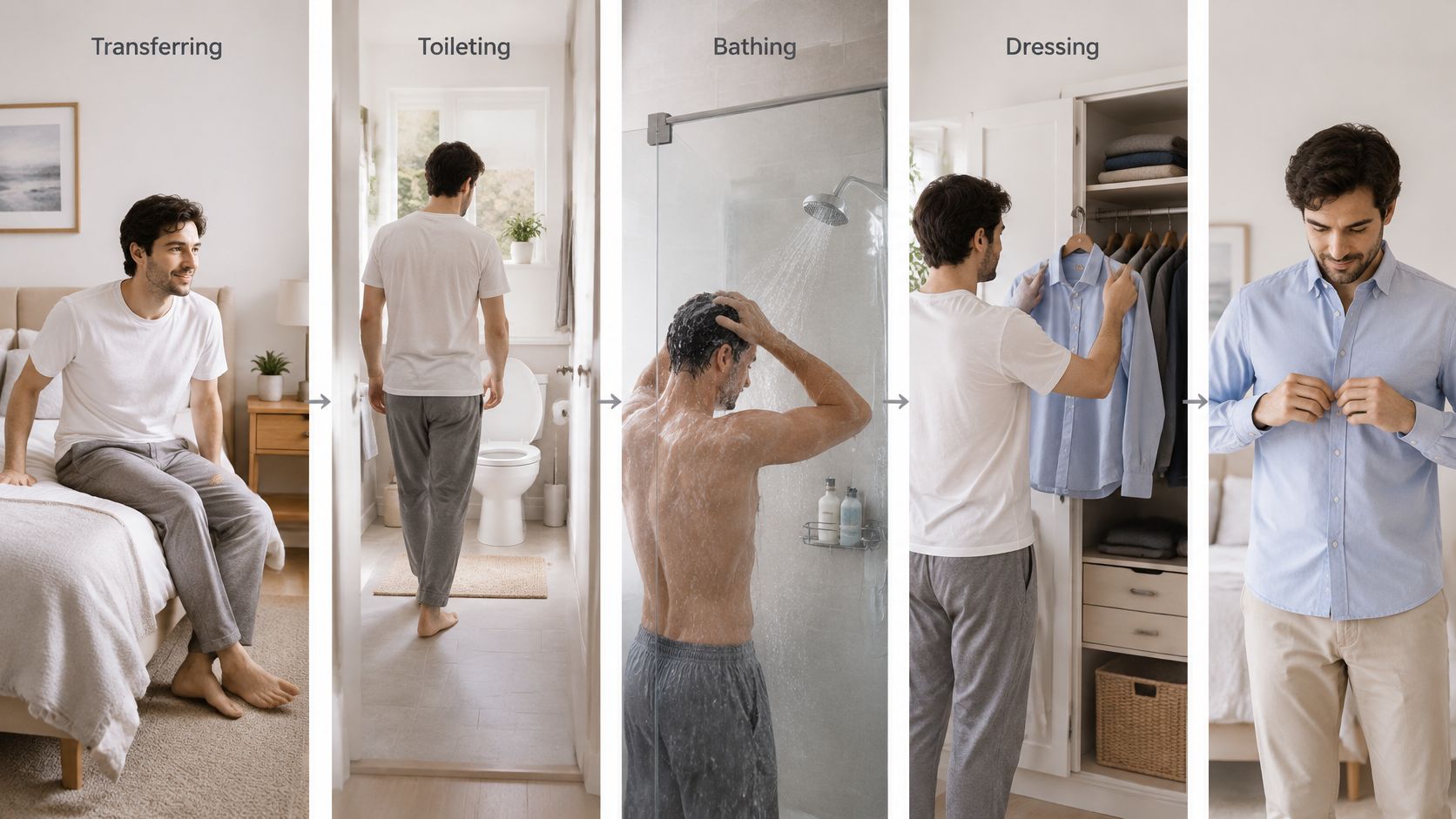
You wake up, sit on the edge of the bed, stand, and walk to the bathroom. That's transferring. You use the toilet and wash your hands. That's toileting.
Next comes a shower, drying off, and maybe sitting on a sturdy chair while you get dressed. That's bathing followed by dressing, including choosing clothes, buttoning a shirt, and putting on socks and shoes.
Then you head to the kitchen, sit down, and cut your toast or lift a spoon to your mouth. That's feeding. A bowl that's easy to grip, clothes laid out the night before, and a non-slip mat in the bathroom are small details, but they can make each step feel smoother.
The Same Morning Can Look Different
Think of ADLs like the foundation of a house. You rarely think about the foundation until a wall needs a little support, and needing support in one spot doesn't change the whole house.
- One person's version: Bathes and dresses alone, but prefers a hand with socks on stiff mornings.
- Another person's version: Moves quickly most days, but takes longer after a poor night's sleep or during a busy, tiring week.
Day-to-day variation is normal. A slow Tuesday isn't the same as a lasting change that shows up week after week.
Try a simple exercise tonight. Write your own morning in five short lines and tag each line with the ADL it belongs to. You'll likely see your routine more clearly than any checklist could show it.
Where ADLs End and IADLs Begin
A full morning of self-care can still leave the afternoon unfinished. You might bathe, dress, and eat without help, then pause when the grocery run, the bus time, and a bill all wait on the same day. That pause is often where basic daily tasks give way to a wider set of skills.
A standard clinical description from the National Center for Biotechnology Information describes ADLs as basic self-care and mobility tasks such as eating, dressing, bathing, toileting, continence management, walking, and transferring between positions. These routines stay close to the body.
Activities of Daily Living, or IADLs, are higher-order tasks required for independent community living. They include medication management, shopping, meal preparation, transportation, finances, household work, and telephone use. ADLs work like the lower steps of a staircase you climb through the week. IADLs sit on the steps above them: still part of the same routine, just farther from the body and closer to the household and the neighborhood.
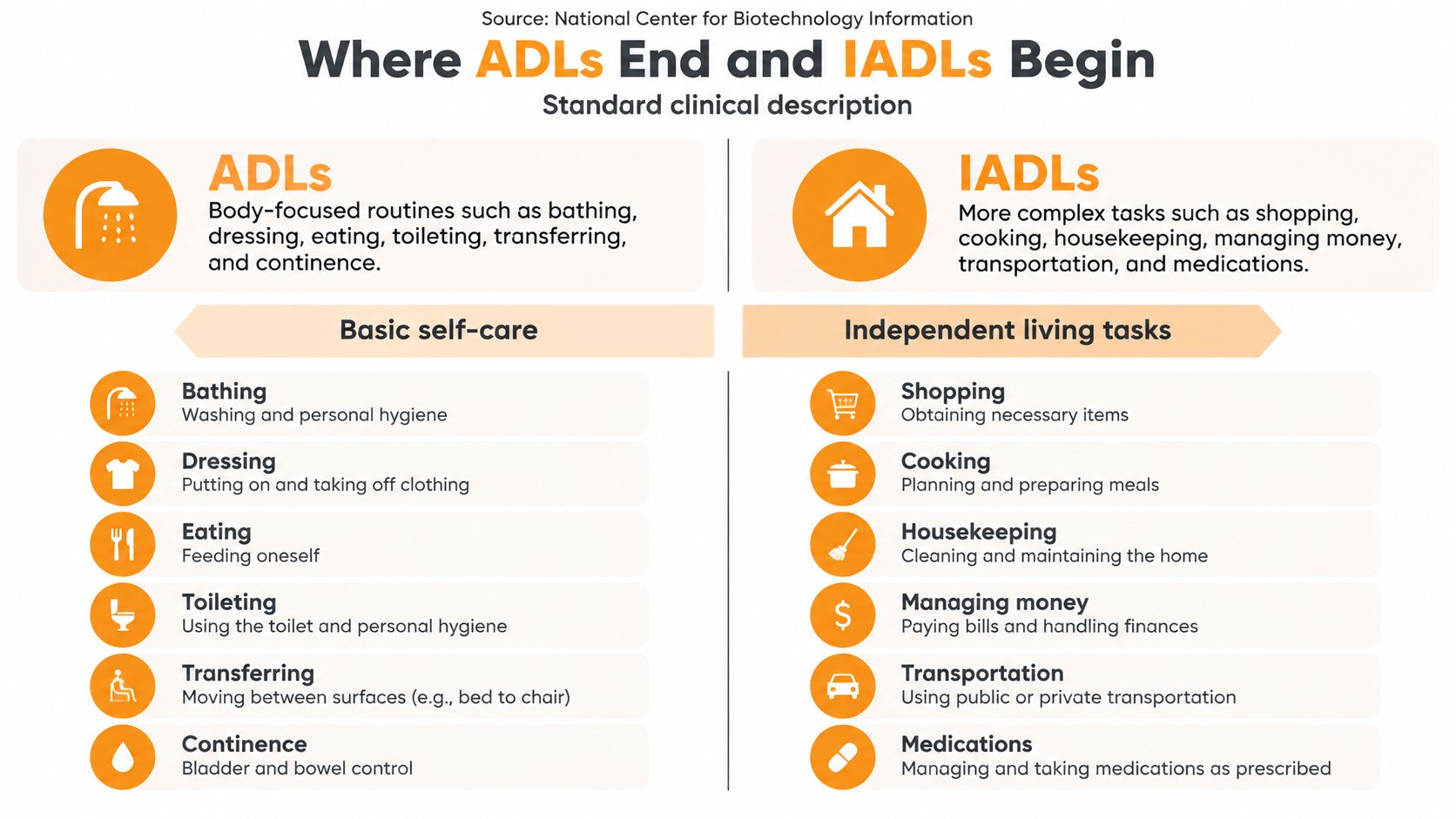
A quick check helps. If the task is about caring for your body, it is an ADL. If it is about managing your home, your errands, or your connections with other people, it is an IADL. Many weeks include both, and a person can be steady on one step while needing a hand on another.
IADL Domains and What Each One Involves
| IADL domain | What it involves | Everyday example |
|---|---|---|
| Telephone use | Making and answering calls | Calling a friend or answering a call from family |
| Shopping | Planning and buying necessities | Picking up groceries or household items |
| Food preparation | Planning and cooking meals | Making a simple lunch |
| Housekeeping | Keeping the home tidy and safe | Vacuuming or washing dishes |
| Laundry | Washing and folding clothes | Running a load and folding towels |
| Transportation | Getting around the community | Riding with a neighbor or taking a bus |
| Medication management | Keeping track of medicines | Using a weekly pill organizer |
| Finances | Managing money and bills | Paying a bill on time |
Someone can stay independent in basic ADLs and still find one or two IADLs harder than they used to. That pattern is a place to notice support, not a diagnosis and not a label for the whole person.
IADL tasks can be shared, supported, or set up with reminders. A shared grocery list or a ride from a neighbor does not take independence away. It often helps independence last longer, because the harder community tasks stay doable while the body-care routines continue on their own.
How ADLs Are Scored With the Katz Index
The scoring described here comes from a peer-reviewed article in PMC on functional measurement, which explains that the Katz Index uses a binary model for six functions, bathing, dressing, toileting, transferring, continence, and feeding. Each function gets one point when a person performs it without supervision, direction, or personal assistance, and zero when assistance is required.
Say someone bathes, dresses, uses the toilet, transfers, and feeds independently, but needs help with one function. That's five points out of six. The total can range from 0 to 6.
Katz Index Score Bands and What They Describe
| Total score | Commonly cited reading | What it describes |
|---|---|---|
| 6 | Full function | All six tasks done without supervision or personal help |
| 4 | Moderate impairment | Some tasks need supervision, direction or personal help |
| 2 or less | Severe impairment | Most tasks need help or full care |
These readings describe performance on the scale. They're not a diagnosis. They provide families and care teams a shared language for talking about everyday function.
You're not limited to yes or no when you make your own notes. Observations are more useful when they record the level of assistance, and our guide to functional independence measurement explores that idea further.
- Independent: Done alone, without reminders.
- Using an assistive device: Done with a tool, such as a grab bar or easy-grip utensil.
- Needing verbal cues: Done after a reminder or prompt.
- Needing hands-on help: Another person physically helps with part of the task.
- Fully dependent: Another person does the task.
A total score can stay the same while effort, time, or reminders quietly increase, so notes about context add meaning that a number alone can't show.
That's the main limit of the binary model. It can miss small day-to-day changes. A family could still track the six tasks informally with a simple yes or no each week, as long as everyone remembers it's a personal record, not a formal assessment.
Why Daily Living Skills Matter for Aging in Place
Someone may dress without help on Monday, need a hand with buttons by Friday, and manage alone again the next week. Daily living skills rarely switch from “can” to “can't” overnight. They move along a continuum, and that continuum is what aging in place is built around.
The number of older adults who need some support with daily activities is expected to grow substantially in the coming decades. Planning for home life works better when it starts from the routines a person already does, rather than from one yes-or-no label.
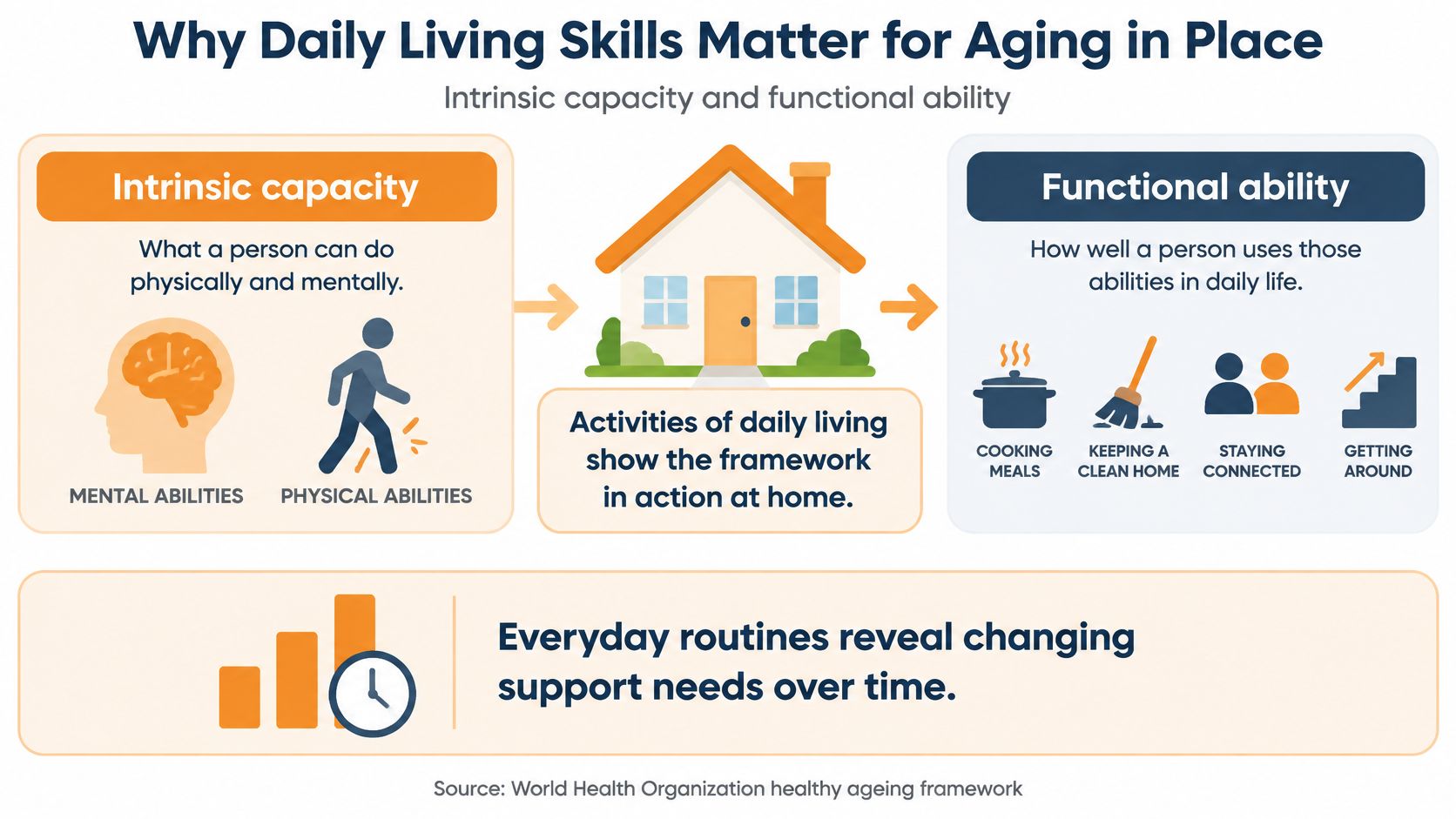
Capacity and ability are not the same thing. Capacity is the mix of physical and mental resources a person can draw on, such as walking, thinking, seeing, hearing, and remembering. Ability is what those resources let someone do once the room, the tools, and the people nearby are part of the picture. A sturdy chair or brighter light can change what the same person manages on a given morning, the way a well-placed handrail turns a short walk from risky to ordinary.
That pairing of person and place is why an overview of aging in place solutions looks at home setup alongside personal routines.
Five Broad Areas in Everyday Life
- Meeting basic needs: Eating, dressing, and bathing.
- Learning, growing, and making decisions: Choosing what to wear or planning the day.
- Being mobile: Moving from bed to chair or around the home.
- Building and maintaining relationships: Sharing a meal with a neighbor.
- Contributing to society: Volunteering or helping in the community.
A morning spent washing, dressing, and making breakfast does more than finish chores. It keeps the day in order, keeps the body moving, and leaves time for people and hobbies. Across a week, those same tasks show where support would help and where it would get in the way. ADLs give families a shared everyday language, so help can be added where it is useful without taking over tasks a person still enjoys doing.
Signs of Change Worth Noticing and Sharing
This section opens with a 2023 comparison published by the U.S. Department of Veterans Affairs Health Systems Research, which found that estimates of older adults receiving help with dressing varied from 5.3% to 12.4% across three nationally representative U.S. surveys.
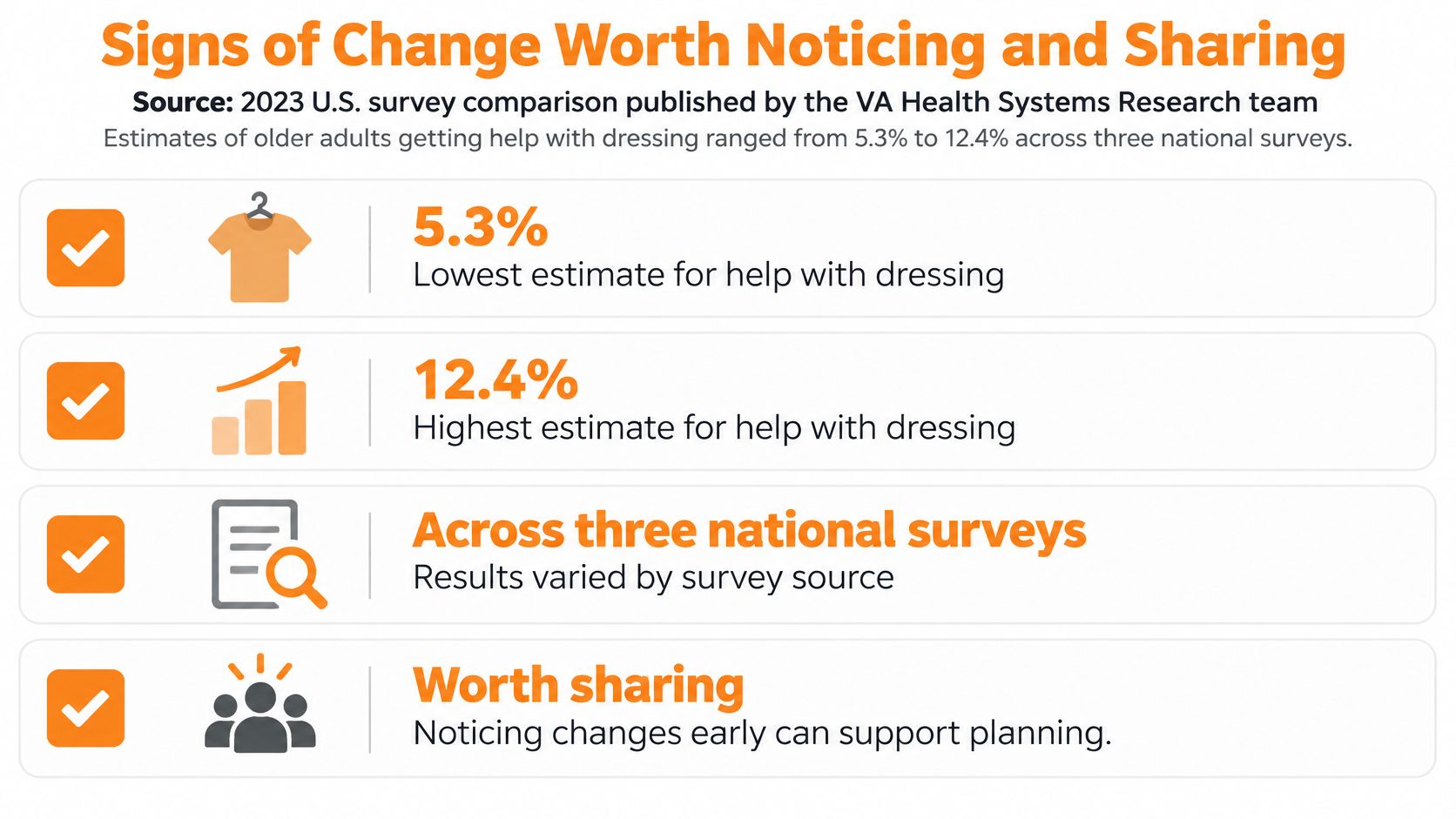
Those numbers show that getting some help is more common than many people expect. They also show that results can vary by survey, so one number never tells your personal story. The goal is noticing patterns, not reacting to one bad day.
Observations Worth Writing Down
- Taking noticeably longer: A routine that once felt quick now stretches out most days.
- Skipping a task: A step that used to be easy gets left out more often.
- Using furniture for balance: Hands reach for walls, counters, or chair backs more often.
- Needing more reminders: Daily tasks need extra prompts to get started or finished.
- Changing clothing choices: Outfits are chosen differently, or fasteners are avoided.
- Shifting frequency: A habit happens much more or much less often than before.
Normal ups and downs happen with tiredness, a busy week, or a new season. A steady trend is different because it keeps showing up over several weeks. Writing the date beside each note helps you see that difference, much like the ideas in our article on behavior pattern recognition.
You're describing what you noticed, not deciding what it means.
If a change feels sudden, or the same pattern keeps showing up over several weeks, pass your notes to a family member or a care team member and ask what the next step should be. Sharing clear, dated notes makes that conversation easier for everyone. You don't need to name a condition or guess at a cause.
Everyday Habits That Support Independence at Home
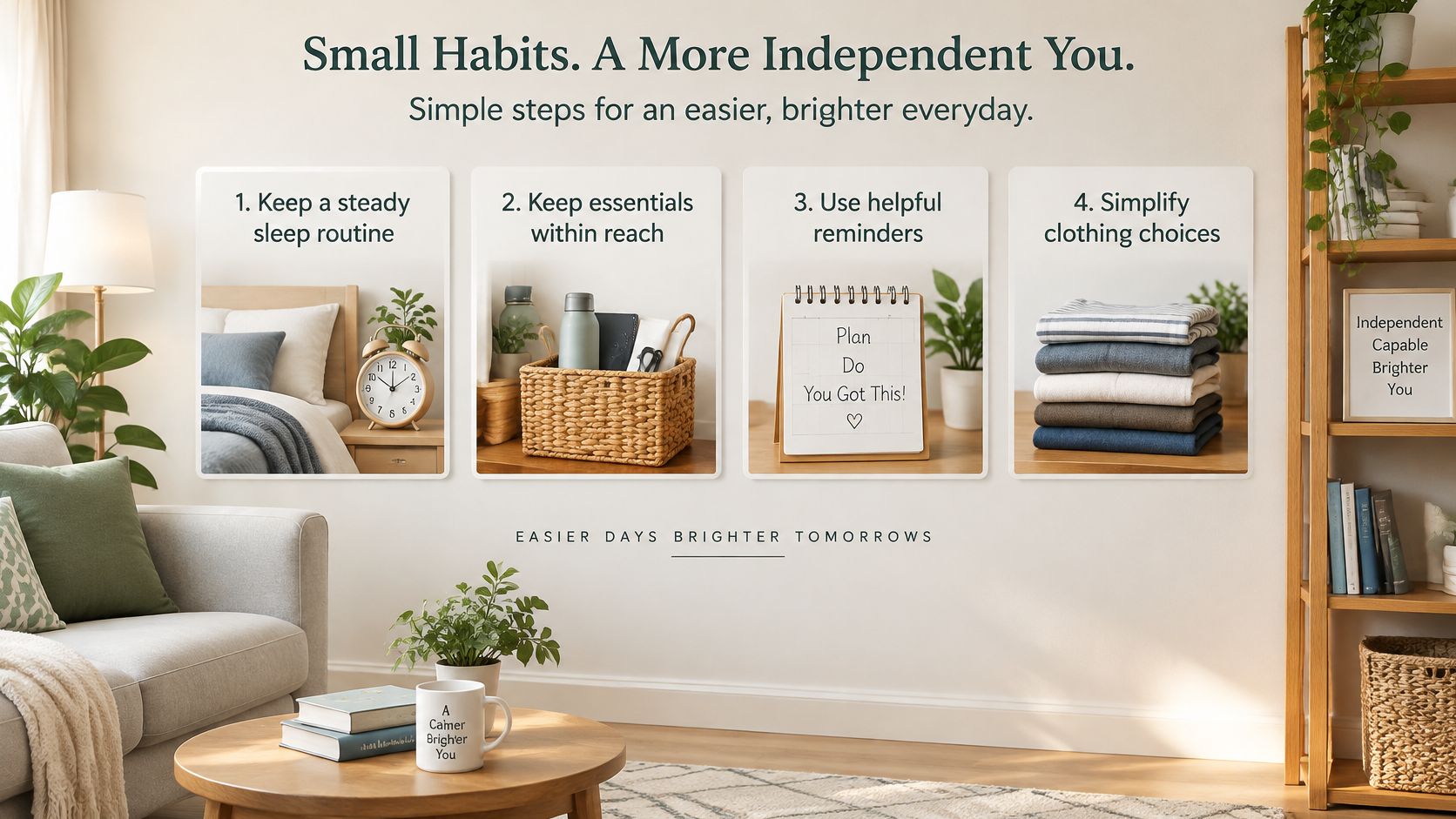
A Tuesday can look ordinary and still show how much ease a day needs. The kettle clicks on, a shirt goes over the head, and the walk to the mailbox takes a few extra breaths. Capability works like a dimmer, not a switch that is only on or off. A little more ease in one task can make the next one smoother.
These ideas are general information about everyday routines. They are not medical advice, and they do not promise a particular result. Small habits you can repeat on a normal week usually fit real life better than a total overhaul. Pick the ones that feel pleasant enough to do again.
Simple Habits to Explore
- Keep a steady sleep routine: Going to bed and getting up around the same time can make mornings feel more predictable and easier to start. Morning energy often sets the pace for washing, dressing, and breakfast.
- Add short daily movement: A brief walk or gentle movement built into the day supports getting around as part of a normal routine, whether that is a hallway loop or a slow trip outside.
- Practice balance in small moments: Standing tall at the kitchen counter while you rinse a cup turns an everyday minute into gentle practice. You stay near a sturdy surface the whole time.
- Set up your home for ease: Good lighting, sturdy chairs, grab bars where useful, and everyday items within reach cut extra stretching and searching. Fewer awkward reaches can make bathing, dressing, and moving through rooms feel steadier.
- Make IADLs visible: A weekly calendar on the fridge or a pill organizer on the counter keeps medications and appointments easy to see. Planning stays in the room where you already stand, instead of living only in memory.
- Stay socially connected: Calls, group activities, or a regular meal with friends weave relationships into the week. Conversation can sit beside meals and errands rather than waiting for a perfect free afternoon.
- Keep your mind active: Puzzles, reading, or learning something new gives the day variety. That interest can ride along with a quiet hour you already have, such as after lunch or before bed.
Sleep, movement, balance, a clearer home, a visible calendar, company, and mental variety each touch a different part of the same week. Together they describe a range of support, from tasks you handle alone to moments where a cue, a rail, or a friend makes the routine easier to finish.
Start Noticing One Routine This Week
Pick one routine, such as your morning bathroom and dressing sequence or your weekly grocery run, and notice how it goes for seven days. Jot down what feels easy, what takes more time, and any reminders you rely on. Keep the notes short and kind, like a diary rather than a test.
A wellness platform can sit alongside that habit if you'd like extra structure. Rx360 is a modern wellness platform for independent older adults, designed to support active, independent living. Its pilot services include Medication Dashboards, Medication Reminders, Support Circle Sharing, Location Tracking, and Fall Tracking, which can support IADLs like medications and help loved ones receive updates when you choose to share.
It's one helpful option among several, and paper notes work well too. Either way, you can share your week of observations with a family member or a care team member, who can help interpret what you've seen. Your routines stay yours, with connection close by.
If you'd like your daily routines and medication reminders to feel easier to track while you stay connected to the people who matter, visit Rx360 to explore a modern wellness platform built for independent older adults. Its pilot services support active, independent living at home, so you can keep enjoying the routines you love with support within reach.
Lower-Risk Medication Plan Checklist
Below is a practical checklist and step plan you can implement into your daily life:
-
List all medications
Include prescriptions, over-the-counter drugs, supplements, sleep aids, creams, patches, eye drops, and inhalers.
-
Mark fall-risk drugs
Flag medicines that cause dizziness, sleepiness, confusion, blurred vision, low blood pressure, or low blood sugar.
-
Ask for a medication review
Bring the list to a pharmacist or prescriber.
-
Review after any warning sign
Request a new medication check after a fall, near-fall, new prescription, dose change, dizziness, or confusion.