
Your daughter is three time zones away. She wants to know how Dad's week is going, but calling every hour could make his days feel crowded. He may have met a friend for coffee, tended the tomatoes, or taken his usual afternoon walk.
Long distance caregiving tips work best when they make room for an older adult's routines, preferences, and independence. Distance is one part of the picture. Family members can learn how to take part in the rhythms that already make a day feel like their own.
These seven ideas draw on published guidance from AARP, the Family Caregiver Alliance, the World Health Organization, and the National Institute on Aging. The Family Caregiver Alliance reports that approximately 5–7 million U.S. caregivers, about 15% of all caregivers, live at a distance.
Table of Contents
- 1. Scheduled Regular Check-Ins
- 2. Shared Digital Calendar for Daily Routines
- 3. Discreet Smart Home Technology That Supports Independence
- 4. Building a Local Support Network
- 5. Encouraging Movement and Consistent Sleep Routines
- 6. Shared Activities and Virtual Hobbies Together
- 7. Planning Together and Respecting Personal Preferences
- How the seven approaches compare at a glance
- Keep the Circle Turning Wherever You Live
1. Scheduled Regular Check-Ins
This rhythm starts with the AARP caregiving hub, a public collection of ideas for staying in touch when you don't share a kitchen or a street.
A standing call gives both of you a place on the week instead of a surprise ring in the middle of a show. Say a daughter keeps Sunday late morning for a video chat with her father. One week her brother leads and asks about the garden. The next week a grandchild shows a drawing. Dad knows the time, so he can set the tablet on the table before anyone dials.

Families who like this pattern often keep three habits.
- Match the day to real life: Pick a time that fits meals, rest, and work, then keep it.
- Leave room for ordinary talk: Hobbies, neighborhood news from his point of view, and old stories belong on the call.
- Jot a shared note: A few lines about what you discussed help the next call pick up there.
A predictable Sunday call can feel kinder than three unplanned check-ins, because everyone knows when connection is coming.
Siblings can split the week so one person isn't the only voice he hears. The call can stay short. The habit is what carries the relationship.
2. Shared Digital Calendar for Daily Routines
AARP's caregiving conversations often turn toward one shared view of the week. In a survey of 1,000 technology-using family caregivers, 47% had used an electronic organizer or calendar for caregiving tasks, as reported in the e-Connected Family Caregiver Study.
Picture a parent who adds Thursday book club herself. Her children see it without texting "what are you doing Thursday?" She still owns the day. They might offer a ride, or they might know she'll be out and happy about it.
A plain shared calendar can hold a walking group, a hobby class, a family call, and other plans she wants visible. Agree together on what is shared and what stays private. Large text and a simple layout help on a phone or tablet. Once a month, look at the week together and clear events that no longer happen.
If you're comparing tools, a roundup of apps caregivers actually use can sit beside that monthly look, as one place to see options rather than a required list.

A shared week: When book club is on the calendar, nobody has to ask twice, and the person who added it stays in charge.
3. Discreet Smart Home Technology That Supports Independence
Ideas in this section start with AARP Livable Communities, which looks at homes and neighborhoods that make everyday life easier to keep. Separate U.S. caregiver reporting found that 25% of family caregivers used apps, video platforms, wearables, or other monitoring systems in 2025, up from 13% in 2020, according to Caregiving in the US technology findings.
Most families still aren't using those tools, so a quiet start beats a house full of gadgets. A voice assistant, set up with the older adult's approval, can read the day's reminders out loud. A short path of connected lights can make a nighttime walk to the kitchen easier to see. The home should still feel like a home.
Say a son who lives in another state helps his mother choose one lamp for the hallway and nothing else for a month. If she likes it, they talk about a second device. If she doesn't, they stop.
- Begin with one or two devices: Add more only if daily life feels easier.
- Talk through sharing settings first: Decide who can see what, and how to turn sharing off.
- Favor simple controls: Large buttons, clear voice feedback, or a very plain app tend to stick.
A closer look at aging in place solutions can help a family compare home setups while independence stays the point.

4. Building a Local Support Network
This part draws on the World Health Organization's page on ageing and health, which treats community life as part of growing older, not as an extra. Practical help is already common in U.S. caregiving. The 2024 National Survey of Older Americans Act Participants reports that 95% of caregivers helped with shopping or transportation to appointments, and 90% helped arrange services or assist with finances.
From far away, that help often sits with neighbors, friends, a faith group, or a community center. A daughter might ask a trusted neighbor to join her father's weekly walk through the park. He might already like lunch and cards at a local center. The family role is to know those people, not to replace them.
A short contact list
- Name the trusted circle: Write who they are, how to reach them, and what they like doing with him.
- Match groups to interests: A garden club, a choir, or a walking group beats a generic signup.
- Check roles now and then: A quick note keeps everyone clear without turning friendship into a job.
The neighbor who already waves from the driveway may be the most natural part of the week.

5. Encouraging Movement and Consistent Sleep Routines
Movement and rest in this section start from the World Health Organization's physical activity fact sheet. A separate Administration for Community Living lesson plan lists four activity categories for maintaining mobility: aerobic activity, muscle strengthening, flexibility, and balance. It lists weekly targets of 150 minutes of moderate-intensity aerobic activity or 75 minutes of vigorous activity, plus muscle-strengthening on two days and balance exercises for 10 minutes on two days each week. Those figures are general activity recommendations, not an individual plan.
A grandchild and a grandparent can each take a daily walk and swap a photo of the route. Nobody is scoring the other person. On a weekly call, a family might also talk about a steady evening wind-down, like dimmer lights, a favorite radio show, and a regular bedtime. More ideas for that wind-down sit in this piece on sleep hygiene for elderly adults who want the routine to stay simple.
Keeping it light
- Start small: A short walk or a few balance minutes can be enough to begin.
- Share a simple log: Days, minutes, and a note about the weather are plenty.
- Notice consistency: Showing up matters more than a perfect week.
The calendar from earlier can hold "walk" and "wind-down" as ordinary entries he chose, right beside book club.
6. Shared Activities and Virtual Hobbies Together
Shared pastimes here draw on the National Institute on Aging, whose public pages treat staying engaged as part of later life.
Doing something together, even from different cities, can make distance feel less like a gap and more like a standing date. A family might run a monthly online trivia night with relatives in several places. Grandchildren might send a photo of a meal they cooked, and a grandparent sends the family recipe back. A virtual book club, a joint puzzle, or a shared photo album works the same way.
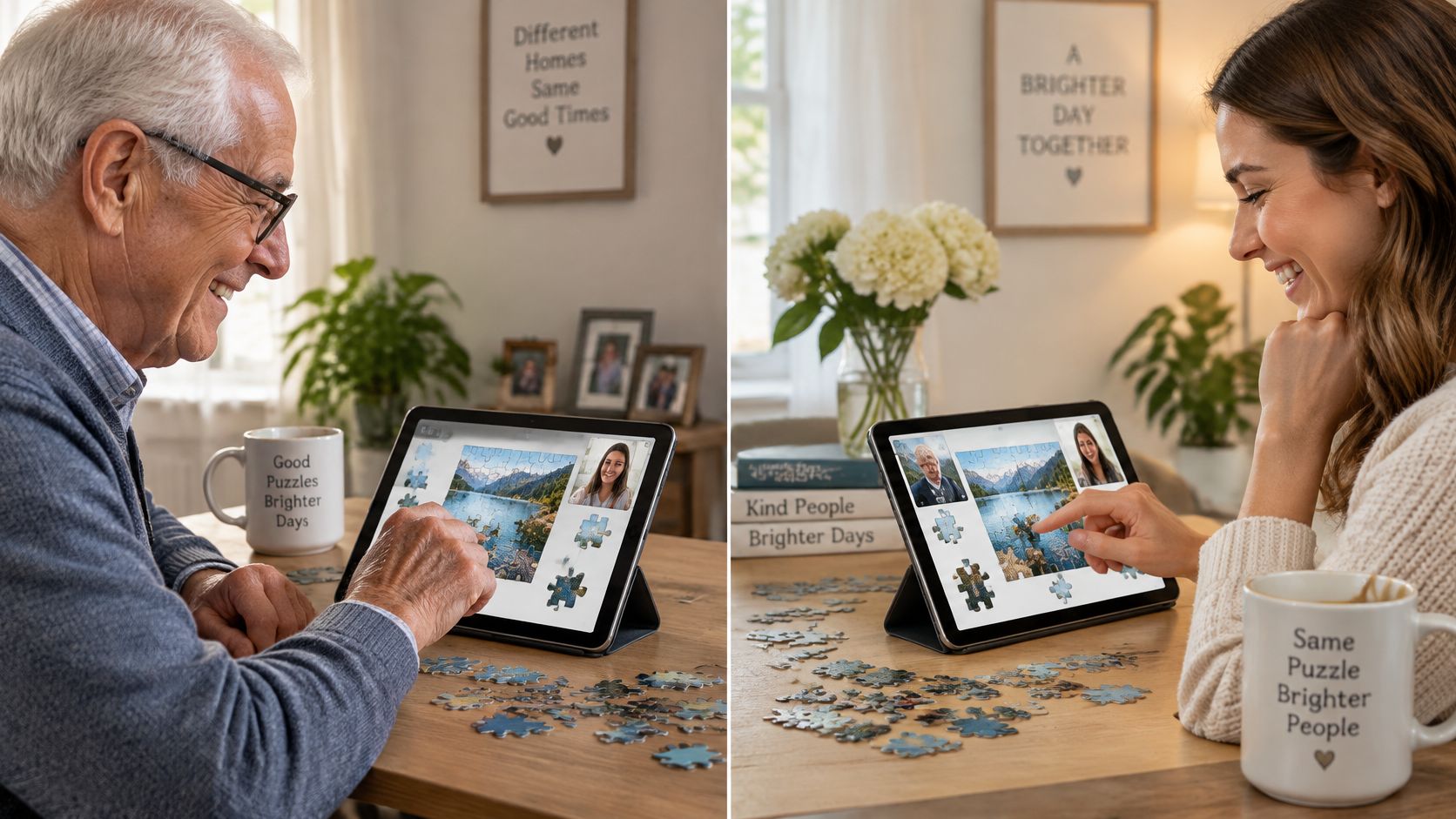
Ask what he already enjoys, then build around that. If he likes birds, the call can be ten minutes of "what did you see this week?" If he likes cooking, trade one recipe a month. Short and relaxed beats a long production.
- Let him pick the hobby: Interest is what brings him back next time.
- Keep the session brief: Twenty unrushed minutes can be plenty.
- Leave a trail between calls: A group chat or shared album keeps the fun going on ordinary days.
The activity belongs to him. Everyone else is joining in.
7. Planning Together and Respecting Personal Preferences
Planning notes in this section follow AARP's caregiving materials and Atul Gawande's Being Mortal (2014), both of which keep the person's own wishes in the middle of family decisions. Time matters here. The National Alliance for Caregiving reported that in 2025 the average duration of family caregiving was 5.5 years, and nearly 30% of caregivers had provided care for at least five years.
A shared "about me" page can hold favorite routines, important contacts, and personal preferences in plain language. One family revisits that page each year over tea on a video call. What still feels right? What has he outgrown? What does he want more of, like morning radio, Tuesday lunch with a friend, or an untouched afternoon?
A curious conversation
- Start with his goals: Ask what a good ordinary week looks like to him.
- Write preferences clearly: A shared note is easier to update than a long binder.
- Set a review reminder: Once a year, or after a big change, look again together.
Curiosity first, paperwork second, keeps the plan from drifting away from the person it is about.
The Administration for Community Living describes family caregivers, including people who help from a distance, as most often supporting someone to remain in their own home and community. That is a practical reason to write preferences down while everyone is calm.
How the seven approaches compare at a glance
| Item | Best For | Setup Needed | Best Starting Point |
|---|---|---|---|
| Scheduled Regular Check-Ins | Building a steady connection and noticing changes over time | Choose a recurring call time and preferred format | Set a weekly call that fits everyone's routine |
| Shared Digital Calendar for Daily Routines | Coordinating schedules while supporting independence | Choose a shared calendar and agree on access and privacy | Add recurring activities and review the calendar together |
| Discreet Smart Home Technology That Supports Independence | Supporting everyday independence and offering general reassurance | Select devices, configure them, and agree on privacy settings | Start with one or two useful devices |
| Building a Local Support Network | Providing in-person companionship and practical help | Identify trusted local contacts and relevant services | Make a contact list and connect with nearby groups |
| Encouraging Movement and Consistent Sleep Routines | Supporting healthy habits with flexible, shared goals | Choose enjoyable activities and a simple way to track them | Begin with a small daily movement or sleep goal |
| Shared Activities and Virtual Hobbies Together | Creating enjoyable shared experiences from a distance | Pick an activity and set up any needed device or app | Ask what the older adult enjoys and plan a short session |
| Planning Together and Respecting Personal Preferences | Keeping the older adult's goals central and coordinating family support | Discuss preferences, document key details, and assign tasks | Start with a conversation about what matters most |
Keep the Circle Turning Wherever You Live
Distance changes how help shows up. It doesn't have to move an older adult out of the center of his own week. A Sunday call, a calendar he can edit, one useful light, a neighbor who walks with him, a photo of today's route, a shared puzzle, and a page of preferences can sit together as a circle. None of those pieces asks him to give up the day he already likes.
Small routines are easier to keep than grand plans. Pick one habit this week and let it become familiar before you add another. If the call is already steady, the next gentle step might be the shared calendar, or the "about me" page. If a local friend is already in the picture, a short note about who does what can be enough.
Rx360 offers a Family Connection feature designed to help loved ones stay close when they are far away. It is one option among many, not a requirement, for families who want a simple way to stay in the loop while independence stays intact. If a shared rhythm sounds useful, you can explore Rx360 and start with whichever idea on this list fits this week.
Rx360 is a wellness platform for independent older adults, with Family Connection and a support circle so relatives can stay close to daily routines from far away. That kind of connection fits long distance caregiving tips that keep preferences, movement, rest, and local friendships in view. Visit Rx360 and try one shared habit from this list with someone you love this week.
Lower-Risk Medication Plan Checklist
Below is a practical checklist and step plan you can implement into your daily life:
-
List all medications
Include prescriptions, over-the-counter drugs, supplements, sleep aids, creams, patches, eye drops, and inhalers.
-
Mark fall-risk drugs
Flag medicines that cause dizziness, sleepiness, confusion, blurred vision, low blood pressure, or low blood sugar.
-
Ask for a medication review
Bring the list to a pharmacist or prescriber.
-
Review after any warning sign
Request a new medication check after a fall, near-fall, new prescription, dose change, dizziness, or confusion.