
A wrist watch that takes blood pressure can show two familiar numbers, and still be doing a completely different job from the watch beside it on the shelf. One squeezes the wrist. Another watches the pulse with light and estimates. People often treat those screens as the same tool.
That mix-up is easy to make, and it changes what the number is for. A calm morning routine, a walk, better sleep, and staying independent at home all benefit from clear information. A wrist number can sit beside those habits. It is not a diagnosis, and it is not a reason to change a medicine.
Sorting the hardware first makes later accuracy claims easier to read.
Table of Contents
- The Three Kinds of Wrist Watch Blood Pressure Readings
- Pros and Cons
- How Calibration Shapes the Number You See
- What Validation Studies Show and How to Read Them
- What to Check When Choosing a Watch for an Older Adult
- How to Take a Reading the Right Way
- Troubleshooting Readings That Look Off
- Sharing Readings, Privacy and Your Next Step
The Three Kinds of Wrist Watch Blood Pressure Readings
The short answer is that wrist watches reporting blood pressure fall into three groups, and they are not interchangeable. The 2025 American Heart Association scientific statement reported that cuffless devices, including smartwatches, rings, patches, and fingertip monitors, show promise but had not yet demonstrated sufficient accuracy and reliability for diagnosing hypertension or guiding treatment.
Picture a family comparing three boxes for a parent who wants a simple morning check beside a walk and a regular bedtime. One box is a traditional monitor. One is a watch with a band that inflates. One is a slim smartwatch with no pump at all. The table is the sorting step.
| Type | How it gets the reading | Role in current research | Validation to look for |
|---|---|---|---|
| Upper-arm cuff monitor | Inflatable cuff on the upper arm | Reference device that watches are compared against | Testing under a named protocol such as ISO 81060-2 |
| Wrist cuff watch | Inflatable band at the wrist, direct measurement | Measures directly; still needs its own accuracy testing | Published testing for that exact model |
| Cuffless smartwatch | Optical pulse sensor, estimate after calibration | Studied, but not yet shown accurate enough for diagnosis | Per-model validation and clear calibration rules |
An upper-arm cuff monitor inflates on the upper arm and is the reference device that validation studies compare other devices against. A wrist cuff watch inflates a small band at the wrist and measures directly. A cuffless smartwatch uses an optical pulse sensor and estimates pressure from pulse signals after calibration.
The product page or spec sheet usually gives the type away. Look for words such as cuff, optical sensor, or estimate. A watch that only shows a trend is a different tool from one that measures directly, so the type should match the question you want answered.
Pros and Cons
A real-world study of three watch-type devices, described on PubMed, found that average readings were within 5 mmHg of a sphygmomanometer. None of the three met all ISO 81060-2 reliability criteria, and one device systematically underestimated systolic pressure by about 8.5 mmHg.
Wrist cuff watches measure with an inflatable band, so the reading is direct rather than an optical estimate. That still leaves model-by-model testing. The study above is a clear example: a close average did not mean every reliability criterion was met.
Cuffless watches are easy to wear through a day of errands, balance practice, or time with friends, and readings can sit beside sleep and activity. Drawbacks named in device comparisons include arm position, skin characteristics, arterial stiffness, motion, and time since calibration.
Upper-arm cuffs remain the reference device in validation work, and they use a standardised test method. They ask the person to sit still, and the fit is less convenient for all-day wear.
Practical rule: Match the tool to the question, whether that question is a trend, a check against an unexpected value, or a conversation starter with a clinician.
How Calibration Shapes the Number You See
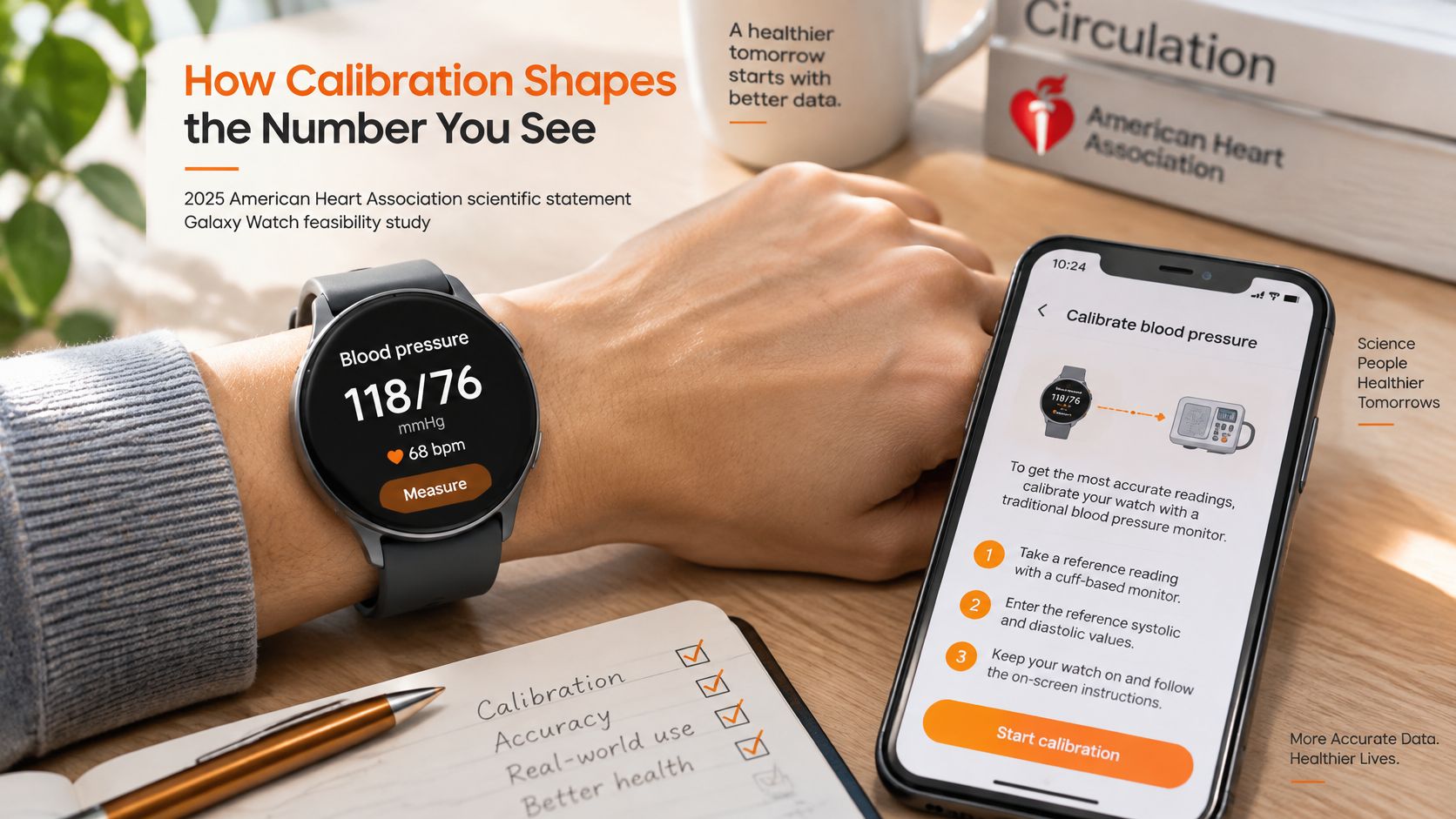
Calibration is the step that turns a pulse signal into a personal estimate. A 2026 feasibility study of a photoplethysmography-based Galaxy Watch algorithm, published on PubMed Central, built that algorithm from 6,117 measurements in 440 participants.
A personal baseline
Think of a kitchen scale. It needs a zero before the weight means anything. A cuffless watch often needs a reference reading to set a personal baseline before it estimates change.
That Galaxy Watch work used three stages: signal preprocessing, calibration, and estimation. During estimation, new pulse-wave features were normalized against baseline features from calibration, with feature scaling for nonlinear variation. After calibration, estimated mean arterial pressure changes showed a correlation of 0.92 with invasive measurements and a mean bias of 0.51 mmHg. The researchers called the results preliminary and said the protocol did not satisfy all relevant validation requirements.
A separate 2025 feasibility study, summarized on PubMed, found a mean pre- versus post-calibration difference of 4.64 ± 4.73 mmHg for systolic pressure and 3.66 ± 3.62 mmHg for diastolic pressure.
What can shift the estimate
The American Heart Association statement lists real-world variables that can distort cuffless readings: exercise, sleep, daily activity, medication effects, arm position, skin color, and time elapsed since calibration. A watch calibrated weeks ago can sit farther from its reference point than one calibrated this morning, because those variables keep changing.
Not every wrist device clears that bar. In a 2025 validation study of the low-cost Smartwatch KC08, reported on PubMed Central, researchers collected 1,000 paired readings from 100 participants. They found statistically significant differences from reference measurements for systolic and diastolic pressure, and poor reliability for blood pressure. Only resting heart rate performed reliably. They concluded the device did not provide clinically meaningful blood-pressure data and was not recommended for clinical use.
Beside every reading, note three details:
- Calibration date: when the baseline was set.
- Activity: what the person was doing beforehand, including a walk or a restless night.
- Arm position: where the wrist rested during the reading.
What Validation Studies Show and How to Read Them
Does a small average error mean every reading is close? That question separates a wrist cuff watch from a cuffless watch that estimates from pulse signals, and it shows how to decode an accuracy claim before trusting it.
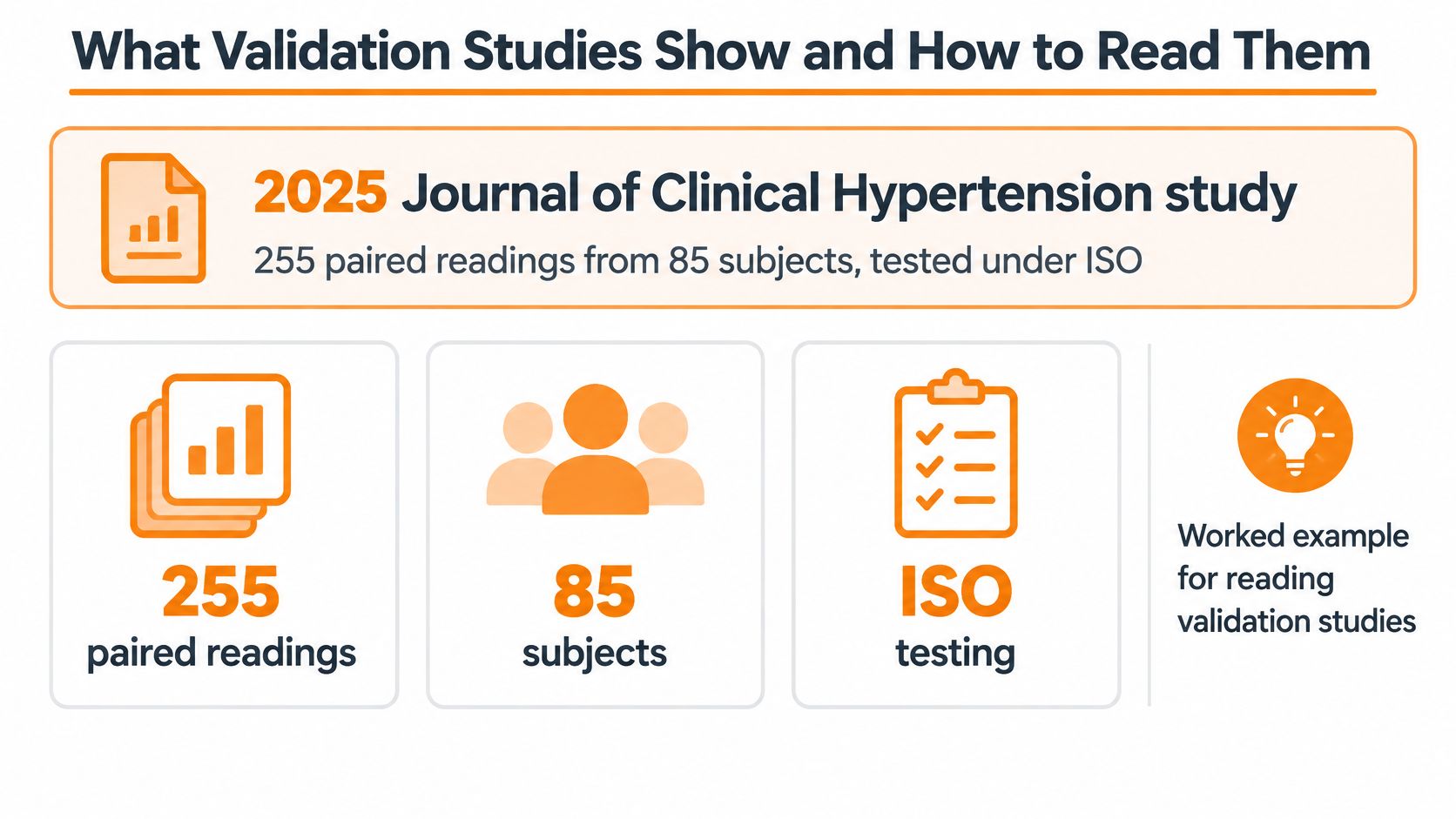
A 2025 study in the Journal of Clinical Hypertension tested a wrist-worn oscillometric smartwatch against a mercury sphygmomanometer in 85 subjects under ISO 81060-2:2018, using 255 paired readings.
Bias and scatter
Bias is the average difference from the reference device. In that study it was 1.33 mmHg for systolic pressure and -0.22 mmHg for diastolic pressure. A small bias means the watch did not, on average, sit far above or below the reference.
Standard deviation shows how far single readings scatter. It was 5.96 mmHg systolic and 4.81 mmHg diastolic. A small average can hide a wide gap on one reading. Paired readings are taken close together on the watch and the reference.
This study also examined seated and supine measurements, and the device met both primary criteria in that protocol. ISO 81060-2:2018 names the test method. A claim that only says accurate, without a named protocol, sample, and reference device, is harder to decode.
| Study | Sample | Main result | What researchers concluded |
|---|---|---|---|
| Smartwatch KC08 validation (2025) | Independent test of a low-cost model | Significant differences from reference for systolic and diastolic pressure | Not clinically meaningful; not recommended for clinical use |
| Oscillometric smartwatch under ISO 81060-2:2018 (2025) | 85 subjects, 255 paired readings | Systolic bias 1.33 mmHg (SD 5.96); diastolic bias -0.22 mmHg (SD 4.81) | Met both primary criteria in that protocol |
| Wrist wearable vs ambulatory monitor (24-hour study) described on PubMed Central | 20 healthy volunteers, 9,090 measurements | Compared favourably with the ambulatory monitor in that setting | Not sufficient to replace established ambulatory monitoring; did not meet validity criteria |
| Galaxy Watch feasibility study (2026) | Feasibility report with a large measurement set | High correlation and small mean bias reported as preliminary | Protocol did not meet all validation requirements |
| ASUS VivoWatch SP validation (2025) | 35 participants, 140 measurement pairs | Direct paired comparison with a sphygmomanometer | Model-specific comparison; the note does not transfer the result to other watches |
| Huawei Watch D2 evaluation (2024, reported 2025) | 85 subjects under universal standard; two 35-subject exercise and 24-hour studies | Tested under the AAMI/ESH/ISO Universal Standard, plus separate exercise and 24-hour comparisons | Reported as a model-specific evaluation, not a category-wide pass |
One cuffless wrist device was evaluated with 9,090 measurements from 20 healthy volunteers whose average age was 20.3 years, over 24 hours, against an ambulatory monitor and a home device. Measurements compared favourably with the ambulatory monitor, yet researchers said results were not sufficient to recommend the wearable as a replacement, and the device did not meet established validity criteria.
A young and healthy sample limits what transfers to older adults with stiffer arteries, irregular rhythms, or different skin and activity patterns. A 2025 ASUS VivoWatch SP study compared pairs from participants with a sphygmomanometer. A 2025 review in Hypertension Research reported that a 2024 Huawei Watch D2 evaluation included subjects under the AAMI/ESH/ISO Universal Standard, plus exercise and 24-hour comparisons.
Questions for any accuracy claim
- Which reference device was used?
- How many people and pairs were included?
- Does the claim name a published standard, or only say the watch is accurate?
Each row belongs to one model, one population, and one protocol. A pass on one watch does not move to the next model. For cuffless estimates, calibration date and daily conditions add another layer, so the same model can read differently after activity, poor sleep, or a long gap since calibration.
What to Check When Choosing a Watch for an Older Adult
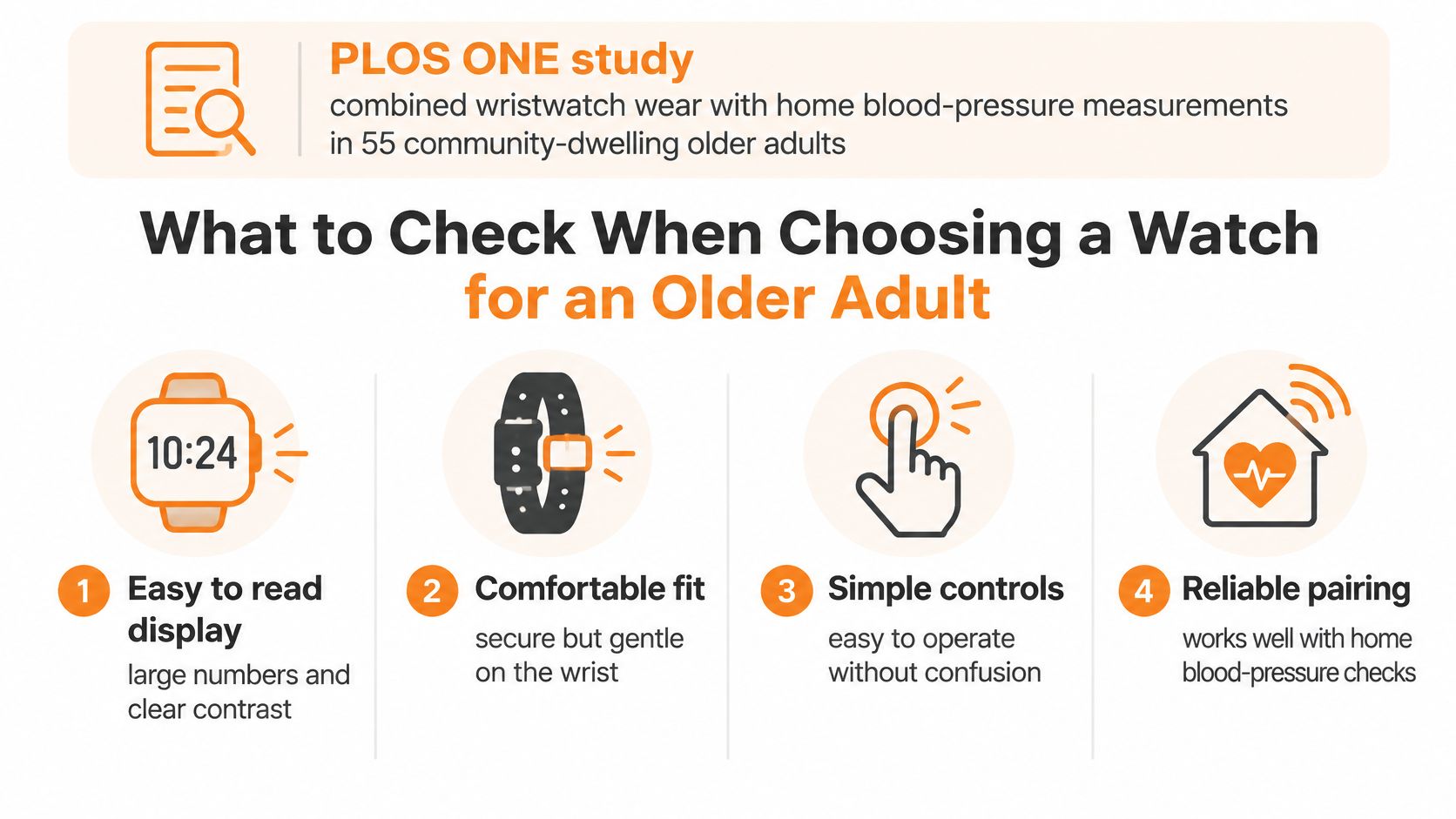
A PLOS ONE study combined wristwatch wear with home blood-pressure measurements in 55 community-dwelling older adults over 5 to 7 consecutive days. Linking readings with sleep and activity was part of the design. Usability decides whether that data gets used at all.
Four checks before you buy
- Usability: A readable screen, large buttons or voice prompts, and a clear sign of whether the watch is measuring now or showing an earlier estimate. If that sign is muddy, a missed morning reading gets mixed up with yesterday's number.
- Comfort: Band adjustment, weight, a snug but not tight fit, and easy removal for limited dexterity or tremor. A band someone can put on before a walk is the one that stays in the routine.
- Published testing: A named standard, a published study for that exact model and software version, and a clear note on whether the maker points users to a validated upper-arm cuff for confirmation.
- Data-sharing: Who can see readings, whether a caregiver can receive trends, how data can be exported, and what the privacy policy says about storage. Social connection works better when the share is chosen, not automatic.
A watch that produces many readings is not automatically the best fit for aging in place.
The better match is the one an older adult can wear through ordinary days, and the one a family can interpret.
How to Take a Reading the Right Way
These are general measurement habits drawn from a manufacturer's instructions and from the factors named in the 2025 American Heart Association statement. They are not a clinical protocol.
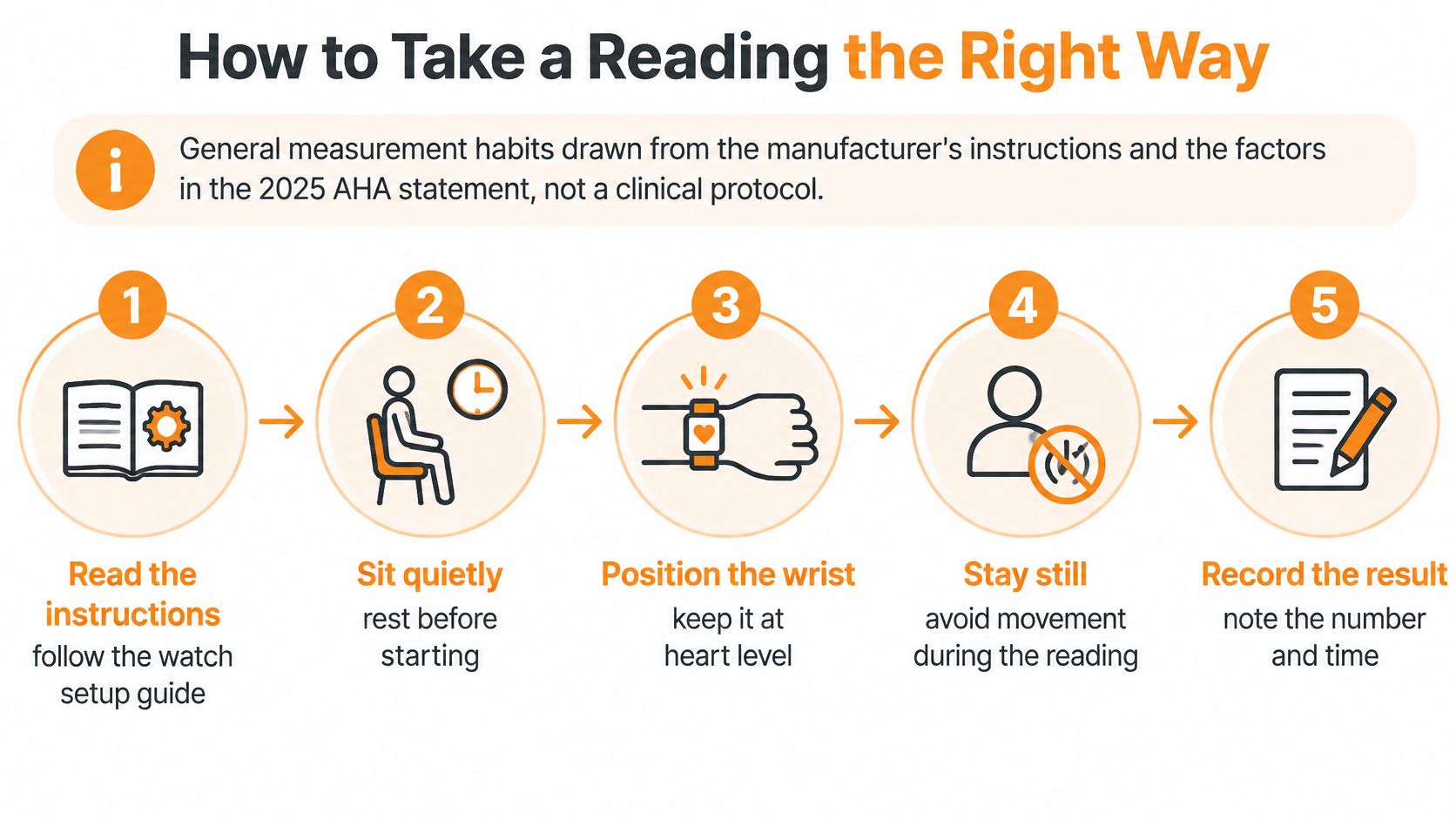
- Read the device instructions and confirm the model is the one a validation study tested. A different software version is a different test.
- If the device asks for calibration with a validated cuff, do that step and note the date. The estimate is tied to that baseline.
- Sit still for a few minutes with your back supported and feet flat. Movement and talking change the conditions of the reading.
- Rest the wrist on a table at about heart level, relaxed, with no tight sleeve. Wrist height is one of the factors that can shift a result.
- Skip a reading right after exercise, and note any recent activity. A walk, poor sleep, or a busy morning belongs in the log.
- Take the reading, rest briefly, and measure again. Two values show whether the first one was a one-off.
- Log both values with the time, activity, sleep quality, and arm position. Patterns need context.
- Compare patterns over several days rather than single values. A week of notes is easier to talk through than one spike.
If redness or skin irritation appears on the wrist while wearing the hardware, remove it immediately.
A simple log
A consistent sheet has columns for date, time, both values, calibration date, sleep, activity, and arm position. Blank cells stay blank. That sheet is what a family can review together before a routine visit, alongside notes about mobility, balance practice, and how the day felt.
Troubleshooting Readings That Look Off
An odd number is usually a setup problem before it is a sensor problem. In a small pilot, older adults wore watches alongside home measurements for several consecutive days, and the practical snags that surfaced, such as a loose band, a skipped morning, or a reading taken straight after a walk, shaped how usable the data turned out to be. The same watch can give a believable value and a strange one minutes apart, and the difference is often fit, timing, or posture. Placing a suspect number against typical vital-sign ranges for older adults helps you judge whether it is out of line or unfamiliar.
- Inconsistent readings. Repeat after a short rest, check that the wrist sits near heart level, and note recent exercise, sleep, and medication timing. Those details explain much of the swing between two readings taken an hour apart.
- Missed measurements. Set a daily time that fits an existing routine, such as after breakfast. Log a gap as a gap rather than a zero, so a missing morning never reads as a low value.
- Poor fit. Re-seat the band so it is snug without pinching. Remove the hardware immediately if the skin shows redness or irritation.
- Tremor or limited dexterity. Rest the forearm on a table, use voice prompts or larger buttons where the watch offers them, and ask someone to help with the band.
- Unclear timing. Check whether the screen shows a live measurement or an earlier estimate, and note the calibration date. A stored estimate can look like a fresh result.
- Readings that keep drifting. Run a comparison against an upper-arm cuff following the manufacturer's instructions, and bring the pattern to a clinician as a set of notes rather than a single alarm.
Two questions fit a care visit: what the trend means for this person, and which readings deserve confirmation with a cuff. A single wearable value is a thin basis for an automated alert.
Sharing Readings, Privacy and Your Next Step
The 2025 American Heart Association statement also clarified that FDA clearance alone does not guarantee accuracy, because clearance does not necessarily require formal testing under a standardized accuracy protocol. Regulation and accuracy are separate questions.
Sharing works best as a short trend summary rather than every reading. Send the device model, calibration date, activity notes, and the log from the routine above. Confirm a single unusual value before it is passed on as a conclusion. A week that includes sleep, walks, and social plans is easier for a clinician to read than a pile of unlabelled screenshots.
Privacy questions
- Who can see the data, and do caregivers get live alerts or a weekly summary?
- Where is data stored, and is it shared with third parties?
- What happens to records if the device is stopped, reset, or returned?
- Can readings be exported in a format a clinician can read?
Our pilot services are not medical devices and are intended for informational purposes only as a wellness tool. The platform is organized into three areas: Health Insights, Smart Technology, and Connected Care. Families comparing connected options can read how connected health solutions describe sharing. If a family already uses Rx360, check that service's own privacy and data-sharing terms directly.
A wrist watch that takes blood pressure can fit an aging-in-place routine as a trend and conversation tool. Unexpected values are the ones people confirm with a validated upper-arm cuff and review with a clinician. Next, compare two or three watches against the four-part checklist, test comfort with the older adult for two weeks, agree on who receives alerts, and review the log together before a primary-care visit.
Rx360 brings Health Insights, Smart Technology, and Connected Care together so independent older adults can keep an eye on everyday wellness signals without giving up the routines they enjoy. A wrist trend, a shared log, and a simple check-in with family fit that same idea of aging in place. Visit Rx360 to see how the platform supports that circle of connection.
Lower-Risk Medication Plan Checklist
Below is a practical checklist and step plan you can implement into your daily life:
-
List all medications
Include prescriptions, over-the-counter drugs, supplements, sleep aids, creams, patches, eye drops, and inhalers.
-
Mark fall-risk drugs
Flag medicines that cause dizziness, sleepiness, confusion, blurred vision, low blood pressure, or low blood sugar.
-
Ask for a medication review
Bring the list to a pharmacist or prescriber.
-
Review after any warning sign
Request a new medication check after a fall, near-fall, new prescription, dose change, dizziness, or confusion.